Portugal – Quinta de Gatão

October 10, 2008

This summer we spent a wonderful week on Quinta de Gatão (www.quintagatao.com), near Penafiel, about 40 km east of Porto. “Quinta” is either translated as “Farm/Vineyard/Winery” or “Manor house”.
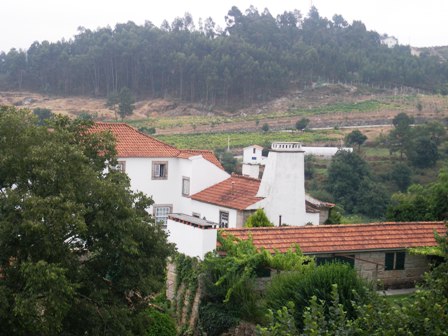
Quinta de Gatão is owned and managed by Mr. Jorge Coelho da Silva, a very lovely man who’s day job is being a professor at a teachers college in Porto. The property has been with the family since four generations. Five peasant families used to live and work there. Today, the vineyards are only cultivated every other year to produce vinho verde., a bottle of which waited for us in the fridge. In the mornings, fresh bread is delivred and you can find it hanging on the door. What a treat! The horse stable and the riding school were the main attractions for our daughters. The old folks were equally attracted by the vineyard feature.
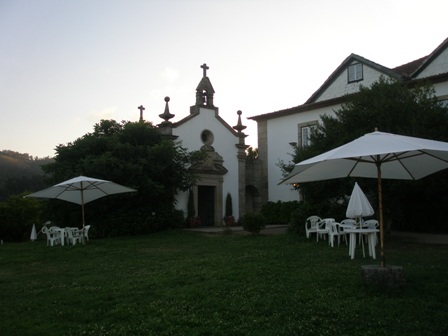
The Quinta de Gatão consists of a manor house with a chapel surrounded by various farm buildings. Some of these were converted into cottage type accommodation. We had rented one of them. Because of its elevation one has a magnificent view of the area which is quite densely populated. In comparison to the rural Australia we are used to around Glenburn, the housing sprawl in Penafiel is a bit too much. However, it does not seem fair to compare quasi empty rural Australia to the vicinity of a bustling port city such as Porto.

The Manor house from the backside

The entrance to our cottage

We loved our cottage. With its rustic rural charm it put a spell on all of us. The walls consisted of big granite stone blocks. It has a fire place in the kitchen, a bathroom and a bedroom with a loft (just as our home in Australia).

This is the place where we prepared delicious country meals

The vines are providing shade, originally to produce vegetables and other crops underneath.
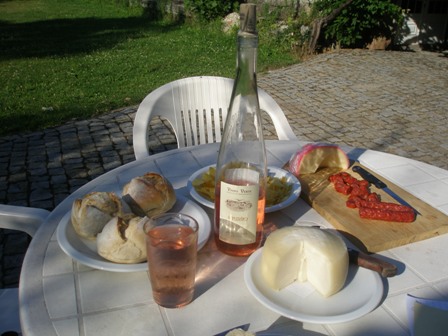
A typical snack in the afternoon consisted of Vinho Verde (here ni rose), country cheese, some sausages, olives and bread.

An Australian vintner in a Portugeuse vineyard

The swimming pool with a great view of the surroundings

Apart from the riding stable and the riding arena, Quinta de Gatão has other facilities to offer its visitors. Among them is the beautiful swimming pool, a tennis court, and a large field to play all kinds of ball games; indoor entertainment such as kicker etc. and billyard is also available. One can have long walks in the vineyards and the surrounding forests.

The entrance to the chapel

We had a great time there and I can only highly recommend the place. Actually, we plan to return next year and spend some more time in this region. We had juts not sufficient time to explore the region. There is so much to see. The Douro is close by. Porto less an an hour away. But it is the hospitality of Mr. da Silva and his family which will draw us back. There are no words to describe the welcome we received on Quinta de Gatão.

Address:
Quinta de Gatão


Henry of Pelham Family Estate Winery

October 8, 2008

In December 2007 I wrote about the Niagara Wine region in Ontario, Canada. Lorie from “Lorie loves wines” named some of her favourite wineries in this region (thanks Lorie). One of them was Henry of Pelham Family Estate Winery.

According to Lorie, Henry of Pelham make the best hybrid wines, Baco Noir in Niagara. They also make a great Gewurztraminer. Daniel Speck, one of the proprietors of Henry of Pelham Family Estate, wrote to us and introduced some of his wines.

When I surfed on youtube the other day, I found a video clip about the winery. In fact it seems that many wineries in the Niagara wine region put videos about their vineyards and wineries on to the net. Without having been to the place, I can now check it out (which I did) and when I will visit Ontario next time, I might go and taste their wines. Have a look. You will find many more video clips about Henry of Pelham on the net.


Life in the City – Bangkok

October 5, 2008

Well, it’s a month now that the family has been living in Bangkok. From a spacious house with a grand garden (I had one rose apple, two mango and five rambutan trees) in suburban Jakarta into a serviced apartment on the 11th floor in Bangkok, that’s quite a change.

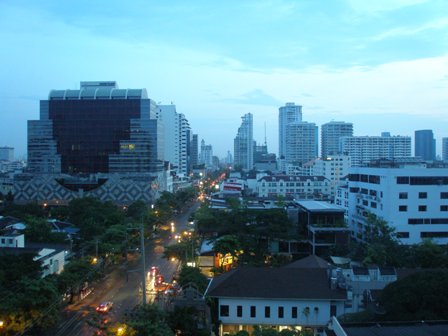
The view from Centre Point Thong Lo in the evening

Both cities are mega cities in Asia with millions of inhabitants, and in fact we lived most of our 20 years in Asia in these kinds of cities (Beijing, New Delhi were the others, the only exception was maybe Singapore which was small in comparison, with only 3.5 million inhabitants). But in Jakarta we lived as if we were in one of the millions of villages on Java island, with roosters crowing in the mornings, goats bleating, a motorcycle passing, the call of the chatib from the local mosque, these were the sounds we were used to. The garden was green, which had a calming down effect on me. My tropical garden was where I could forget where I was.

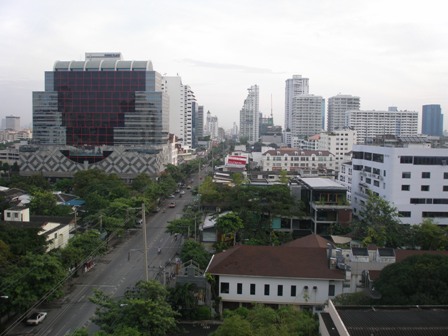
Much less traffic in the morning

Without the double glazing here on the 11th floor, we would be engulfed in motorcar noise. Thong Lo is the name of the neighbourhood and it’s a lovely place with many small shops and restaurants. Most of the people living here seem to be Thai, interspersed with the odd foreigner here and there. There a quite a few wine shops and wine bars in the vicinity. I will have to explore them and report to you. Soon you will hear more about fine wines in Bangkok.


Trier, Mosel: Wine Auction 2008

October 4, 2008

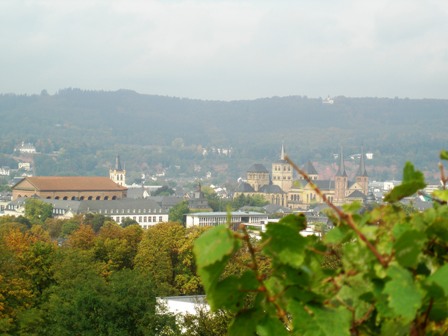
The wine city of Trier (from the Petrisberg side)

According to the website www.riesling.de the annual wine auction of the “grosser Ring” (freely translated as ‘big ring’) a subdivision of the regional section of the Association of German Prädikat Wine Estates (that is how on the website of the association, the German title: “Verband der Deutschen Prädikatsweingüter” is translated) was a full success. The association has about 200 members German wide. About 13,000 bottles of wine were auctioned off. The sale brought in an amount of € 1.3 million.

The top prices were earned by wines from Weingut Egon Müller (Saar), Weingut Joh. Jos. Prüm, and Weingut Dr. Loosen, all top producers of the Mosel wine region.

The most expensive wine of the auction was a single bottle of a ‘1959 Wehlener Sonnenuhr Riesling Trockenbeerenauslese’ by Weingut Joh. Jos. Prüm which was sold for € 5.097.96. Wow, isn’t that amazing.

But also prices for recent vintages were quite high. A ‘2007 Scharzhofberger Auslese Goldkapsel’ by Weingut Egon Müller sold for € 582.62 , a ‘2007 Graacher Himmelreich Auslese Lange Goldkapsel’ by Weingut Jo. Jos. Prüm for € 485.52 and a ‘2007 Erdener Prälat Auslese Lange Goldkapsel’ by Weingut Dr. Loosen for € 449.11

Wine bar Kesselstadt in Trier just opposite the church of Liebfrauen

The auction lasted for more than 5 hours much longer than a marathon run. The general trend as far as bottle size is concerned seems to be heading towards magnum bottles. For wines filled in such size bottles premiums were paid.

The tasting prior to the auction revealed the very high quality standard of the 2007 vintage Rieling wines. On www.riesling.de you can find the detallied rating of the individual wines and the prices paid for the various lots sold.

Even for ordinary mortals like me, the auction is good news. The superior quality of the 2007 Mosel Riesling vintage will also apply for more everyday wines which I can afford. Next time in Trier I will indulge myself again. Why don’t you come with me.


Grape grower of the year in McLaren Vale

October 3, 2008

The Daily Wine News, an e-newsletter from the Australian Wine Industry Portal of Winetitles, carried the other day a summary of the McLaren Vale Annual Wine Industry Awards. One of the award winners (in the category ‘Grape grower of the Year Award’) was a vintner names Joch Bosworth of Edgehill Vineyards.

I went straight on to google the man and found a very interesting website (www.edgehill-vineyards.com.au). Joch’s wine label – the Battle of Bosworth -is named after a famous battle in England in 1485. The Bosworth family has grown grapes in the McLaren Vale region since the 1840’s. The Edgehill vineyard is located in Willunga, and was established by Peter and Anthea Bosworth, the parents of Joch, in the early 1970’s.

Needless to say that Edgehill Vineyard was converted to organic viticultural practices (in 1995) and today is a certified A-grade organic farm (certified by ACO www.australianorganic.com.au). It has some 50 acres under vines, planted to Shiraz (some more than 20 years old), Cabernet Sauvignon, Chardonnay, Viognier, Sauvignon Blanc and Mourvèdre.

What I find remarkable too is the fact that the rows between the vines are left to a “vicious” weed, the Soursob, the picture of it featuring on the wine label. The Soursob produces a very pretty yellow flower. The life cycle of the Soursob complements the cycle of the grape vines in so far as it dies off in spring and flowers and uses water in winter when the vines are dormant. Would love to know wht his neighbours say to that system.

I present you a video which is posted on Joch’s website. I do this for two reasons:

1. It is interesting to watch and informative
2. It shows the relaxed atmosphere and vine growers culture of my adopted home Australia which I treasure so much.

Enjoy watching it.

I have visited the McLaren Vale wine region only once and enjoyed the triop tremendously, but next time I will look out for Edgehill Vineyards in Willunga.

Address:
Battle of Bosworth Wines
PO Box 11 McLaren Vale
South Australia 5171
(Ganney Road, Willunga, SA)
Tel.: +61-885562441
http://www.edgehill-vineyards.com.au


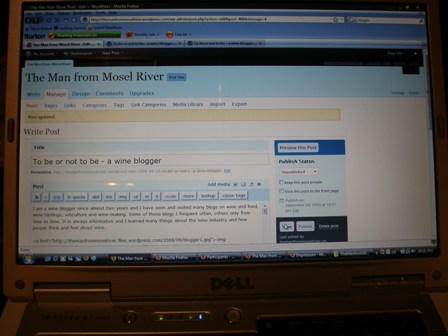
To be or not to be – a wine blogger !

September 30, 2008

I am a wine blogger since almost two years and I have seen and visited many blogs on wine and food, wine tastings, viticulture and wine-making. Some of these blogs I frequent often, others, only from time to time. It is always informative and I learned many things about the wine industry and how people think and feel about wine.

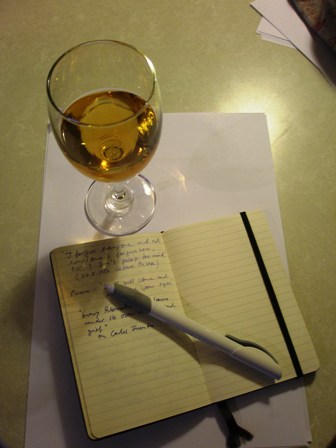
The romantics view of wine blogging: A glass of White Porto from Quinta do Castelinho in the Douro wine region, Portugal

Last night was another one of those nights when I could not sleep and so I started to surf the internet’s wine websites and blogs. I was reminded what a terrific world is out there. Goodness me, how interesting this is. I could not stop looking around. Amazing what I found. The wine and food bloggers come in many types, colours, shapes, characters, personalities, professions, etc.

Some are

professionals

and others are

amateurs

some are

expert connoisseurs

others are

wild enthusiasts

some are

profit oriented businesses and wine journalists

others, however, are

enthusiastic hobby writers

some are

cellar door and wine distributors

others are

private individuals and consumers

some of them are

sophisticated, polished urbane wine freaks

others are

rural folks (like me), vintners and wine makers

some write

all alone (like me)

others

work in teams and thereby share the burden to produce content and attempt to avoid boredom.

Some do it for money, most do it to have fun. It goes without saying that some, while doing it for money, have fun as well.

The reality of the modern blogger.

Let me share with you some of my findings and conclusions.

First, I felt pretty small and amateurish, technically as well as subject matter wise. There are so many knowledgeable people out there, amazing.

My own blog which I tend with loving care since January 2007 is a rather simple affair. Out there in cyberspace there are sites with podcasts, with videos, with music, with slide shows, presentations, breathtaking links and so on. Exciting stuff.

I have only stories and some pictures.

Second, the world of wine bloggers is pretty dynamic. Moreover, they seems to lead interesting lives.

Third, wine bloggers network quite a bit. Last year I followed the German wine bloggers workshop at an important wine expo (I forgot which one).

At the end of August the European Wine Blogger Conference (http://ewbc2008.wineblogger.info) was held in Spain (in Logrono!).

The American blogger community will follow suit in October in Sonoma County in California (http://winebloggersconference.org). The participants list is very impressive. What a large community there is.

German wine bloggers conduct regularly the so called “wine rally”, American wine bloggers have a format called “Wine Blogging Wednesday”. Both formats are used to share interesting stories about a given wine theme and publish them in a co-ordinated way. The Americans have even established a website for the purpose (www.winebloggingwednesday.org)

As with music and films wine bloggers are rated in “top” …. something. For instance the top 100 and other lists of top bloggers, either rated by links and/or traffic or after voting by users.

I found such a list from June this year. And can you imagine the top 100 is lead by a German wine blogger (Dr. Achim Becker of Wineterminator). The second blogger gets almost only a third of the top one’s votes. Wine Library TV (Gary Vaynerchuk) ranks only in 5th position. No. 6 is another German (Mario Scheuermann and his Planet Bordeaux) who ranks in 10th position with another blog (drink tank).

I suggest you explore this cyberworld yourself. And do not forget to visit wineries and vineyards from time to time. the real stuff.


From North to South

September 28, 2008

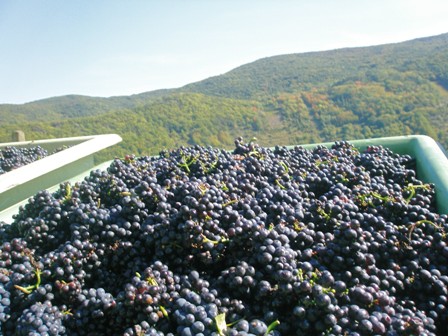
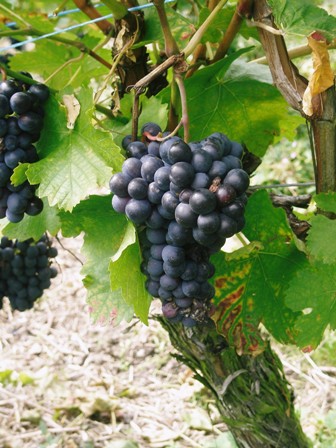
Pinot Noir grapes at the Ahr.

It’s vintage time in my native Germany. Reports I am reading about the harvest conditions seem to indicate that everything is going well. Also my German wine blogger colleagues seem to be content.

Down under in Victoria, we have springtime. Spring is usually Victoria’s wettest season. However, weather reports indicate that this September will be one with the lowest precipitation in history of Victoria.

Melbourne recorded only 16 mm of rain in September, the lowest since recording began in 1855. The long-term average is about 59 mm. Also average day temperature was well above the long-term average (19 instaed of 17 degrees celsius) which make September 2008 the warmest September since 2001. The same trend could be observed regarding night temperatures.

Reservoirs around the state are at a record low as well. That’s no good news for vintners and grape growers.

I wonder how full our two dams at Two Hills Vineyard are. So far we had always had sufficient water to bridge the 4-6 weeks of high summer. Last year we had hoped that the draught would be finally broken. That seems not to be the case.

But as always, we hope for a good harvest.

Lake Eildon low on water (only 23% of capacity, 09/2008)


The Pearl of the Orient

September 27, 2008

No, I am not writing about wine this time. But you might ask ‘What is the pearl of the orient’ if not a wine? Well, read this.

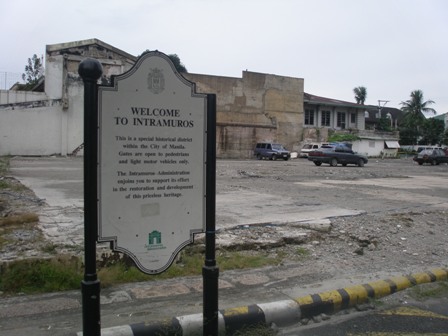
“Intramuros” (freely translated as ‘within the walls’) is the title of the walk through old Manila City which I joined last Sunday. It should turn out to be the most amazing city tour I ever participated in in my life.

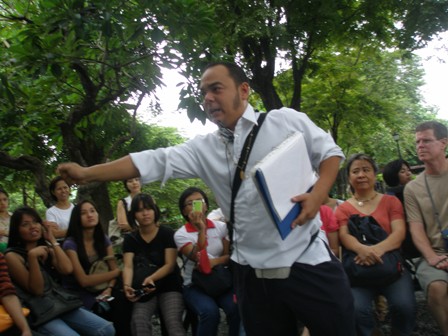
Carlos Celdran, the man who guided us through old Manila (www.celdrantours.blogspot.com), is the most interesting tour guide I have met. Before writing this I visited his blog and recommend you to logging on to it. There are many reviews about the Intramuros walk as well. So google the man it will reward you with more information than I can give. Walk this way please.

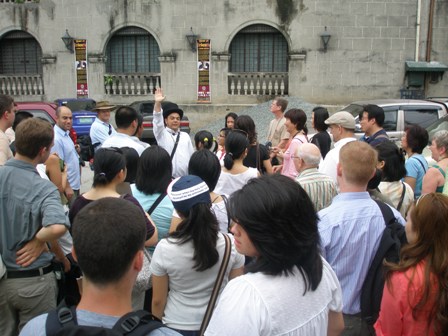
About 60 people had showed up at the entrance of Fort Santiago to learn more about the history of “The pearl of the Orient” as Manila was called. The normal number is around 25 to 30 people. The showing of that Sunday was just overwhelming. Half of the eager tourists wanting to learn about the history of Manila were Filipinos or better Filipinas, because most of them were female.

Carlos arrived in a black Spanish hat, had a microphone around his neck and a folder in his hands. He invited all the Filipinos to help him with the tour and subsequently involved them in all kinds of questions and answer games.

But starting we did with a joint singing of the Philippine national anthem followed by an explanation of the meaning of various words in the local language (Tagalog). “Nila” from Ma-nila for instance standing for a kind of flowering mangrove which was to be found in the area.

Above you see the entry with the wooden relief of Fort Santiago. The Spanish had taken the city from their Muslim rulers by force which is shown somehow on the relief (I forgot who the slayer is). At that time the city was made entirely of bamboo because no other building material was available.

I cannot repeat here all what was explained to us. Anyway the history of Manila can be read about on the internet and in books. But while following Carlos on our walk, we learned about history, religion, culture, people, the Spanish and the Americans and others who left their traces in this place. We got a glimpse of Jose Rizal, the national hero of the Philippines, generals and politicians crucial for Manila and the Philippines. Walk this way please.

But if you are around, join the tour of Carlos. That’s better than reading and you might have a chance to remember much more because of the vivid, energetic and illustrative style of Carlos. He uses songs, photos, mimic, some acting, all in all great showmanship. And its educational as well; entertaining too I should add.

Here is the group in front of the museum next to St. Augustin church, the only one remaining of the original seven churches in the perimeter of Intramuros. The main entrance of the church is guarded by four Chinese lions. We lit candles in the church which entitled us (novices to churches in the Philippines) to three wishes. Walk this way please.

The painting in the museum depicted the landing of the Spanish among other scenes from colonial times.

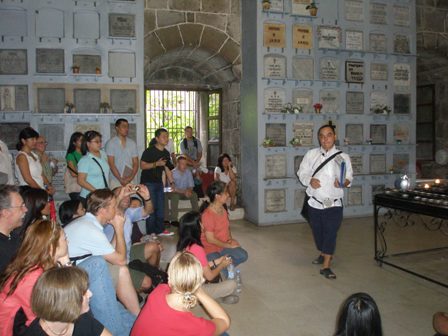
In the crypt, we learned about the Japanese occupation, the slaughtering of Manila citizens and the bombing by the Americans that finally destroyed the historic centre.

Carlos is among others promoting the better maintenance, preservation and even the reconstruction of Intramuros as it is part of the core of Philippine civilization.

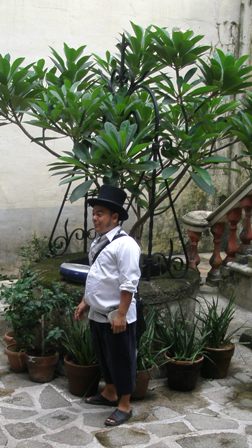
Carlos in his outfit.

The end of the three hour tour consisted of an explanation of Filipino cuisine. It inspired me so much that I should buy a Philippine cooking book a couple of days later. At the end of the “show”, and I mean the very entertaining city walk, Carlos made us all taste “halo-halo” (meaning mix-mix), the traditional iced dessert Filipinos are so fond of. He finally recommended a traditional restaurant to us and sold us some of his maps.

The good-byes were warm, we all left mesmerized. I guess nobody was dissatisfied and nobody minded the price (850 Pesos, half-price for students). I must conclude that Carlos changed my perception of Manila and the Philippines quite a bit. I have less prejudices now and I am very appreciative of the island nation. I will visit again and I might go on to another walk with Carlos Celdran.
Walk this way please.

How to contact:
The Blog and Tour Schedule of Carlos Celdran.
A man who is trying to change the way you look at Manila – one step at a time.
Telephone: (02)4844945
Text/Cell:(0920)9092021 or
Email: celdrantours@hotmail.com


Restaurants in Jakarta – Anatolia

September 24, 2008

It was our last Saturday night in Jakarta. Everything must come to an end. After 10 years, leaving was not an easy thing. A quiet “last supper” with our friends Liz and Walter was our preferred choice. They invited us to Anatolia, a Turkish restaurant in South Jakarta.

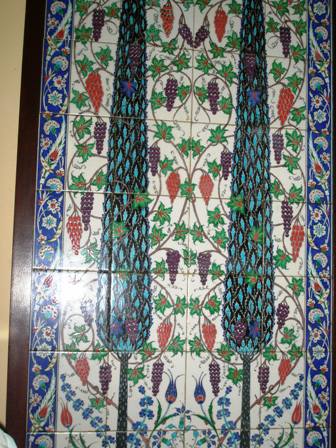
Beautiful tiles depicting among others “grapes”.

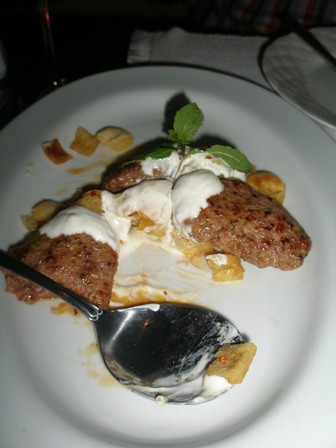
I am a lover of Turkish food and so it came as no surprise that we just loved the various dishes which were put in front of us. Good food, good company, good conversations, fun and good wine, that should become the recipe of the evening. And look at some of the food!

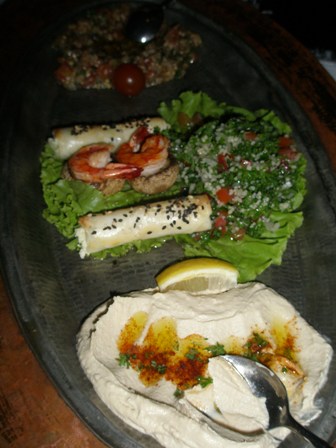
Various starter platters.

Unfortunately, I forgot most of the names of the different dishes. The atmosphere in the restaurant was lively. We were entertained by a dancer and modern music from the Middle East.

What did we drink? As so often before, I was given the task of selecting the wine. I could have chosen some Australian reds but could not resist to order something new, something I had never heard of: a Turkish wine. Have you ever heard about Yakut (not not the thin Japanese milk-yoghurt drink, which is written with an l before the t)?

‘Yakut Kavaklidere’ was written on the bottle. Fortunately the back label was in Turkish. I just could not resist ordering the bottle and some more were to follow. The wine was dark red in colour. We were all surprised by its round taste, an intense fruit flavour, a bit of plum and cherries. But it was unlike other wines. I could not identify the grape variety. We all agreed that the wine matched the food very well. Existing prejudices about Turkish wines were quickly transformed into admiration. Despite the fact that this wine was simple (and not expensive) and not at all sophisticated, we just loved it. Thanks Liz and Walter for the wonderful evening.

Are you living in Jakarta and having no plans for Friday night as yet? The choice is clear. Have a meal at Anatolia.

Address


Wine all over the place – a glimpse at Berlin wine shops

September 19, 2008

The wine industry receives confusing signals these days. In Germany and the EU the ban of advertisement for alcohol and alcoholic drinks is in the making. In some media the devastating effects of such regulations are already being discussed. There were also voices in favour of a ban supporting the current regulatory trend which attempts to further restrict our basic human freedoms and violating our rights.

After the bad news, the good one: In recent news the advent of wine distribution through Amazon was hinted at. The start of wine marketing through such a potent internet channel could not be a more distant twin of the current ascetic (fun and joy hating) trend described above, first hitting smokers and now (maybe) the wine lovers. However, history suggests that human freedoms can be curtailed for a short while only. Ultimately we will break free from such patronizing behaviour of the state, because we are all voters and tax payers and as we say in German, ‘where there is a will, there is a way’ (Wo ein Wille ist, da ist ein Weg).

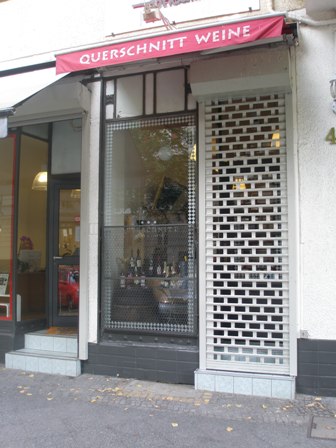
I bring you good news from Berlin. The other day I strolled through the streets near Nollendorf Platz, and discovered to my great surprise a rather large number of wine shops in a rather small area. I randomly took pictures which I present to you below.

Most of the wine shops are specialised, usually carrying wines from one or more regions or a selection of countries. Above a Rioja specialist, below a shop selling mainly French wines.

Some shops try to offer a wider selection, despite being “small”.

Others, as above in Goltz street, offer broad choices.

I even found an Australian wine shop with remarkable decoration.

Others offer Italian wines combined with other shopping and relaxation capabilities.

‘European and overseas wines’, is what the writing says; wow that’s amobitious.

But there are not only very specialised wine shops to be found but also very specialised restaurants. I do not refer to the Habibi Falafel, the Iranian, the Italian, the Turkish, Indian and Spanish restaurants. I found two eating places which were quite special. Many years ago I have dined in a Tibetan restaurant once in Kathmandu. Never before I have seen a Massai restaurant, even when I travelled through Tanzania and Kenia, there were no such eatery in sight. Berlin got it all.

What would you eat in a Buddha House? Answer: Tibetan, Napali and Thai cuisine. Bon appetit.

My tip: visit Berlin, it is such a fabulous place to explore and to discover.