On Sunday we had a bottle of the newly released ‘2011 Khao Yai Shiraz’ by PB Valley, Khao Yai, Thailand with our lunch.
This wine is from the newest collection of Khao Yai wines which was presented on November 30th to a group of wine critiques, journalists, trade representatives and marketing experts at the Great Hornbill Bistro in Bangkok.
This wine from the Sawasdee label is for easy drinking. It is fruity and dry with aromas of blackberry and a hint of chocolate, in short a wine easy to understand also for beginners.
I like if it is served slightly chilled. In the tropics “room temperature” is just a no go. Who wants to drink a red wine at 30 degrees Celsius?
I will report about the wine tasting of the newly released PB Valley wines at the Great Hornbill Bistro later this week.
The shutters of Wang Ping Steak House when still closed
Together with my friend Jim I went to Wang Ping Steak House in 桃園 (Taoyuan) for a kind of farewell meal. The International Center Land Policy Studies and Training (ICLPST) had made a booking but we had to be there at 17.20 h already, because the place was fully booked.
Can you imagine that? Chinese gourmets seem to know what is good, and they eat early. So off we went and presented ourselves at the above time. It was a rainy day, with low hanging clouds, and it was dark when we arrived.
We had to wait a few minutes. Then we were shown to our table on the ground floor. The menu is in Chinese and in English. Straight forward so to say. We ordered in no time.
The appetizer arrangement
The salmon and mushroom arrangement was lovely and wetted our appetite. We were offered a glass of fizz, so to say, fizz with a sweet plum taste. We did not protest.
The fizzy plum drink
Both of us had ordered the mushroom soup. It came in two vessels, a soup bowl with the mushrooms lumped together like a little tower, the broth came separate. I was not quick enough to take a photo of both. The soup was good, fully flavoured, creamy and intense.
The mushroom soup
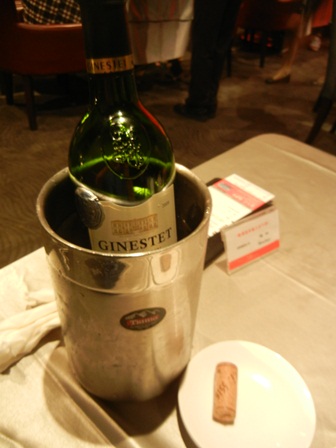
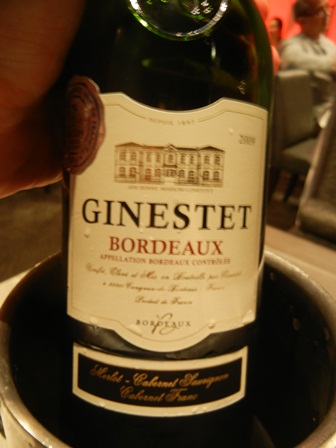
We ordered a bottle of house wine. Red was the colour we had chosen. I do not know much about French wines. When a bottle of ‘2010 Ginestet Bordeaux’ arrived, I was wondering what it would taste like.
As it turned out, Maison Ginestet is a wine trading house specializing in Bordeaux wines.
The wine was full bodied, had beautiful forest fruit aromas, and was dense with a long finish. Just the right wine with red meat, I thought. The typical Bordeaux blend is a good choice when eating beef or lamb.
Grand vin de Bordeaux
I liked the dark red colour
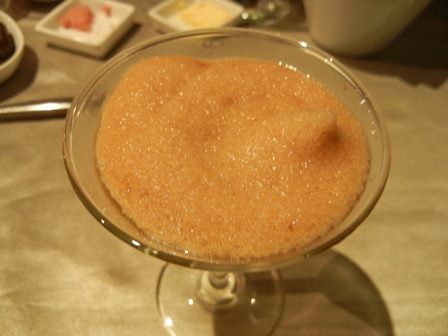
The sorbet
To cleanse the palate, a sorbet was offered. Again it had a plum taste. The fine acidity made sure our palates were ready for the main course.
Dried plums and plum sauce for the lamb
Jim’s main course: lamb
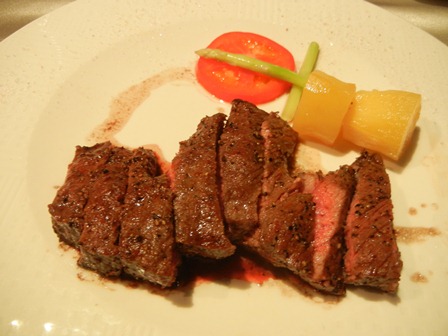
Beef fillet
Jim went for the lamb chops, I ordered the beef fillet. Big dishes but we were ready for it.
Chocolate dessert with ice cream
Crème brûlée in a shell
Also the desserts did not disappoint us. What a lovely way to end our farewell meal.
The service at Wang’s is very efficient. The well trained waiters and waitresses are polite and attentive. We both enjoyed the evening.
I was about to board a plane a few hours later. Jim stayed behind for another two weeks at the Centre. As always we are confident to meet again for another joint teaching engagement at ICLPST.
Chinese flower tea
Come and eat at Wang’s
PS: I highly recommend a meal at Wang’s. They have several outlets, I think.
The other day, while I was waiting for my flight home to Bangkok, I discovered to my great amazement in the business class airline lounge of EVA Air, that a wine from my native Mosel was on offer.
What a pleasant surprise, I thought, when I spotted the label in the wine cooler. It was a ‘2011 Bockstein Kabinett Grand Cru’ by St. Urbans-Hof in Leiwen, Mosel. The wine village of Leiwen is only a couple of kilometers away from my home town Trier.
I have visited the winery and love their crisp-dry Rieslings. For the first time I had the opportunity to taste one of their off-dry wines. The terroir, “Bockstein” in Ockfen, a small village at the Saar river, a tributary to the Mosel, is also a place very dear to me.
From the raised hides in the hunting territory of Schoden (another village at the banks of the Saar river) one could have a glimpse of the “Bockstein”, a rock formation towering over the Saar valley. It’s vineyards are very steep and the Riesling grapes grown are famous for their high quality.
Off-dry whites are not my favourites, but of course this wine showed it’s outstanding quality. It was full and lush, smooth as silk in the mouth, with intensive and mellow Riesling aromas. It had also a long finish, and I loved the balance of sugar and acidity.
Moreover, I found my beloved Mosel (Saar) here, thousands of miles away in a place of Asia where I least expected it.
My readers know that I adore Riesling wines. Here is another one which we had with a delicious pasta (see photo above) the other day. The intensity of the tomatoe sauce was matched by the vivid citrus aromas, the fine balance of the acids and the mineral character of the Riesling from the Rheingau, Germany.
The ‘2011 Steinberger Riesling trocken (dry)’ by the famous estate of Kloster Eberbach is a great drop for every day consumption. It is their basic wine, and at the cost of 8.90 Euro it is quite affordable. The wine has all what it takes to be an excellent Riesling.
Enjoy.
As the name “Steinberger” suggests, the vineyard is a kind of “stone hill” and just located nearby the monastry. For centuries fine wines were produced from this terroir. The short video below gives you an idea about it.
As you know, I like to eat game of all kind. The best wild boar I have eaten in a long time was served to me by my good old friend Ulrich Hillejan and his wife Elfriede when we visited them this summer near Muenster. The so called Muensterland is a very picturesque agricultural region right north of the former industrial heartland of the Ruhr.
Ulrich comes from a tranditional farming family which goes back a couple of hundred years (he keeps very impressive records). He inherited one of the traditional farm houses away from the manor house, just outside the nearby village.
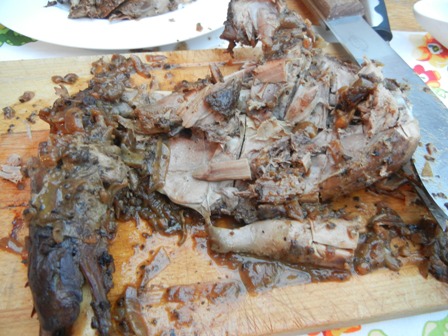
His mother (I call her aunty Doris) prepared for us the leg of a young wild boar, shot by Ulrich’s younger brother Georg. Let me say from the outset that this was the best piece of game I have ever eaten. I asked her to tell me the secret of this delicacy. Her instructions were rather sketchy. I figured that mustard plays a central role. The meat needs to be rubbed carefully with a mustard-pepper-salt potion.
The following photos show what we had for dinner. Of course the side dish with the carbs consisted of good German potatoes.
The potatoes
The young wild boar’s leg
On the plate
And after….
Needless to say that we had various kinds of delicious wines with our meal. We started the extensive tasting with a white wine, a fresh Gruener Veltliner from Weingut Setzer, Austria. The Setzer winery was decoreated with the “winery of the year 2013” award.
The estate has about 30 ha under vines and produces a wide variety of wines. Main grape variety are Gruener Veltliner, and red Veltliner. Recently, Hans Setzer, owner-operater of the estate, was awarded with the “Vinter of the year award” for 2013. With its low (11%) alcohol content, this wine is wonderful for warm summer days. It is refreshing and shows great temperament.
Gruener Veltliner Vesper, Austria
Knipser Riesling, Pfalz
We followed up with a German dry Riesling by the well-known Knipser Estate in Laumersheim, Pfalz.In 2009 the winery was awarded the “vintner-of-the-year” award by Gault Millau.
The ‘2001 Laumersheimer Kapellenberg Riesling Kabinett Trocken’ was just the right wine to complement the meal. I like the minerally note and the tropical fruit aromas.
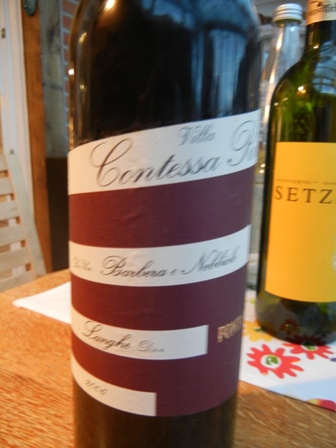
Barbera and Nebbiolo blend by Villa Contessa Rosa
Mid-term through the meal, we changed colour and switched to a red wine from Italy. Villa Contessa Rosa has currently about 70 ha under vines. The blend of Barbera and Nebbiolo, produced in the wine region Langhe, was also a good accompliment to the wild boar.
The meat from the forest animal and the red and Forest berry aromas from the wine went well together. Below you see the colour of the drop from heaven.
From here on I lost track of the wines we sampled in the course of the evening. There were a few more red wines, but honestly I cannot recall what they were and where they came from.
The generosity of our hosts knew no bounds, I might say (thank you again Ulrich and Elfriede). It was a terrific evening of reminiscing about the past and making plans for the future.
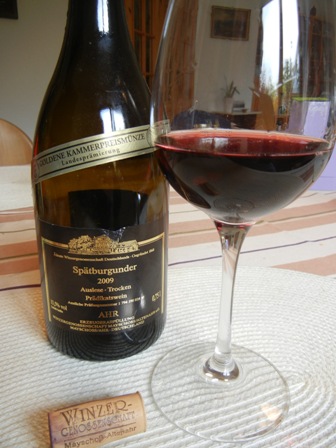
The Ahr wine region is well known for producing outstanding Pinot Noir wines in Germany. During a visit this summer we bought a bottle of ‘2009 Spaetburgunder Auslese dry’ from the Mayschoss Vintner Co-operative.
The co-operative is the oldest in Germany. In 2012 one of it’s wines was awarded the best “Blanc de Noir of Germany” title by the food magazine „Der Feinschmecker“ (5/2012 edition). We visited the cellar door in August and had a guided tour which was very lovely.
Recently I tasted the Mayschoss Pinot Noir together with my friend Juergen. The wine has a beautiful dark red colour. The black fruit aromas with a tiny hint of peach are lovely. The wine is medium-bodied, smooth and shows a fine balance. We drank it on a Sunday morning, just like that without food, what we call in Germany a “Fruehschoppen”, a drink (glass of wine or beer) taken after church, and before going home for lunch.
Thanks Juergen and Elisabeth for the excellent company.
In the last week of September three of my favourite German wineries were honoured by the Wine & Spirits Magazine, and included in the top 100 list of the best wineries of the world in 2012.
The three wineries are the following:
1. Dr. Loosen, Bernkastel, Mosel
The winery has been in the Loosen family for more than 200 years. Ernst Loosen took over in 1988, and, as they say, the rest is history. Dr. Loosen is maybe one of the best known German vintners in the international wine scene. I was so happy when Barrique, my local wine shop in Healesville, Victoria was carrying Dr. Loosen wines.
Address: Winery Dr. Loosen,
St. Johannishof
54470 Bernkastel, Mosel
Tel.: +49-6531-3426
info@drloosen.com www.drloosen.com
2. C. von Schubert, Mertesdorf, Ruwer, Mosel
This winery has also a long tradition. The “Grünhaus”, as the estate is also known, was already mentioned in ancient documents in 966 when it belonged to the Benedictine monastery of Saint Maximin in Trier.
Carl von Schubert, the current owner-operator, belongs to the fifth generation of the von Schubert family. The estate produces outstanding wines and was awarded many national and international prices. I tasted some of the Maximin Grünhäuser 2011 vintage dry Riesling wines during our summer vacation
Address: Dr. Carl von Schubert
Hauptstr. 1
54318 Mertesdorf
Tel.:+49-651-5111
Fax: +49-651-52122
info@vonschubert.de www.vonschubert.com
3. Robert Weil, Kiedrich, Rheingau
The winery was set-up in 1875. The founder was the university professor Robert Weil who taught German at the Sorbonne in Paris. The Franco-Prussian war of 1870/71 forced him to return to his native Germany. He settled down in Kiedrich, Rheingau and extended his vineyards and laid the foundation for today’s estate. In 2010 I found some bottles of the Robert Weil 2008 vintage in a Bangkok wine shop. Delicious.
Address: Winery Robert Weil
Mühlberg 5
65399 Kiedrich, Rheingau
Tel.: +49-6123 2308
Fax: +49-6123 1546
info(at)weingut-robert-weil.com www.weingut-robert-weil.com
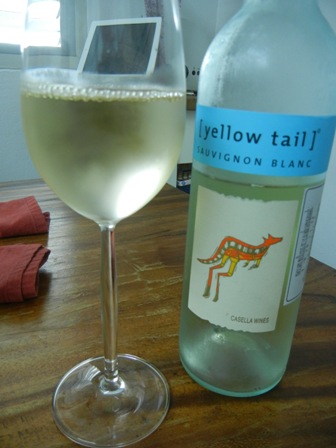
When a little boy, my Australian nephew Nick, had written in a guest book “great place, crap food”. I was reminded of this great line the other day when we tried to enjoy a wonderful Jamie Oliver seafood dish with a mass produced, cheap industrial wine. We adapted this seafood soup from Los Angeles to accommodate Thai conditions.
Yellow tail SB from Australia and New Zealand
We knew what we were in for. I was not surprised that this wine by yellow tail was of low quality. The Shiraz from the same series, I would call “very drinkable”. The Sauvignon Blanc is also “drinkable”, however, I would omit the word “very”. Anyway.
But a good thing happened nonetheless, and that was the big surprise for me. Because of the high quality of the food, the wine was, shall I say “augmented” beyond belief. It became quite drinkable.
Yellow tail Sauvignon Blanc
The bottle does not carry a production or vintage year. The blend is an Australian & New Zealand one, with grapes coming from both places. I do not know if the producer is doing himself a favour with this kind of wine. The fact that it is on the market is proof that there is demand, and therefore there should be supply.
After all, it was my choice to have this wine with the seafood soup.
Well, how should I say it? I cannot afford for every day drinking the wine on offer in 0.7 bottles any longer. Wine prices in Thailand are just too high.
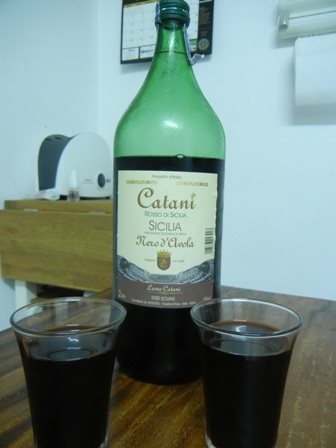
Instead, we have taken to some cheap stuff. I know, that ‘life is too short to drink cheap wine’. However, some of the cheap stuff is actually quite drinkable.
The above wine is one of them, easily available in any super-market in Bangkok. Value for money, so to say, and in a two litre bottle. I feel like in the good old student days.
It is not worth to try to identify the producer or the location. No, just enjoy a drop of red for “the time in between”, I would like to call it.
Reminiscing about the past is one of the privileges of the not so young. A Sunday lends itself to such action, especially when considering the traditional German Sunday lunch.
Roe deer on noddles
While in my mothers house a few weeks back during our summer vacation, we were treated to roe deer goulash with noddles and salad. My friend Heinz, a passionate hunter, had reserved this particular piece of meat for me. He knows that I love game, especially meat of young animals.
Needless to say that this piece of roe deer was super delicious. When asked how they cook it, I can never quite figure out the recipe. Just simmering for a long time in a pot with some onions, is all what I could extract from the uttering of my mum. Well, I will have to prepare such a dish myself, one day and see.
The choice of wine was a foregone conclusion. Just a couple of days earlier we had visited the winery of the Schäfer-Fröhlich family in the village of Bockenau, Nahe.
In 1995 Tim Fröhlich took over the management of the vineyards and winery from his father. Today the estate has 16 ha under vines, some in the best locations in the vicinity (for instance Monzinger Halenberg, Monzinger Fruehlingsplaetzchen and Bockenauer Felseneck). His fine Riesling wines have won wide acclaim in the world of German wine. In 2010 Gault&Millau selected Tim for its “vintner-of-the-year award”.
The ‘2011 Bockenauer Riesling dry’ is a young wine. It comes from the hill just behind the winery. On the label it says “Schiefergestein” which means the the vines grow on blue and grey slate. I loved the lime and citrus aromas. The wine has great character, is fresh and exuberant. Its fine acidity shows great balance. This elegant Riesling has a long finish and might gain even more complexity when aged. No chance to age for this bottle, though. We needed it with the deer dish on that Sunday to bring absolute enjoyment to the Adam family.
PS: If you want to know where the grapes for this were grown, please visit Weinlagen-Info.de. My wine blogger friend, the winegetter, made me aware of this handy tool to find the vineyards and places where the grapes come from.


 Posted by themanfrommoselriver

















 The Man from Mosel River