Riesling – Domaines Schlumberger, Alsace

May 25, 2010

Mussels

These days mussels are inexpensive in Bangkok. So why not having a large pot of mussels of Sunday lunch? Done. I like them cooked with chorizo sausages. In this combination of flavours the mussels are amazing. The pork sausage with the red paprika somehow bring the shells from the sea “to land”, so to say. The dish has bite.

Mussels with chorizo

What to drink with it, was the question? White, OK. But I could not think of any better wine than a Riesling from Alsace. Fortunately, such a Riesling was just at hand. The ‘2006 Les Princes Abbés Riesling’ from Domaines Schlumberger in Guebwiller, about 20 km south of Colmar, Alsace, France, was the ideal wine to go with our food.

Front label

Since 1810 this estate is in the hands of the Schlumberger family. That’s lot’s of tradition in an Australian context. It started with 20 ha under vines. Today the family farms (in sixth generation) about 140 ha of vines of which about half is classified as “Grand Cru”, best locations.

The location (terroir), “The Princes Abbés” ,originally belonged to the monastery in Murbach. Monks always knew what was good for body and spirit. Today “The Princes Abbés” label offers seven Alsatian wine varieties. It is does not belong to the Grand Cru locations of the estate (4 “terroirs” : Kitterlé, Kessler, Saering, Spiegel).

The back label

The Schlumberger’s grow all the fruit for their wines themselves. Yields are kept low. Many vineyards are very very steep. The Schlumberger’s also use drought horses to work their vineyard. This is also one of my dreams when finally settling in Glenburn, Victoria. I intend to buy a pair of Percheron horses for farm work.

The Schlumberger’s farm more land in the vicinity of their vineyards according to organic and bio dynamic principles. Total wine production per year is about 70,000 cases. Well, I should acquire some more of their bottles.

Light golden coulor, gorgeous liquid

“The Princes Abbés” Riesling has great character. It has zest and structure and is a citrus bomb with the oily characteristic of the Alsatian Riesling.

A cork to close the bottle

I should visit the Alsace again. It’s such a wonderful region, easy to reach, just about a two to three hours drive south from Frankfurt. See you there, maybe?

Address:
Domaines Schlumberger
100 rue Théodore Deck
68501 Guebwiller Cedex –
France
Téléphone: +33 3 89 74 27 00,
Fax : +33 3 89 74 85 75


The wines of China

May 23, 2010

Soon, I will go the China again, and I very much look forward to this visit. When we moved to China in 1990 we were so happy that wine made from grapes was available at all. That was the time of the first French- or Italian-Chinese joint ventures. Ever since the Chinese wine industry has made great progress.

However, if you look for boutique vineyards, China is the wrong place. China after all was and is a beer drinking place. In the countryside it is “bai jiu” (high percentage white liquor or Schnaps) made from maize or sorghum (gao liang) which is consumed in large quantities.

Most of the grape wines on sale in shops and supermarkets in big Chinese cities come from the corporate wine producers such as Dynasty Wines or Great Wall Wines. In 1990 Dynasty, a joint venture of Remy Martin set up in Tianjin in 1980 (only the second joint venture in China at the time), was already 10 years old.

Dynasty Dry Red Wine

Back label

Great Wall Red Wine

Back label

As everything, wine-making goes back a long way in China. However, after the end of the cultural revolution and the start of the economic reform era, there was hardly any expertise left. With the help of wine-makers from France, Italy and Australia, Chinese vintners have made remarkable advances. The product range of the large corporate producers is quite impressive.

Today grape wines are gaining popularity. Especially red wine is popular among male consumers and a kind of status symbol as well. For Western wine connoisseurs some of the consumption habits of the Chinese are strange (or disgusting). For instance the custom of drinking first class Bordeaux wine mixed with soft drinks, called “Red wine set menu” (one bottle of red, ice and two cans of sprite or coke).

The largest producing region is Yantai-Penglai in Shandong province with about 40% of total production in China. It is estimated that China will match the quality of Bordeaux wines in about 50 years time.

I will check it out next week. I’ll keep you posted.


Australia: WFA Vintage Report 2010

May 17, 2010

Two Hills Vineyard Merlot grapes 2010

The new figures are out. Today the Daily Wine News presented the Winemakers Federation of Australia (WFA) vintage report 2010. About 360 wineries participated in the survey, representing about 89% of total production.

The basic findings are well known to grape growers, vintners and wine makers. 2010 was a dreadful year especially for grape growers. The 2010 vintage of about 1.53 million tonnes (did they count my grapes as well?) was lower than 2009 (-12%) and 2008 (-5%).

The decline in white wine grapes was sharper (-14%) than the red ones (-8%), but I sold my white though almost nobody bought my Merlot and the Pinot Noir). My own experiences do not conform to the trend, I guess. Especially regarding my Pinot I must have missed something (+26% increase to 35,ooo tonnes). Or was it the other way round: because of the increased intake I could not sell my Pinot Noir?

Well the real reason is that my buyer walked out on me after a perfectly beautiful fruit which my buyer wanted to have some more days of sun was subsequently hit by rain and with it the destruction rain might bring at this time of the year.

Australia’s Sauvignon Blanc crush increased by 15%. OK, I sold all of mine. SB is still Australia’s third most important white variety after Chardonnay and Semillon.

Good that I ripped out my Cabernet (total production 213,000 tonnes), it further decreased in intake (by 14%) as did Merlot (total tonnage 109,000 tonnes), The big winner seems to be Shiraz which we unfortunately do not produce at Two Hills Vineyard. I love Australian Shiraz wines.

What does the enthusiastic Riesling drinker from the Mosel think of the Australia’s Riesling vintage: incredible, there is a 11% decrease in the crush of Riesling. Can you believe this? My most favoured wine available in much less quantity? I hope the quality shows just the opposite trend.


And out they go: The exodus of vintners in Australia

April 29, 2010

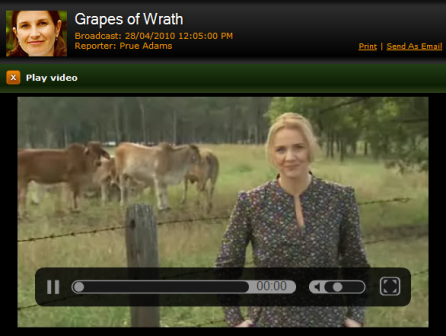
The recent ABC Landline report nicely summarizes the predicament of the Australian winegrowers. A$ 250 per tonne for your fruit is just not covering costs. Grape growing has no future, it seems. I find it quite shocking somehow. The documentary depicts the individual detiny in a very touching way.

Click on the link below and watch this very informative film.

ABC Landline


Country meals with Rocky Passes Syrah 2005

April 24, 2010

Chicken, vegetables and cauliflower

Lunch in the vineyard is always a highlight, especially if the weather allows us to have it on the terrace outside with those spectacular valley views. Of course wine is an important ingredient in a successful lunch. We had another bottle of Rocky Passes Syrah, the 2006 vintage this time. It received 92/100 Parker Points by James Halliday.

2005 Rocky Passes Syrah

Later the same day we followed the 2006 vintage with a 2005 Syrah. I had just one bottle of the 2005 vintage left which had received a whopping 94/100 Parker Points. Vitto Oles is doing a great job on these stony slopes of Rocky Passes Estate. Good food and good wine, that’s what makes a great day. The other two ingredients are old friends and good music.

Hope you have a good Saturday yourself.


Wine tasting at the Lake House in Bangkok

March 7, 2010

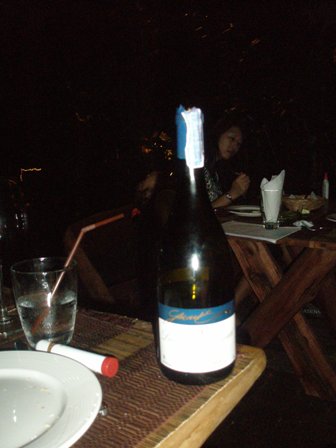
The bottle of red by Domaine de Rapatel at Lake House

In the morning when we drove past Lake House on our way into town, we decided spontaneously that we should go there for dinner. Margit had seen a review about the place in the Bangkok Post. Of course we had to check the place out ourselves.

It was already dark when we arrived but the surroundings of the lake were very romantic. My camera, however, could not cope with the conditions. We choose a small table in the garden and had just ordered our food when an excited waitress came and invited us to a wine tasting. Surprise surprise, we thought, why not taste some wines.

In a small room in the main building, we met the winemaker, Gérard Eyraud, his daughter and grandson, and some more French people from the wine importer. We tasted four wines, three from Gérard, one from another producer from Southern France (Domaine Bouche Red, Cote du Rhone). I had nothing to write with, took no notes and also forgot completely to take a picture of the winemaker and his family.

The white from Domaine de Rapatel was a blend of Roussanne with Bourboulenc with a taste of apricots, one red was a blend of Grenache with Syrah and the third one was a blend of Syrah, Grenache and Mourvèdre (14.5% vol. alc.). The last one I know for sure, because we could not continue to drink the wine I had ordered earlier, after we had tasted these wonderful fruity wines made by Gérard. In the process we got to know Matt, one of the three co-owners of the restaurant, from Melbourne and established that his brother Dan is an old mate of my nephew Nik Meinhold. How small the world is.

Gérard and Christine Eyraud have about 15 ha under vines southwest of the city of Nîmes. Gérard sells most of his wine as Vin du Pays du Gard, the grand cru wines are labeled “Costières de Nîmes”, a wine region in the Carmargue, in the South of France. I have visited the city and its surroundings but had never tasted wines from there before. I loved the fruitiness which reminded me of Australian wines and not necessarily typical for French wines.

We had a jolly good evening. The tapas we had ordered were delicious, the wine was just superb. The staff was very friendly. We went home with the sincere intention to come back and taste some more wines. By the way the wine list of Lake House is quite extensive, and the prices are the best I have seen in Bangkok so far.
Needless to say that we ordered a couple of dozens of the wines the next morning by e-mail. More soon about these wines maybe with proper tasting notes.

PS: During the wine tasting we also learned that the house used to belong to Tiziano Terzani (14.09.1938 – 28.07.2004), an Italian journalist and writer, and a native of Florence. He stayed there for about two years. The house was called “the turtle house”. He also had lived in Beijing, China for a while where he was the correspondent for the German magazine Der Spiegel, until he was thrown out. I red his book “Behind the forbidden door: travels in unknown China” in 1986.

Address:
Lake House
http://www.lakehousebkk.com
18 Soi Prommitr, Sukhumvit 39
Bangkok, กรุงเทพมหานคร 10110, Thailand
+66-2-662 6349


The top German Vintners or the VIP club of German wineries: VDP

March 1, 2010

The logo of the VDP

VDP stands for “Verband Deutscher Praedikatsweingueter”. The German can be freely translated as “Association of German Wineries of Excellence”. The VDP is a club-like organisation with 196 member wineries.

It was founded in 1910 and celebrates this year its 100th anniversary. According to its website, VDP is the oldest association of the top quality wine estates. membership requirement is to adhere to the standards of the association which includes among others the strict limitation of yields. There is an inspection and certification process in place which members must submit to in oder to not loose the membership status. It is supposed to uphold the high quality of the produce.

The sign of quality are the eagle (no surprise for Germans who have made it part of their national insignia) and the cluster of grapes, usually embossed on the bottles of their “Erstes Gewaechs” comparable to France’s “premier cru”, wine made from grapes from the best terroir or locations.

The members of the association sell about 35 million bottles per year, for an average price of about 9 Euro /bottle. 80% of their production is sold on the domestic market, 20% is exported. Almost half of the bottles are sold directly to consumers.

The members come from all German wine regions. More than half of them (acounting for about 6% of all Riesling plantings worldwide) produce the finest Riesling wines Germany has to offer. In 1990 it had 161 members. Since then 73 wineries have left and 108 have joined the association.

According to www.riesling.de it’s newest three members are:

Klaus Zimmerling, Saxonia
Konrad Schloer, Taubertal
Thomas Seeger, Baden

Some of my favourite producers are members of the association, for instance Van Volxem Wine Estate in Wiltingen at the Saar.


Vineyards of Thailand Part 3: PB Valley Khao Yai Winery

February 25, 2010

Wine tastings at PB Valley

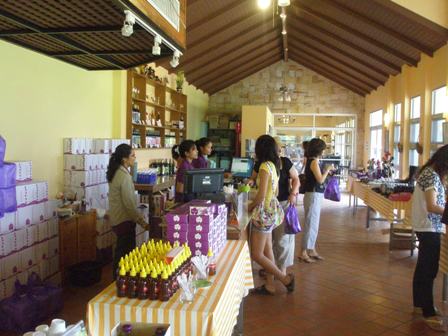
PB Valley is the largest of the Khao Yai vineyards and wineries. It’s total production is about 600,000 bottles a year. It is also the oldest vineyard in the region. It was started in 1989 on a large plot of land. It took a couple of years to identify the most suitable grape varieties for the climate.

PB Valley wines have won a number of international wine awards (mostly at AWC in Vienna). Apart from vineyard and winery, it also has a restaurant, the Great Hornbill with about 200+ seats, and holiday accommodation. I like their reserve Shiraz and Tempranillo wines best.

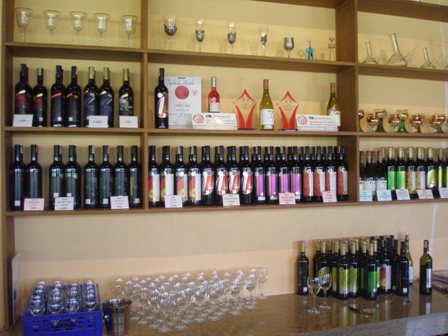
Unfortunately, we had no time for a winery tour or any organised tasting. We just dashed to the cellar door and bought a couple of bottles. As in other wineries, the product range includes all kinds- of non-wine products from health care, cosmetics to nutrition.

The entrance to the sales room

The cellar door

Wide product range

If you visit Bangkok, rent a car with driver for the day and visit the wineries and vineyards of PB Valley and Gran Monte. This gives you a perfect start for the exploration of new latitude wines. The area is beautiful and the national park offers some unique experiences of Thailand.

If you have no time, visit their sales offices in Bangkok and stock up on their wines.


Who destroyed the Australian wine industry? …and the culprit is….

February 15, 2010

I have not been reading the Daily Wine News for a couple of days. After coming home last night, I browsed through the accumulated news. And, Eureka, I found for the first time someone who points his finger in the direction of the big corporate producers.

So far the tenor of most critics has been that there is just too much wine around (surplus of 20-40 million cases of wine each year) and that mostly greedy investors, money trusts and lifestyle (hobby) vintners, loaded with money made in construction or as medical doctors are the ones to blame. They are the ones who single handedly destroyed the wine sector; they produced the “wine lake”, and planted unsustainable hectares of new vineyards. The remedy was also clear: the small ones have to go. Instead wine production had better be left to the professionals (i.e. the corporates).

In comes Brian Croser, the founder and former owner of Adelaide Hills based Petaluma winery, with his view of the problem. He believes that the 2,000-odd Australian vintners are the originators of first-class Australian wine and have been the creators of the outstanding international image of their produce. The large companies, the corporates, have benefited from this positive image and “sailed on it”. However they mainly produce commodity wines of inferior quality which they dump on world markets, thereby destroying the reputation of fine Australian wines.

Whether this is true or not is certainly debatable. Everyone who extended their plantings in the hope of a larger marketshare is somehow to blame. However, finally we can hear another tune, not heard before and the public conversation has not only become more colourful but also more pluralistic, which is good for everyone.

If we have to pull out 40,000 ha of grape vines, they should come from various sources. If one of the four big companies would go and leave the sector, a lot could be gained for the remaining producers. Alternatively, small producers could pull out. What would be better for the country? this is a question not easily answered.

We will see small, medium as well as big companies leaving the industry. Many small family businesses will have their niche and will thrive regardless of the downturn of the sector. Others will close down, especially fruit producers who are at the end of the value chain (actually they are at the start of it). Also some of the investor and dividend driven schemes will come to an end. Vineyards and wineries will be hard to sell for some time to come. The big corporates will clean up their portfolios, they might de-invest in wine production and move into other segments of the beverage industry. Lower average profits in wine making will make other investments relatively more profitable. The wine sector will remain unattactive for young professionals for a while until the pendulum swings back, and the cycle of boom and bust will start all over again.

We at Two Hills Vineyard came too late to the party, and were caught out, so to say. I guess, we will go into hibernation and see what the prospects are in a couple of years time. I hope we can afford this strategy and that it will pay off some day when we can reduce costs and better market our produce. I remain optimistic and we will hang in there. Cheers to Two Hills wines!

Two Hills Vineyard, Glenburn


Vineyards of Thailand Part 2: Gran Monte, Asoke Valley, Khao Yai

January 11, 2010

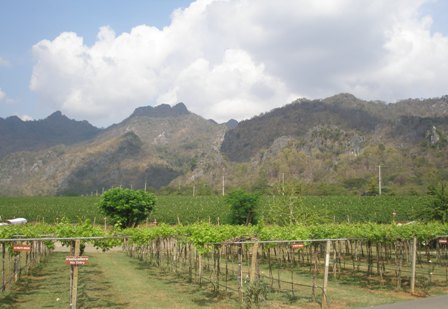
Gran Monte vineyards

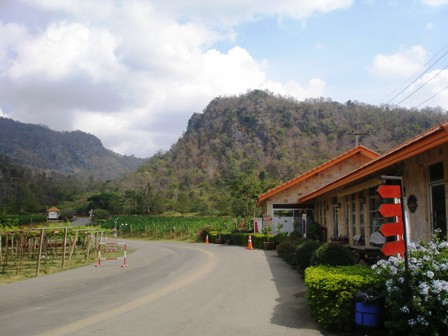
I have visited Gran Monte located in the Asoke Valley in the Khai Yai area before. But this time we did not have an appointment with the boss, Mr. Visooth Lohitnavy, and a winery tour was out of the question. We played the innocent tourist, and walked right into the cellar door and tasted the new vintage.

Cellar door to the right, beautiful mountains ahead

The tasting room

2009 was a great year for Gran Monte. The winery won about 20 national and international awards for its “new latitude” wines, and is now firmly established as one of Thailand’s top producers easily matching international standards.

Wines on display in the tasting room

2009 Spring Chenin Blanc

Though Chenin Blanc is usually not “my variety”, I just loved the ‘2009 Spring Chenin Blanc’ which won a silver medal at the AWC Vienna International Wine Challenge 2009. It’s a very fresh wine with a beautiful bouquet, and a clean finish. I liked it much better than the ‘2009 Sole Unwooded Chenin Blanc’. The ‘2009 Sakuma Rose Syrah’ was not for tasting but we bought some bottles nonetheless. Finally, we bought a whole selection from different vintages, varieties and price ranges. More about the food and wine pairings and our experiences with Gran Monte wines will follow soon.

Newspaper reviews about Nikki Lohitnavy

The daughter of Visooth Lohitnavy, the managing director and CEO, is Nikki (or Visootha). She is the first female wine-maker in Thailand. With a degree in oenology from Adelaide, the young vintner is on a mission, and one can feel this when visiting Gran Monte. The 2009 vintage with its excellent whites shows her hand.

Gran Monte has a guest house and restaurant at the winery. The park around the house and the cellar door is very lovely too. When we visited the place was very busy, with many visitors dropping in, most of them Thai. Apart from wine, there are a wide range of local produce including creams and lotions available from the shop.

Gran Monte is definitely worth visiting when going on a winery tour in Thailand, a “must” so to say. There are many other interesting things to visit in the Asoke valley and its surroundings. Khao Yai is just a beautiful region.

Address:
GranMonte in Bangkok
Granmonte Co,Ltd.
17 / 8 Soi Sukhumvit 6, Sukhumvit Road,
Klongtoey, Bangkok 10110
Tel : +66-2-653-1522
e-mail: Marketing@granmonte.com

GranMonte Vineyards and Wines at Asoke Valley, Khao Yai
52 Moo 9 Phayayen, Pakchong,
Nakornrachasima, Thailand
Tel : 081-923-200-7 , 084-904-194-4, 081-900-828-2 , 080-661-755-5
www.granmonte.com