The Mosel river

October 10, 2012

The Mosel river near Schweich

I am rapping things up here in Bangkok. Only two more days to go. Friday night I will be on the midnight flight to Germany. After about 11 hours on the plane, I will land in Frankfurt early in the morning. I might have a coffee and breakfast at the train station.

Then I will catch a train to Tier, my home town to see my parents. The train ride will be wonderful regardless of the weather. Autumn might extend its magic with colourful leaves in red, brown and yellow.

First, my trip will lead me along the Rhine river, then I’ll change trains in Koblenz. The next leg of the journey will be along the Mosel river. Some of the views will be spectacular.

I will admire the vineyards of both valleys, the Rhine and the Mosel. On the hilltops will be castles here and there. The slopes are steep, and I will think of all the hard work the vintners put into their vineyards. How can one work these terrible steep slopes? Backbreaking work, done for generations.

Vineyards and wine production have been a feature of the place for more than 2.000 years, incredible. I will have only about 24 hours there before I will move on for a business trip to Berlin.

Saturday night I will patronize my favourite wine bar, Weinsinnig. It will be my cellar door so to speak since I plan to pick up a few bottles of my favourite Mosel wines. There will be certainly a crisp Riesling among them.

I very much look forward to going home.


“Great food, crap wine”!

October 9, 2012

Delicious seafood soup

When a little boy, my Australian nephew Nick, had written in a guest book “great place, crap food”. I was reminded of this great line the other day when we tried to enjoy a wonderful Jamie Oliver seafood dish with a mass produced, cheap industrial wine. We adapted this seafood soup from Los Angeles to accommodate Thai conditions.

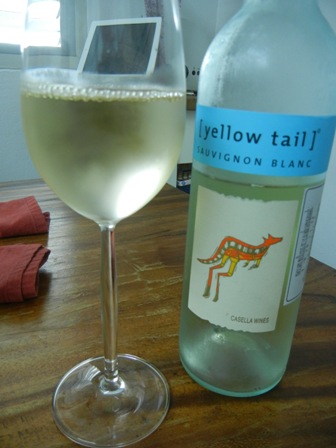
Yellow tail SB from Australia and New Zealand

We knew what we were in for. I was not surprised that this wine by yellow tail was of low quality. The Shiraz from the same series, I would call “very drinkable”. The Sauvignon Blanc is also “drinkable”, however, I would omit the word “very”. Anyway.

But a good thing happened nonetheless, and that was the big surprise for me. Because of the high quality of the food, the wine was, shall I say “augmented” beyond belief. It became quite drinkable.

Yellow tail Sauvignon Blanc

The bottle does not carry a production or vintage year. The blend is an Australian & New Zealand one, with grapes coming from both places. I do not know if the producer is doing himself a favour with this kind of wine. The fact that it is on the market is proof that there is demand, and therefore there should be supply.

After all, it was my choice to have this wine with the seafood soup.

Cheers


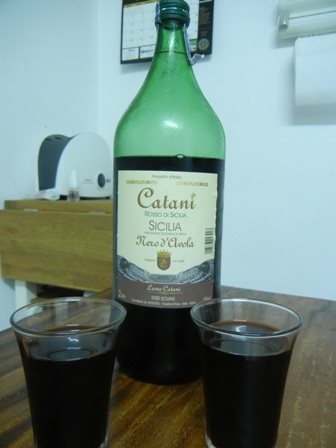
Leone Catani – Two litre bottles of Nero d’Avola from Sicily

October 7, 2012

Leone Catani – Nero d’Avola

Well, how should I say it? I cannot afford for every day drinking the wine on offer in 0.7 bottles any longer. Wine prices in Thailand are just too high.

Instead, we have taken to some cheap stuff. I know, that ‘life is too short to drink cheap wine’. However, some of the cheap stuff is actually quite drinkable.

The above wine is one of them, easily available in any super-market in Bangkok. Value for money, so to say, and in a two litre bottle. I feel like in the good old student days.

It is not worth to try to identify the producer or the location. No, just enjoy a drop of red for “the time in between”, I would like to call it.

Cheers from Bangkok.


German wine tradition: the wine queen and wine princess

October 2, 2012

German wine tradition

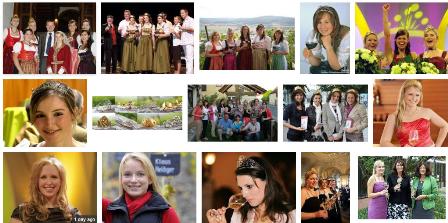
I do not think that Australia has already embarked on this path, but Germany certainly has a long tradition of wine queens and wine princesses (since about the 1930s).

The German wine queen is the elected representative of German wine for the duration of one year. The candidates are the 13 regionally elected wine queens from the officially recognized 13 wine regions.

It is tradition that the new wine queen will be crowned in Neustadt, Pfalz. The 64th German wine queen is Julia Bertram from the Ahr win region. She was inaugurated on September 29.

The German wine princesses (allowed are up to three) are the deputies of the German wine queen. Usually the runner-up in the election is appointed wine princess. Currently there are two, Anna Hochdörffer, Pfalz, and Natalie Henninger, Baden.

The electoral college consists of about 70 members. I could neither find out how the selection committee is composed nor how these jury members are selected, though. From the 13 regional wine queens, normally six are nominated as finalists for the contest. The jury elects one as queen and two as her princesses. Of the 64 queens, 11 came from my native Mosel.

The candidates do not need to come from a winery or vineyard but need solid knowledge about German wine and the wine industry, oenology and wine-making. The wine queen and the princesses are representing the wine industry for a year at all major wine festival, fairs, exhibitions, wine tastings, including international events. They need to be eloquent and good ambassadors for the German wine industry.


Sunday treat – dry Riesling from Weingut Schäfer-Fröhlich, Bockenau, Nahe

September 30, 2012

Mother’s roe deer dish

Reminiscing about the past is one of the privileges of the not so young. A Sunday lends itself to such action, especially when considering the traditional German Sunday lunch.

Roe deer on noddles

While in my mothers house a few weeks back during our summer vacation, we were treated to roe deer goulash with noddles and salad. My friend Heinz, a passionate hunter, had reserved this particular piece of meat for me. He knows that I love game, especially meat of young animals.

Needless to say that this piece of roe deer was super delicious. When asked how they cook it, I can never quite figure out the recipe. Just simmering for a long time in a pot with some onions, is all what I could extract from the uttering of my mum. Well, I will have to prepare such a dish myself, one day and see.

The choice of wine was a foregone conclusion. Just a couple of days earlier we had visited the winery of the Schäfer-Fröhlich family in the village of Bockenau, Nahe.

In 1995 Tim Fröhlich took over the management of the vineyards and winery from his father. Today the estate has 16 ha under vines, some in the best locations in the vicinity (for instance Monzinger Halenberg, Monzinger Fruehlingsplaetzchen and Bockenauer Felseneck). His fine Riesling wines have won wide acclaim in the world of German wine. In 2010 Gault&Millau selected Tim for its “vintner-of-the-year award”.

The ‘2011 Bockenauer Riesling dry’ is a young wine. It comes from the hill just behind the winery. On the label it says “Schiefergestein” which means the the vines grow on blue and grey slate. I loved the lime and citrus aromas. The wine has great character, is fresh and exuberant. Its fine acidity shows great balance. This elegant Riesling has a long finish and might gain even more complexity when aged. No chance to age for this bottle, though. We needed it with the deer dish on that Sunday to bring absolute enjoyment to the Adam family.

PS: If you want to know where the grapes for this were grown, please visit Weinlagen-Info.de. My wine blogger friend, the winegetter, made me aware of this handy tool to find the vineyards and places where the grapes come from.


Food and wine pairing: vegetable soup and Riesling?

September 28, 2012

Our vegetable soup

As you probably know summer days in Germany can be chilly. This is not a big deal because the appropriate food is easy to find. How about a real vegetable soup? Not one out of a tin but with real veggies, cut into small pieces and cooked with just the best stock. And how about some home made bread as well?

Sounds yum. I tell you.

But what about a wine? Should it be red? Should it be white?

Well, my choice was a young and fresh Riesling from the Rheingau. From my recent visit of Schloss Johannisberg, Rheingau I had brought a bottle of ‘2011 Schloss JOhannisberg dry Riesling’ from the “Gelblack” series.

I got the bottle from the cellar door for 13.70 Euro/bottle. The alcohol content is 12.5%, residual sugar is 7.9 g/l, and total acidity is 7.5 g/l. The colour is a beautiful straw yellow. It shows lush aromas of green apple and tropical fruit. The acidity is charmingly fresh and zesty.

We gave the wine no chance to age and show it’s long-term potential. The young fragrant Riesling complemented the creamy soup with its carrots, cellery and other fresh garden-vegetables very well.

Cheers and enjoy!


Big summer wine tasting at Weingut Karthäuserhof, Eitelsbach II

September 26, 2012

Wine tasting

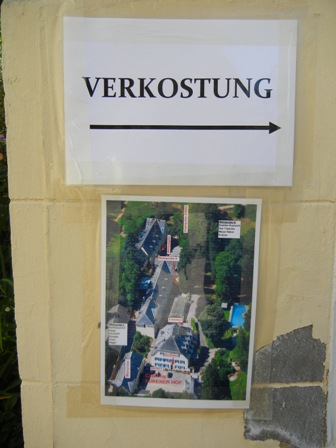
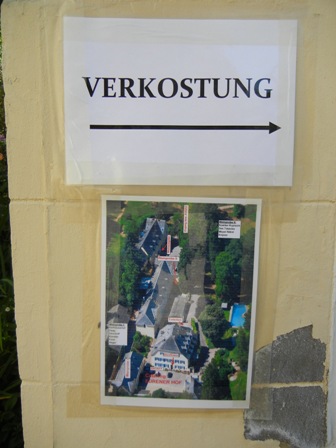
Let us come back to the Karthäuserhof estate tasting on August 11, 2012. It was a splendid summer’s day with blue sky and ample sunshine when we walked into the estate.

We paid our entrance fee of 15 Euro/person. It was all very confusing for a first time visitor. Many of the other guests, it seemed, knew their way around. Lot’s of people had showed up.

The wine tasting was conducted in two seperate locations. The first was a rather crammed barn with four tasting stations. I can only recall three of the wineries represented. The barn was packed with people, pushing and shoving along.

The vintners behind their tables were equally, let’s call it – stressed. I immediately felt some regret. Why did I give up a perfectly spacious table elsewhere and a bottle of wine in a quite atmoshere, I aske myself.

The tasting station of Knipser Estate

The three wineries were:

Weingut Knipser (Knipser Estate), Laumersheim, Pfalz
My first wine from Knipser I had tasted in Beijing, China, about 24 years ago, when my friend Norbert who is a native of the Pfalz, presented me with some dry Riesling from this estate. The family tradition of wine production in the Pfalz goes back to 1615 (an incredible long time in an Australian context).

Weingut Meyer-Näkel (Meyer-Näkel Estate), Dernau, Ahr
The Meyer-Näkel family, now in the fifth generation, has about 15 ha under vines, 75% of which are Pinot Noir, 12% early Pinot Noir, 5% Pinot Blanc, 5% Riesling and 3% others. One of the two daughters presented the wines when we were there. The Ahr is the northernmost (and the smallest) wine region of Germany and produces some stunning Pinot Noir wines.

Weingut Koehler-Ruprecht or The Vintage Vineyard as it is called on the webpage, Kallstadt, Pfalz
The vineyard is about 10.5 ha in size. The mainly white varieties (Riesling, Pinot Blanc, Chardonnay, Muscat, Scheurebe and Pinot Gris) are planted on a calcerous soil in four locations in Kallstadt (Saumagen, Annaberg, Steinacker, Kreidkeller).

The first two wineries I know quite well. I have tasted wines from these producers at various occasions. The Koehler-Ruprecht estate was new to me. I admit that I do not know the village of Kallstadt near Bad Dürkheim. The webpage of Koehler-Ruprecht, however, is presenting the estate in five languages (German, English, Chinese, Norwegian and French)!

The Meyer-Näkel tasting table

And now the bad news: the crowded conditions did not lend themselves to note taking. Anyway, I was not in the mood while being pushed and shoved to think about anything, except: let’s get our of here as quick as possible.

But then I also thought, Rainer, you should taste some of the wines. Which I did. I remember nothing, except that the grand cru Meyer-Näkel Pinot Noir was wonderful, and that the daughter behind the counter was very kind and friendly.

We went to search for the second wine tasting station thereby recovering a bit from our claustrophobia.

More about this later.
Stay tuned.


Big summer wine tasting at Weingut Karthäuserhof, Eitelsbach

September 23, 2012

Karthäuserhof Estate, main gate

A winery I always wanted to visit is the Weingut Karthäuserhof in Eitelsbach, a small hamlet which is part of Ruwer, a suburb of Trier, just a couple of kilometres away from my home in the city centre.

The wine estate Karthäuserhof is a member of the elite club of German wine estates, the VDP. It is a prime producer of outstanding Riesling wines. The estate if farmed by the sixth generation of the Tyrell family. The vintner Christoph Tyrell is well known in the region and beyond.

Every year on the second weekend in August, Karthäuserhof is hosting a wine tasting conducted in co-operation with about a dozen other top German wineries from various wine regions. The 2012 tasting was a very special occasion since it marked the 200 anniversary and jubilee vintage of the Tyrell family.

The 11 August 2012 was a special day indeed; it was our last full day in Germany before our departure to Bangkok. My wife Margit and I, we were looking forward to the event despite the fact that we knew we could not buy a lot since our suitcases were already full with various bottles of wine which we had already purchased.

Our view from the bathroom window

Since we stayed with friends right across from the estate, we had a great view of the location “Karthäuserhofberg”, one of the ‘grand cru terroir’ of Karthäuserhof.

The vineyard has an inclination of about 50%. The soil is Devon grey and blue slate. It is situated right next to the winery and exclusively in the ownership of the Tyrell family. The total area under vines in one plots (very unusual for Germany, I would say) is about 19 ha, 17.7 of which are under Riesling, the rest under Pinot Blanc grapes.

I hope I have wetted your appetite. My next blog entry will deal with the wine tasting, the various wineries represented and their wines. Stay tuned.

Address:
Weingut Karthäuserhof
Karthäuser Straße,
54292 Trier,
Germany
Tel.: +49-651-5121
http://www.karthaeuserhof.com


Food and wine pairing: spicy prawns with off-dry Riesling from the Mosel river

September 21, 2012

Spicy prawns sizzling in the pan

I love spicy food, especially seafood. I find it also easy to identify an appropriate wine for such occasion. During a casual stroll through one of the local super markets here in Bangkok, I found a small selection of wines from my beloved Mosel river.

I could not believe muy luck.

‘2010 Brauneberger Juffer Riesling Kabinett’ by Weingut Max Ferdinand Richter

I selected a bottle of ‘2010 Brauneberger Juffer, Riesling Kabinett’ by Weingut Max Ferdinand Richter, in Muehlheim, Mosel.

The name of this vineyard (31 ha, opposite the villages of Brauneberg and Muehlheim) is intriguing, Braunenberger Juffer. “Brauneberg” stands for ‘the browninsh colour of oxidized devon slate’ and “Juffer” means ‘un-married young woman’/vestal-virgin. There is a story about a young woman who rather tended the vines in this prime vineyard location instead of getting married.

Well!

‘Braunberger Juffer’ is is one of the top terroirs along the lower Mosel. I was so mesmerized when I read ‘Brauneberger Juffer’ on the label, that I did not pay attention to the “attribute”, ‘Kabinett’ which suggests an off-dry type of wine. Not my favourite usually. 50 or so odd grams of residual sugar at 7 to 8 g./l. acidity, is just too much for me.

Fortunately, such information is not mentioned on the label. I would not have bought it. But after all, the sweetness of the wine balanced the spiciness of the prawns exceptionally well, and I was reconciled with my choice of wine.

I guess a dry Riesling would also have been a good choice, but maybe next time.

I love the label: Braunberger JUffer Riesling Kabinett

This wine is full and round, mellow, almost oily. The dominant aroma is peach with some hint of honeysuckle. On the palate the sweetness of bee honey is dominant. However, the wine is light and fresh. The acids are well balanced. The fine texture is tangible and the long finish is rewarding.

Address:
Weingut Max Ferd. Richter
Owner: Dr. Dirk M. F. Richter
Hauptstrasse 85
54486 Mülheim/Mosel
Germany
Tel.: +49-6534-933003
e-mail: drichter@maxferdrichter.com


Riesling from the Ruwer river: Maximin Grünhaus

September 14, 2012

2011 Maximin Grünhäuser Riesling trocken

One of the nicest dry Mosel Riesling wine I tasted during our summer vacation in Trier was a ‘2011 Maximin Grünhäuser Riesling trocken’ by Schlosskellerei Maximin Grünhaus C. von Schubert in Mertesdorf, Ruwer.

It was at Weinsinnig, one of my favourite wine bars in Trier, that we sampled this wine with its romantic and old fashioned label. The wine has character. Although just from their “ordinary” dry Riesling class, you get value for money (9.90 EURO/0.75 l. bottle).

2011 Maximin Grünhäuser Riesling trocken

It has the zest, the exuberance, the fine balance of acids, the opulent aromas, the structure and long finish one longs for in a Mosel Riesling. Although I had driven past the winery many times before, I had never tasted a wine from this first class producer in the Ruwer valley.

The MUNDUS VINI award for the best dry white wine in Germany 2011 and the “Big Gold Medal” were bestowed on the ‘2009 Maximin Grünhäuser Abtsberg Riesling Qualitätswein old vines’, of the estate. I wonder what this wine would taste like.

But I tell you, I will return, and include some more of their wines when I visit the Mosel next time.

Address:
Dr. Carl von Schubert
Hauptstr. 1
54318 Mertesdorf

Tel.: +49 (651) 5111
Fax : +49 (651) 52122
info@vonschubert.de

Maximin Grünhaus