
Without words!
Merry Christmas to all my readers
Without words!
Merry Christmas to all my readers
 1 Comment |
  wine | Tagged: blogging, Christmas, home, merry christmas, nature, The Man from Mosel River, wine, wine blogger, winter |
  Permalink
 Posted by themanfrommoselriver
It has been a while since my last blog entry. Somehow my work does not allow regular blog entries any longer. You will have guessed right: I was on an extended business trip to Germany.
After my official program was completed I also visited my mother in my home town Trier, just for a short weekend only. It was a cold and rainy day when I arrived late in the evening. My beloved Mosel lay in the dark.
Fortunately, a splendid meal was waiting for me. My friend Heinz had prepared roast venison for me. It was the last piece of meat he had left over from his hunting days in Schoden, Saar. In spring 2010 Heinz and his friends had lost their hunting rights to a group of hunters from Luxemburg.
Fortunately, he had the freezer full of delicious meat: venison, wild boar, wild sheep among others. The last piece of a young deer was just the right stuff to make me happy. As you can see from the two pictures below, the meal was awesome.

Roast venison with noodles and vegetables
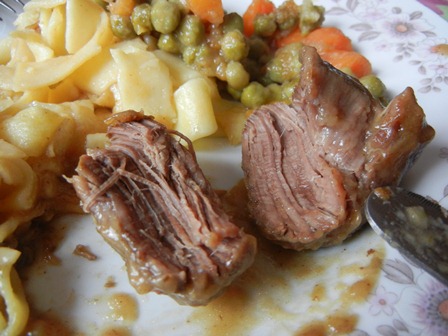
What a fine consistency
What wine would go with this meal? Well, since the meat came from the Saar, the wine had to come from the Mosel. Fortunately, we had a bottle of ‘1999 Neumagener Rosengaertchen Riesling Spaetlese’ by Rainer Krebs, a winery in Neumagen-Drohn, Mosel.

1999 Neumagener Rosengaertchen Riesling Spaetlese
The wine was amazing. It had the nose of petrol fumes, was full and buttery. Despite its age, the wine still displayed its great character. I do not know how many more year it would have lasted.

It complemented our meal in a perfect way. We were reminiscing about the glorious hunting days in Schoden, the nights we spent together sitting in the cold and waiting for deer or wild pigs to show themselves. It was a wonderful time, and I am sad that the hunting rights could not be retained. But such is life, good things come, and go.
I salute all the hunters who treasured their time in this fabulous place.
Address:
Rainer Krebs
Weingut in Neumagen Dhron
Hinterburg 14
54347 Neumagen Dhron
Tel.:+49-6507 / 5934
1 Comment | food, food and wine, wine | Tagged: food, German Riesling, German wine, Mosel, Neumagen-Drohn, Rainer Krebs, Riesling, roast venison, Saar, Schoden, Spaetlese, Trier, wild pigs, young deer | Permalink
Posted by themanfrommoselriver

Friday last week I was invited to the presentation of the new vintage of PB Valley Khao Yai Winery and the tasting of the newly released wines. The event was conducted at the Great Hornbill Bistro which is PB Valley cellar door in Bangkok, one could say.

The place filled up quickly. I met old and new friends from the Thai wine industry, gastronomy, and journalism. There were also some wine bloggers like myself.

Khun Prayut, chief wine-maker of PB Valley
Khun Prayut started the event with a brief overview of PB Valley, it’s grape production and wine making. Lots of things have happened since the start in 1992, the first vintage in 1998 and the international recognition of PB Valleys contribution to the wine industry in South East Asia. In 2011 PB Valley was awarded the Asia Wine Pioneer Award in Singapore.
With a total area of 320 ha of which almost 50 ha are under grapes, PB Valley is not a small enterprise. About 10 ha are for table grapes, the rest is planted with wine grapes such as Shiraz, Tempranillo, Chenin Blanc, Colombard, Dornfelder, Cabernet Sauvignon, Pinot Noir, Merlot, Durif and Petit Verdot.
The flagship wines are Chenin Blanc, Shiraz and Tempranillo. Total production is about 65% red and 35% white, but demand is more on the red side, 80 to 20. Some of the residual white wine juice is distilled. To the “grappa” or “schnaps” some lichee juice is added which makes a beautiful “digestivo” called Licci Schnaps.

The capacity of the winery is about 450,000 liters. Total production comes to 100,000 to 150,000 bottles per year. The newest vintage is, with the exception of PIROM Supremacy Shiraz Cabernet Sauvignon, all under screw caps!
After that the wine tasting proper was about to start. Khun Joolpeera Saitrakul, wine-maker at PB Valley, introduced the three whites, one rose, and four red wines. He explained all the individual wines, how they were made and what their qualities were. I will come to this in a later blog entry.
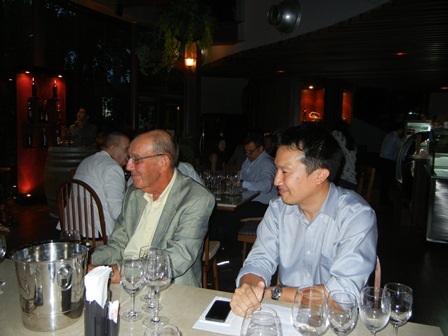
Khun Prayut at our table
At this point suffice it so say that I loved all the wines, but especially the whites. I never thought much of Chenin Blanc before coming to the tropics and tasting tropical wines.
The reds grown in new latitude locations need more time to show their true potential, I think. But a glass of cold Chenin Blanc or a Rose from a winery in Thailand is not easy to beat. I loved the PIROM Chenin Blanc best with his passion-fruit aromas, and the fine acidity. The residual sugar is about 5 grams.

The four reds in the tasting
Of the four reds, each has its strong points. The PIROM Supremacy is out of my price range (2000 Thai bath/bottle), but delicious. The Sawasdee Shiraz is for easy drinking, the PB spicy Shiraz is good with a piece of red meat and the PB Tempranillo I suggest to have with a South American barbecue.

The success team from PB Valley
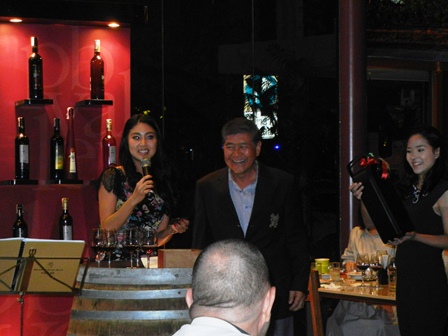
Dr Piya Bhirombhakdi presenting gifts
I was a lucky draw winner of a bottle of PB Valley wine and took it from the hands of the famous Dr. Piya.
After that the buffet was opened, and we all indulged in the delicious food of the Great Hornbill Bistro. The evening continued with discussions about wine, food and everything. To sum it up, this was a great event, well prepared and executed by the very motivated staff of the Bistro and PB Valley.
My verdict: try some Thai wine next time you are in a restaurant in Bangkok. Ask for it, even if they don’t have it, make it known that you want to “taste the land”.
PS: I also learned why there is so little Thai wine on offer in the many wine bars in Bangkok. Importers of foreign wines give concessions to the wine bars, meaning they only have to pay for the wine after they have sold it. Thai wineries cannot afford this level of generosity.
2 Comments | food, food and wine, wine, wine regions, wineries | Tagged: Bangkok, Khun Prayut, New Latitude Wines, PB Valley Khao Yai Winery, screw caps, Thailand, The Great Hornbill Bistro, tropics, wine grapes, wine tasting | Permalink
Posted by themanfrommoselriver

Beautiful colour of the Carignan Old Vines by De Chansac
The other day I bought some wine at wine connection in Bangkok. On special was some wine from France. Frankly speaking I do not buy much French wine these days.
Today, I opened one of the bottles, a ‘2011 Carignan Old Vines’ by De Chansac Winery in l’Herault, a French wine region.
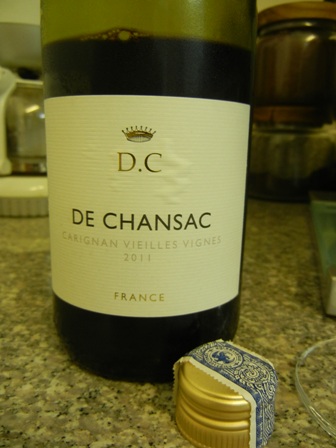
2011 Carignan Old Vines by De Chansac
The wine is made from 40 years old Carignan vines. The grape variety, originating from Aragon in Spain, is usually used in blends (in the wines from Rioja for instance) as a colouring component. It’s average yield is very high (11 t/acre).
Varietal wines are the exception rather than the rule. I assume that 40 year old vines have much lower yields and therefore it is worth making a varietal wine such as this one by De Chansac.
The wine has a dark red, almost purple colour. The alcohol content is 12.5% only. The dominant aroma is blackberry. The wine is full bodied, fruity, round, soft, almost velvety.
And did you see in the picture above? Even the French come around to screw caps these days. I was so surprised.
Of course we had the wine with some food. The pasta (below) was delicious and the wine went very well with the intensive aromas of the all amatriciana. I buy this wine again.

All Amatriciana
4 Comments | wine, wine regions, wineries | Tagged: Carignan, De Chansac, food, France, French wine, l'Herault, old vines, red wine, screw caps, varietal wines, wine, wine connection, wine from france | Permalink
Posted by themanfrommoselriver

2011 Khao Yai Shiraz
On Sunday we had a bottle of the newly released ‘2011 Khao Yai Shiraz’ by PB Valley, Khao Yai, Thailand with our lunch.
This wine is from the newest collection of Khao Yai wines which was presented on November 30th to a group of wine critiques, journalists, trade representatives and marketing experts at the Great Hornbill Bistro in Bangkok.
This wine from the Sawasdee label is for easy drinking. It is fruity and dry with aromas of blackberry and a hint of chocolate, in short a wine easy to understand also for beginners.
I like if it is served slightly chilled. In the tropics “room temperature” is just a no go. Who wants to drink a red wine at 30 degrees Celsius?
I will report about the wine tasting of the newly released PB Valley wines at the Great Hornbill Bistro later this week.
Leave a Comment » | food and wine, vineyards, wine, wine regions, wineries | Tagged: Bangkok, climate, food, Khao Yai, nature, New Latitude Wines, PB Valley Winery, red wine, restaurants, Shiraz, Thai wine, Thai wine industry, Thailand, trade representatives | Permalink
Posted by themanfrommoselriver
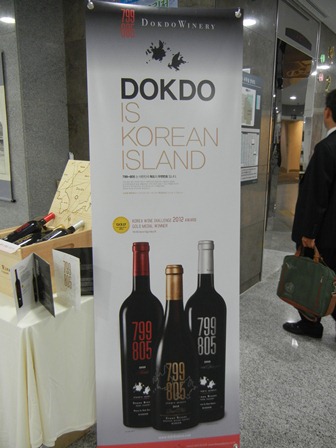
Korean wine
During a recent visit of the Korean parliament in Seoul, I came across the above poster. The advertisement was not about soju, the popular rice wine, but a wine made from grapes.
I was puzzled. Do they grow wine grapes in Korea? When approaching the display, things became a bit clearer.

The award winners
As it turned out, the display was about the islands of Dokdo, which are claimed by Korea and Japan in a territorial dispute arousing nationalist feelings in both places. The display was a kind of political statement.
A winery in the Napa Valley in California was bearing the same name, Dokdo Winery or Dokdo Vineyards. This brand was created by a Korean-American dentist Ahn Jae-hyun living in the Napa Valley, California.
Established in 2007, the winery produces about 20,000 bottles a year. Dokdo wines had also won a gold medal at the 2012 Korea Wine Challenge.

The 2012 Korea Wine Challenge
According to the wineries website, the new product was introduced into the market to draw people away from the controversial debate over which country – Korea or Japan – owns the rocky islands.
“Instead of appreciating the beauty of Dokdo, the world has been too busy fighting over it. The island should not be fought over; it should be shared,” the website said.
Unfortunately, I had no chance to sample the wine.
True is also, that Korea is an emerging market as far as grape wine is concerned. With rising incomes, wine consumption is also rising. In fact every restaurant I visited during my brief stay offered a selection of various wines, often from France but also from other wine producing countries.
8 Comments | culture, wine, wine regions | Tagged: 2012 Korea Wine Challenge, Ahn Jae-hyun, California, Californian wine, Dokdo Island, Dokdo Winery, Korea, Napa Valley, napa valley california, Wine consumption, wine grapes, wine in Korea | Permalink
Posted by themanfrommoselriver
Recently quite a few reports and news sources have talked about the end of the wine oversupply which we experienced in global wine markets during the last couple of years. After years of wine surplus, it seems that poor vintages in the USA, Australia and Europe will lead to a drop in global production by about 20%.
“Technically” Australia is still oversupplied. But the demand for Australian bulk wine is back to normal, say some analysts. New acquisitions of vineyards producing wines at the luxury end is being reported. Sales prices for such estates were rather depressed during the last couple of years. For cash rich buyers sales prices and timing are right to make such new investments.
The mid-term prospects for high-quality grapes and high-quality wines are good. Such news is music to my ears. As a small vineyard with just under 4 ha under vines we have survived so far. Our plan is to bring our Pinot Noir vineyard back into production this season. The rest remains mothballed for another year.

Two Hills Vineyard Chardonnay plot
After that, we intend to bring first the Chardonnay and if demand should recover also the Sauvignon Blanc back into production. Currently we work on land fertility. Some of our Merlot is going to be pulled out. If we replant, it would be with Pinot Noir, I guess. But this is not going to happen until we are sure to find buyers for our fruit.
Let us hope that the wine glut is over, and that a reorientation to high-value grapes and wines is becoming a robust trend.
Leave a Comment » | general, wine | Tagged: Australian wine, Glenburn, Pinot Noir, Two Hills Vineyard, wine | Permalink
Posted by themanfrommoselriver

The shutters of Wang Ping Steak House when still closed
Together with my friend Jim I went to Wang Ping Steak House in 桃園 (Taoyuan) for a kind of farewell meal. The International Center Land Policy Studies and Training (ICLPST) had made a booking but we had to be there at 17.20 h already, because the place was fully booked.
Can you imagine that? Chinese gourmets seem to know what is good, and they eat early. So off we went and presented ourselves at the above time. It was a rainy day, with low hanging clouds, and it was dark when we arrived.
We had to wait a few minutes. Then we were shown to our table on the ground floor. The menu is in Chinese and in English. Straight forward so to say. We ordered in no time.

The appetizer arrangement
The salmon and mushroom arrangement was lovely and wetted our appetite. We were offered a glass of fizz, so to say, fizz with a sweet plum taste. We did not protest.

The fizzy plum drink
Both of us had ordered the mushroom soup. It came in two vessels, a soup bowl with the mushrooms lumped together like a little tower, the broth came separate. I was not quick enough to take a photo of both. The soup was good, fully flavoured, creamy and intense.

The mushroom soup
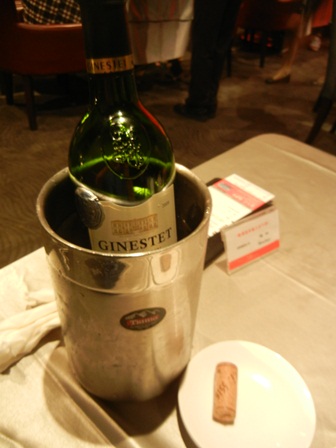
We ordered a bottle of house wine. Red was the colour we had chosen. I do not know much about French wines. When a bottle of ‘2010 Ginestet Bordeaux’ arrived, I was wondering what it would taste like.
As it turned out, Maison Ginestet is a wine trading house specializing in Bordeaux wines.
The wine was full bodied, had beautiful forest fruit aromas, and was dense with a long finish. Just the right wine with red meat, I thought. The typical Bordeaux blend is a good choice when eating beef or lamb.
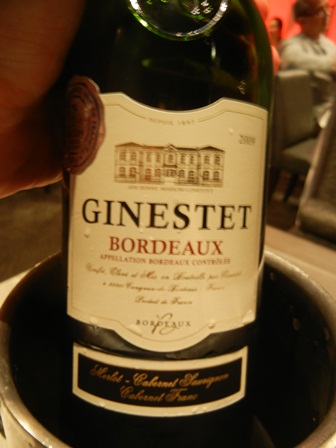
Grand vin de Bordeaux

I liked the dark red colour
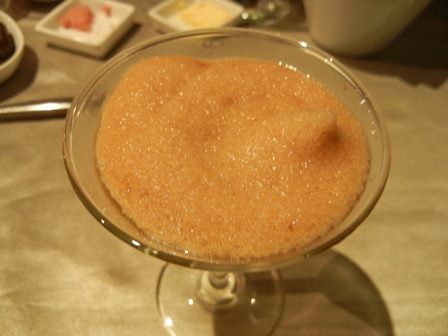
The sorbet
To cleanse the palate, a sorbet was offered. Again it had a plum taste. The fine acidity made sure our palates were ready for the main course.

Dried plums and plum sauce for the lamb

Jim’s main course: lamb
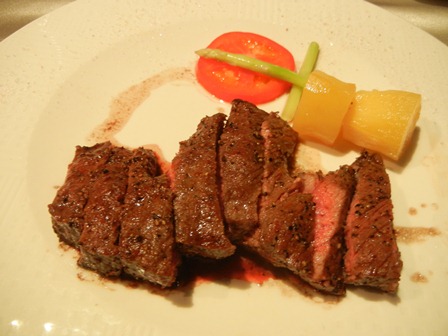
Beef fillet
Jim went for the lamb chops, I ordered the beef fillet. Big dishes but we were ready for it.

Chocolate dessert with ice cream

Crème brûlée in a shell
Also the desserts did not disappoint us. What a lovely way to end our farewell meal.
The service at Wang’s is very efficient. The well trained waiters and waitresses are polite and attentive. We both enjoyed the evening.
I was about to board a plane a few hours later. Jim stayed behind for another two weeks at the Centre. As always we are confident to meet again for another joint teaching engagement at ICLPST.

Chinese flower tea
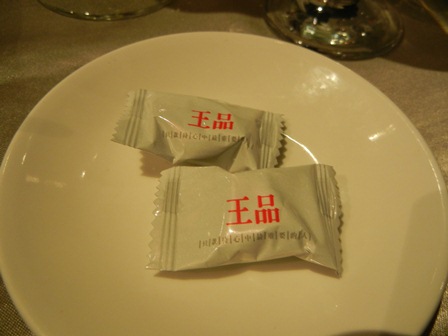
Come and eat at Wang’s
PS: I highly recommend a meal at Wang’s. They have several outlets, I think.
Address:
Wang Ping Steak – Taoyuan Jhongshan Branch
No. 546, ZhongShan Road, Taoyuan
Taiwan –
Tel.:+886 – 03 – 339 1650
1 Comment | culture, food, food and wine, Restaurant Review, wine, wine regions, wineries | Tagged: Bordeaux, bordeaux wines, food, French wine, fruit aromas, Ginestet, grand vin de bordeaux, Maison Ginestet, red wine, restaurants, Taiwan, Taoyuan, vin de bordeaux, Wang Ping Steak House, Wang Steak House, wine, 桃園 | Permalink
Posted by themanfrommoselriver
The other day, while I was waiting for my flight home to Bangkok, I discovered to my great amazement in the business class airline lounge of EVA Air, that a wine from my native Mosel was on offer.
What a pleasant surprise, I thought, when I spotted the label in the wine cooler. It was a ‘2011 Bockstein Kabinett Grand Cru’ by St. Urbans-Hof in Leiwen, Mosel. The wine village of Leiwen is only a couple of kilometers away from my home town Trier.
I have visited the winery and love their crisp-dry Rieslings. For the first time I had the opportunity to taste one of their off-dry wines. The terroir, “Bockstein” in Ockfen, a small village at the Saar river, a tributary to the Mosel, is also a place very dear to me.
From the raised hides in the hunting territory of Schoden (another village at the banks of the Saar river) one could have a glimpse of the “Bockstein”, a rock formation towering over the Saar valley. It’s vineyards are very steep and the Riesling grapes grown are famous for their high quality.
Off-dry whites are not my favourites, but of course this wine showed it’s outstanding quality. It was full and lush, smooth as silk in the mouth, with intensive and mellow Riesling aromas. It had also a long finish, and I loved the balance of sugar and acidity.
Moreover, I found my beloved Mosel (Saar) here, thousands of miles away in a place of Asia where I least expected it.

1 Comment | wine, wine regions, wineries | Tagged: Bockstein, Eva Air, German wine, grand cru, Kabinett, Leiwen, Mosel, Mosel wine, Ockfen, Riesling, Saar, Schoden, St Urbans-Hof, Taipei, Taiwan, Trier | Permalink
Posted by themanfrommoselriver

Selecting the wine
If you want to imagine me happy, imagine me in “Weinsinnig”, my favourite wine bar in Trier, Mosel.
Manuela Schewe and her team are doing a great job. I just love, that the wine bar is also a kind of cellar door for quite a few wineries. Most of them do have a cellar door of their own. However, with Weinsinnig they have a cellar door right in the middle of town.
I love this concept.
Among the wine producers you can find: Winery
Bender
Deutschherrenhof
Heymann-Löwenstein
Jakoby Pur
Lauer
Markus Molitor
Maximin Grünhaus
Nick Köwerich
Pauly
Philipp Kettern
Stephan Steinmetz
Van Volxem
Von Hövel and
von Othegraven
The selection of these, mostly local, wineries guarantees to the wine lover that he or she can choose from a broad range of different wine styles, varieties, terroir and even wine regions.
So far I was not able to try all of them as yet, but believe me I am working on it whenever I visit my lovely Trier. Stay tuned.
Cheers
Address:
WEINSINNIG
Weinbar & Verkauf
Palaststraße 12
54290 Trier
Tel.: +49-651-979 01 56
info@weinsinnig.com
Leave a Comment » | history and culture, wine, wine bars | Tagged: German wine, Manuela Schewe, markus molitor, Maximin Grünhaus, Mosel, Riesling, Trier, Weinbar Weinsinnig, Weinsinnig, wine bar, wine producers | Permalink
Posted by themanfrommoselriver
You are currently browsing the archives for the wine category.
 The Man from Mosel River
 The Man from Mosel River