Riesling from the Upper Goulburn

January 23, 2009

dont-tell-dad1

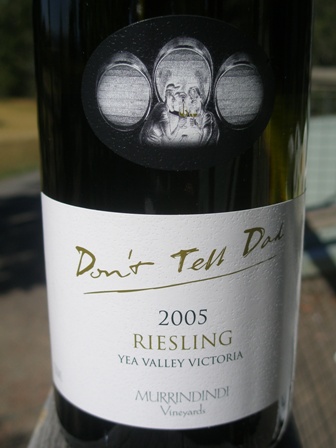
‘2005 Don’t Tell Dad Riesling’, Murrindindi Vineyards, Upper Goulburn Wine Region

Being a Man from the Mosel I love Mosel Riesling wines and find it hard at times to appreciate other styles of Rieslings. Australia produces out standing Riesling wines. Most of them are of the Alsatian style, they are thick bodied and coat the palate. Moreover, petrol is the dominant nose when you sniff it. Although finding petroleum notes is a common occurrence in aged Riesling wines, it is usually not to be found in young wines coming from the Mosel. And this might be why, though appreciative of those Rieslings from Alsace and Australia, I usually prefer a Mosel Riesling. Here I like the young freshness, the balance between acidity and minerality, the zest, and the exuberance.

But in my meandering search for new experiences, I always give Australian Rieslings a go, often reluctant I admit. The best Australian Rieslings come from Eden Valley and Clare Valley in South Australia.

In his 2009 edition of ‘The Australian Wine’, Jeremy Oliver, a famous Australian wine writer, ranks a Riesling from Victoria, the ‘2007 Seppelt Drumborg’ from Henty (98 points) as the best for the year. Henty, a little known wine region outside Australia, is located in South Western Victoria near the border to South Australia, between Hamilton and Portland. Henty has about 25 vineyards including 12 wineries. The nine Rieslings which follow in the rankings of Jeremy Oliver all come from Eden (4) and Clare (5).

The more I was pleased when James Halliday recently ranked a Riesling from our own wine region, the Upper Goulburn Wine Region, quite highly and gave 87 points to the ‘2006 Barwite Upper Goulburn Riesling’.

While browsing the shelves of the supermarket in Yea , I bought the above bottle of the ‘2005 Don’t Tell Dad Riesling’ from Murrindindi Vineyards, also a member of our wine growers association. Wines from Murrindindi Vineyards have won accolades of praise by wine critics and judges. To cite James Halliday again, he awarded the ‘2006 Murrindindi Don’t Tell Dad Shiraz’ 89 points, the ‘2006 Murrindindi Chardonnay’ 88 and the ‘2005 Murrindindi Family Reserve Cabernet’ 88. The 2005 Riesling even got 89 points.

I brought the above bottle to a dinner with my friends Hillary (from the end of our street), Beth and Richard and was amazed. The petroleum note was not as dominant as with some Rieslings, the wine has elegance and length which I liked. The ‘2005 Don’t Tell Dad Riesling’ retails for about 15 A$ and is a bargain. Check it out. I will drink it again when back in Glenburn.

PS: The Top 10 Australian Riesling wines according to Jeremy Oliver 2009:

1. 2007 Seppelt Drumborg, Henty, 98
2. 2007 Mountadam, Eden Valley, 96
3. 2003 Peter Lehman Reserve, Eden Valley, 96
4. 2005 Leasingham Classic Clare, Clare Valley, 96
5. 2002 Pewsey Vale Vineyard, Eden Valley, 96
6. 2007 Grosset Polish Hill, Clare Valley, 96
7. Kilikanoon Mort’s Reserve, Clare Valley, 95
8. 2005 Taylors St. Andrews, Clare Valley, 95
9. 2007 Grosset Springvale, Clare Valley, 95
10. 2008 Leo Buring Leonay DW L17, High Eden, 95


Industry outlook: The Australian wine sector in 2009

January 18, 2009

grapes

Too many of those

It does not look good for us grape and wine producers here “down under” at the beginning of 2009. Analysts and wine industry experts, among others, are predicting another surplus for the 2009 vintage. The global financial crisis (and not the drought) is the “hammer” going to hit many artisan as well as industrial wine producers. Otherwise the bigger producers would not worry so much in public. Everybody expects the demand for fine wine to be sluggish at best in 2009 and the years to come.

Australia has about 170,000 ha under vines. The total volume of the coming vintage is expected to be around 1.85 million tonnes, about 400 to 500 thousand too much, according to some analysts. Experts at the Australian Wine and Brandy Corporation believe that the sector has to shrink by 10, maybe 20 % in order to survive.

Grape growers will be hit particularly hard. Prices for fruit might be as low as 150 to 200 A$ per tonne. This is less than half of cost. The 600 A$/t we received for grapes last year are looking big by these new standards. For many grape growers the making of their own wines and the development of brands and markets are out of reach, and would anyway only be a temporary relief.

The “big producers”, accounting for about 73% of total production in Australia, are most likely to survive. In fact, they have recently made public statements calling for small producers to get out of production and out the way, thereby making room for the survival of the biggest (not the fittest). For instance wineries below an investment of 5 million A$ should close.

Findings from an accounting firm suggest that “most wineries with a sales volume below 10 million A$ (which is about 90% of all producers) are loosing money”. Implying that small producers are not competitive but inefficient and wasteful. Other suggestions call for the forced merger of wineries with less than 5 million A$ turnover per year. Average vineyard size, currently about 20 ha in Australia, should be more like 80 ha.

Well, small, boutique and artisan vineyards and wine producers have been around for a long long time at least in Europe and North America. Australia has a rather strong concentration in the sector where 4 to 5 big players are in fact calling the shots. Nowhere else in the world do such large wine companies exist.

However, why should we boutique vintners and small wineries loose out this time? Of course not everybody is going to stay in the business, but imagine who should keep the dream up? We not only sell wine, but visions and dreams about the land and the people, about how these people grow grapes and turn them into fine wine.

Just think of a wine factory and industrial production! How can it appeal to people looking for something else than the industrial age has to offer. Technically correct wine is one thing, a vintner on his vineyard is another.

We, the “small” vintners, add value to the lives of all the wine drinkers, the people driving through blooming landscapes planted with small vineyards and vines. The dreams are about freedom and independence, about love and nature, in short, the good life.

Fortunately, the development of modern technology is on our side too. Just read Chris Anderson’s book “The Long Tail” and how the many “fame less” products bought over the internet make more money than the few famous brands. Of course selling wine bottles over the internet is not the same as selling music etc. files but the major advantages of the “Long Tail Economy” (democratisation of production, distribution and marketing, the reduction of storage cost and the cost of information) can still be grasped.

thv-in-the-evening

Two Hills vineyard in the evening light

We at Two Hills Vineyard are still optimistic. We have a long-term strategy and are not fuzzed by quarterly profit and loss accounts and share market valuations. We have no debt and Margit and I are in good health. Millions of new wine consumers in India, China, Russia and elsewhere will eventually make their demands known. We only need a tichy tiny share of this to let us fly high.
Cheers, “auf Ihre Gesundheit” as we say in German (to your health)


Connoisseurs delight: a wine tasting in Berlin of a special kind

January 15, 2009

schlau0

While in Berlin an old friend of mine, Gerhard Schlaudraff, had invited me spontaneously to join and celebrate his birthday in his new home near Warschauer Platz. Since Gerhard is not only a wine lover but a real wine expert, the feast promised to be something special. And indeed, it turned out to be a wine tasting of a special kind.

schlau1

I was about an hour late and many wines had been already swallowed up by gay drinkers. I came just in time for the two reds, the ‘1995 Corton Grand Cru Domaine Bonneau du Martray and the ‘1996 Grand Vin Château Beychevelle Saint-Julien’.

We all agreed that the two wines should have been drunk some time ago, they had, unfortunately, already passed their prime. That’s why we moved on swiftly without loosing too much time.

schlau21

The ‘2003 Kuenstler Reichestal Spaetburgunder’ from the Rheingau was a ripper of a wine. It can hold itself against the best Pinot Noirs from Burgundy. The wine was well balanced despite the “horror” announcement of 15% alcohol on the label. So forget about France and Burgundy and explore this wonderful drop from the Rheingau. More and more Germany is showing itself as a Pinot Noir producer of high distinction. My tip: get a bottle of this wine now and enjoy it, preferably over a good meal, with family and friends.

schlau3

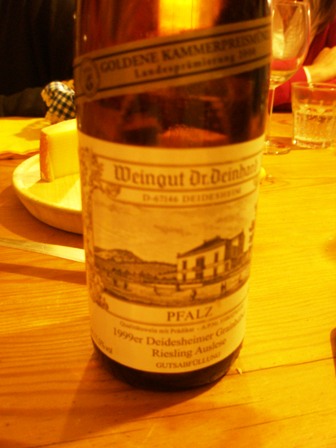
After that we moved on to sweet wines for dessert. We started with a ‘1999 Deidesheimer Grainhübel Riesling Auslese’ from Weingut Dr. Deinhard, Pfalz. This wine was “heaven on a stick”, a dessert Riesling which you want to try. Our eyes rolled in their sockets with delight and our taste buds were exposed to an opulence and richness from which mere human palates are often excluded.

schlau4

The last wine came from my adopted home, Victoria, Australia. It was a Muscat from Rutherglen, a wine region about three hours north from our own place in Glenburn.

The ‘Chambers Rosewood Vineyards Grand Muscat’ was the highlight of the evening. Chambers produces outstanding Muscat wines of superior quality. The average age of its Grand cuveés is about 70 years.

The Chicago Wine Company gives the wine 98 out of a 100 and has given up to describe the wine, because tasting notes would read the same year after year.

For me this wine was the perfect ending to an utterly enjoyable wine and birthday celebration. From here on only spirits with a much higher alcohol content could be taken. I left the diners to it when I made my way home on the subway.


Bubbly, bubbly, bubbly…

January 9, 2009

“Bubbly” that’s what the Australians call all sparkling wines including sparkling from Champagne. The first day of the year is of course full of sparkling, wine included.

I started the New Year with feeding the parrots, to be precise, the King Parrots. They come to Helen’s and Michael’s terrace. The picture encapsulates my encounter with a very gentle king parrot, a very good omen for 2009, I hope.

ny2009

After a long, or better, short night (behind me Mt. St. Leonard to the left)

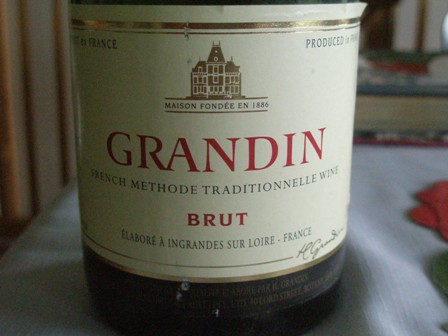
We had some sparkling, starting with sparkling Shiraz, but went on to French sparkling and quickly changed to Australian fizz.

Below the various bottles which were consumed by us.

champus1

champus2

champus7

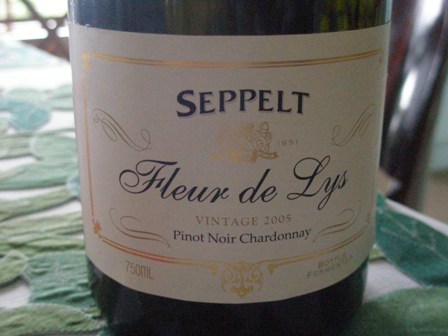
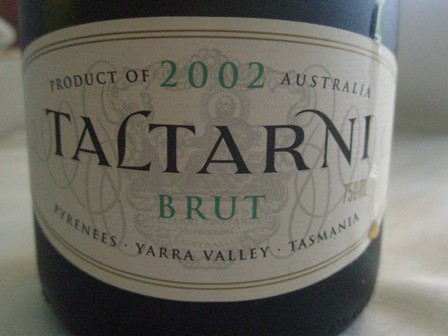
I loved the ‘2005 Seppelt Fleur de Lys’, but also the Taltarni was very delectable. Though the grapes came from three different regions (Pyrenees, Yarra Valley and Tasmania), the blend was just superb. I suggest you try them out.

Cheers 2009, keep on drinking, life is too short to drink bad wine (especially if you are above 50).


Upper Goulburn Wines Shine

January 3, 2009

In the summer edition of the ‘Upper Goulburn Food and Wine Cultural News’ newsletter also the wines from this rather new wine region (our wine region!) are mentioned.

One of the “popes” of the wine industry, James Halliday, has included wines from the Upper Goulburn Wine Region in his 2009 edition of the Wine Companion.

The following summary rates some of the regions wines:

2006 Barwite Upper Goulburn Riesling (87)

2006 Buller View Cabernet/Shiraz/Merlot (88 )

2006 Cheviot Bridge Yea Valley Shiraz (94)

2006 Delatite Polly Sparkling Gewuerztraminer (88 )

2006 Growlers Gully Shiraz (90)

2005 Jean Paul’s Vineyard Shiraz (94)
2005 Jean Paul’s Bold Colonial Red Cab/Sav (88 )

2005 Kinloch Wines Mary Friend (90)
2007 Kinloch Sauvignon Blanc (87)

2005 Lost Valley Thousand Hills Shiraz (89)
2007 Lost Valley Cortese (88 )

2004 Mount Cathedral Reserve Merlot (94)
2005 Mount Cathedral Reserve Merlot (90)
2005 Mount Cathedral Chardonnay (89)

2006 Mount Samaria Tempranillo (88 )

2006 Murrindindi Don’t tell your Dad Shiraz (89)
2006 Murrindindi Chardonnay (88 )
2005 Murrindindi Family Reserve Cabernet (88 )

2005 Myrtlevale Vineyard Cab/Sav (88 )

2006 Rubicon Lorna’s Vintage Chardonnay (88 )

2006 Sedona Estate Yea Valley Shiraz (90)

2005 Snobs Creek VSP Shiraz (89)
2006 Snobs Creek Dolcetto Syrah (88 )
2005 Snobs Creek Wooded Chardonnay (87)

2005 Tallarook Chardonnay (92)
2005 Tallarook Marsanne (90)
2006 Tallarook Rousanne (90)

The rating demonstrates once again that the wines from the Upper Goulburn Wine Region are of superior quality. Amzing is also the wide range of varieties and wine styles. It’s a pity that our wines were not included in the tasting. But we have been slack with wine marketing in Australia during the last 12 months.

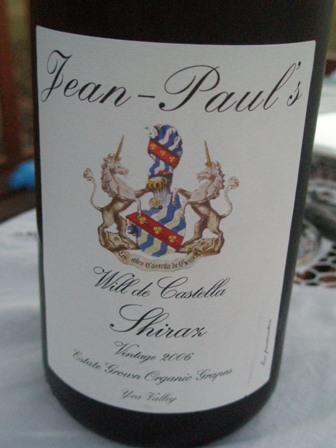
While celebrating Christmas we tried for the first time a wine from Will de Castella, a ‘2006 Jean Paul’s Vineyard Shiraz’ (the following vintage of the above ’94 point wine’). What a fabulous wine this was. Intensive aromas of plum and blackberry filled our mouths. Our only regret was that we had only one bottle. I bought the wine in the Yea Supermarket (about 20 A$).

jean-pauls1

jean-pauls2

PS: By the way, our wine growers association has upgraded its website. Please check it out, its much better than before: www.uppergoulburnwine.org.au


Welcome 2009

January 1, 2009

clouds2009

Clouds over the hills around Healesville with mount St. Leonard (1028 m) to the left

As customary, we spent Christmas and New Years Eve with Michael, my brother in law, and his lovely wife Helen in their cosy family home in Healesville, Victoria. Boy did we have a great time. The time went by just too fast for the six of us.

The year 2008 is gone and with it the anxiety, the joy, the disappointments, the chagrin and the happiness. We deplore the losses, and welcome the changes.

The past year brought great changes to our family. We moved from Jakarta/Indonesia to Bangkok/Thailand, experienced a new job, a new school, a new environment, a new culture to get acquainted with and it will take us some more time to adjust, to understand, to appreciate, and to feel at home.

For 2009 our expectations are high. Our ambitions at Two Hills Vineyard are to continue to produce first grade fruit for excellent wines. Despite the loss of about 50% of our Pinot Noir grapes due to a severe frost at the end of October, we are very optimistic about the coming vintage. The Sauvignon Blanc fruit look very good, and our Merlot is in a good condition. The Chadonnay vines, now one year old, prosper and we have very few losses.

alan-johns1

Tasting the 2008 Two Hills Merlot with Alan Johns, owner and winemaker of Yering Farm Wines

Our 2008 Merlot also showed promising first results. At Yering Farm, we tasted the young wine from various barrels. The wine was fruity, had good structure for a medium bodied wine, and the tannins were just right. We hope it will mature nicely so that we can present our customers with another excellent vintage of our flagship red wine from Two Hills Vineyard.

th2008new

Two Hills Vineyard, Sauvignon Blanc (left) and Chardonnay (right)

Temperatures are low for this time of the year but we had some rains which helped to make everything looking very green. A little digging, however, shows that the soil is still very dry and that we urgently need more rains. The general drought has bot been broken as yet.

A new year means new opportunities. Also in 2009 grapes will be grown, wines will be made, and we will get ample material to apply our taste buds to. Sampling fine wines and enjoy them with good food, either within the family or with our friends, will be our prime pastime in the 12 months to come. Hope you can join us. Cheers and a happy New Year to you all.

PS: I write this new blog entry from our vineyard. Yes, we installed a broadband internet connection on the last day of 2008. From now on, I do not have to hurry to a wireless spot (35 km from here) or any other place with an internet connection. Blogging will take a new dimension. Hurray!


Trivento – Wine from Argentina

February 9, 2008

You might remember that the other day in Kuala Lumpur I could not taste the wine on the menu, a ‘2005 Trivento Golden Reserve Malbec’ of the Maredo Restaurant because it was sold out.

Guess what? I found the brand in Vin +, a small wine shop in Kemang, Jakarta. I bought one bottle only to try it out.

trivento-malbec.jpg

The Trivento 2005 Golden Reserve Malbec

You might wonder about the results?

Today I went again and bought a whole case of it. It is a most delicious wine and retails for about 235,000 Indonesian Rupiah which is equivalent to about 17 € or 28 A$.

It is a deep, red, ruby wine with a wonderful nose displaying aromas of mint, cherries and chocolate. The wine was matured in new French oak for a year and was aged for another year in the bottle before its release. Its a pity that Malbec has this short, dry finish but the aromas compensate you for that. However, for non-Malbec lovers there are Syrah and Cabernet Sauvignon wines on offer as well.

Moreover, I also bought from the Trivento product range a ‘2006 Reserve Chardonnay’, a ‘2006 Tribu Torrontes’ and a ‘2005 Reserve Malbec’. More about these wines later.

Trivento Bodegas Y Vinedos (www.banfivintners.com) was founded in 1996 and is located in Mendoza, Argentina. Most of its vineyards are to be found on high altitude in the best zones of Mendoza (up to 1100 meters above sea level). Trivento Vineyards possess a modern winery with a capaity of about 27 million litres of wine. It has all the modern equipment used nowadays to make wine. The winery is surrounded by about 10 ha of vineyards.

Tomas Larrain holding a degree in agricultural economics from the Catholic University of Chile is the general manager and Federico Galdeano, a native of Mendoza with extensive experience in the Napa Valley/California and Tuscany/Italy, is the wine maker.

By the way I now found out that the rumour – that the Argentineans drink their best wines themselves and export only the rest – is false. They do export some of their good wines!


Wine Mythology II

June 8, 2007

You might remember my entry about the Celtic god of wine and the vintners in the Mosel river valley, Sucellus (the good striker: the prefix “Su” meaning “good”, and the Celtic word “cellus/cellos” meaning “striker”). In Jakarta we have very talented stone masons. They usually work with soft white stones. Well, I showed them my picture of Sucellus (from Kinsheim) and they produced a replica. Unfortunately, I did not explain to them who Sucellus was. I did not explain to them how powerful he was and how he was loved by the Celts and how he was worshipped in the Southern and the Eastern parts of Gaul. – Traces of him are found from Geneva to Lausanne, from the Mosel river to places in Alsace and even in York in England. He was also part of Lusitanian mythology which was heavily influenced by it’s Celtic and Roman invaders.

My beardless Sucellus

So instead of a middle-aged man with a curly beard, I got back a handsome young Sucellus without these insignia of the Celtic forest god. Fortunately, the long-handled hammer (or mallet) was depicted rightly. He also holds grapes as in the original. The only un-bearded Sucellus in this world is now in my possession and I will put him up in my small winery on Two Hills vineyard to remind me of my Celtic heritage and all the many people before me who enjoyed growing grapes and making wines.

I try to imagine 10.000 years from now when to some archaeologists’ surprise, a statue of the Celtic god is found far from Europe in the rolling hills of Two Hills vineyard near Glenburn, Victoria. Then finally also Australia will be on the map of the Celtic god searchers of the universe.


Mama’s kitchen: tender bighorn fillet with mushrooms

May 11, 2007

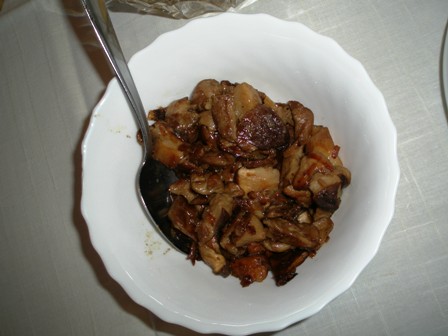
Because I am from a hunter’s family, we have from time to time dished with meat from wild animals at home. During my recent visit to Trier, my mother prepared a tender fillet of a young bighorn sheep (Mufflon in German). The young Mufflon was shot in Schoden at the Saar river by my friend Heinz. She served it with freshly collected wild mushrooms (Steinpilze also from Schoden), a cabbage salad and spaetzle (literally translated: little sparrow), a kind of tiny noodles or dumplings made with flour, eggs, water or milk, salt and sometimes nutmeg mainly used in the South German (my mother comes from Franconia), Austrian, Alsace and Swiss cuisine. I took some photos of the delicacies so that one gets a better idea. It was such a wonderful meal.

p5020662web.jpg

The bighorn fillet

p5020661web.jpg

The mushrooms

p5020664web.jpg

The old folks

When I raided my mother’s wine cellar, I found a bottle with the picture of Karl Marx, one of the most famous sons of my home town Trier. Agreed, the application (or the interpretation hereof) of his ideas has brought much misery to the world. However, now mankind knows for sure that planning economies do not work, but that market based economic co-ordination systems are much better for us all.

p5020656web.jpg

This bottle was given to me for my 50th birthday a couple of years ago. It contained a 2002 Eitelsbacher Marienholz Pinot Noir (Spaetburgunder) from the von Beulwitz Estate (www.von-Beulwitz.de), now owned by the Weis family in Mertesdorf, one of the villages at the Ruwer river, a small tributary to the Mosel (and part of the Mosel-Saar-Ruwer denomination). The Ruwer terroir has about 300 ha under vines in various locations (Ruwer/Eitelsbach, Mertesdorf, Kasel, among others). Some of the best German Riesling is grow here since Roma time. In fact the earliest findings of vine cultivation date back to the 2nd century. A stone relief called “The vintner in his wokshop” is the one of the oldest historical relicts (the other one is the wine ship of Neumagen).

p5010602web.jpg

Ruwer vineyards

The von Beulwitz estate goes back about 140 years and produces mainly Riesling wines, many of which have won international awards and trophies. The most recent one is the “Trophée d’excellence” “Riesling du monde”/Strassbourg for it’s 2003er Kasler Nies’chen, Riesling Auslese, “Alte Reben” (old vines). The 2005 Riesling Spaetlese from this location gained 97 points.

The estate grows vines on about 5 ha, mainly in steep locations in Kasel and Eitelsbach. Yields are kept low in order to produce wines of great elegance and finesse. Unfortunately, the Pinot Noir of 2002 did not fall into this superb category, it was a rather ordinary wine. But despite this, we enjoyed the meal and the wine and had a good time at home. I promised myself to try some of the award wines next time.