Climate change and grape varieties

November 2, 2009

RieslingSchoden

Riesling grapes in Schoden, Saar, shortly before vintage 2009

Uff, I am reading in todays “Your Daily Wine News” newsletter that some of Australia’s top wine experts think that over the next 20 years climate change will be responsible for the decline of Shiraz and Chardonnay and the rise of varieties such as Vermentino, Arneis, Nebbiolo, Pinot Grigio and Viognier (some call them “alternative varieties”).

This is bad news for me and my own small vineyard. At Two Hills Vineyard we have concentrated on some of the traditional French varieties: Sauvignon Blanc, Pinot Noir, Merlot and Chardonnay (first vintage in 2011 or 2012). Our fruit ripens usually well (if we do not suffer severe frosts) and shows a superior quality. But will that persist under the conditions of climate change?

I still remember vividly how I pulled out the 2 1/2 acres of Cabernet. it was hard work, wrapping a chain around every single vine and lifting the hydraulic of the tractor. I should have left them in, I guess. If temperatures rise in Glenburn, the drought persits, and/or we’ll have less percipitation in the future, Cabernet could have been the ideal variety for our spot. I ripped the vines out because the grapes would not fully ripen. At the moment we have sufficient water, our two dams are overflowing after years of drought but that might change quickly again.

Another issue is age, my age. At 55 I might still have a chance to enjoy some of the coming Chardonnay vintages but replanting would “cost” me many years of waiting. I could contemplate to plant on our second hill where we still have another 5-6 acres of space. Well, let us see what is going to come.

At least there is no politician who tells me what to do and chances are small that an elector such as Clemens Wenzeslaus of Saxonia, who changed the Mosel by instructing vintners to ripp out their red varieties and replant with Riesling, would appear on the Australian scene. However, danger is looming from the anti-alcohol lobby in Canberra which is working day and night to convince law-makers that the purchase of alcoholic beaverages needs to be made more costly for the consumer and profitable for the taxmen.


A pesto pasta with Alsatian Riesling

October 25, 2009

My homecoming was celebrated with a dinner featuring one of my favorite pasta dishes: a pasta al pesto. But it did not stop there. The basilico for the pesto sauce was grown on our terrace. Freshly harvested the leaves were processed with pine nuts and the best olive oil we could get hold of in Bangkok. The pictures below shows the different stages of the pesto-making process.

Basilico1

Basilico leaves

Basilico2

Healthy leaves of home grown Basilico

Basilico3

Pesto in the making

Basilico4

The fresh pesto sauce

I tell you this pasta was worth killing for. What ‘profumo’, goodness me, it filled our kitchen, the living room and transcended to the terrace where it filled my nostrils long before the dish arrived. We treasured every bite.

If you think that in the 1760s French cultural supremacy was so dominant that Italian cooking was considered totally inferior even by Italians. Local cooking had to have the coda, “”perfected in Paris” to be taken seriously. Today, every second top restaurant in Bangkok and indeed in all cosmopolitan world cities is Italian. That’s just amazing!

Basilico5

Linguine with pesto

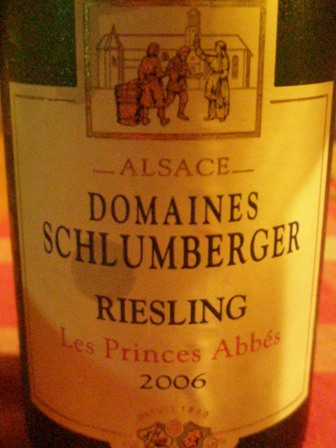
We celebrated the reunion with a French Riesling from Alsace, a ‘2006 Les Princes Abbes, Domaines Schlumberger, Riesling’. The price was a bit on the high end for us. TBH 1,600, about 32 Euro (or US $ 48), from our local super market is quite some money. That it sells for about US $ 20 in California somehow consoled me. We thought that life is just too short to waste it with drinking cheap wine and the occasion warranted something special, and special this Alsatian Riesling was.

Schlumberger1

This wine is just a wonderful specimen of Alsatian Riesling and it went very well with the pesto pasta. The fresh and fruity wine with aromas of citrus, lime and lemon and some floral notes, opened our taste buds wide. The wine has character and shows its typical Alsatian traits with some refined and not overpowering petrol notes. Alcohol is 12%, and just right. The finish is pleasantly vibrant but not overly long.

Schlumberger2


Rioja in Taiwan

October 22, 2009

Beronia

After teaching a full day I am usually exhausted and somehow empty. the best way to spend the evening is with a glass of wine. Jim and I, we marched into the wine shop just across the ICLPST in Taoyuan and shopped for some wine.

I choose a ‘2006 Tempranillo Beronia Rioja’ from Spain. What a nice wine this was; an “umpf” wine, as we call it in Australia. Dark red in colour, full of wild fruit, plum, and berry flavours, this wine is of a more traditional character, heavy and intense, but with balanced acidity and spicy notes from the oak it is matured in, and good mid-palate weight.

Beronia1

We had no wine glasses but drank it from large, thick tea glasses. That’s the reason why I have no picture to show the beautiful colour of the wine. The ‘2006 Tempranillo Beronia Rioja’ sells for about US $ 13 in the USA, we got it for the equivalent of about US $ 21 in Taoyuan, not bad for such a wine.


2008 Loch Riesling

October 10, 2009

Loch0

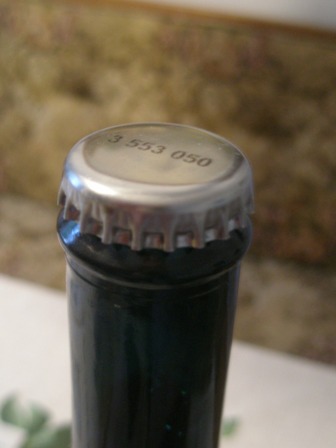
When I opened the first bottle produced by Weinhof Herrenberg, a ‘2008 Loch Riesling’, a was quite surprised when I found a it to be closed with a metal cap.

Loch00

This was the first time in my life that I was confronted with such a kind of enclosure. In the process of getting to the wine unwrapping some of the plastic, I first thought it would be a glass stopper. But then I discovered the metal cap. Whow, all my traditional gear, my corkscrews, were useless and could be pushed aside and I searched for a beer bottle opener.

Loch000

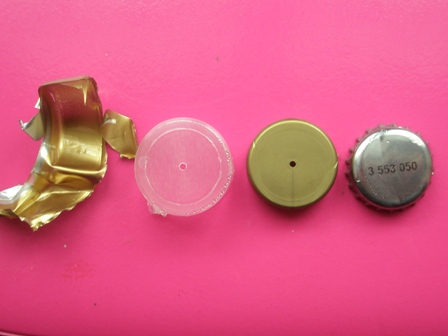
The above picture shows all the elements of the metal cap including the plastic covering it.

The Loch Riesling is a clean wine typical for the Saar. Aromas of tropical fruit, fully ripened, were displayed. The wine was fresh, a little spicy, with good structure and a medium finish. I had it without food, just like that, on a beautiful autumn afternoon. The golden colour of the wine reflecting the golden autumn sun. I recommend you try it.

Address:
Claudia and Manfred Loch
Weinhof Herrenberg
D-54441 Schoden/Saar
Tel.: +49-6581-1258
Fax: +49-6581-995438
info@lochriesling.de
www.lochriesling.de


Vintage time: Schodener Herrenberg

October 6, 2009

Schoden1

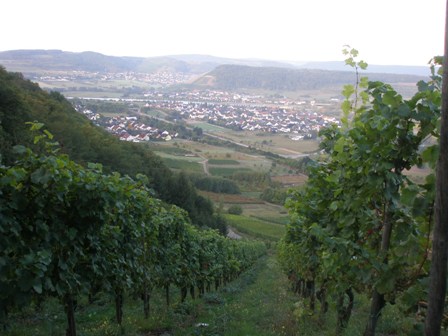
Schodener Herrenberg, in the background the village of Schioden with the Saar

One of my favourite places along the Saar river is Schoden, a small hamlet about 30 minutes southwest of Trier, my hometown. I visit regularly, because my friend Heinz together with some friends has rented the local hunting territory and when I visit Trier, we often go together on the hunt.

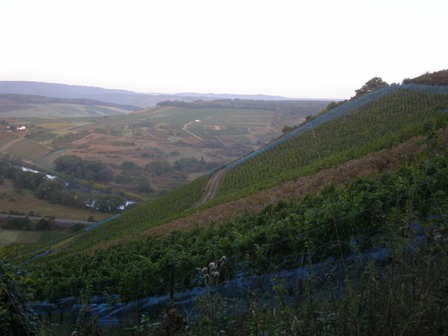
Schoden has also some vineyards and wineries. The location (terroir) “Herrenberg” is one of them. The vineyards are quite steep, which is difficult to depict in a photograph as you can see from the comparison of the two pictures above and below. It is realy a steep site, and the best location for producing Saar Riesling wines of superior quality.

Schoden2

Schodener Herrenberg: vineyards from the South

Schoden3

Schodener Herrenberg: the vineyards from below

Schoden4

A promising vintage?

Schoden5

Beautiful Riesling fruit

The fruit on the vines looked very healthy. In a couple of days or weeks, depending on the weather, the pickers will come to harvest. Needless to say that no machinery can be used, all the work will be done by hand. The vineyards workers will have to navigate the steep hills and balance on the slate pebbels which can be tricky when they are wet.

Needless to say that Schodener Herrenberg produces outstanding Riesling wines. Learn more about these Saar wines on my blog soon. Cheers


The sky is the limit

September 30, 2009

Sky1

It was at a Sunday afternoon, I had one hour for myself before our official meeting was about to start and I decided to have a glass of wine in Vapiano in Mittelstrasse which is near Friedrichstrasse in the centre of Berlin.

Vapiano is a worldwide operating chain restaurant in an Italian style, but at times I like to go there. The standardization means that you know in advance what you are getting.

Sky2

I went through the wine list and choose the Gavi (6 Euro/glass) which was nice but I should have odered the most expensive wine on the list, the Riesling (8.5 Euro).

GAVI »ORO« GAVI DOCG
La Scolca, Piemont, Italy.
fine, elegant, harmonious and fresh.

GEHEIMRAT »J« RIESLING, SPÄTLESE, TROCKEN
Weingüter Wegeler, Rheingau, Germany.
According to ‘Fine Wine Review’, of the USA, this Riesling is the best Spaetlese in Germany and award winner of the German Riesling competition.

I sat in the “garden” (or better: the yard) of Vapiano and enjoyed my glass of wine in the hope that I was not to be disappointed when later that day the election results would come in. What a splendid hours that was.


Autumn in Berlin – Affentaler Spaetburgunder

September 27, 2009

Abendstimmung

Evening at Griebnitzsee, near Berlin and Potsdam

I am in Germany right now attending meetings and conferences. Ever since I landed in Hamburg, the weather has been fine, with mild and sunny autumn days.

Today is election day and at about 18 h we will know who is going to govern the Germans for the next four years. Last night we were all invited by our boss to dine at his home. He and his wife are known for their hospitality. One of the wines on offer came from Baden, a famous German wine region. I must admit that I am rather ignorant about it’s wines.

Affentaler

2008 Affentaler Spaetburgunder 1.5 liter bottle – look at the colour

I was presented with a glass of ‘2008 Affentaler Spaetburgunder’ (12.5% vol. alc.). Needless to say, that I had never heard of “Affentaler”. And only while writing this blog entry I learned that the producer of this excellent German Pinot Noir is a wine co-operative. “Affental” is located 10 km south of Baden-Baden and belong to the city of Buehl.

This is a very elegant wine, fruity, dry and very harmonious, a thorough enjoyment. The 2007 vintage had earned 87 Parker points. The 1.5 liter bottle lasted a while but it was difficult to drink any other wine after we finished it. All of us wished for more. I will look out for it when shopping for wine next time.


Italian wines for Sunday lunch

September 23, 2009

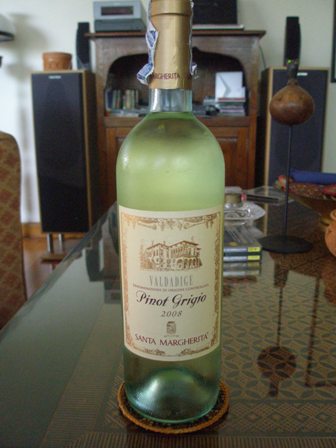
Sundays in Bangkok is usually fish day. There are many beautiful fish for sale in the markets. So for lunch we select a fish and a white wine. Often I choose to have a Riesling with the food. This time we went “Italian” and bought two bottles of white wine, one on the cheap side, the other a bit dearer. The former was a ‘2007 Montecelli Soave Classico’ from Piave in the Veneto, the latter a ‘2008 Santa Margherita Pinot Grigio’ from the Trentino, in Alto-Adige, Italy.

Pinot2

2007 Montecelli Soave Classico

Pinot3

2008 Santa Margherita Pinot Grigio

Pinot4

The Soave might costs about 3-4 Euro in Europe (or less). If I would buy the Pinot Grigio in the US I would have to pay 25 to 28 US$ for the bottle. In Thai Bath I paid about 500 for the Soave and about 1,000 for the Pinot, which corresponds roughly to 10 and 20 Euro respectively. We liked both wines. The Soave is a bit edgy and had a salty/oily after taste. The Pinot Grigio from Santa Margherita is just great, light bodied, spritzy with crisp acidity and a light lemon-citrus flavour.

Pinot6

Fried potatoes, zucchini and onions

Pinot7

Red snapper in caper and olive marinade

The food was simple. Red snapper is a beautiful fish which I like very much. The recipe is from the Philosopher’s Kitchen by Francine Segan. I have written about this fabulous cooking book in earlier entries of my blog.

I just love lunches like this one. We all relax, enjoy the food and the company. This was the first time we moved away from the dry Riesling-fish pairing and moved tp the Italian whites. We will repeat this, for sure.
And as Epicurus said: “Pleasure is the beginning and end of living happily”.


A Sunday at Bloody Hill

September 21, 2009

TimoM0

Great Yarra Valley views from the Mayer Vineyard (left to the dam)

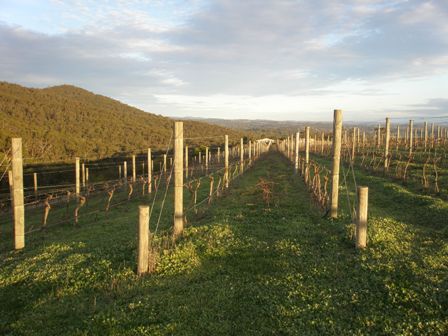
On a beautiful Sunday in early August, we were in for a surprise visit to the Mayer’s. We bought some “nibblies” (Australian for cold meats, sausages, cheeses, condiments, etc.) and some wine in Healesville and drove up the steep drive to Bloody Hill on top of which their beautiful house (rammed earth) is situated. Alas, they were in and happy to welcome their unannounced intruders.
TimoM00

The vineyard at the crest of the hill is very neat

TimoM1

Some of the wines on “offer” (f.l.t.r.: a Silvaner from Franconia, Dr. Buerklin-Wolf, a Riesling from the Pfalz and a Dr. Mayer Pinot Noir from the Yarra Valley)

We came at the right time. A shipment of Riesling wine (about 60 cases) which Timo had made on a visit to Germany last year had just arrived and was ready for tasting. Moreover, as a member of the South Pack, Timo was in the preparation of a wine tasting tour to three Australian cities (Melbourne, Sydney and Brisbane). The South Pack is a group of eight innovative young Australian wine-makers who have raised the bar for the selling of premium and super-premium wines in sluggish markets.

TimoM3

The German Brotzeit

A quick “Brotzeit” was thrown up and the wine tasting could start. We did not drink in any kind of order but rather according to gusto and enthusiasm. First cap of the rank was the German Riesling Timo had made, Dr. Mayer Riesling of which I have no picture which speaks for itself. This was not a time for tasting notes but for joy and nourishment of body and soul, for Australian and Swabian story telling and song.

TimoM2

Bloody Hill Pinot Noir

Timo is a native of a small hamlet, called “Grossheppach” (about 4,500 inhabitants), today part of the small town called Weinstadt (translated: wine city) in the Rems valley (the Rems is a small river), Wuerttemberg, about 15 km east of Stuttgart. As everything in Germany, Grossheppach has a long history.

Grossheppach

Coat of arms of Grossheppach showing the river Rems and four grapes on a vine

Furthermore, the village has a long tradition of vine cultivation and wine making. Timo comes from a family of small vintners (and farmers).

In 1279 a historical deed is the earliest written testament of the flourishing wine production in Grossheppach. Magister Rudolf, a local doctor, had bequeathed his house in Esslingen and three vineyards in Grossheppach to the Abbey of Bebenhausen which was witnessed by knight ‘Fridericus miles de Heggebach’.

Timo showed as a historical chronicle of Grossheppach with black and white photos which also depicted his family in the 18th and 19th century. Here we are, thousands of kilometres away from the old land and talking grape production, wine traditions and wine styles. To cut a long story short, Timo had made his first ever Riesling wine in Grossheppach and shipped it for sale to Australia.

It was not the time for tasting notes, I guess. We opened one bottle after the next. First the Riesling wines, then Chardonnay and finally Pinot Noir and Shiraz, all Mayer Vineyard wines and Timo Mayer creations.

TimoM6

Mayer and Dr. Mayer Pinot Noir and a traditional German wine label with the coat of arms of Grossheppach

The Mayer Vineyard is only a small operation (2.5 ha under vines). All wines are hand crafted and from a single vineyard. Timo believes that wine is made in the vineyard, therefore there is minimal interference. The reds are unfined and unfiltered. Timo makes wines with a difference, with great character and individuality. As he says “he wants to bring back the funk”, and funky these drops are. James Halliday, “the wine pope of Australia”, has awarded his highest rating, a 5 stars, to the Mayer Vineyard.

The Dr. Mayer Pinot Noir is one of the newest creations from the masters hands; a great wine, elegant, whole bunch fermented if I am not mistaken. Timo assumed that all of it would be sold during the South Pack promotion tour together with the Riesling. By now there should be nothing left, I guess.

Needless to say that the day extended to the night and ended with a pasta feast for 9 hungry mouths.
TimoM5

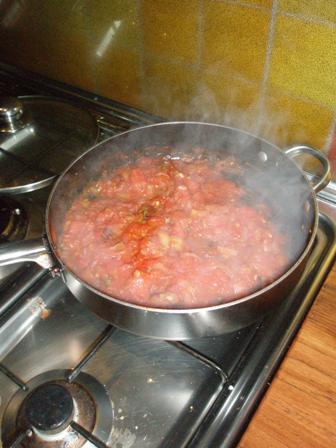
The pasta sauce in the making

TimoM4

TimoMM

The magician at work, this time in the kitchen and not in the wine cellar

We had a great time. The children played all afternoon. We walked the vineyard and Timo showed me where he shot a deer. Then we went to get some of that venison for us to take home. The “Brotzeit” led to dinner and then it was time to drive home to our own vineyard in Glenburn. Good news is that Timo is planning to make Riesling again in 2009 and maybe the following years.

For sales and enquiries contact:
timomayer@bigpond.com.au

The following wines are for sale:
Bloody Hill Chardonnay
Bloody Hill Pinot Noir
Big Betty Shiraz
Mayer Close Planted Pinot Noir (also as the Dr. Mayer Pinot Noir)


From the sidelines: Judging the wine judges II

September 9, 2009

The day I received the results from the 2009 Decanter World Wine Awards, I also received an e-mail from Karl Storchmann from the American Association of Wine Economists announcing the newest publication of the Journal of Wine Economics (Vol 4, No 1).

The lead article in this issue of the journal is about the wine judges and their reliability in judging wines. This was the perfect contrast reading to the long list of award winners from Decanter. Again Robert T. Hodgson has summarized some more research about the topic in question.

The title of the article is “An Analysis of the Concordance among 13 U.S. Wine Competitions”. Hodgson followed over 4,000 wines entered in these competitions of which 2,440 wines were entered in more than three competitions. 47% of these wines received gold medals in one show but 84% of these same wines received no medals at all in the subsequent shows. These results indicate that winning a Gold medal is greatly influenced by chance alone. Or to put it another way: Wines which were deemed of an extraordinary quality by some wine judges were assessed as very ordinary by others.

In come the Decanter World Wine Awards 2009 results. What does the study say about these awards. Nothing, of course. My skepticism about wine shows, however, is rather stronger then before.

One may ask the question are the Hodgson findings about wine shows in the U.S. applicable to shows such as Decanter? Can we safely conclude that some of the Decanter award winners would be seen as ordinary by other wine judges at other shows, and that some of non-winners could easily win a Gold somewhere else. Or could the Decanter wine judges replicate the tasting with the exact identical findings? Or what would their “margin of error” or inconsistency be?

What Hodgson’s study also tells us is, that wine judges are just human beings who are inconsistent and unpredictable. But we might rightly assume that they are trying to do the right thing but fail in this from time to time. The judges at the wine competitions surveyed, though, seem to have a shared idea about the wines they do not like and therefore win no awards at all. That’s at least something.

A few wine blogs have taken up the issue as well. Alder Yarrow for instance writes on Vinography about the AAWE paper and calls for a stop of the proliferating state wine shows. He admits, however, that the shows surveyed where, and I quote, “essentially the largest and most prestigious wine competitions in America”.

What does this tell us wine consumers? Well, wine quality and medals won at wine shows are not “orthogonal”, the presence of one doesn’t imply the presence of the other. Therefore, trust your own taste and buy what you like, possibly after tasting and let the wine shows be wine shows.

How about the vintner? Well, it is very nice for any wine producer to be recognized for outstanding quality and performance. So it is nice to win a medal at a wine show or getting a five star winery rating from James Halliday for instance. But it is not the end if this is not coming along. Most important is that ordinary people like to drink and buy your wine; the rest takes care of itself.

papa290131

Cheers folks, trust your own judgment and taste as many wines as you can.