Alexandra – Annual Food and Wine Expo

August 19, 2007

One of the highlights of our recent visit to Australia was certainly the Upper Goulburn Winegrowers Association’s (UGWA) Food and Wine Expo in Alexandra on August 11th. For the first time ever, Two Hills Vineyard participated in a wine expo, and that was truely exciting (our 2002 Sauvignon Blanc had participated in the Singapore Wine Show were the wine received a bronze medal but we were not present at the event).

Alexandra is a small but very charming country town in the middle between Mansfield and Yea, about an hours drive from Glenburn.

expo1.jpg

A sign somewhere along the road

expo2.jpg

The summary display with regional products

As newcomers to the game, our learning experience was steep. In fact we were poorly prepared indeed. However, our fellow wine growers from the UGWA welcomed us cordially and were not puzzled by our amateurish enthusiasm. Thanks to Susan Kinloch, the secretary of the UGWA, we were participating in the first place. Though we had only one variety to offer, a 2001 and a 2004 single vineyard Merlot, Susan convinced us that our participation would be welcome and beneficial. And so it was. Apart from learning how wine should be presented at such an occasions, we got to know some more of the members of our Association. Unfortunately, Charlie from Buller View Vineyard, who was to share a table with us could not make it. Our immediate neighbours were Henke Vineyard from Yark to our right and Nillahcootie Estate to our left. Large and small wineries and vineyards were all represented side by side.

expo3.jpg

The Two Hills “stall”

It started quite slowly at 10:30 in the morning but picked up in the early afternoon. Apart from wine, there were various processed foods, organic vegetables, olive products, salmon, bread and even locally produced textiles on display. We were lucky that our neighbours allowed tasters at our stall to us their spittoons. And in the end though we had only one red wine to offer, we had quite respectable sales. The joyous athmosphere had its effect also on us. Although we had to pack up rather quickly after the official closure and could not participate in the customary Wine Expo Dinner, we left the Alexandra Shire hHall rather enchanted and the firm belief that we would definitely come back next year for some more exposure in such an important regional event. We can only thank the other members of the UGWA for making it so easy for us to praticiate. It was a great experience.


Sauvignon Blanc

July 10, 2007

My morning newspaper, the International Herald Tribune, carried the other day an article summarising the tasting of 25 Sauvignon Blanc wines from New Zealand. Sauvignon Blanc is one of my most favourite white wines. The results were interesting. Only about 10 of the 25 wines found the approval of the tasting panel (it was a New York Times event of the dining section). For the judges, the tasting was a disappointment. They were looking for the bold, pungent refreshing SB but found that too many wines were dull, too sweet or simply wishy-washy or as Eric Asimov put it “commercially inoffensive”. My favourite SB from New Zealand, Cloudy Bay came up third (behind “Villa Maria” in number one position), described as “quieter than the top wines” but still “bold, zesty and delicious”. In my bottle shop in Jakarta it retailed for 40 US$ the bottle last week. Gone are the days when I had to pay only 18 US$ for this most delicious white.

Mr. Asimov is of the opinion that many producers have decided to push quantity at the expense of quality and that they are over cropping (too high yields per acre). I learned something else from the article: that in New Zealand wine producers are allowed to add sugar or acid to make up for “green” (not fully ripened) grapes, as we say. In Australia, we are not allowed to engage in this technique or should I say “manipulation”. Next time in the bottle shop it will be much easier for me to walk away from the dear SB from Marlborough and turn to some cool climate Sauvignon Blanc of Australian provenance. I might be enticed to make some Two Hills Sauvignon Blanc again in 2008. Kinloch Wines (www.kinlochwines.com.au) Sauvignon Blanc of 2006 is sold out, as I learn from their website. Guess who provided some of the fruit for this most delicious wine from the Upper Goulburn River (www.uppergoulburnwine.org.au)?


Obituary to a name: Mosel-Saar-Ruwer

July 5, 2007

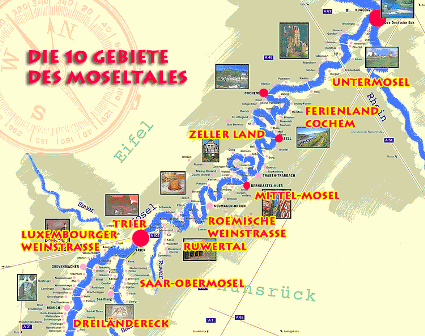
Decisions have been made to rename the wine region where I come from. Soon it will not be called any more by the familiar name of Mosel-Saar-Ruwer but only Mosel. The two tributaries, Saar and Ruwer, where some of the best Rieslings of the world are grown, will not feature any more in the name of the wine region. Personally I find this a pity. I love the two tiny wine producing areas with their distinct character. They are the most charming and lovely destinations for wine lovers and other tourists alike.

The Mosel-Saar-Ruwer wine region

gebiete-moselbauweb.png

Source: http://www.die-mosel.de


Merlot Night

July 2, 2007

Looking at the calendar, we were alarmed that quasi “half of the year is already over”. Time flies, it seems. What have we been doing? How could it go so fast? Consequently, we spontaneously decided to celebrate this event with a wine tasting on the last evening inJune.

Merlot was our choice of the day. Our wine cellar had only two brands left:

● a 2003 Hungerford Hill, Orange Merlot from the Hunter Valley and

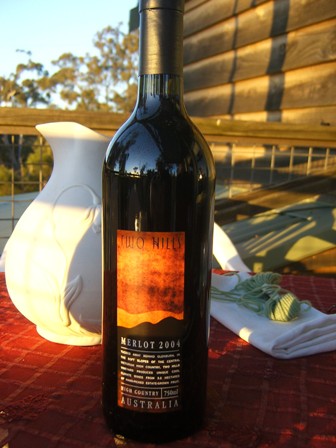
● a 2004 Two Hills Merlot from the Upper Goulburn Wine Region.

The Hunter Valley (www.hunterweb.com.au) is one of the oldest wine regions in Australia. Its flagship wines are Semillion and Shiraz but it has also pockets of cool climate sites. The Upper Goulburn Wine Region (www.uppergoulburnwine.org.au) is a significant cool climate grape growing area in Victoria with quite remarkable diversity of varieties and wine styles.

We had the two wines after dinner with a most delicious cheese, a Brie “au lait entier”, processed according to traditional methods by “Paysan Breton” and fresh baguette.

Both wines come from cool climate regions. Hungerford Hills Merlot belongs to the regional series of the brand (www.hungerfordhill.com.au). It is produced in Orange in New South Wales, a rather new location on the Australian wine map (established in 1983). Formerly it was know as the Central Highlands centred on the slopes of Mount Canobolas which is an important fruit producing area (apples, pears, cherries). The first commercially planted vineyards were established in the 1980s. The location of some of the vineyards for this regional wine is above 600 m altitude.

The 2003 vintage is under cork whereas the Orange Merlot 2004 is already under metal capsules. Both are available at duty free bottle shops in Jakarta, retailing for about 23 to 26 US$ per bottle. The internet order form of the winery shows 28 A$ per bottle for the Merlot (22.40 A$ for wine-club members). Whereas the 2003 bottle does not show wine awards stickers, the 2004 shows a gold medal and other distinctions at the 2006 Sydney International Wine Competition. The winemaker is Philip John.

As you probably know, Two Hills Vineyard also produces cool climate wines. The Geographical Indication (GI) for the Upper Goulburn Wine Region was only recently identified (formerly also called Central Victorian High Country) but grapes have been grown there since more then 30 years. The vineyard is a single site on a slight northerly slope. The 2004 vintage is under a DIAM cork closure. The wine is made by Alan Johns, the owner-winemaker cum viticulturist of Yering Farm Wines in the Yarra Valley (www.yeringfarm.com.au). Retail price at the Old England Hotel (www.oldenglandhotel.com.au) in Heidelberg, Melbourne should be around 15-17 A$/bottle. It can also be obtained at the upcoming Upper Goulburn Wine and Food Expo (Saturday, 11th August, in Alexandra Town Hall).

picture-076webmerlot.jpg

Tasting notes
Both wines show excellent dark crimson red colours. The nose of the Hungerford Merlot shows complex aromas of wild berry fruit with a slight nose of liquorice and nutty French oak. The wine is a blend from different vineyards in Orange. It is medium bodied, has a soft finish and displays balanced tannins.

All wines at Two Hills Vineyards are hand crafted. The grapes for Two Hills Merlot are coming from a single site, the vines are hand pruned and the grapes are hand harvested. The ‘2004 Two Hills Merlot’ also displays ripe wild berry fruit but not the liquorice and nuts flavours. The wine is very subtle, elegant with great finesse. It is medium bodied, dry, with good acidity, and a long finish. Its tannins are firm and give the wine a fine balance.

Hungerford Hill, Orange Merlot 2003
14% alcohol, matured in 60% new and 40% old French oak for about 15 months

Two Hills Merlot 2004
13.5 % alcohol, matured in 90% old and 10% new French oak for about 18 months


Wine Mythology II

June 8, 2007

You might remember my entry about the Celtic god of wine and the vintners in the Mosel river valley, Sucellus (the good striker: the prefix “Su” meaning “good”, and the Celtic word “cellus/cellos” meaning “striker”). In Jakarta we have very talented stone masons. They usually work with soft white stones. Well, I showed them my picture of Sucellus (from Kinsheim) and they produced a replica. Unfortunately, I did not explain to them who Sucellus was. I did not explain to them how powerful he was and how he was loved by the Celts and how he was worshipped in the Southern and the Eastern parts of Gaul. – Traces of him are found from Geneva to Lausanne, from the Mosel river to places in Alsace and even in York in England. He was also part of Lusitanian mythology which was heavily influenced by it’s Celtic and Roman invaders.

My beardless Sucellus

So instead of a middle-aged man with a curly beard, I got back a handsome young Sucellus without these insignia of the Celtic forest god. Fortunately, the long-handled hammer (or mallet) was depicted rightly. He also holds grapes as in the original. The only un-bearded Sucellus in this world is now in my possession and I will put him up in my small winery on Two Hills vineyard to remind me of my Celtic heritage and all the many people before me who enjoyed growing grapes and making wines.

I try to imagine 10.000 years from now when to some archaeologists’ surprise, a statue of the Celtic god is found far from Europe in the rolling hills of Two Hills vineyard near Glenburn, Victoria. Then finally also Australia will be on the map of the Celtic god searchers of the universe.


Grape production in China: Turfan – Oasis in the far West

June 7, 2007

Today I want to take my readers on a long trip to the Far East. China is our destination. That wine is produced in China, is “no news”. When we were living in Beijing in the early 1990s, we were very pleased to find Qingdao Huaguan Chardonnay, Great Wall and the Dragonseal reds. Today, shops in the big cities are well stoked with wines from all over the world. Wine consumption is increasing. The internet is full of news and analysis about Chinese wines and wines in China (www.wines-info.com). I found on the net a lovely 200 pages book manuscript of the late Pieter Eijkloff with the title: “Wine in China – Its history and contemporary development”. There is so much to read about wines in China, incredible.

In 2005 my wife Margit and I, visited the most Western part of China and we stayed a couple of days in Turfan. The main motive was sightseeing and to get to know this part of China which we had never visited before despite the fact that we resided almost six years there. Turfan is a very fertile oasis in the middle of the dessert along the Silk Road. it is located in a depression about 30 m below sea level and the Turfan basin extend to about 50,000 sqkm.

A mosque in Turfan

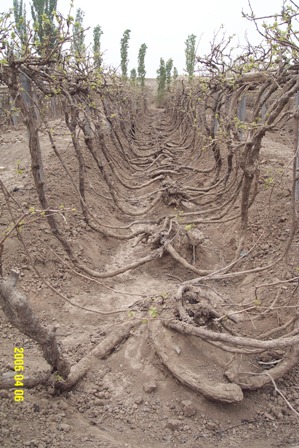
The pictures below give you an idea under what condition grapes are produced in this region with an extreme climate, very short, but hot summers (up to + 40 Celsius) and very long and ice cold winters (up to -20 Celsius). There is only minimal precipitation, on average about 20 mm per year. When we were there it “rained”. That’s what the local guide told us, otherwise we would not have notices. It was just a bit humid.

A typical vineyard near Turfan in spring

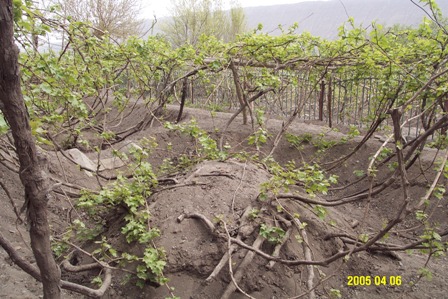
During the winter months the canes are buried in the ground to keep them alive. In spring they dug out and “hung” over various kinds of racks. Because wood is so scarce, we find all kinds of material where the vines are hung up. According to our guide there are many hundreds of different varieties. Unfortunately, our guide was not a grape expert.

Vines in the two-row system

Vines in the one-row system

However, we visited a family and could buy some of their produce. Traditionally they produce raisin not wine. Most Uigurs are Muslim therefore they do not drink alcohol. The grapes are dried in open barns.

A drying barn

Margit buying raisin in the market

In the local supermarkets of Turfan we could get a good overview on what wines were on offer. The sales prices drive tears into the eyes of an Australian primary producer. My vintners heart almost broke. What a pittance of a price for the producer will be left when all the costs of the agents are deducted!

The vines are irrigated with an age old irrigations system, called the Karez system. The water from the surrounding mountains, mostly from melting snow, is brought to Turfan through a sophisticated system of wells and deep channels dug by hand and lined with sheep skins. Thousands of kilometres of underground water channels can be found. From this precious resource mostly vegetables and fruit are grown.

Vines coming from a “central point and hung in squares”

Most meals we had included of some kind of mutton dish. We enjoyed the rustique but delicious cuisine of the Uigurs. After many beers and some “schnaps”, we also tried some of the reds. I do not remember the brands but we loved the drop. Traditional dances were presented and in one location the local invited us to dance to their music to which we joyful obliged. It was a very memorable visit to this most Western part of China and its friendly people in the bubbling markets. Needless to say that I brought back some of the traditional head gear and an lute like instrument.


Country Inns in Germany: Asparagus and river perch

May 18, 2007

While travelling in Germany recently, I had a lot of fish and seafood dishes, the reason for this being that I accompanied a group of visiting Indonesians to a number of coastal towns on the East and the North Sea. Since Germany had a splendid spring, this was the more enjoyable.

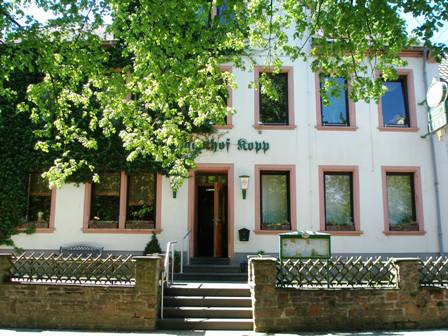
Later, together with my brother and my old folks in Trier, I visited one of the traditional German country inns so prevalent in my home area, the Mosel River Valley, the Landgasthof Kopp (www.landgasthofkopp.com) in Hentern, a small village between the Mosel tributaries Ruwer and Saar.

p4300582web.jpg

Landgasthof Kopp main entrance

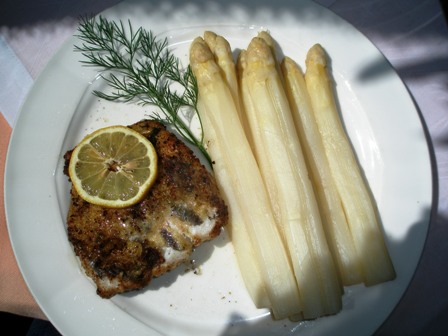
Springtime in Germany is ‘asparagus time’. Everywhere the lush white sticks can be purchased or consumed. All four of us ordered some kind of an asparagus dish. I had asparagus with perch (German: Zander).

p4300579web.jpg

River perch with asparagus

With this delicious meal, I drank the house wine, Ockfener Scharzberg Riesling, a local product from a small village on the Saar river called Ockfen (www.ockfen-home.de). Ockfen has about 700 inhabitants and of the agricultural used land of 246 ha about 90 ha are under vines on very steep slopes. The most famous terroir is ‘Ockfener Bockstein’ which is among the best wines from the Saar. The wines from this location are very dry, minerally and fruity with a good structure.

From the Middle Ages onwards it was the monasteries along the Saar river that cultivated vines and promoted the wine industry. The wealth and prosperity of Ockfen was almost exclusively based on its wine industry. The many small villages and towns along the Saar river are worth visiting (among them Saarburg, Ayl, Kanzem, Oberemmel, Serrig, Wiltingen to name only a few. I highly recommend this very beautiful part of Germany.

As regards the inn, the Landgasthof Kopp, this place is a must, not only because of the superb quality of the food and the service. The price too was a pleasant surprise, unbeatable, I must say. For the four of us, including drinks, we spent a total of only 60 Euro for a memorable family lunch.


Mama’s kitchen: tender bighorn fillet with mushrooms

May 11, 2007

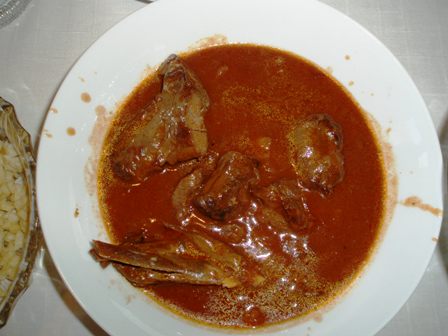
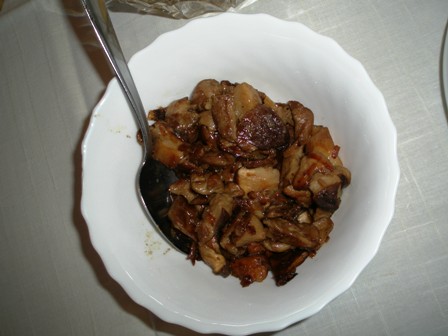
Because I am from a hunter’s family, we have from time to time dished with meat from wild animals at home. During my recent visit to Trier, my mother prepared a tender fillet of a young bighorn sheep (Mufflon in German). The young Mufflon was shot in Schoden at the Saar river by my friend Heinz. She served it with freshly collected wild mushrooms (Steinpilze also from Schoden), a cabbage salad and spaetzle (literally translated: little sparrow), a kind of tiny noodles or dumplings made with flour, eggs, water or milk, salt and sometimes nutmeg mainly used in the South German (my mother comes from Franconia), Austrian, Alsace and Swiss cuisine. I took some photos of the delicacies so that one gets a better idea. It was such a wonderful meal.

p5020662web.jpg

The bighorn fillet

p5020661web.jpg

The mushrooms

p5020664web.jpg

The old folks

When I raided my mother’s wine cellar, I found a bottle with the picture of Karl Marx, one of the most famous sons of my home town Trier. Agreed, the application (or the interpretation hereof) of his ideas has brought much misery to the world. However, now mankind knows for sure that planning economies do not work, but that market based economic co-ordination systems are much better for us all.

p5020656web.jpg

This bottle was given to me for my 50th birthday a couple of years ago. It contained a 2002 Eitelsbacher Marienholz Pinot Noir (Spaetburgunder) from the von Beulwitz Estate (www.von-Beulwitz.de), now owned by the Weis family in Mertesdorf, one of the villages at the Ruwer river, a small tributary to the Mosel (and part of the Mosel-Saar-Ruwer denomination). The Ruwer terroir has about 300 ha under vines in various locations (Ruwer/Eitelsbach, Mertesdorf, Kasel, among others). Some of the best German Riesling is grow here since Roma time. In fact the earliest findings of vine cultivation date back to the 2nd century. A stone relief called “The vintner in his wokshop” is the one of the oldest historical relicts (the other one is the wine ship of Neumagen).

p5010602web.jpg

Ruwer vineyards

The von Beulwitz estate goes back about 140 years and produces mainly Riesling wines, many of which have won international awards and trophies. The most recent one is the “Trophée d’excellence” “Riesling du monde”/Strassbourg for it’s 2003er Kasler Nies’chen, Riesling Auslese, “Alte Reben” (old vines). The 2005 Riesling Spaetlese from this location gained 97 points.

The estate grows vines on about 5 ha, mainly in steep locations in Kasel and Eitelsbach. Yields are kept low in order to produce wines of great elegance and finesse. Unfortunately, the Pinot Noir of 2002 did not fall into this superb category, it was a rather ordinary wine. But despite this, we enjoyed the meal and the wine and had a good time at home. I promised myself to try some of the award wines next time.


My hometown: Augusta Treverorum – a short visit to Trier

May 5, 2007

It was four busy days in Trier, running from appointment to appointment. Spring this year in Germany is most beautiful. Temperatures almost like in summer, sunshine, blue skies and very dry, no rains (bad for all the farmers and vintners). The four days included among others a family gathering with brother Wolf and my old folks, visits of old friends, meals in country pubs and at home, long walks in Trier, barbecues, afternoon coffee and cake, a Riesling wine tasting with the winemaker, a hunting trip in the forests of the Saar river, and a birthday party of my niece Adriane who turned 24!. When I finally had my train ticket to Frankfurt in my hands, I knew the time had come to say good bye. I payed a short visit to my favourite wine bar, Kesselstatt, opposite the cathedral (Trierer Dom) and had a last drink, a fine and dry 2005 Wiltinger Riesling. Then I went to an internet cafe near the train station but could not enter this text into my blog so I had to defer it to later. “Good byes” as always in the hope that you meet again and off I went on the train to catch my plane in Frankfurt for Jakarta.

Weinstube Kesselstatt

Weinstube Kesselstatt in Trier

The train trip makes the farewell easier. Along the Mosel river to Koblenz I could enjoy the beautiful Mosel valley with its steep vineyards, old castles, small settlements, and lovely countryside. After a change of trains follows the middle Rhine river valley with magnificent castles, stepp slopes covered in vines, the narrow valley, and the beautiful and winding river. When I had passed Bingen and entered Mainz, the long farewell had almost come to an end. From the familiar to the unfamiliar, the known to the unknown; the ancient, rural, pituresque and wine producing land gave way to industrial landscapes, big cities and finally the airport. My time in Germany had come to an end. So long, farewell, Auf Wiedersehen, good bye and the promise to return in September with more time on my hands for family and friends and the tasting of fine wines from the Mosel-Saar-Ruwer.

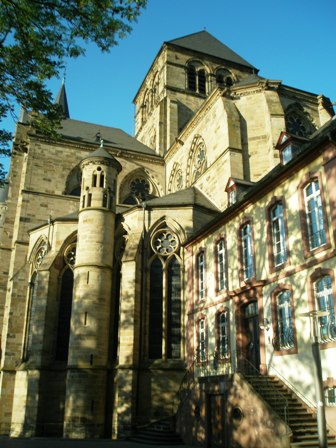
Trierer Dom

Trierer Dom and Liebfrauenkirche


Upper Goulburn Wine Region – Vintage celebrations

April 17, 2007

On Saturday, 28th April, 2007 at Delatite Winery in Mansfield, Victoria, a great new festival will be brought to you by the Upper Goulburn Wine Growers Association (www.uppergoulburnwine.org.au).

Come along and enjoy new and museum vintages of elegant and aromatic cool climate wines.
The region is ideally located for the production of crisp and racy aromatic white and sparkling wines and elegant textural red wines.

The following fruit and wines are grown and made: Riesling, Gewuerztraminer, Pinot Gris, Sauvignon Blanc, Chardonnay, Marsanne, Viognier, Pinot Noir, Pinot Meunier, Merlot, Shiraz, Cabernet Sauvignon and Temperanillo.

Taste the flavours of the Upper Goulburn, listen to music from Connie Lansberg, enjoy a balloon flight chill out in the high country!

Showcasing
– A variety of aromatic whites and elegant reds – over 20 labels
– Gourmet food from the region’s best restaurants and cafes
– Regional products – olives, oils, breads, trout
– Art and sculpture
– Vintage cars
– Fun activities for the kids – puppet shows, face painting
– Balloon flights over the Delatite Vineyard
– Musical entertainment (sponsored by Crazy Johns): Jazz n Shiraz featuring Connie Lansberg

picture-077blog.jpg

Two Hills Merlot 2004