Wine of the day: The Wanderer, Yarra Valley

May 16, 2010

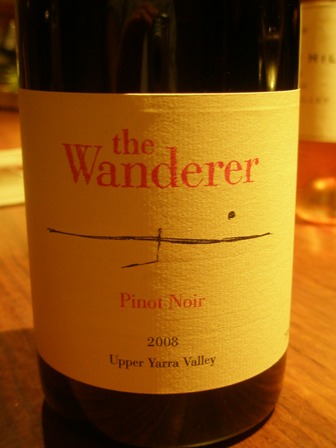
2008 Pinot Noir The Wanderer, Yarra Valley

My wine tip of the day is the Pinot Noir made by wine maker Andrew Marks of Gembrook Hills in the Yarra Valley. The wine is very light in colour with 13% alcohol and has a lot of cherries on the nose. It has some oak and is made from grapes grown from a single vineyard near Tarrawarra in the Yarra Valley.

I know that you have to be in Australia to get hold of this wine. But never mind, visiting Victoria is a bonus anyway. Have a nice Sunday, wherever you are.


Les Ormes de Cambras – Merlot from France

May 9, 2010

I grabbed the bottle from the supermarket shelve. Just like that. Again, I liked the label. This time a traditional one, with some trees, an alley. Later I learned that they were elm trees. I also liked the price, below 450 Bath (about 11 EURO) which is cheap for Thai conditions. That of course also meant that this wine was a “cheap” one, considered the many import duties and the exorbitantly high Thai alcohol taxes.

‘Les Ormes de Cambras Merlot’, the wine is called (2008 vintage). It’s alcohol content is quite low (12.5%), the colour is a beautiful dark red. Since we produce Merlot ourselves, I am often intrigued to buy other peoples Merlot to see what it is like.

The website of Les Ormes de Cambras told me that the Merlot could be had for 2.30 EURO/bottle in France if you also buy the three other wines produced by this enterprise (a Cabernet Sauvignon, a Sauvignon Blanc and a Cinsault).

2.3 versus 11 EURO for the bottle. I wonder how much the producer of the wine gets from this? What is his profit? 20 cents? 30 cents?

Since the website does not say anything about a vineyard, I assume this is a mass wine of industrial dimensions. But it tasted much nicer than expected. I might consider to get some more bottles.

‘2008 Les Ormes de Cambras Merlot’, Vin de pays d’Oc, France

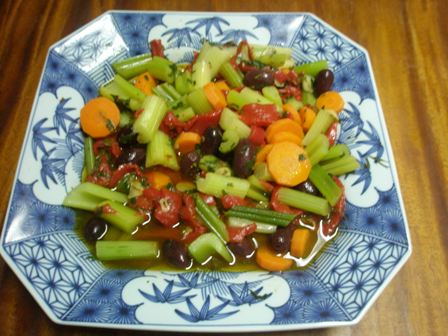
We always have food with our wine. It was a light dinner, just the celery salad with olives, carrots, peppers and garlic and some self-baked white bread. Delicious, and so healthy.

The Merlot was sufficiently well balanced, not heavy, a fruity almost elegant wine which went well with the salad.

A salad for dinner

The celery salad

By the way, Les Ormes de Cambras is located near the city of Béziers in Languedoc in the South-west of France.


Pierre Sparr Riesling, Alsace

May 8, 2010

Pomfret con alceitunas y alcaparras

We had fish for dinner. Following a Spanish recipe, we had “Bonito con Aceitunas y Alcaparras” (tuna with olives and capers) from the “Culinaria Spain – Spanish Specialities” cookery book by Koenemann, 1998, Cologne, which is a wonderful book. It has not only breathtaking recipes but great pictures, stories about the food and the people, the various regions of Spain and, of course on Spanish wines.

We deviated from the original recipe by replacing the tuna fillets by whole pomfret fish but used all the other ingredients for the preparation of the dish. Needless to say, it was delicious. The recipe worked also with pomfret, one of my favourite fishes here in Asia.

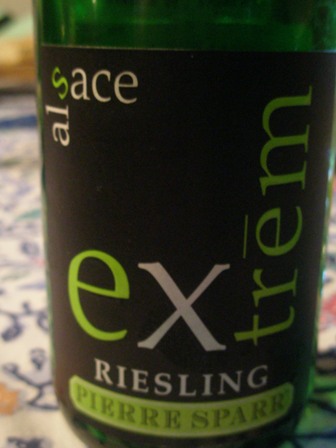
2008 Pierre Sparr Riesling, extreme, Alsace

I had no Spanish wine in my wine fridge, but a Riesling from Alsace which I had bought a couple of days earlier because of its funky modern label. Pierre Sparr is the name of the estate. The 2008 vintage Riesling is still young and exuberant, just the right stuff for pairing it with the strong taste of the olives and the capers. The acidity made all the difference.

Pierre Sparr Riesling extreme

2008 Pierre Sparr Riesling, extreme, Alsace

I tried to find the same label on the Pierre Sparr website but could not. It must have been a special label for the export market. Back home in Alsace the same wines have more traditional wine labels. The Sparr family winery goes back to 1680. Pierre Sparr is representing the ninth (!!!) generation of Sparr family wine-makers and vignerons. The winery is located in Sigolsheim at the heart of the Alsace region. The family owns and operates 34 ha under vines and contracts fruit from about another 150 ha, usually small growers.

I love this wine region and have visited many times, especially during my student days. Alsace has a outstanding gastronomy, spread over the most picturesque region, right at the foot of the Vosges mountains down to the Rhine river. Vines have been cultivated since Roman times.

Pierre Sparr offers a wide range of wines (and also grappa). I guess the wine we had belongs to the lowest quality segment which you can buy in France for about 8.25-9.50 EURO/bottle. I paid much more for it here in Bangkok. It displays rose petal aromas, citrus, peach and honey. The wine is sprizzy and has zest, a good structure and a long finish. Its’ perfectly made and will last for some more years (12% alc/vol).

I hope we have the chance to visit Alsace again this year. And meanwhile I look out for Pierre Sparr wines here in Bangkok.


And out they go: The exodus of vintners in Australia

April 29, 2010

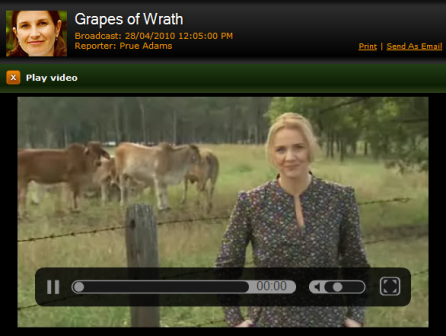
The recent ABC Landline report nicely summarizes the predicament of the Australian winegrowers. A$ 250 per tonne for your fruit is just not covering costs. Grape growing has no future, it seems. I find it quite shocking somehow. The documentary depicts the individual detiny in a very touching way.

Click on the link below and watch this very informative film.

ABC Landline


The last sip – a Delatite Riesling

April 18, 2010

Leaving Two Hills Vineyard in Glenburn is always a sad affair. The evening before departure we bid farewell to our old friend Steve and our family, Michael and Helen. On Sunday morning we said good bye to our neighbours, Hillary and Ken. Then we drove to Yarra Glen where we left the car at Gayle’s farm. We had a morning tea, moved the luggage into her car and off we went to Melbourne Airport. Gayle dropped us there and we did the usual stuff.

Fortunately, there was a nice bar called “Plonk”, right next to gate No. 4 from which we were to depart for Bangkok. We went through their wine list and chose a wine from our wine region (the Upper Goulburn Wine Region), a ‘2008 Delatite Riesling’. What a delight this wine was, fresh and fruity with citrus and passion-fruit aromas, a good structure and a long finish. The waiter was particularly charming. Here we said our final good bye. Reminiscing about the past is an old man’s vice, but the memories we took with us are treasures of a very special kind.


Getting ready for the 2010 vintage

February 22, 2010

Two Hills Pinot Noir shortly before the nets went on

The nets are on now, and we are expecting a good harvest at Two Hills Vineyard for 2010. After the total loss of last year the prospects are not too bad.

Estimates are:

– Sauvignon Blanc: about 8 tonnes of fruit, and already sold
– Pinot Noir: about 5 tonnes of fruit and still looking for a home

The Merlot grapes look good too, but we are not making any wine this year. This will make the bird in the vicinity very happy, what a feast. That’s the price we have to pay for the grape glut. It’s sad but cannot be helped at this point in time.

Our new tractor will come into action for the vintage. This will make things easier, I hope.
Let us hope no unexpected disaster occurs before the grapes are in safely.

The plan for 2011 is to mothball the vineyard for a couple of years and see if the market recovers.


Vineyards of Thailand Part 2: Gran Monte, Asoke Valley, Khao Yai

January 11, 2010

Gran Monte vineyards

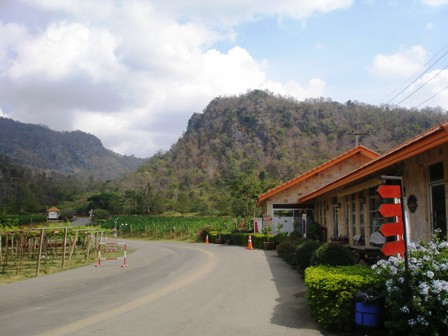
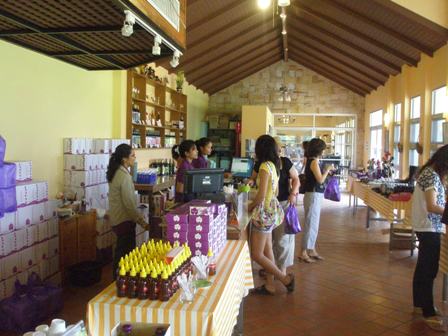
I have visited Gran Monte located in the Asoke Valley in the Khai Yai area before. But this time we did not have an appointment with the boss, Mr. Visooth Lohitnavy, and a winery tour was out of the question. We played the innocent tourist, and walked right into the cellar door and tasted the new vintage.

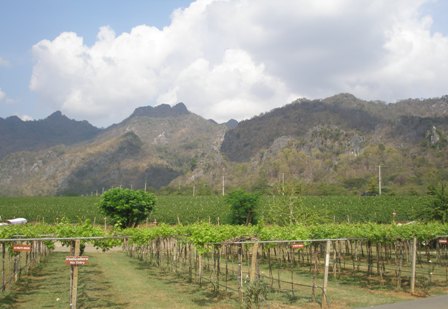
Cellar door to the right, beautiful mountains ahead

The tasting room

2009 was a great year for Gran Monte. The winery won about 20 national and international awards for its “new latitude” wines, and is now firmly established as one of Thailand’s top producers easily matching international standards.

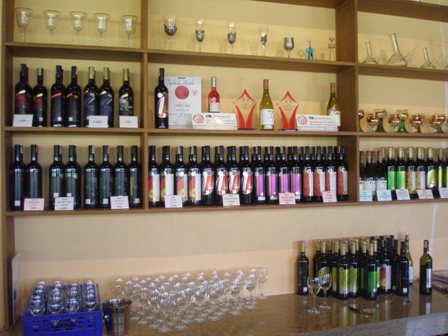
Wines on display in the tasting room

2009 Spring Chenin Blanc

Though Chenin Blanc is usually not “my variety”, I just loved the ‘2009 Spring Chenin Blanc’ which won a silver medal at the AWC Vienna International Wine Challenge 2009. It’s a very fresh wine with a beautiful bouquet, and a clean finish. I liked it much better than the ‘2009 Sole Unwooded Chenin Blanc’. The ‘2009 Sakuma Rose Syrah’ was not for tasting but we bought some bottles nonetheless. Finally, we bought a whole selection from different vintages, varieties and price ranges. More about the food and wine pairings and our experiences with Gran Monte wines will follow soon.
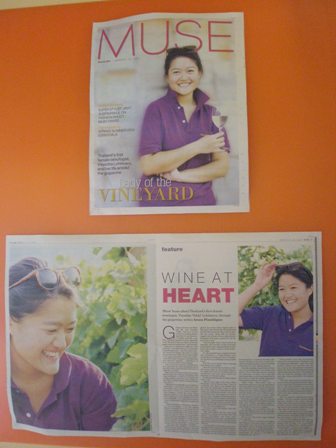
Newspaper reviews about Nikki Lohitnavy

The daughter of Visooth Lohitnavy, the managing director and CEO, is Nikki (or Visootha). She is the first female wine-maker in Thailand. With a degree in oenology from Adelaide, the young vintner is on a mission, and one can feel this when visiting Gran Monte. The 2009 vintage with its excellent whites shows her hand.

Gran Monte has a guest house and restaurant at the winery. The park around the house and the cellar door is very lovely too. When we visited the place was very busy, with many visitors dropping in, most of them Thai. Apart from wine, there are a wide range of local produce including creams and lotions available from the shop.

Gran Monte is definitely worth visiting when going on a winery tour in Thailand, a “must” so to say. There are many other interesting things to visit in the Asoke valley and its surroundings. Khao Yai is just a beautiful region.

Address:
GranMonte in Bangkok
Granmonte Co,Ltd.
17 / 8 Soi Sukhumvit 6, Sukhumvit Road,
Klongtoey, Bangkok 10110
Tel : +66-2-653-1522
e-mail: Marketing@granmonte.com

GranMonte Vineyards and Wines at Asoke Valley, Khao Yai
52 Moo 9 Phayayen, Pakchong,
Nakornrachasima, Thailand
Tel : 081-923-200-7 , 084-904-194-4, 081-900-828-2 , 080-661-755-5
www.granmonte.com

Vineyards of Thailand Part 1: Holiday Park

January 10, 2010

This blog entry if the first of three looking at various vineyards in Thailand. During the Christmas vacation, we went on a winery tour, visiting three Thai vineyards; Holiday Park, Gran Monte and PB Valley, except Holiday Park, all in the Khao Yai area.

Holiday Park, about two hours north of Bangkok, is a complex undertaking, more a holiday home cum entertainment facility than a vineyard cum winery. However, they do produce grapes, as it seems mostly table grapes for direct consumption. When we arrived in the place, vineyard workers were busy “cleaning” the grapes, which was thinning individual bunches of smaller berries so that the remaining ones could grow bigger. The table grapes we saw were very healthy.

Vineyard workers thinning bunches under the trellis system

Table grapes at Holiday Park

Small tractors were converted into small “locomotives” with wagons so that visitors can be driven around the property including a holiday housing park, a lake, an activity centre, the vineyards and a play ground.

The locomotive

The undertaking is obviously targeting domestic tourists and visitors. The staff at the tasting counter did not speak English. But nonetheless there were wines and juices to be tasted. It was my first ever experience with small plastic cups for a tasting.

Plastic cups for wine tasting at Holiday Park

I assume the wine made is just a by-product of the table grape business. The grapes which cannot be used as table grapes and/or are left over are made into wine. The price of the bottle was THB 250 (about 5 EURO or A$ 7.50). We did not buy any wine.

Holiday Park red

If you have small children, Holiday Park is still worth visiting. I suggest you go there early in the morning when it is not too hot. From there on you drive to Khai Yai to visit other wineries or the national park.

I could not find any address for Holiday Park on the internet in English. Sorry folks.


Tractor delivered

December 14, 2009

I know that many of the visitors of my blog are not interested in my “farm affairs” (statistics and comments point to that sad conclusion). This might have to do with the fact that most wine consumers are urban people removed from the realities of rural life and work on the land.

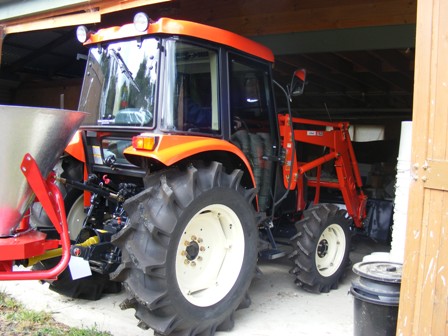
Nonetheless, I am thrilled by the fact that my new tractor was delivered last Friday. Michael, my brother in law, and Steve Sadlier, who manages our vineyard were there when Gordon rocked up with the trailer and dropped off our brand new Daedong tractor, received the good and stored them in the shed. We are ecstatic about this. I cannot wait to try the new Daedong out next time I am visiting. Michael took a couple of pictures which I show below.

Loading the machine off the trailer

Brand new Daedong tractor

Instructing the new user, Steve and Gordon

Get the machine into the shed

Dob well done, Michael and Steve


Climate change and grape varieties

November 2, 2009

RieslingSchoden

Riesling grapes in Schoden, Saar, shortly before vintage 2009

Uff, I am reading in todays “Your Daily Wine News” newsletter that some of Australia’s top wine experts think that over the next 20 years climate change will be responsible for the decline of Shiraz and Chardonnay and the rise of varieties such as Vermentino, Arneis, Nebbiolo, Pinot Grigio and Viognier (some call them “alternative varieties”).

This is bad news for me and my own small vineyard. At Two Hills Vineyard we have concentrated on some of the traditional French varieties: Sauvignon Blanc, Pinot Noir, Merlot and Chardonnay (first vintage in 2011 or 2012). Our fruit ripens usually well (if we do not suffer severe frosts) and shows a superior quality. But will that persist under the conditions of climate change?

I still remember vividly how I pulled out the 2 1/2 acres of Cabernet. it was hard work, wrapping a chain around every single vine and lifting the hydraulic of the tractor. I should have left them in, I guess. If temperatures rise in Glenburn, the drought persits, and/or we’ll have less percipitation in the future, Cabernet could have been the ideal variety for our spot. I ripped the vines out because the grapes would not fully ripen. At the moment we have sufficient water, our two dams are overflowing after years of drought but that might change quickly again.

Another issue is age, my age. At 55 I might still have a chance to enjoy some of the coming Chardonnay vintages but replanting would “cost” me many years of waiting. I could contemplate to plant on our second hill where we still have another 5-6 acres of space. Well, let us see what is going to come.

At least there is no politician who tells me what to do and chances are small that an elector such as Clemens Wenzeslaus of Saxonia, who changed the Mosel by instructing vintners to ripp out their red varieties and replant with Riesling, would appear on the Australian scene. However, danger is looming from the anti-alcohol lobby in Canberra which is working day and night to convince law-makers that the purchase of alcoholic beaverages needs to be made more costly for the consumer and profitable for the taxmen.