Karl Marx and Mosel wine

September 26, 2007

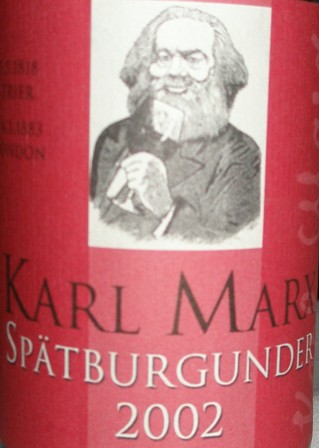
When I visited my hometown Trier recently, I also went to the place where Karl Marx, the most famous of our citizens, was born in 1818 (the Karl Marx Haus). What I did not know about him was his relationship to wine and the Mosel wine industry. From a leaflet collected at the tourist paraphernalia shop I learned that the parents of Karl Marx were vineyard owners along the Ruwer in Mertesdorf where they owned several parcels. It was quite common for bourgeois families of the times to acquire vineyards either for their own wine consumption and/or for investment and old age security reasons. The Marx family vineyard was found in the location “Viertelsberg” a medium quality terroir near the castle ‘Gruenhaus’. Today, the ‘Weingut Erben von Beulwitz’ produces a 2002 Spaetburgunder (Pinot Noir) wine with a Karl Marx label to commemorate this famous “son” of Trier. The wine is not exactly from the old Marx family vineyard but derived from vineyards nearby. Some time ago I had tasted this wine with some delicious venison (big horn sheep) which my mother had prepared for me.
karlmarxweb.jpg

The label with Karl Marx

Marx himself was fond of drinking wine and appreciated the value of it. More interesting is the fact that among others the misery of the Mosel wine producers inspired Marx to study and research economic issues in general. In various newspapers Marx reported about the problems of the Mosel vintners. He criticized the Prussian government for its lack of support which in the end brought him into conflict with the authorities in the 1840ies which in the end led to his exile first in Paris, later in Brussels and finally in London.

After Napoleon lost the war and with it the once occupied lands west of the Rhine river, these territories were given to the Kingdom of Prussia after the peace congress of Vienna in 1815 and administered as the Prussian Province of the Lower Rhine. This marked the beginning of a golden age for Mosel wine producers since they benefited from tax-free export of their wines to Prussia. Unfortunately, the phenomenon was short lived when, with the introduction of the German Customs Union (Zollverein) in 1834, vintners from the southern German states were in the position to successfully displace their competitors from the Mosel. This in turn brought wine prices down. An unfavourable Prussian tax policy coupled with bad harvests led to the pauperization of many vintners at the Mosel. Marx was appalled by their suffering, criticized the government, violated press censorship requirement and in the end had to leave into exile.

In 1857 the Marx family sold its vineyards in Mertesdorf. But due to the efforts of the Weiss family (the owners of the Weingut Erben von Beulwitz, www.hotel-weiss.de), we can enjoy today a Pinot Noir depicting the face of Karl Marx on the label. These bottles can also be bought at the aforementioned shop (7.5 €/0.75 l bottle).
mertesdorf-ruwer.jpg

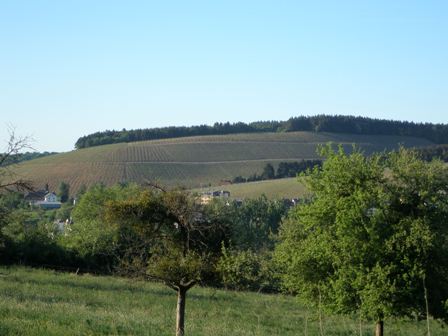
Ruwer vineyards near Mertesdorf in spring

PS: I personally think that it is a pity that the wide adoption of his ideas in Eastern Europe, Vietnam and China for instance brought so much misery to mankind. Less emphasis on the collective and more on individual freedom would have gone a fair bit. Marx should have stayed with drinking and enjoying wine and give up writing in the first place, one is tempted to argue.

In a letter to the father-in-law of his daughter he mentioned that “a man who does not love wine will never achieve anything good for mankind”. Unfortunately, wine drinking is not a guaranty for such deeds as his own life showed.


The vintners knife II

July 11, 2007

You might remember that I introduced a while ago to you the brothers Consigli from Scarperia, Italy (www.conaz.com) and their knife-making art.

When I browsed trough the many photos I have on my PC the other day, I found two copies of vintners knives from Roman times unearthed in the Mosel River valley.

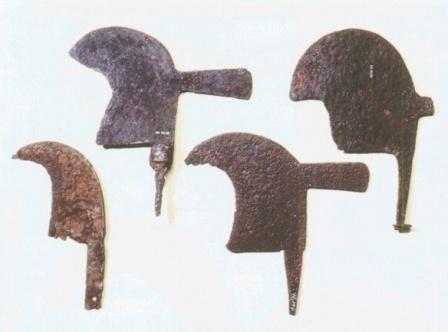
In the “Bacchus and Sucellus” book of Karl-Josef Gilles (Rhein-Mosel Verlag, Briedel, 1999, pages 61 and 62), two forms of vintners knives of the Roman times are shown.

The first type is for pruning, it is massive with a broad blade and a small pruning chisel on the backside. The second type was for harvesting grapes and looks like a sickle. It is slighter and finer. Also a knife which was slid over a finger was found and used for the same purpose.

rebmesserb.jpg

The Roman knives for pruning (Brauneberg, Leiwen)

rebmessera.jpg

The Roman knives for harvesting (Piesport, Wittlich, Trier)

Most likely from tomorrow onwards I will be pruning vines in my own vineyard in Glenburn, Victoria. I will be back in August. Have a good time and drink some bottles of fine wine, somewhere with someone you like (should not be that difficult).

Postscript: I was made aware by Bob Burgess that the back of the pruning knife consists of a small pruning chisel and not a hammer knob as I have mistakenly believed. Thanks Bob for the correction of this error. Please visit also Bob’s very interesting webpage (www.billhooks.co.uk) on early edge tools.


Merlot Night

July 2, 2007

Looking at the calendar, we were alarmed that quasi “half of the year is already over”. Time flies, it seems. What have we been doing? How could it go so fast? Consequently, we spontaneously decided to celebrate this event with a wine tasting on the last evening inJune.

Merlot was our choice of the day. Our wine cellar had only two brands left:

● a 2003 Hungerford Hill, Orange Merlot from the Hunter Valley and

● a 2004 Two Hills Merlot from the Upper Goulburn Wine Region.

The Hunter Valley (www.hunterweb.com.au) is one of the oldest wine regions in Australia. Its flagship wines are Semillion and Shiraz but it has also pockets of cool climate sites. The Upper Goulburn Wine Region (www.uppergoulburnwine.org.au) is a significant cool climate grape growing area in Victoria with quite remarkable diversity of varieties and wine styles.

We had the two wines after dinner with a most delicious cheese, a Brie “au lait entier”, processed according to traditional methods by “Paysan Breton” and fresh baguette.

Both wines come from cool climate regions. Hungerford Hills Merlot belongs to the regional series of the brand (www.hungerfordhill.com.au). It is produced in Orange in New South Wales, a rather new location on the Australian wine map (established in 1983). Formerly it was know as the Central Highlands centred on the slopes of Mount Canobolas which is an important fruit producing area (apples, pears, cherries). The first commercially planted vineyards were established in the 1980s. The location of some of the vineyards for this regional wine is above 600 m altitude.

The 2003 vintage is under cork whereas the Orange Merlot 2004 is already under metal capsules. Both are available at duty free bottle shops in Jakarta, retailing for about 23 to 26 US$ per bottle. The internet order form of the winery shows 28 A$ per bottle for the Merlot (22.40 A$ for wine-club members). Whereas the 2003 bottle does not show wine awards stickers, the 2004 shows a gold medal and other distinctions at the 2006 Sydney International Wine Competition. The winemaker is Philip John.

As you probably know, Two Hills Vineyard also produces cool climate wines. The Geographical Indication (GI) for the Upper Goulburn Wine Region was only recently identified (formerly also called Central Victorian High Country) but grapes have been grown there since more then 30 years. The vineyard is a single site on a slight northerly slope. The 2004 vintage is under a DIAM cork closure. The wine is made by Alan Johns, the owner-winemaker cum viticulturist of Yering Farm Wines in the Yarra Valley (www.yeringfarm.com.au). Retail price at the Old England Hotel (www.oldenglandhotel.com.au) in Heidelberg, Melbourne should be around 15-17 A$/bottle. It can also be obtained at the upcoming Upper Goulburn Wine and Food Expo (Saturday, 11th August, in Alexandra Town Hall).

picture-076webmerlot.jpg

Tasting notes
Both wines show excellent dark crimson red colours. The nose of the Hungerford Merlot shows complex aromas of wild berry fruit with a slight nose of liquorice and nutty French oak. The wine is a blend from different vineyards in Orange. It is medium bodied, has a soft finish and displays balanced tannins.

All wines at Two Hills Vineyards are hand crafted. The grapes for Two Hills Merlot are coming from a single site, the vines are hand pruned and the grapes are hand harvested. The ‘2004 Two Hills Merlot’ also displays ripe wild berry fruit but not the liquorice and nuts flavours. The wine is very subtle, elegant with great finesse. It is medium bodied, dry, with good acidity, and a long finish. Its tannins are firm and give the wine a fine balance.

Hungerford Hill, Orange Merlot 2003
14% alcohol, matured in 60% new and 40% old French oak for about 15 months

Two Hills Merlot 2004
13.5 % alcohol, matured in 90% old and 10% new French oak for about 18 months


The Many Wines

June 28, 2007

One of my favourite poets is Rumi, also know under his full name of Mawlānā Jalāl-ad-Dīn Muhammad Rūmī (Persian: مولانا جلال الدین محمد رومی, Turkish: Mevlânâ Celâleddin Mehmed Rumi, Arabic: جلال الدين الرومي, shortened to إبن الرومي). a 13th century Muslim jurist and theologian from Persia.

200px-mawlana_rumi.jpg

Rumi (from wikipedia)

For us modern, 21st century vintners and wine lovers the following excerpts from one of his poems on wine are of interest:

The Many Wines

God has given us a dark wine so potent that,
drinking it, we leave the two worlds.

There are thousands of wines
That can take over your minds.

Be a connoisseur,
And taste with caution.

Any wine will get you high.
Judge like a king, and choose the purest,

The ones unadulterated with fear,
or some urgency about “what’s needed”.

Drink the wine that moves you
as a camel moves when it’s been untied,
and is just ambling about.

(Source: cited from: “The Essential Rumi”, translated by Coleman Barks, with John Moyne, A.J. Arberry and Reynold Nicholson, Castle Books, 1997, page 6 and 7)


The vintners knife

June 18, 2007

Some years ago my wife surprised me with the most marvellous birthday gift: a vintners knife which she had ordered from Italy. She kept all the transactions secret from me. I only notices some e-mail going back and forth from our PC in Jakarta to Italy in Italian. But I did not look at them thinking it must be old acquaintances from the good old days when we were living in Rome. I was really chuffed. It is a traditional Italian knife used by vintners even for pruning of vines which I carry with me every day when on the farm.

The producers are two Italian brothers, Luigi and Enrico Consigli who opened their forge about 50 years ago in Scarperia a small town in Tuscany. The settlement traces its roots back to 1306 when it was created at the foot of the Giogo Pass linking Florence to Bologna. The city of Florence soon established a castle (Castel San Barnaba) their in order to control the most important road crossing Italy. “Scarpa” means “shoe” in Italian and “ria” (in Tuscan) means “steep”, the two words were combined and so the name Scarperia was born. The town has since the 1980s a very interesting “cutting irons” museum and till today, it is a world renown centre for the ancient art of knife making.

Back to the two Consigli brothers. Today, Luigi is retired and the family business is carried on by Enrico and his children Elena and Pietro. It is a typical Italian business venture moulding tradition. Modern tecyhnique with elegance and refinement. The company does not only produce traditional workmen’s knives (for vintners, fishermen, shepherds, olive growers, etc.) but also kitchen cutlery. The family business website (www.conaz.com) is also in English. It introduces the visitor to the history of the region, the company, the trade (how a knife is made) and provides a wonderful catalogue with various regional, and historic knives as well as table and kitchen cutlery.

Below, a photo of my traditional “vintners knife”. A couple of years ago it was still produced in different sizes. When I screened the catalogue on the website, however, I could not find it any more. It must be out of production. The more I am happy to own such a treasure which is of great help in my little vineyard at Two Hills near Glenburn in the New World, far away from Italy and its traditions. But when I cut away at my vines, Italy is on my mind, and the forge of the Consigli brothers who made all this pleasure possible. While browsing the catalogue I had already singled out some very elegant models for future birthdays.

nive2web.jpg

My vintners knife, Consigli brothers, Scarperia


Wine Mythology II

June 8, 2007

You might remember my entry about the Celtic god of wine and the vintners in the Mosel river valley, Sucellus (the good striker: the prefix “Su” meaning “good”, and the Celtic word “cellus/cellos” meaning “striker”). In Jakarta we have very talented stone masons. They usually work with soft white stones. Well, I showed them my picture of Sucellus (from Kinsheim) and they produced a replica. Unfortunately, I did not explain to them who Sucellus was. I did not explain to them how powerful he was and how he was loved by the Celts and how he was worshipped in the Southern and the Eastern parts of Gaul. – Traces of him are found from Geneva to Lausanne, from the Mosel river to places in Alsace and even in York in England. He was also part of Lusitanian mythology which was heavily influenced by it’s Celtic and Roman invaders.

My beardless Sucellus

So instead of a middle-aged man with a curly beard, I got back a handsome young Sucellus without these insignia of the Celtic forest god. Fortunately, the long-handled hammer (or mallet) was depicted rightly. He also holds grapes as in the original. The only un-bearded Sucellus in this world is now in my possession and I will put him up in my small winery on Two Hills vineyard to remind me of my Celtic heritage and all the many people before me who enjoyed growing grapes and making wines.

I try to imagine 10.000 years from now when to some archaeologists’ surprise, a statue of the Celtic god is found far from Europe in the rolling hills of Two Hills vineyard near Glenburn, Victoria. Then finally also Australia will be on the map of the Celtic god searchers of the universe.


Grape production in China: Turfan – Oasis in the far West

June 7, 2007

Today I want to take my readers on a long trip to the Far East. China is our destination. That wine is produced in China, is “no news”. When we were living in Beijing in the early 1990s, we were very pleased to find Qingdao Huaguan Chardonnay, Great Wall and the Dragonseal reds. Today, shops in the big cities are well stoked with wines from all over the world. Wine consumption is increasing. The internet is full of news and analysis about Chinese wines and wines in China (www.wines-info.com). I found on the net a lovely 200 pages book manuscript of the late Pieter Eijkloff with the title: “Wine in China – Its history and contemporary development”. There is so much to read about wines in China, incredible.

In 2005 my wife Margit and I, visited the most Western part of China and we stayed a couple of days in Turfan. The main motive was sightseeing and to get to know this part of China which we had never visited before despite the fact that we resided almost six years there. Turfan is a very fertile oasis in the middle of the dessert along the Silk Road. it is located in a depression about 30 m below sea level and the Turfan basin extend to about 50,000 sqkm.

A mosque in Turfan

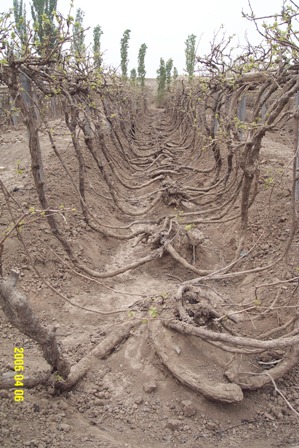
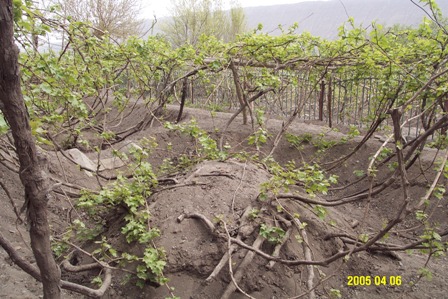
The pictures below give you an idea under what condition grapes are produced in this region with an extreme climate, very short, but hot summers (up to + 40 Celsius) and very long and ice cold winters (up to -20 Celsius). There is only minimal precipitation, on average about 20 mm per year. When we were there it “rained”. That’s what the local guide told us, otherwise we would not have notices. It was just a bit humid.

A typical vineyard near Turfan in spring

During the winter months the canes are buried in the ground to keep them alive. In spring they dug out and “hung” over various kinds of racks. Because wood is so scarce, we find all kinds of material where the vines are hung up. According to our guide there are many hundreds of different varieties. Unfortunately, our guide was not a grape expert.

Vines in the two-row system

Vines in the one-row system

However, we visited a family and could buy some of their produce. Traditionally they produce raisin not wine. Most Uigurs are Muslim therefore they do not drink alcohol. The grapes are dried in open barns.

A drying barn

Margit buying raisin in the market

In the local supermarkets of Turfan we could get a good overview on what wines were on offer. The sales prices drive tears into the eyes of an Australian primary producer. My vintners heart almost broke. What a pittance of a price for the producer will be left when all the costs of the agents are deducted!

The vines are irrigated with an age old irrigations system, called the Karez system. The water from the surrounding mountains, mostly from melting snow, is brought to Turfan through a sophisticated system of wells and deep channels dug by hand and lined with sheep skins. Thousands of kilometres of underground water channels can be found. From this precious resource mostly vegetables and fruit are grown.

Vines coming from a “central point and hung in squares”

Most meals we had included of some kind of mutton dish. We enjoyed the rustique but delicious cuisine of the Uigurs. After many beers and some “schnaps”, we also tried some of the reds. I do not remember the brands but we loved the drop. Traditional dances were presented and in one location the local invited us to dance to their music to which we joyful obliged. It was a very memorable visit to this most Western part of China and its friendly people in the bubbling markets. Needless to say that I brought back some of the traditional head gear and an lute like instrument.


Single Malt

June 1, 2007

What happened, you might ask yourself? Single malt, that’s not wine! Has Rainer finally left the so much loved and appreciated result of grape fermentation behind and turned to harder drinks? Well, on a recent trip to Bangkok, my old friend Rainer Heufers, who has earlier introduced me to the amazingly complex and enjoyable world of whiskies, gave me a copy of one of the bibles for whisky connoisseurs, “Michael Jackson’s Malt Whisky Companion”, 4th edition.

What a marvellous book this is. Michael Jackson must be to the whisky world what James Halliday and Hugh Johnson are to the wine drinkers. Wine and whisky do have commonalities. For both wood is important. Vintages are clearly identified. The rating system consists of a 100 points scheme. And finally, the verbal description of the liquid as provided by the tasters show similarities with wine too. I give you some examples:

Colour: very full gold with orange tinge
Nose: fresh, soft, very aromatic, with rich malt dryness
Body: light to medium, creamy
Palate: clean, grassy, fruity, becoming cookie-like and nutty
Finish: long, firm dry, malty, restrained, dessert apple

malt-whiskey-small.jpg

The book cover: Michael Jackson’s Malt Whisky Companion

Hundreds of different whisky brands are listed and described in this beautiful book. Of some of the distilleries, photos are added. Short histories provide the readers with another kind of “bait” to explore the world of whisky on their own. Maps and detailed descriptions of the various locations, products, vintages and the distillery process invite the reader to engage and appreciate the world of single malts. Because water is so important for whisky production, many distilleries are located in glens, valleys with streams. My home in Australia is located in Glenburn, family and friends live in Yarra Glen, both places have their water and clear mountain streams.

But the whisky world is full of “Glens”. Names such as Glen Albyn, Glenallachie, Glenburgie, Glendronach, Glendullan, Glenfarclas, Glenfiddich, Glenmorangie, and Glenugie sound exotic to my ear. I decided on the spot that our next trip to Europe would include a visit to Scotland and some distilleries there, probably in the highlands or on the Spyside.

Being of Celtic extraction myself (remember the Treverer! Of the Mosel river valley), I have a soft spot for everything Celtic, as you probably know. I could combine the whisky exploration with some sightseeing. I always wanted to see Edinburgh. Among others I could fulfil one of my dreams: buy a Scottish kilt, probably a young designer item by Howie Nicholsby. They are really cool. Ever since I saw some examples of his art in an airline magazine, I hedged this idea of acquiring a kilt for myself. Tonight there is another Scottish highlight waiting for me. On the eve of the Jakarta Highland Gathering, the Java St. Andrew Society (www.javastandrewsociety.com) is organising Scotland in Concert, a splendid presentation of Scottish music. They will certainly also offer whisky, maybe even a single malt. See you there.


Burns Supper – Java St. Andrews Society

February 10, 2007

I will write more about Celts and Celtic traditions today. Friends of ours got flooded out and could not attend this year’s Robert Burns (1759 – 1796) Supper and the related celebrations of the Java St. Andrews Society (www.javastandrewsociety.com). They kindly passed the ticket on to us and we were welcomed as replacements by the Scots. Thanks again Liz and Walter for your generosity.

Burns Supper 2007

We sat at the “Holy Willie’s Prayer” table together with four Americans. Most men at the supper were in kilts and every time I see this, I want to buy a traditional Bavarian outfit (with leather trousers and so on) which would at least come a bit closer to this formidable dress for the Scottish men. We used to be members of the society many years ago but when our Scots friends at the time had left Jakarta we did not renew our membership. We had also attended quite a few Burns Suppers so that we knew what we were in for. A very memorable one was the first ever held on Chinese soil in Beijing in 1992.

Robert Burns is the beloved poet and lyricist of the Scots (the national poet). He is regarded as a pioneer of the Romantic movement and his poems and writings became a source of inspiration to the founders of both liberalism and socialism. Burns loved women and drink. Statues of Robert Burns can also be found in Australia (Sydney, Canberra and Adelaide). The celebration of his birthday (25th January) follows a fixed ritual.

The program in Jakarta looked as follows:

● The Selkirk Grace (by Sandy Duncan)

● Address to the Haggis (by Chieftain Scott Thompson)

● The Loyal Toast (by Tony McEwan)

● Songs of Burns (by Barbara and Alastair Speirs)

● The Immortal Memory (Robert Burns Live by Chris Tait)

● The Land we Live in and Absent Friends (by Ross Scholes)

● The Land we Hail From (by Brian Scott)

● To the Lassies (by Tony Milne)

● Holy Willie’s Prayer (by Jim Tait)

● The Reply from the Lassies (by Alex Faulds)

● Poems of Burns (Robert Burns Live by Christ Tait)

As customary at this occasion, the haggis (filled sheep’s stomach) is served. It is brought into the hall accompanied by pipe music and usually a guard of honour sometimes holding bottles of whiskey crossed in front of their chests like swords. The pipers were the Edinburgh Chevaliers flown in for the occasion and they entertained us very well. The speeches were well presented too. In addition a Robert Burns look alike (Chris Tait) gave quite a performance. For non-Scots it is at times difficult to follow but its great fun. I always enjoy listening to these old almost forgotten Celtic languages.

The dinner consisted of green pea soup followed by the customary haggis with neeps and tatties. As the main course, we had angus steak pie with new Ayrshire Potatoes, baby carrots and Iona parsley. The desert, McEwan’s Apple Tart and ice cream, we spiced with the whisky which was generously deposited on each table. This year it consisted of bottles of Johnny Walker (12 years old).

The Scots do not grow vines as we all know. We drank a 2004 Timber Ridge Shiraz, a wine from Western Australia. It showed a very lively, fruity character of black fruit, raspberry mainly. My palate detected cherries but I might have gotten it all wrong. The wine was clean and well balanced and surprised us. I had never heard of the vineyard. The next day I searched it on the internet. Unfortunately, the website of the Timber Ridge Vineyard is not yet operational. There is a vineyard of the same name in the USA but I could not find out more about the Western Australian venture, except tasting notes for the 2004 vintage.

For the Whiskey

The Whisky “Taster”


The Treverer

February 4, 2007

The first time the river Mosel is mentioned in a written document is the account of Gajus Julius Caesar in his De Bello Gallico, IV in 55 B.C. where he describes his battle and the subsequent victory over two German tribes, the Usipeter and Tencterer. Around the same time we also learn about the original settlers in the Mosel river valley and around Trier, the Celtic Treverer.

“The Treverer are cleverer” sounds a line in a popular song of a local rock music group called “Leiendecker Bloas”. But not only that. The Treverer were feared by the Roman invaders as well.

Treviros vites censeo. Audio, “capitales” esse; mallem, auro, argento aeri essent.

This is what Marcus Tullius Cicero wrote to a friend during Caesar’s war against the Treverer in about 55 B.C. In a free translation that reads as “better avoid the Treverer; they go for your throat. I wish those guys would rather work as silver and gold smiths”. The Romans in fact had some troubles in controlling the Celtic population of the Mosel valley. In 69/70 A.D. the Treverer revolted against the imperialists from Rome but were defeated again. The Roman general Petilius Cerealis did not lose his composure in battle despite the fact that his cavalry was already wiped out, his camp fortification destroyed and the walls overrun by the fierce Celtic fighters from the Mosel.

But over the decades that followed the Celtic swineherds were transformed into vintners and the people thanked the god of wine – Sucellus – for this. The Treverer were known to be hungry for fame, quarrelsome and rowdy. They were also known to be big drinkers, more so than even the Germans. The many drinking competitions they held are ample proof of their favourite pastime. The ones who could not drink were despised as weaklings. That people could call themselves lucky if they got away alive from those fierce drinking competitions, was a common notion. That’s how it was: The good old days. These times have long gone and modern man does of course some drinking here and there but we are all more or less domesticated in some way or another. We go to work 5 days a week. We do sports in our free time, watch TV, send sms and e-mail, write blogs and so on.

Joseph Roth in “The Radetzky March” describes the changes at the turn of the 19th to the 20th century but his description can certainly also be applied to earlier times and ages.

Everything that grew took long to grow
and everything that ended took a long time to be forgotten.
Everything that existed left behind traces of itself
and people then lived by their memories,
just as we nowadays live by our capacity to forget,
quickly and comprehensively.

Schale

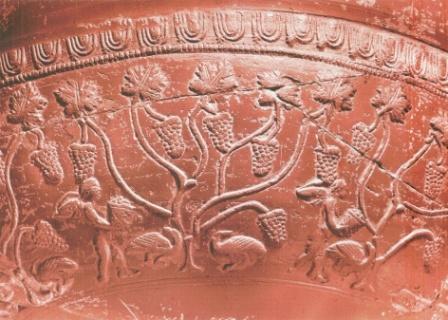
Terra Sigillata bowl found in Trier (Karl-Josef Gilles: Bacchus and Sucellus, Briedel 1999)

Vinum vires is what the Romans said, wine gives power! My suggestion for the day: open a bottle of your favourite wine and enjoy the Sunday.

Bene tibi sit “Wohl bekomms” or To your health, salute, cincin and so on

————————
Reading tip: Edgar Christoffel: “Mosel und Wein – Stimmen aus zwei Jahrtausenden”, Trier 2003