Merlot Night

July 2, 2007

Looking at the calendar, we were alarmed that quasi “half of the year is already over”. Time flies, it seems. What have we been doing? How could it go so fast? Consequently, we spontaneously decided to celebrate this event with a wine tasting on the last evening inJune.

Merlot was our choice of the day. Our wine cellar had only two brands left:

● a 2003 Hungerford Hill, Orange Merlot from the Hunter Valley and

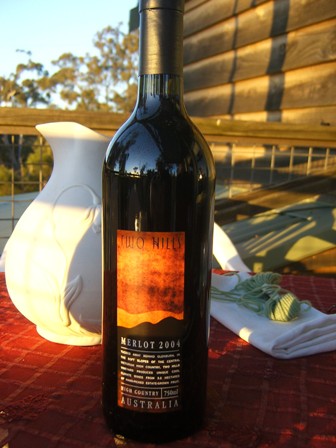
● a 2004 Two Hills Merlot from the Upper Goulburn Wine Region.

The Hunter Valley (www.hunterweb.com.au) is one of the oldest wine regions in Australia. Its flagship wines are Semillion and Shiraz but it has also pockets of cool climate sites. The Upper Goulburn Wine Region (www.uppergoulburnwine.org.au) is a significant cool climate grape growing area in Victoria with quite remarkable diversity of varieties and wine styles.

We had the two wines after dinner with a most delicious cheese, a Brie “au lait entier”, processed according to traditional methods by “Paysan Breton” and fresh baguette.

Both wines come from cool climate regions. Hungerford Hills Merlot belongs to the regional series of the brand (www.hungerfordhill.com.au). It is produced in Orange in New South Wales, a rather new location on the Australian wine map (established in 1983). Formerly it was know as the Central Highlands centred on the slopes of Mount Canobolas which is an important fruit producing area (apples, pears, cherries). The first commercially planted vineyards were established in the 1980s. The location of some of the vineyards for this regional wine is above 600 m altitude.

The 2003 vintage is under cork whereas the Orange Merlot 2004 is already under metal capsules. Both are available at duty free bottle shops in Jakarta, retailing for about 23 to 26 US$ per bottle. The internet order form of the winery shows 28 A$ per bottle for the Merlot (22.40 A$ for wine-club members). Whereas the 2003 bottle does not show wine awards stickers, the 2004 shows a gold medal and other distinctions at the 2006 Sydney International Wine Competition. The winemaker is Philip John.

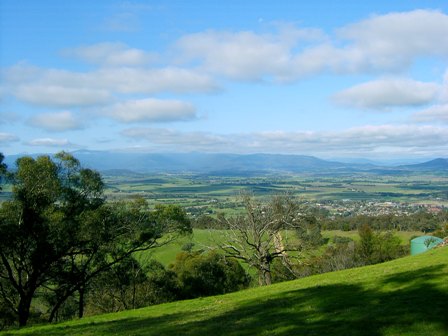
As you probably know, Two Hills Vineyard also produces cool climate wines. The Geographical Indication (GI) for the Upper Goulburn Wine Region was only recently identified (formerly also called Central Victorian High Country) but grapes have been grown there since more then 30 years. The vineyard is a single site on a slight northerly slope. The 2004 vintage is under a DIAM cork closure. The wine is made by Alan Johns, the owner-winemaker cum viticulturist of Yering Farm Wines in the Yarra Valley (www.yeringfarm.com.au). Retail price at the Old England Hotel (www.oldenglandhotel.com.au) in Heidelberg, Melbourne should be around 15-17 A$/bottle. It can also be obtained at the upcoming Upper Goulburn Wine and Food Expo (Saturday, 11th August, in Alexandra Town Hall).

picture-076webmerlot.jpg

Tasting notes
Both wines show excellent dark crimson red colours. The nose of the Hungerford Merlot shows complex aromas of wild berry fruit with a slight nose of liquorice and nutty French oak. The wine is a blend from different vineyards in Orange. It is medium bodied, has a soft finish and displays balanced tannins.

All wines at Two Hills Vineyards are hand crafted. The grapes for Two Hills Merlot are coming from a single site, the vines are hand pruned and the grapes are hand harvested. The ‘2004 Two Hills Merlot’ also displays ripe wild berry fruit but not the liquorice and nuts flavours. The wine is very subtle, elegant with great finesse. It is medium bodied, dry, with good acidity, and a long finish. Its tannins are firm and give the wine a fine balance.

Hungerford Hill, Orange Merlot 2003
14% alcohol, matured in 60% new and 40% old French oak for about 15 months

Two Hills Merlot 2004
13.5 % alcohol, matured in 90% old and 10% new French oak for about 18 months


The Many Wines

June 28, 2007

One of my favourite poets is Rumi, also know under his full name of Mawlānā Jalāl-ad-Dīn Muhammad Rūmī (Persian: مولانا جلال الدین محمد رومی, Turkish: Mevlânâ Celâleddin Mehmed Rumi, Arabic: جلال الدين الرومي, shortened to إبن الرومي). a 13th century Muslim jurist and theologian from Persia.

200px-mawlana_rumi.jpg

Rumi (from wikipedia)

For us modern, 21st century vintners and wine lovers the following excerpts from one of his poems on wine are of interest:

The Many Wines

God has given us a dark wine so potent that,
drinking it, we leave the two worlds.

There are thousands of wines
That can take over your minds.

Be a connoisseur,
And taste with caution.

Any wine will get you high.
Judge like a king, and choose the purest,

The ones unadulterated with fear,
or some urgency about “what’s needed”.

Drink the wine that moves you
as a camel moves when it’s been untied,
and is just ambling about.

(Source: cited from: “The Essential Rumi”, translated by Coleman Barks, with John Moyne, A.J. Arberry and Reynold Nicholson, Castle Books, 1997, page 6 and 7)


The top 100 Wineries in Germany

June 14, 2007

Today, I visited the website of the winery Adolf Schick (Jugenheim/Rheinhessen) which I had visited with a group of Indonesian politicians some years ago. The visit and the tasting was a great adventure, because Mr. Schick was so enthusiastic about his wines and his family business with a tradition of winemaking going back to 1590!

Our Indonesian guests were very impressed and so was I. Well, as an Australian boutique vineyard vintner I find a family business going back to 1590 very remarkable. At that time kangaroos were hopping through the forests where today, Two Hills Vineyard is located, I guess.

w_gut.jpg

Weingut Adolf Schick in the heart of Jugenheim

The winery is located in the village of Jugenheim, a very charming place, which I know from own experience. The family does not only produce high quality wines, it also owns the Hotel Weedenhof. The hotel’s restaurant is very good too. We had lunch there. The vineyard consists of 9.8 ha planted with the Burgundy varieties, Chardonnay, Rieling, Kerner, Portugieser and Dornfelder. Needless to mention that the wines won many local and national awards. The wines are very reasonably priced and you will find a wide range of different products including grape juice. All my Indonesian friends all bought some bottles of it.

As in previous years, the Weingut Adolf Schick (www.weingutschickjugenheim.de) was also in 2006 ranked (by the DLG, the German Agricultural Society) among the 100 best wineries in Germany (rank 47). Only 12 wineries from Rheinhessen can be found in the top 100. From my home region, the Mosel, 11 wineries made it into the list (www.wein.de), and only one of them came from Trier (Weingut Deutschherrenhof). I loaded down the list to plan my next excursion to German wineries when I will be visiting again in September. Happy tastings ahead of me, I guess.


The “wine map” of Trier

June 6, 2007

My friend Elisabeth from Berlin sent me an interesting article the other day. It was from the Brigitte magazine (www.brigitte.de/trier) and showed a map depicting some recommended wine bars, bistros, restaurants and country inns where fine wines and good food could be enjoyed in my home town Trier (Augusta Treverorum) at the Mosel river.

I must admit that I grew up as a beer drinker, from time to time also enjoying the local cider called “Viez” (very dry) and maybe a Schnaps called “Trester” and made from distilled pressed grapes. My maternal grandfather (Hans-Heinrich Schuessler), however, came from a small hamlet (Reichenberg) near Wuerzburg at the Main river, and was an enthusiastic wine connoisseur. In fact, it was he who introduced me at the tender age of 15-16 to the world of fine wines, mostly dry Silvaner (Bocksbeutel) from the Main region. But because he lived in Martinstein at the Nahe river, we also drank wines from this terroir. He did not like the Mosel wines much.

As you probably know, I usually patronize “Weinstube Kesselstatt” (a wine bistro) near the cathedral. During my recent visit to Trier, I found some of the wine drinking places described in the Brigitte magazine. Due to the shortage of time, however, I could not try them out. I found for instance the wine-restaurant “CUMVINO” which belongs to the diocese of Trier. The catholic church, monasteries and the clergy, were traditionally always lovers of fine wines and developers, promoters and masters of vineyards and wine production.

Other places mentioned in the magazine, I have never heard of, for instance the restaurant “Beckers” in the valley of Olewig at the outskirts of Trier in the middle of steep vineyards. I have to try some of these places. My plan for September and October, when I will be visiting Germany and Trier again, is getting fuller and fuller.

p5030692web.jpg


Single Malt

June 1, 2007

What happened, you might ask yourself? Single malt, that’s not wine! Has Rainer finally left the so much loved and appreciated result of grape fermentation behind and turned to harder drinks? Well, on a recent trip to Bangkok, my old friend Rainer Heufers, who has earlier introduced me to the amazingly complex and enjoyable world of whiskies, gave me a copy of one of the bibles for whisky connoisseurs, “Michael Jackson’s Malt Whisky Companion”, 4th edition.

What a marvellous book this is. Michael Jackson must be to the whisky world what James Halliday and Hugh Johnson are to the wine drinkers. Wine and whisky do have commonalities. For both wood is important. Vintages are clearly identified. The rating system consists of a 100 points scheme. And finally, the verbal description of the liquid as provided by the tasters show similarities with wine too. I give you some examples:

Colour: very full gold with orange tinge
Nose: fresh, soft, very aromatic, with rich malt dryness
Body: light to medium, creamy
Palate: clean, grassy, fruity, becoming cookie-like and nutty
Finish: long, firm dry, malty, restrained, dessert apple

malt-whiskey-small.jpg

The book cover: Michael Jackson’s Malt Whisky Companion

Hundreds of different whisky brands are listed and described in this beautiful book. Of some of the distilleries, photos are added. Short histories provide the readers with another kind of “bait” to explore the world of whisky on their own. Maps and detailed descriptions of the various locations, products, vintages and the distillery process invite the reader to engage and appreciate the world of single malts. Because water is so important for whisky production, many distilleries are located in glens, valleys with streams. My home in Australia is located in Glenburn, family and friends live in Yarra Glen, both places have their water and clear mountain streams.

But the whisky world is full of “Glens”. Names such as Glen Albyn, Glenallachie, Glenburgie, Glendronach, Glendullan, Glenfarclas, Glenfiddich, Glenmorangie, and Glenugie sound exotic to my ear. I decided on the spot that our next trip to Europe would include a visit to Scotland and some distilleries there, probably in the highlands or on the Spyside.

Being of Celtic extraction myself (remember the Treverer! Of the Mosel river valley), I have a soft spot for everything Celtic, as you probably know. I could combine the whisky exploration with some sightseeing. I always wanted to see Edinburgh. Among others I could fulfil one of my dreams: buy a Scottish kilt, probably a young designer item by Howie Nicholsby. They are really cool. Ever since I saw some examples of his art in an airline magazine, I hedged this idea of acquiring a kilt for myself. Tonight there is another Scottish highlight waiting for me. On the eve of the Jakarta Highland Gathering, the Java St. Andrew Society (www.javastandrewsociety.com) is organising Scotland in Concert, a splendid presentation of Scottish music. They will certainly also offer whisky, maybe even a single malt. See you there.


Country Inns in Germany: Asparagus and river perch

May 18, 2007

While travelling in Germany recently, I had a lot of fish and seafood dishes, the reason for this being that I accompanied a group of visiting Indonesians to a number of coastal towns on the East and the North Sea. Since Germany had a splendid spring, this was the more enjoyable.

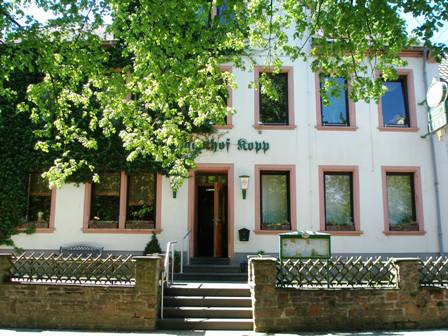
Later, together with my brother and my old folks in Trier, I visited one of the traditional German country inns so prevalent in my home area, the Mosel River Valley, the Landgasthof Kopp (www.landgasthofkopp.com) in Hentern, a small village between the Mosel tributaries Ruwer and Saar.

p4300582web.jpg

Landgasthof Kopp main entrance

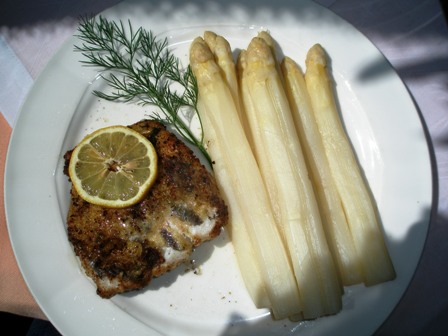
Springtime in Germany is ‘asparagus time’. Everywhere the lush white sticks can be purchased or consumed. All four of us ordered some kind of an asparagus dish. I had asparagus with perch (German: Zander).

p4300579web.jpg

River perch with asparagus

With this delicious meal, I drank the house wine, Ockfener Scharzberg Riesling, a local product from a small village on the Saar river called Ockfen (www.ockfen-home.de). Ockfen has about 700 inhabitants and of the agricultural used land of 246 ha about 90 ha are under vines on very steep slopes. The most famous terroir is ‘Ockfener Bockstein’ which is among the best wines from the Saar. The wines from this location are very dry, minerally and fruity with a good structure.

From the Middle Ages onwards it was the monasteries along the Saar river that cultivated vines and promoted the wine industry. The wealth and prosperity of Ockfen was almost exclusively based on its wine industry. The many small villages and towns along the Saar river are worth visiting (among them Saarburg, Ayl, Kanzem, Oberemmel, Serrig, Wiltingen to name only a few. I highly recommend this very beautiful part of Germany.

As regards the inn, the Landgasthof Kopp, this place is a must, not only because of the superb quality of the food and the service. The price too was a pleasant surprise, unbeatable, I must say. For the four of us, including drinks, we spent a total of only 60 Euro for a memorable family lunch.


Mama’s kitchen: tender bighorn fillet with mushrooms

May 11, 2007

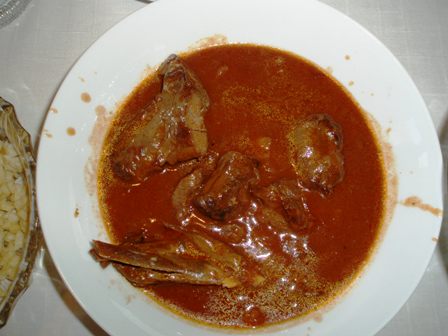
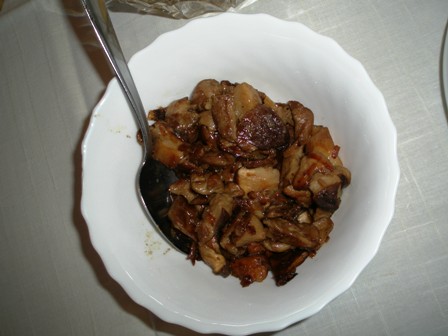
Because I am from a hunter’s family, we have from time to time dished with meat from wild animals at home. During my recent visit to Trier, my mother prepared a tender fillet of a young bighorn sheep (Mufflon in German). The young Mufflon was shot in Schoden at the Saar river by my friend Heinz. She served it with freshly collected wild mushrooms (Steinpilze also from Schoden), a cabbage salad and spaetzle (literally translated: little sparrow), a kind of tiny noodles or dumplings made with flour, eggs, water or milk, salt and sometimes nutmeg mainly used in the South German (my mother comes from Franconia), Austrian, Alsace and Swiss cuisine. I took some photos of the delicacies so that one gets a better idea. It was such a wonderful meal.

p5020662web.jpg

The bighorn fillet

p5020661web.jpg

The mushrooms

p5020664web.jpg

The old folks

When I raided my mother’s wine cellar, I found a bottle with the picture of Karl Marx, one of the most famous sons of my home town Trier. Agreed, the application (or the interpretation hereof) of his ideas has brought much misery to the world. However, now mankind knows for sure that planning economies do not work, but that market based economic co-ordination systems are much better for us all.

p5020656web.jpg

This bottle was given to me for my 50th birthday a couple of years ago. It contained a 2002 Eitelsbacher Marienholz Pinot Noir (Spaetburgunder) from the von Beulwitz Estate (www.von-Beulwitz.de), now owned by the Weis family in Mertesdorf, one of the villages at the Ruwer river, a small tributary to the Mosel (and part of the Mosel-Saar-Ruwer denomination). The Ruwer terroir has about 300 ha under vines in various locations (Ruwer/Eitelsbach, Mertesdorf, Kasel, among others). Some of the best German Riesling is grow here since Roma time. In fact the earliest findings of vine cultivation date back to the 2nd century. A stone relief called “The vintner in his wokshop” is the one of the oldest historical relicts (the other one is the wine ship of Neumagen).

p5010602web.jpg

Ruwer vineyards

The von Beulwitz estate goes back about 140 years and produces mainly Riesling wines, many of which have won international awards and trophies. The most recent one is the “Trophée d’excellence” “Riesling du monde”/Strassbourg for it’s 2003er Kasler Nies’chen, Riesling Auslese, “Alte Reben” (old vines). The 2005 Riesling Spaetlese from this location gained 97 points.

The estate grows vines on about 5 ha, mainly in steep locations in Kasel and Eitelsbach. Yields are kept low in order to produce wines of great elegance and finesse. Unfortunately, the Pinot Noir of 2002 did not fall into this superb category, it was a rather ordinary wine. But despite this, we enjoyed the meal and the wine and had a good time at home. I promised myself to try some of the award wines next time.


Upper Goulburn Wine Region – Vintage celebrations

April 17, 2007

On Saturday, 28th April, 2007 at Delatite Winery in Mansfield, Victoria, a great new festival will be brought to you by the Upper Goulburn Wine Growers Association (www.uppergoulburnwine.org.au).

Come along and enjoy new and museum vintages of elegant and aromatic cool climate wines.
The region is ideally located for the production of crisp and racy aromatic white and sparkling wines and elegant textural red wines.

The following fruit and wines are grown and made: Riesling, Gewuerztraminer, Pinot Gris, Sauvignon Blanc, Chardonnay, Marsanne, Viognier, Pinot Noir, Pinot Meunier, Merlot, Shiraz, Cabernet Sauvignon and Temperanillo.

Taste the flavours of the Upper Goulburn, listen to music from Connie Lansberg, enjoy a balloon flight chill out in the high country!

Showcasing
– A variety of aromatic whites and elegant reds – over 20 labels
– Gourmet food from the region’s best restaurants and cafes
– Regional products – olives, oils, breads, trout
– Art and sculpture
– Vintage cars
– Fun activities for the kids – puppet shows, face painting
– Balloon flights over the Delatite Vineyard
– Musical entertainment (sponsored by Crazy Johns): Jazz n Shiraz featuring Connie Lansberg

picture-077blog.jpg

Two Hills Merlot 2004


Old Friends and Good Wine

April 6, 2007

According to Plato “only philosophers have what it takes to venture outside of the cave into the sunlight”. And what do they do there (apart from eating as we know from my last blog entry)?

They drink good wine of course!

When our friend Alan Wall came over from Canberra they other day, he brought with him, as usual, some bottles of good wine. Alan is one of these people who has forgotten more about wine then many of us will ever learn. He has a fine collection of about 3,000 bottles which are stored in his insulated garage.

We started with a single vineyard wine, a Mount Pleasant 2000 Lovedale, Hunter Valley Semillion. The bottle was decorated with five trophies of gold and top gold medal signs. What a wine this was. It displayed honeyed toast and hay aromas but it also showed some lemon and grapefruit character as many young wines do. It could have easily be cellared for much longer but when old friends meet, good wine has to flow. Of course we had food with it, a delicious seafood pasta.

The Hunter Valley, one of the oldest wine regions in Australia, is famous for its Semillions and its Shiraz. Whoever plans to visit Sydney should also include into their program a trip to the Hunter Valley just a 2 hours drive north of cosmopolitan Sydney.

The main dish was grilled beef (on my Weber) and with it we drank a Coonawarra Rymill Shiraz of 1996, a very well aged and harmonious wine of great depth and with a long finish. What a delight this was with it’s spicy peppery character and the blackcurrant flavours.

After the desert we continued with a wine from Sonoma County, a Chateau St. Jean Merlot of 2004 which displayed all the good Merlot charactereristics which we are looking for, deep cherry and plum aromas, with good texture, some weight in the mid-pallate and a long finish.

Of course the company was what really counted. Drinking wine we discussed about electoral systems, political party and democracy development and the future of the young Indonesian democracy. Life is just too short to drink bad wine.

sa500267forbloga.jpg

The Yarra Valley in Victoria


A philosopher’s lunch

March 30, 2007

What a beautiful lunch we had the other day. I have to give away the secret of the most delicious dishes we enjoyed last Sunday. In fact it is not a secret at all because the recipe is from a very well known and very beautiful cookbook, the Philosopher’s Kitchen by Francine Segan.

This cookbook’s subtitle reads, “Recipes from Ancient Greece and Rome for the Modern Cook”. Nothing sounds better to the ear of a Celtic Treverer who had enjoyed Roman cuisine for a couple of centuries. We had a fish dish and afterwards a salad, that’s all, but what most delectable food this was. I would have loved to have Sucellus, Epicurus and Lucretius over for lunch that day. Only on the wine side I would have made concessions to modernity. A Sauvignon Blanc from the new world vineyards I find much more appealing than a wine of Roman times which would have needed mixing with water and honey to be drinkable at all.

Wine god

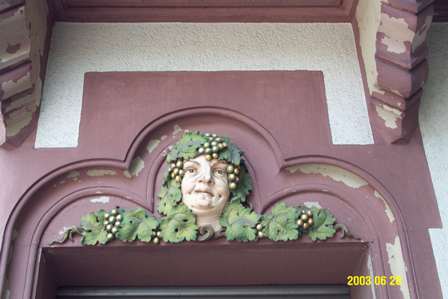
On a portal in Trier: Bacchus and vine leafs

And here is the recipe: red snapper in parchment. The ingredients are as follows:

– juice of freshly pressed lemons
– 2 garlic gloves, minced
– ¼ cup of extra virgin olive oil
– 4 bay leaves crushed
– 1 ½ teaspoons whole pink peppercorns
– 2 table spoons of capers, rinsed
– 15 oil-cured black olives, pitted and halved
– 2 red snapper fillets, without skin
– Salt and freshly milled pepper
– Lemon wedges

Mix and combine the lemon juice, garlic, bay leaves, peppercorns, capers and olives in a large bowl and soak the red snapper(in Bahasa Indonesia: Kakap Merah) in this marinade for about two hours in a cool spot. Then put the fish into the oven (up to about 200°). We put it into aluminium foil and topped it with the marinade; then closed the foil and baked it for about 10 to 13 minutes. We served the fish on a plate. We had just plain baguette with it but you can add all kinds of things, eat it with rice, potatoes, and with various vegetables. It was such a wonderful dish, mouth watering. The capers in the marinade give it a spicy edge, and this complements the white flesh of the fish. The olives and the capers take you to the Mediterranean. I could see the ocean, the sand, the beach…and taste the salt, the smells of the water….

After the main course we had a warm spinach salad. The recipe is also in the above cookbook and is called, “Baby Greens with Caper Vinaigrette”. The caper vinaigrette is similar to the marinade, just that no olives and no garlic is added. It goes as follows:

– 2 tablespoons of freshly squeezed lemon juice
– 2 tablespoons wine vinegar
– ¾ cup of extra virgin olive oil
– 3 tablespoons of capers
– Salt and freshly milled pepper
– 3 cups of assorted green vegetables

As I said, we used spinach (Bahasa Indonesia: Bayam Hijau) which we blanched before adding the vinaigrette and the warm salad did in fact complement the first dish and harmoniously end this philosopher’s meal. I highly recommend the cookbook. It makes a wonderful gift. If you love the classics and you want to delve in the past of these two great Mediterranean cultures, you should get it (www.atrandom.com).

You will have noticed that I did not yet mention any wine so far. Well, the wine I chose was a disappointment. I though a Sauvignon Blanc would go well with it, and this is certainly so. I chose a 2006 Sauvignon Blanc from Giessen of Marlborough, New Zealand, of which I had fond memories. But what a surprise. It was stale, oily and did not display any of the varietals’ characteristics of a cool climate Sauvignon Blanc. With sadness and melancholy I thought of times gone by and our own 2002 Two Hills Vineyard Sauvignon Blanc and it’s brilliant taste. Unfortunately, we were down on white wine and we just ended the meal with a port and an Italian coffee. I might have to consider buying a special wine fridge so that this cannot happen again.