Wine Bars in Jakarta – Connoisseur in Citos

November 26, 2007

Given the traffic chaos in the capital city of Indonesia, it is important to have a ‘watering hole’ somewhere nearby. Today I would like to invite you to the Connoisseur, a small wine bar in a shopping centre in South Jakarta near to my home in Lebak Bulus.

I have lived for more than nine years in Jakarta. Many of my friends assume that Indonesia is a Muslim country and that alcohol must be hard to get. Well, the majority of Indonesian people (about 85% of the population of about 220 million people) are Muslim but in fact Indonesia is a secular state as most other states in the region. Despite the terrorist attacks in Bali and other locations, the Indonesian archipelago is a very peaceful, pluralistic and tolerant place. Wine lovers have the freedom to pursue their hobby and sample fine wines. Various wine societies and circles exist with not only expats as members but with a heavy local contingent.

In 2007, however, it’s been more difficult to get hold of fine wine than in previous years. Rumour has it that there was a problem with the import licenses and that therefore only the duty free outlets have stocks left whereas other wine sellers have run out of the liquid.

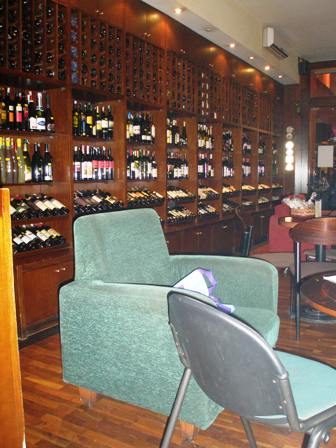
However that may be only about 10 minutes from our home is a shopping mall for the lower middle-class called ‘Citos’. This is a place bubbling with people. There are many small shops and many more little restaurants, most of them of the fast food type. On the ground floor is a small wine bar, named ‘Connoisseur’. Though the place could benefit from a renovation (some of the chairs show cigarette holes and other stains), it’s quite cosy and has a very relaxed atmosphere. The range of wines on offer is amazing. Many of the bottles on display do look a bit ‘worn’ tough with some dust accumulated and some of the labels torn. Prices seem to be reasonable. Nibbles and finger food can be ordered from the neighbouring shops and food courts.

pb230094w.jpg

The Connoisseur with wine racks

We went for some ‘save’ Australian red, a ‘2002 Wynns Coonawarra Estate Shiraz’ (www.wynns.com.au). The estate is located in the famous “terra rossa” strip which produces intensely concentrated flavours. The 2002 vintage was cooler than other years therefore the wines are elegant and show good structure. They are barrel aged (old and new oak) for about 11 months. The bottle looked a bit ‘battered’. Because of the tropical climate conditions in Jakarta one is never sure how wine was handled (sometimes one can find ‘cooked’ wine when containers or bottles spend too much time in the sun and the moist heat). The bottle was reasonably priced for Jakarta conditions (about 320,000 INR which is about 26 EURO). For comparison I tried to find some current Australian prices but I only found the 2003 vintage Shiraz on the internet for about 60 A$.

pb230095w.jpg

The wine was deep red. It showed a nose of black peppers and dark berry fruit flavours. It has a good mid palate weight and a strong finish. Margit and I enjoyed a relaxed Friday evening with a good drop of Australian wine. Come and visit us, we’ll take you there.


German wine regions: Franconia- a visit to Würzburg

November 16, 2007

Together with my mother and my brother Wolfgang, we visited the hometown of my maternal grandfather for a family reunion. The small village of Reichenberg, near the city of Würzburg was our destination. My mothers father, Hans Heinrich Schüssler, was the one who introduced me to wine and wine drinking. When I was about 16 years old he took me to the Juliusspital (one of the three big wineries in the city and winner of this years ‘Riesling of the World’ Challenge in Canberra) in Würzburg where I had my first ‘official’ glas of Franconian wine.

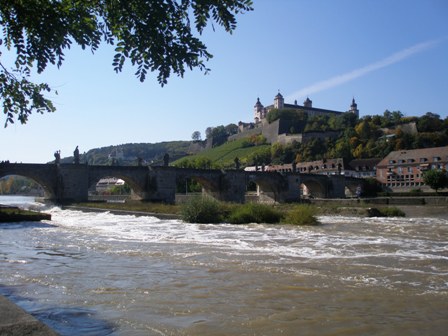
Würzburg is another ancient city where the Catholic church and its archbishops reigned. Needless to say that vineyards and wine production are an old and beloved feature of the local culture and the economy influencing its specific social habits and customs. The castle of Würzburg is one of the main features. On its slopes vines are grown as well.
p9300039w.jpg

The castle in Würzburg, with the historic bridge and the vineyards on the castle slopes

Franconia is the name of the wine region. It currently has about 6,000 ha under vines. The proportion of red varieties is low (19 %). Main varieties are white grape varieties such as Müller-Thurgau (32 %), Silvaner (21 %) and Bacchus (12 %). But, as along the Mosel river, red varieties are on the increase. ‘Franken’ (Franconia) produces some excellent Pinot Noir wines as well. Nowhere in Germany does Silvaner produce such stunning wines as in Franconia.

The shape of the local wine bottles ‘Franconian style’ is very special too. It’s called “Bocksbeutel” in German and usually reserved for higher quality Franconian wines.

p9300012boxbeutel.jpg

The “Bocksbeutel” bottle, trademark of Franconia

The above bottle from “Staatlicher Hofkeller”, the second of the three big wineries in Würzburg (the third one is “Bürgerspital”), was the first I drank with a glas enclosure in my life. It was a “2005 Hammelburg Trautlestal, Silvaner Kabinett, dry” which displayed all the characteristics of an excellent Franconian Silvaner wine. For newcomers to Franconian wine I can highly recommend this drop.

The next day after the family reunion, we visited Würzburg and had lunch at ‘Juliusspital’ (www.juliusspital.de). ‘Juliusspital’ does not only own vineyards, a winery, a historic cellar door and restaurants but also a hospital, a retirement home, an academy, a conference centre and other facilities. “Spital” also means ‘hospital’.

Juliusspital Foundation was founded in 1576 by the prince bishop Julius Echter of Mespelbrunn (a wonderful little castle in the Spessart, a beautiful region full of forests nearby). Today Juliusspital is a modern service company providing mainly health care and related services to the public but traditionally is also involved in agriculture, forestry and wine making. the Juliusspital Wine Estate is as old as the hospice.

The Franconian wine region covered in the 16th century more than 40,000 ha of vineyards and was the largest coherent wine-growing area in Europe. The decline of Franconian viticulture started with the ‘thirty Years” War which destroyed most of the vineyards in Upper and Central Franconia. After a short revival in the 18th century a second decline reduced the region to about 10,000 ha and the thrid decline was accompanied by peronospera and phyloxera outbreaks at the end of the 19th and the beginning of the 20th century. After World War II only about 2,300 ha under vines remained. Today, about 7,000 vintners cultivate the 6,000 ha under vines which produce roughly 50 million bottles and an annual turnover of about 200 million EUROs.

The soils in Franconia consist either of soils based on red sandstone, shell limestone and what the Germans call ‘Keuper’ (clay rocks), all emerging during different geological epochs some going back more than 200 million years.

Today Juliusspital Wine Estate cultivates about 168 ha of vineyards and produces more than 85,000 cases of wine. The composition of its vine varieties is about 35 % Silvaner, 22 % Riesling, 20 % Müller-Thurgau and 5 % Pinot Noir. the rest (18 %) includes Pinot Gris, Pinot Blanc, Baccus, Scheurebe, Traminer, Muskateller, and Rieslaner (a regional variety). the average yield is given with 60 hl/ha. the top locations (terroir) are ‘Würzbuger Stein’, ‘Iphoefer Julius-Echter-Berg’, ‘Randersackerer Pfülben’ and ‘Eschendorfer Lump’.

At the recently held 2007 Canberra International Riesling Challenge, the Juliusspital Wine Estate won the overall award for best Riesling of the World with its “2006 Julius-Echter-Berger Beerenauslese”. By the way, the webpage of Juliusspital shows this wine with a price tag of 47.60 EURO only.

According to the October-November issue of ‘Weinwelt’ (World of wine), a German wine magazine, the top producers in Franconia are:

♦♦♦♦ (four stars)
– Fürstlich Castellisches Domaenenamt, Castell
– Rudolf Fürst, Bürgstadt
– Horst Sauer, Eschendorf

Horst Sauer also participated in the 2007 Canberra International Riesling Challenge and won a gold medal in the ‘current vintage 2006 sweet category’ for his “2006 Eschendorfer Lump Riesling TBA” and a bronze medal for “2006 Eschendorfer Lump Riesling dry”.

♦♦♦ (three stars)
– Juliusspital, Würzburg
– Fürst Löwenstein, Kreuzwertheim
– Hans Wirsching, Iphofen
– Brennfleck, Sulzfeld (significantly improved in 2006 and newly listed with three stars)
– Hofmann, Röttingen (as above)

♦♦ (two stars)
– Walter Erhard, Volkach (improved in 2006 and newly listed as two stars)
– Rudolf Max, Retzstadt (as above)
– Max Müller I, Volkach (as above)
– Trockene Schmitts, Randersacker (as above)
– Graf Schoenborn, Volkach (as above)

♦ (one star for discoveries of the year)
– Burrlein, Mainstockheim
– Felshof. Sommershausen
– Gebr. Geiger Jun., Thüngersheim
– Max Merkert, Eibelstadt
– Reiss, Würzburg
– Markus Schneider, Volkach

Unfortunately, I have only one bottle of Bocksbeutel left in my wine fridge. Empty bottles I have in abundance (for instance “2002 Würzburger Stein, Silvaner, Kabinett, dry” of Staatlicher Hofkeller which won a gold medal, “2003 Baccus, dry” of Schloss Castell and “2003 Würzburger Stein Sivaner, dry” of Juliusspital). The bottle to be enjoyed soon is a “2005 Kitzinger Hofrat, Silvaner, dry” of Bernhard Völker. What a pity that Franconian wines are not available in my local duty free shop in Jakarta.

The red wine “pope” of Franconia is Paul Fürst (Winery Rudolp Fürst in Bürgstadt. He won “German vintner of the year” award in 2003 and “best vintner of Franconia” in 2004. His webpage is very interesting too (www.weingut-rudolf-fuerst.de).
At the wine webpage www.finewinepress.com you will find an interesting interview with Paul Fürst in English. His “2003 Spätburgunder” (Pinot Noir) is a well acclaimed and award winning wine. I will introduce you to the winery at another time.

While in Würzburg we lunched at Juliusspital Restaurant which is what Germans call “gut bürgerliche Küche”, which I freely translate as “good quality, local food” (robust and harty in nature but also with delicate and fragrant elements). We drank from the open wine list (we had to drive home). My brother had a “2006 Juliusspital Schwarzriesling (Pinot meunier), dry” and I drank a “2006 Würzburger Abtsleite, Silvaner, Kabinett, dry”, both solid wines. It was unfortunate that we could not participate in any tasting since we had to get home the same day.

The design of the restaurant, by the way, is typical for historic German country inns. When I visited the restrooms I found to my great suprise wonderful cartoons on tiles. I had to take pictures, one of which you see below.

p9300049kar.jpg

The texts freely translates as “Guess darling whom I am holding in my arm”.

Unfortunately, I do not have good photos of the family reunion. Needless to say that the three of us were overwhelmed by the hospitaly extende to us. Tables were bending under the food and wine on offer. We were talking and talking. It was so exciting that I forgot to take “intelligent” pictures with the result that I have some good ones of some of the participants but not of others. This is the reason why I will not show any of them because it would be unfair vis-a-vis the people whom I did not catch in a good enough pose. Since I have planned to take my wife and children there when we visit Germany next year, I promise to be more careful and present you with some good shots in the future.

The address of the restaurant cum wine bar is

Weinstuben Juliusspital
Familie Frank & Edith Kulinna
Juliuspromenade 19
97070 Würzburg
Tel.: 0931-54080
http://www.juliusspital.de

German Food delights

October 23, 2007

I would like to share with you some of my culinary experiences in Germany. Below you find a select few of the dishes which I had the great fortune to enjoy recently. Some of the wines I had with the food are less memorable than others, therefore don’t worry about it. I have prepared some photos.

d1000033essen2.JPG

Fish wrapped in bacon/ham

This is a very special combination. When I tasted such dishes for the first time I was quite puzzled. Germans living near the sea know them quite well but since I am a native of the deep South-West, I was rather a novice when it comes to German fish eating habits.

I would like to share an anecdote with you. I once accompanied a group of Muslim politicians to the most northerly state of Germany (Schleswig-Holstein). In Kiel, the state capital, we had ordered a filet of plaice (a local flat fish) “Finkenwerder Art”, me not knowing that this white fish is sprinkled with bacon/ham crumbs when served. The order was utterly inappropriate for pious Muslim adhering to halal food prescriptions. That’s when I learned that Germans do eat fish dishes with pork.

d1000267pasta.JPG

Pasta with scrimps (at Rolandseck Restaurant near Bonn)

d1000305suelz3.JPG

Alsacian “Flammkuchen” the German way (Weingut Sülz in Oberdollendorf)

pa150174rotebeete.jpg

Beetroot soup (Feuerbach Inn in Berlin)

In Berlin I tasted beetroot soup with goats cheese and orange slices in an inn called “Feuerbach”. Unfortunately, I started to eat before realising that I should have taken a picture of the delishes meal before digging my spoon into it. I apologize for that but the soup was so delicious that only immortals could have gotten it right. I promise to visit “Feuerbach” again and replace the picture with a “proper” one.

So far so good you might say but what did he drink with all these dishes? Well, mostly white wines from Germany but not entirely. I drank an Ahr Riesling of the winehouse Meyer-Näkel with the fish in bacon, had an 2005 Heimersheimer Pinot Noir with the seafood pasta, and since at vintage time Germans love to drink “Federweisser”, freshly fermented grape juice (see photo below), I tried some of this rather young and sweatish drink with the Alsacian Flammkuchen.

d1000346rauscher1.JPG

A bottle of “Federweisser”, not a drink common in Australia.


Excursion along the Rhine: Weingut Sülz in Oberdollendorf

October 12, 2007

Carpe diem, ‘enjoy the day’ was the motto my wife suggested I should adhere to, while away from home for the two-month long stay in Germany. I try to follow this advice and make the best out of the separation from my family. Recently I visited a place of my youth, so to speak, from my student times at Bonn University. We used to visit a wine garden-paradise called “Weingut Sülz” (Sülz Estate) in Oberdollendorf near the Seven Peak Mountains (in German, Siebengebirge) on the south side of the Rhine river near Königswinter.

d1000352drachenf1.JPG

The Dragon Rock Mountains seen from the Rhine river

The cultivation of grapes and the production of wine have a long tradition here, dating back to the 10th century. In the 14th century ‘Gut Sülz’ (the Sülz Estate) belonged to the nearby monastry of Heisterbach. A country inn was established in 1656. The estate changed hands a few times. Today Weingut Sülz is neither a vineyard nor a winery, but a lovely country inn with a large open-space garden for its many visitors.

d1000318suelz8.JPG

Sülzenberg vineyards

The location is splendid, featuring a beautiful view of the surrounding vineyards. The inn is to be found at the foot of the Sülzenberg, a vineyard location in the form of a theatre at the edge of the Seven Peak Mountains, south of Bonn. The vineyards might be the most northerly ones along the Rhine. Since land consolidation in 1973 and 1979 all vineyards in the theatre have been cultivated by the Blöser family (more about them in a separate later blog entry).

d1000306suelz7.JPG

The Sülz Country Inn

Since 1999 Andreas Lelke has been running the Weinhaus Weingut Sülz (www.weinhaus-gutsuelz.de). His list consists of more than 500 wines and has received multiple awards. His white wine list is dominated by Riesling wines. In 2000 the Riesling Society awarded Andreas Lelke its Riesling award. The German Wine Institute ranked his wine list as “very good” and the Wine Guide Gault Milau awarded its “best wine list” in 2007 to the country inn. It goes without saying that delicious food is served with the wines at Weingut Sülz.

d1000296suelz1.JPG

“What did I drink?” you might ask. Well, during my first visit I sat outside on the terrace and felt like drinking what the hill behind the inn (the Sülzenberg) had to offer. I had a choice between a Sülzenberg Riesling and a Sülzenberg Blue Portugese (Blauer Portugieser in German). I choose the latter. ‘Blue Portugese’ is an old vine variety grown mainly along the Danube river and in South-Eastern Europe. The variety has many different names in the various places it is grown. However, it has nothing to do with Portugal. I cannot recollect ever having drunk the variety before, so the tasting was a ‘maiden affair’. The picture below shows me with a glass of this dark red, but light and fruity wine in my hand. I took the picture myself, which might explain the strange posture.

d1000300suelz2.JPG


What a degustative experience: Wine tasting in Trier

September 18, 2007

I had the great fortune to spend the most amazing culinary weekend in my hometown Trier. It was organised by my friend Thomas Weber and held at a restaurant called Bagatelle (www.bagatelle-trier.de) in a place called “Zur Lauben” in Trier.

thomas1.jpg

Thomas while giving us the introduction to the degustation

There were 10 of us, Thomas and Birgit, Peter and Baerbel, Rainer and Brigitte, Uli and Hiltrud, Ulrich and myself (another Rainer). Most of us did not know each other prior to the tasting. See some of the tasters in the picture below. The glasses were not empty for long.

thewinetasters.jpg

The meal consisted of three courses: an entree, a seafood platter, a venison main course and a desert. Needless to say that the food was very delicious indeed.

seafoodplatter.jpg

The seafood platter

Thomas had selected all the wines. He provided us with information about the wine producers and he had translated all the tasting notes into German (I am not translating them back, please visit the webpages of the wine producers for tasting notes). We tasted 9 Sauvignon Blanc and 6 Merlot wines.

The ‘9’ Sauvignon Blanc wines were the following:

– 2004 “Monmousseau”, Sancerre, AC-Loire (France)

– 2006 “Nehrener Roemerberg”, Weingut Theisen, Nehren, Mosel (Germany)

– 2005 “Lands End”, Hidden Valley Wines, Elim Vineyards, Cap Agulhas (South Africa)

– 2002 Two Hills Vineyard, Sauvignon Blanc, Upper Goulburn River, Victoria (Australia)

– 2003 Clairault Estate, Margaret River (Western Australia)

– 2006 Clowdy Bay, Marlborough (New Zealand)

– 2003 Johner Estate, Marlborough (New Zealand)

– 2005 Rodney Strong Estate “Charlotte’s Home”, Sonoma County, California (USA)

– the ninth wine was what is called in blind tastings a “pirate”, i.e. a wine which is not a Sauvignon Blanc.

The ‘6’ Merlot wines were:

– 2004 Bimbadgen Estate, Hunter Valley, New South Wales (Australia)

– 2004 Two Hills Vineyard Merlot, Upper Goulburn River, Victoria (Australia)

– 2005 Merlot, Auslese Weingut Guenther Steinmetz, Brauneberg, Mosel (Germany)

– 2001 Domaine Font-Mars, Languedoc (France)

– 2004 Marques de Casa, Concha Peumo Valley (Chile)

In addition and as in the white pannel there was as sixth wine also a “pirate” among the reds.

Tasting wines without restraint is a most wonderful thing. All of the participants were wine lovers with some considerable experience. The self-introduction showed that most of them were staunch Mosel wine afficionados (some with preference for off-dry Mosel wines) with some of them with likings for Spanish red wines. But generally new world wines were seen as somehow to be not very desirable as far as their taste buds were concerned. Well, we were to be taken all around the world with this blind tasting with considerable effects as I can witness.

I only became aware that two of my own wines were part of the tasting when the paper sheets with the information on producers and the tasting notes were distributed. I was of course scared not to be able to identify my own wines and Thomas teased me with the remark, that most producers do not recognize their own wines in blind tastings that he had attended. Well, these were challenging prospects. Without bragging about how many wines I correctly identfied during the evening, I would like to point out here that I did in fact identify the two Two Hills Wines which came as a relief.

We congregated at 17 h in the afternoon and parted company at about midnight. Needless to say that we had a jolly good time. We had to match the tasting notes with the wines and to make it not to difficult, we worked with a pannel of three wines at the time. The results were given after each pannel. Therefore, the odds were not ‘too big a stew to chew’. Tasting notes are indeed an interesting lead to wine but some of us felt more at ease with their own feelings and taste buds. Needless to say that after the completion of the tasting wine drinking did not stop. The dessert called for a dessert wine. Thomas selected from the restaurant wine list (Bagatelle has a very good wine list indeed). Unfortunately, I am not sure what we drank because my tasting notes became rather confused the longer the evening lasted. Moreover, we did not restrain ourselves to one bottle only but had several instead. One of them might have been a 1997 Maximiner Gruenhaeuser Riesling Auslese from Ruwer. Thomas is of the opinion that the first ‘sweet wine’ was a 2006 Drohner Hofberg from A.J. Adam.

Saying good bye was not an easy thing after these marvellous hours together discussing and enjoying wine and food. Ulrich and I walked back home to the Irminenfreihof (located in a part of town next to the old river harbour called Britannia) where my mothers house is located in an elevated spirit.

ulrichh.jpg

My friend Ulrich in a jolly good mood

PS 1: I love certain aspects of gobalisation and modern technology: while writing this down I am listening to wonderful music from Mozart broadcasted by the ABC Australian classic radio via the internet and of course I am enjoying a glass of 2004 Two Hills Merlot.

PS 2: Ulrich is our non-profit importer of Two Hills wines to Germany.

Address:
BAGATELLE restaurant and bistro
Zurlaubener Ufer 78
54292 Trier
Te.: 0651-29722
http://www.bagatelle-trier.de


The Wine Hub

September 3, 2007

Due to an alternator breakdown, we were grounded for three days at my brother-in-law’s house in Healesville. We used the spare time to visit interesting places in the vicinity; one of them was the Yarra Valley Dairy where we had lunch one day. The dairy also houses the Yarra Valley Wine Hub (www.yarravalleywinehub.com.au),in a section of the rustic Dairy shed that is managed by Brook and Stephen Powell ,where they sell local wines usually from small vineyards and wineries. The Wine Hub specialises in single-vineyard wines. It’s a great place. Margit talked with Brook about wine in general and Merlot in particular and within a short time they agreed to conduct a tasting of our 2001 and the 2004 Merlot vintages. Brooke liked them both and ordered a couple of cases. And ever since, Two Hills wines can be bought at the Yarra Valley Wine Hub in the Yarra Dairy near Yarra Glen. Check them out when you pass by next time.

winehub2.jpg


Wine Tasting at the Alexandra Food & Wine Expo

August 23, 2007

expotasting1.jpg

The tasting chamber

During the recent wine expo of the Upper Goulburn Winegrowers Association (UGWA, www.uppergoulbournwine.org.au ), three wine tastings were offered to the visitors. The tasting took place in the meeting chamber of the Alexandra Shire Council where the mayor and the council members convene their meetings. Because Margit and I (Two Hills Vineyard) participated for the first time in an event of the Association, we took the opportunity to learn more about the wines from the region and our fellow members. Margit participated in the first tasting conducted by Les Oates, from Growlers Gully (www.growlersgully.com.au) and chairman of the UGWA. She thoroughly enjoyed herself. I was scheduled for the second one with David Miller, winemaker and partner from Rees Miller Estate (www.reesmiller.com), is one of a few certified biodynamic wineries in the region (the other one I know of is Will de Castella and his Jean Pauls Vineyard near Yea (www.jeanpaulsvineyard.com.au).

expotasting2.jpg

David Miller, winemaker at Rees Miller Estate

David conducted the tasting with great passion. We tasted four wines, two reds and two whites. The first white was a 2003 Kinloch Chardonnay (www.kinlochwines.com.au) which displayed vanilla, melon and passionfruit characters. The second wine came from Barwite Vineyards (www.barwitevineyards.com.au). It was a 2005 Riesling with showed a floral character; it was a citrus bomb explosion in the mouth. Than we moved on to the reds, in this case two Shiraz wines, the first from Snobs Creek Estate (www.snobscreekvineyard.com.au.) It was a was 2005 Shiraz. The second, a 2006 Shiraz, came from the Rees Miller Estate (www.reesmiller.com) itself. Both displayed delicious black fruit characters but whereas the Snobs Creek Shiraz was elegant and showed cherry flavours, the Rees Miller wine displayed a creamy richness that was truly remarkable.

expotasting31.jpg

The four wines

All the wines were superb; they were clean and well crafted. They showed the outstanding quality of the cool climate wines the region can produce. David did a marvellous job in guiding the largely novice tasters through the various stages of grape growing and wine making. He answered many questions and in a twinkle of an eye, two hours were gone. All the participants were very satisfied, enriched by the experience and certain in the knowledge that winemaking is art, as David put it so convincingly. They went straight back to the showroom to sample more wines from the Upper Goulburn Region. The tasting was also a great opportunity to get to know the region’s wines and it enriched the expo tremendously. A great success I would say.


Lunch at the Yarra Valley Dairy

August 22, 2007

Our car had broken down and therefore we had time for some holiday activity and therefore we had lunch at the Yarra Valley Dairy. The Dairy (www.yvd.com.au) is just outside the country town of Yarra Glen between Yering and Coldstream. It’s a great place to visit. Works are under way to extend it. Apart from various cheeses, all made on the premises with locally produced milk, there is a wide range of products on offer such as marmelades, relishes, condiments and country kitchen ware. The Dairy also houses the Wine Hub about which I am going to write another day.

yarradairy3.jpg

The inside of the Yarra Valley Dairy

Anyway, we were stranded so to say and hungry. We ordered two cheese platters and the adults among us had a glas of an earthy Yarra Valley Pinot Noir. Doesn’t the platter look delicious? We had a selection of breads with it. Needless to say that we bought some of the delicacies for home consumption. If you visit the Yarra Valley, the Dairy is a “must visit/must see” item on your itinerary.

yarradairy2.jpg

One of the cheese platters


Alexandra – Annual Food and Wine Expo

August 19, 2007

One of the highlights of our recent visit to Australia was certainly the Upper Goulburn Winegrowers Association’s (UGWA) Food and Wine Expo in Alexandra on August 11th. For the first time ever, Two Hills Vineyard participated in a wine expo, and that was truely exciting (our 2002 Sauvignon Blanc had participated in the Singapore Wine Show were the wine received a bronze medal but we were not present at the event).

Alexandra is a small but very charming country town in the middle between Mansfield and Yea, about an hours drive from Glenburn.

expo1.jpg

A sign somewhere along the road

expo2.jpg

The summary display with regional products

As newcomers to the game, our learning experience was steep. In fact we were poorly prepared indeed. However, our fellow wine growers from the UGWA welcomed us cordially and were not puzzled by our amateurish enthusiasm. Thanks to Susan Kinloch, the secretary of the UGWA, we were participating in the first place. Though we had only one variety to offer, a 2001 and a 2004 single vineyard Merlot, Susan convinced us that our participation would be welcome and beneficial. And so it was. Apart from learning how wine should be presented at such an occasions, we got to know some more of the members of our Association. Unfortunately, Charlie from Buller View Vineyard, who was to share a table with us could not make it. Our immediate neighbours were Henke Vineyard from Yark to our right and Nillahcootie Estate to our left. Large and small wineries and vineyards were all represented side by side.

expo3.jpg

The Two Hills “stall”

It started quite slowly at 10:30 in the morning but picked up in the early afternoon. Apart from wine, there were various processed foods, organic vegetables, olive products, salmon, bread and even locally produced textiles on display. We were lucky that our neighbours allowed tasters at our stall to us their spittoons. And in the end though we had only one red wine to offer, we had quite respectable sales. The joyous athmosphere had its effect also on us. Although we had to pack up rather quickly after the official closure and could not participate in the customary Wine Expo Dinner, we left the Alexandra Shire hHall rather enchanted and the firm belief that we would definitely come back next year for some more exposure in such an important regional event. We can only thank the other members of the UGWA for making it so easy for us to praticiate. It was a great experience.


Like wine: Vintage Chocolate

July 9, 2007

Vintage wine, vintage cars and vintage cigars may be in vogue right now but also other products are coming in a vintage fashion nowadays. When earlier this year my friend Jim Riddel from Minnesota visited Jakarta he brought with him a whole stack of chocolate bars from his favourite producer, Michel Cluizel and his vintage chocolate produced on small farms under controlled conditions. It’s a chocolate for adults with a fantastic unadulterated taste, many of the younger generation, used to industrially produced chocolate, does not yet appeal. Michel Cluizel (www.cluizel.com) is an artisan chocolate producer since 1948. His mission is to produce the best chocolate by vigorously selecting the best cocoa beans to produce the finest chocolate of exceptional quality. He and his four children work in the family enterprise.

In 1997 he created the single plantation chocolate series -1ers Crue de Plantation – which sounds like the denomination of any fine wine from France. In fact the concept for this product includes to find the best cocoa beans and to establish fair and long term relations with the planters. The chocolates are to be enjoyed and compared like fine wines.

We tasted the two single plantation chocolates below, the Los Ancones from Santo Domingo and the Maralumi from Papua New Guinea. From Michel Cluizel’s website I got the following descriptions of the plantation and the tasting notes:

Los Ancones – Dark Chocolate 67% cocoa

“I discovered this plantation in a splendid environment to the north east of the island of Santo Domingo, at the heart of the Caribbean where the family Rizek has produced, since 1903, exquisite cocoa beans.”

“Lengthily worked, the beans release in this chocolate their aromas of liquorice wood, then red berries and green olives with a lingering flavour of currants and apricots.”

Maralumi – Dark Chocolate 64% cocoa

“The island of Papua – New Guinea, off the coast of Australia, is an unusual origin for cocoa. A superb Maralumi plantation lies close to the East coast producing refined beans that greatly appealed to me.”

“The beans give this mellow chocolate slightly roasted and spicy flavours, fresh notes of green bananas and acidulates flavours of red currants prolonged by charming aromas of Havana tobacco leaves.”

2-chocolatesweb.jpg

Cocoa, the fatty seeds from the cocoa tree (Carolus Linnaeus), is the base of which chocolate is made. Cocoa trees are very “individual” which means that they are not suitable for large scale plantations but rather small tree gardens tended to by individual farmers. The trees are usually grown together with other useful trees, either for fruit or firewood. The tree is a native to Latin America but Indonesia is one of the major producers (third after Ivory Coast and Ghana) and blending centres for chocolate. Production worldwide has increased steeply in the last couple of years. Leading consumer of chocolate is Belgium, leading processor is The Netherlands. Chocolate tasting is organised similarly to wine tasting. After a beautiful meal I usually drink a strong espresso and relax with a piece of chocolate, if possible from Michel Cluizel.