Dorfprozelten – at the fringes of the Franconian wine region

October 13, 2008

The first part of our family reunion last July brought us to the village where my mother grew up: Dorfprozelten, a small hamlet at the banks of the Main river in Lower Franconia as the region is called. The village is situated between the small towns of Miltenberg and Wertheim.
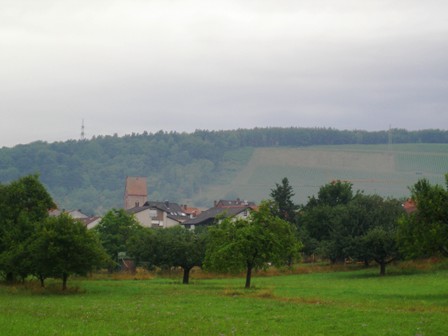
Dorfprozelten in the morning (photo taken from the meadows at the river banks). In the back one can see the location ‘Predigtstuhl’ where vines are cultivated.

I spent most of my childhood summer vacations in Dorfprozelten, lodged at my maternal great-grandmothers house in the middle of the village. Since my family could hardly afford to go on holidays as we do today, we spent our time with relatives and explored the beautiful surroundings between Spessart and Odenwald, two hilly, forested regions sanwiching the Main river.

Many of the village inhabitants were fishermen; many others were barge owners transporting goods from port to port in the inland river and canal systems which link many German lands with its neighbours. My uncle owned and operated a 1,000 tonne ship (river barge) together with two of his sons. My father often joined them during his holidays as a kind of occasional sailor.

In July this year, we arrived on a Friday two days before the fishermen would celebrate their annual local fishing festival. We should miss it all together since we stayed only for one day and one night. But on a rainy Saturday morning walk, I took the picture of this poster stuck to a tree near the river.

The billboard introduced the various fish varieties which call the river Main their home. Their numbers are on the increase ever since river pollution was reduced by the introduction of waste water treatment plants in the 1970s and 1980.
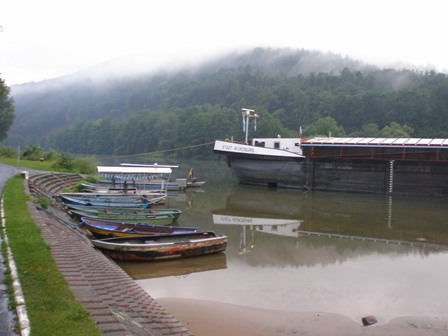
When on holidays we swam in the river as little kids until it was forbidden because of the rising pollution. My father used to swim out into the stream to greet barges, at times go on board and jump back into the rapid river waters. He was a very good swimmer. Today, swimming is again allowed because of the improved water quality.

The wine produced in Dorfprozelten does not come from “premier cru” terroir but rather belongs to the “Landwein” category (table wine or ‘vin de pays’). Among others Bacchus vines are cultivated. I am personally not a lover of Bacchus grapes and wines, but I drink “local” as much as I can.
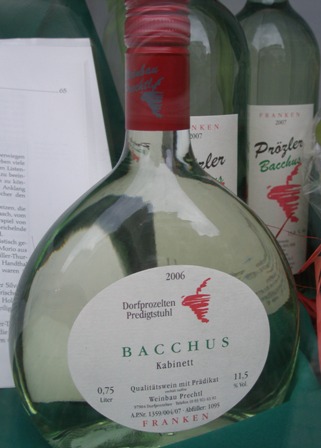
Franconian wines are often filled in traditional bottles, called “Bocksbeutel” with a rounded, big belly shape. Sylvaner is the dominant grape variety, much liked by the locals and of outstanding quality only in this part of Germany. Apart from Riesling, Sylvaner is my most preferred variety of the German white wines.

We stayed in a typical country inn, named “Gasthaus Krone”.

Country inns in Germany offer home style cooking and local German cuisine which is not easy to find these days. Most Germans eat home style dishes at home and when they go out, they are looking for some more exotic cuisines. Moreover, these days many Germans try to avoid the restaurant business because of the long working hours. Therefore, today many country inns are operated by non-Germans offering everything from Turkish, Chinese, Thai, Italian Greek and other foods. But not so in Dorfprozelten.

The rooms were furnished in a typical Southern German country style. They were clean and spacious. Ideal for two families with children. The breakfast was a delight, offering many local cheeses, eggs cold cuts, sausages, and other meats.

The menu was a typical ‘country inn’s menu with a lot of local dishes. I loved the richly decorated hard cover in thick leather.

The wine list, here the section with local white wines only, was dominated by local wines from Franconia. Unfortunately, we could not taste them all. I guess we have to come back for some more sampling.
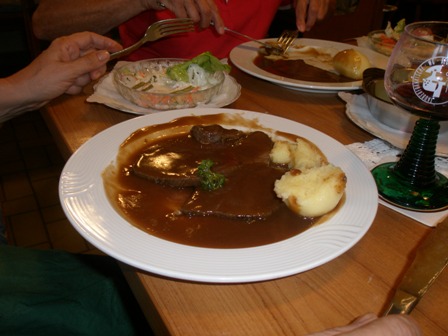
Sauerbraten with Knoedel, a hearty German country meal.

If you plan to visit Lower Franconia, I recommend you stay in this village of my ancestors for a night or two. It’s worth it, I promise.


Portugal – Quinta de Gatão

October 10, 2008

This summer we spent a wonderful week on Quinta de Gatão (www.quintagatao.com), near Penafiel, about 40 km east of Porto. “Quinta” is either translated as “Farm/Vineyard/Winery” or “Manor house”.

Quinta de Gatão is owned and managed by Mr. Jorge Coelho da Silva, a very lovely man who’s day job is being a professor at a teachers college in Porto. The property has been with the family since four generations. Five peasant families used to live and work there. Today, the vineyards are only cultivated every other year to produce vinho verde., a bottle of which waited for us in the fridge. In the mornings, fresh bread is delivred and you can find it hanging on the door. What a treat! The horse stable and the riding school were the main attractions for our daughters. The old folks were equally attracted by the vineyard feature.

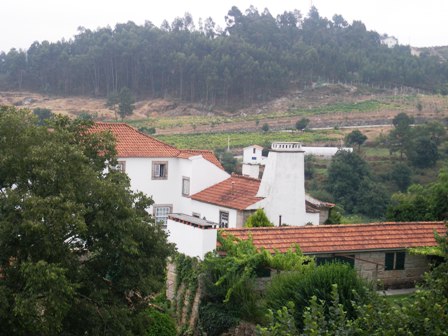
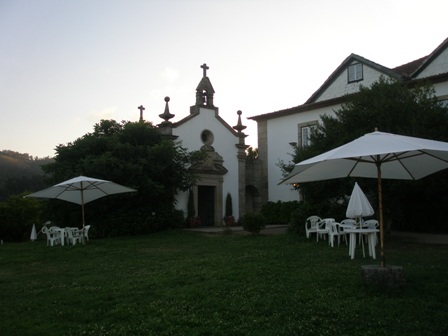
The Quinta de Gatão consists of a manor house with a chapel surrounded by various farm buildings. Some of these were converted into cottage type accommodation. We had rented one of them. Because of its elevation one has a magnificent view of the area which is quite densely populated. In comparison to the rural Australia we are used to around Glenburn, the housing sprawl in Penafiel is a bit too much. However, it does not seem fair to compare quasi empty rural Australia to the vicinity of a bustling port city such as Porto.

The Manor house from the backside

The entrance to our cottage

We loved our cottage. With its rustic rural charm it put a spell on all of us. The walls consisted of big granite stone blocks. It has a fire place in the kitchen, a bathroom and a bedroom with a loft (just as our home in Australia).

This is the place where we prepared delicious country meals

The vines are providing shade, originally to produce vegetables and other crops underneath.

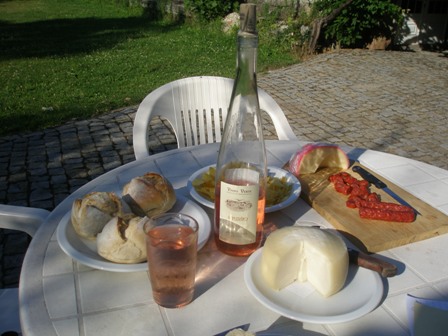
A typical snack in the afternoon consisted of Vinho Verde (here ni rose), country cheese, some sausages, olives and bread.

An Australian vintner in a Portugeuse vineyard

The swimming pool with a great view of the surroundings

Apart from the riding stable and the riding arena, Quinta de Gatão has other facilities to offer its visitors. Among them is the beautiful swimming pool, a tennis court, and a large field to play all kinds of ball games; indoor entertainment such as kicker etc. and billyard is also available. One can have long walks in the vineyards and the surrounding forests.

The entrance to the chapel

We had a great time there and I can only highly recommend the place. Actually, we plan to return next year and spend some more time in this region. We had juts not sufficient time to explore the region. There is so much to see. The Douro is close by. Porto less an an hour away. But it is the hospitality of Mr. da Silva and his family which will draw us back. There are no words to describe the welcome we received on Quinta de Gatão.

Address:
Quinta de Gatão


Henry of Pelham Family Estate Winery

October 8, 2008

In December 2007 I wrote about the Niagara Wine region in Ontario, Canada. Lorie from “Lorie loves wines” named some of her favourite wineries in this region (thanks Lorie). One of them was Henry of Pelham Family Estate Winery.

According to Lorie, Henry of Pelham make the best hybrid wines, Baco Noir in Niagara. They also make a great Gewurztraminer. Daniel Speck, one of the proprietors of Henry of Pelham Family Estate, wrote to us and introduced some of his wines.

When I surfed on youtube the other day, I found a video clip about the winery. In fact it seems that many wineries in the Niagara wine region put videos about their vineyards and wineries on to the net. Without having been to the place, I can now check it out (which I did) and when I will visit Ontario next time, I might go and taste their wines. Have a look. You will find many more video clips about Henry of Pelham on the net.


Life in the City – Bangkok

October 5, 2008

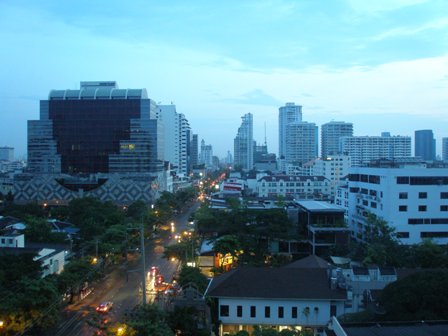
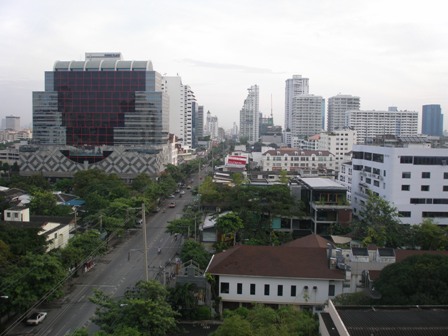
Well, it’s a month now that the family has been living in Bangkok. From a spacious house with a grand garden (I had one rose apple, two mango and five rambutan trees) in suburban Jakarta into a serviced apartment on the 11th floor in Bangkok, that’s quite a change.

The view from Centre Point Thong Lo in the evening

Both cities are mega cities in Asia with millions of inhabitants, and in fact we lived most of our 20 years in Asia in these kinds of cities (Beijing, New Delhi were the others, the only exception was maybe Singapore which was small in comparison, with only 3.5 million inhabitants). But in Jakarta we lived as if we were in one of the millions of villages on Java island, with roosters crowing in the mornings, goats bleating, a motorcycle passing, the call of the chatib from the local mosque, these were the sounds we were used to. The garden was green, which had a calming down effect on me. My tropical garden was where I could forget where I was.

Much less traffic in the morning

Without the double glazing here on the 11th floor, we would be engulfed in motorcar noise. Thong Lo is the name of the neighbourhood and it’s a lovely place with many small shops and restaurants. Most of the people living here seem to be Thai, interspersed with the odd foreigner here and there. There a quite a few wine shops and wine bars in the vicinity. I will have to explore them and report to you. Soon you will hear more about fine wines in Bangkok.


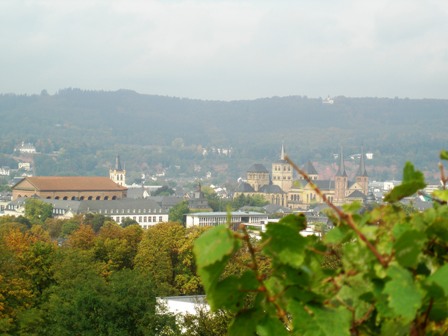
Trier, Mosel: Wine Auction 2008

October 4, 2008

The wine city of Trier (from the Petrisberg side)

According to the website www.riesling.de the annual wine auction of the “grosser Ring” (freely translated as ‘big ring’) a subdivision of the regional section of the Association of German Prädikat Wine Estates (that is how on the website of the association, the German title: “Verband der Deutschen Prädikatsweingüter” is translated) was a full success. The association has about 200 members German wide. About 13,000 bottles of wine were auctioned off. The sale brought in an amount of € 1.3 million.

The top prices were earned by wines from Weingut Egon Müller (Saar), Weingut Joh. Jos. Prüm, and Weingut Dr. Loosen, all top producers of the Mosel wine region.

The most expensive wine of the auction was a single bottle of a ‘1959 Wehlener Sonnenuhr Riesling Trockenbeerenauslese’ by Weingut Joh. Jos. Prüm which was sold for € 5.097.96. Wow, isn’t that amazing.

But also prices for recent vintages were quite high. A ‘2007 Scharzhofberger Auslese Goldkapsel’ by Weingut Egon Müller sold for € 582.62 , a ‘2007 Graacher Himmelreich Auslese Lange Goldkapsel’ by Weingut Jo. Jos. Prüm for € 485.52 and a ‘2007 Erdener Prälat Auslese Lange Goldkapsel’ by Weingut Dr. Loosen for € 449.11

Wine bar Kesselstadt in Trier just opposite the church of Liebfrauen

The auction lasted for more than 5 hours much longer than a marathon run. The general trend as far as bottle size is concerned seems to be heading towards magnum bottles. For wines filled in such size bottles premiums were paid.

The tasting prior to the auction revealed the very high quality standard of the 2007 vintage Rieling wines. On www.riesling.de you can find the detallied rating of the individual wines and the prices paid for the various lots sold.

Even for ordinary mortals like me, the auction is good news. The superior quality of the 2007 Mosel Riesling vintage will also apply for more everyday wines which I can afford. Next time in Trier I will indulge myself again. Why don’t you come with me.


Grape grower of the year in McLaren Vale

October 3, 2008

The Daily Wine News, an e-newsletter from the Australian Wine Industry Portal of Winetitles, carried the other day a summary of the McLaren Vale Annual Wine Industry Awards. One of the award winners (in the category ‘Grape grower of the Year Award’) was a vintner names Joch Bosworth of Edgehill Vineyards.

I went straight on to google the man and found a very interesting website (www.edgehill-vineyards.com.au). Joch’s wine label – the Battle of Bosworth -is named after a famous battle in England in 1485. The Bosworth family has grown grapes in the McLaren Vale region since the 1840’s. The Edgehill vineyard is located in Willunga, and was established by Peter and Anthea Bosworth, the parents of Joch, in the early 1970’s.

Needless to say that Edgehill Vineyard was converted to organic viticultural practices (in 1995) and today is a certified A-grade organic farm (certified by ACO www.australianorganic.com.au). It has some 50 acres under vines, planted to Shiraz (some more than 20 years old), Cabernet Sauvignon, Chardonnay, Viognier, Sauvignon Blanc and Mourvèdre.

What I find remarkable too is the fact that the rows between the vines are left to a “vicious” weed, the Soursob, the picture of it featuring on the wine label. The Soursob produces a very pretty yellow flower. The life cycle of the Soursob complements the cycle of the grape vines in so far as it dies off in spring and flowers and uses water in winter when the vines are dormant. Would love to know wht his neighbours say to that system.

I present you a video which is posted on Joch’s website. I do this for two reasons:

1. It is interesting to watch and informative
2. It shows the relaxed atmosphere and vine growers culture of my adopted home Australia which I treasure so much.

Enjoy watching it.

I have visited the McLaren Vale wine region only once and enjoyed the triop tremendously, but next time I will look out for Edgehill Vineyards in Willunga.

Address:
Battle of Bosworth Wines
PO Box 11 McLaren Vale
South Australia 5171
(Ganney Road, Willunga, SA)
Tel.: +61-885562441
http://www.edgehill-vineyards.com.au