St. Urbans-Hof Estate in Leiwen, Mosel

February 9, 2011

Flat vineyards around the St. Urbanshof winery in Leiwen

There are not only steep slopes and stony vineyards along the Mosel but also flat bits, as in the picture above which shows the vineyards around the winery of St. Urbans-Hof in Leiwen, Mosel.

St. Urbans-Hof Oekonomierat Nic. Weiss Estate is member in the prestigeous VDP, the association of the top wineries in Germany. I visited the cellar door on a bleak November morning last year.

The winery

The entrance to the estate

Cellar door

Cellar door

Cellar door

My purchase

Wine box with label

2009 Laurentiuslay Riesling GG St. Urbans-Hof

The tasting of German “grand cru” (GG=grosses Gewaechs) Riesling wines by the German wine magazine “Weinwelt” awarded 91 points to the ‘2009 Leiwen Laurentiuslay Riesling GG’ by St. Urbans-Hof. I bought a couple of bottles, one of which I openend with a meal of game prepared by my friend Heinz. The wine is a wonderful specimen of Mosel Riesling and shows all the marvelleous characteristics they posses.

My conclusion is that any visitor to the Mosel river should visit the wine village of Leiwen, and – ergo – the fantastic wineries and vineyards to taste these georgeous Riesling wines.

Address:
Weingut St. Urbans-Hof
Urbanusstraße 16
D-54340 Leiwen/Mosel
Tel.: +49 65 07 / 93 77-0
Fax: +49 65 07 / 93 77-30
www.urbans-hof.de


Di Vino – wine bar in Thonglor, Bangkok

February 7, 2011

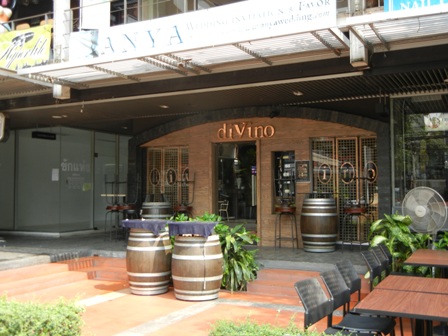
The entry of di Vino wine bar in Thonglor

If you walk through the Thonglor-Ekkamai neighbourhood in Bangkok you might come to the conclusions that wine bars are like mushrooms, sprouting everywhere.

A good place to hang out, enjoy a glass of wine and have some Italian cuisine, is di Vino, a small and cosy wine bar in Thonglor, Bangkok. The play on words is funny too, is it “divine” or “of wine”? Both I suggest.

Roberto, the manager-owner, is a very sociable guy and a pleasure to talk to. He loves quality in wine and food and he is also a good cook. For my wife he made a fegato dish (liver), very difficult to make indeed, which was just superb. And he offers some great wine choices.

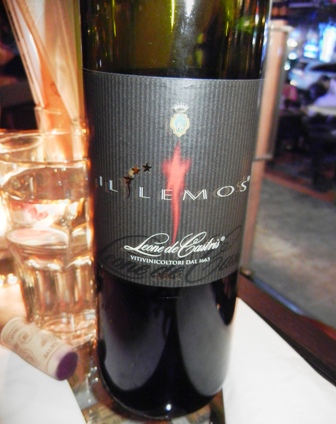
For instance the ‘2003 Il Lemos Negroamaro’ by Leone di Castris. The wine is not displayed on the website of Leone de Castris any more. You will fnid there only younger vintages. But the company has a wide selection of different wines on offer.

Leone de Castris was established in 1925 and the winery was the first in Italy which bottled rose wines. Many of its products are made from indigeneous grape varieties such as Negroamara, Primitivo and Aleatico.

2003 Il Lemos by Leone de Castris

This Negroamaro from Puglia produced in the Salento region, the heel of Italy, is just wonderful. It is a very earthy wine, rustic in character. Often it is blended with the highly scented Malvasia Negra as in the case of Salice Salentino. The grape produces some of the best wines of southern Italy.

Roberto has still some bottles left of the 2003 vintage, but you have to hurry to taste it before it is gone.

Address:
Di Vino
Penny’s Balcony, Thong Lo Soi 55,
Sukhumvit Road, Watthana, Bangkok, 10110


Max Allen, Australian wine writer, and the Upper Goulburn Wine Region

January 26, 2011

Max Allen’s book and three wines from the Upper Goulburn

One of my Christmas presents was a book on wine. I am now the proud owner of Max Allen’s latest book, titled “The Future makers – Australian Wines for the 21st Century”.

So far, I had not had the time to read it, but I glanced at the chapter dealing with our wine region, the Upper Goulburn Wine Region.

Wines from Rees Miller Estate and Jean Paul’s Vineyard

Only three of our vineyards in the region are described in the book. They are: Delatite Winery, Jean Paul’s Vineyard and Rees Miller Estate.

The latter two of these three are practicing biodynamic-organic viticulture which is, in the perception of many conventional vintners, a very complex, complicated and generally difficult way of producing wine. If you talk to biodynamic vintners that’s not at all the case; it’s different of course.

Many conventional vinters have great respect for their biodynamic colleagues. At our recent “welcome of the year 2011 party” at Two Hills Vineyard, the wine-makers and vintners present discussed the challenges of producing healthy grapes at length.

How can they (the bioynamic/organic producers) control the many fungal and other diseases, was one of the pertinent questions? How do they deal with mildew? How about the work in the winery?

Undoubtedly, many of their wines are of outstanding quality. This is also what Max Allen shows in his book. It is certainly worth to explore the production methods of the biodynamic and organic growers. In recent years also many of the larger wineries and vineyards have started to convert to more environmentally friendly methods of production.

Max Allen interviewed Will de Castella, owner and wine-maker of Jean Paul’s Vineyard, how he does it. I highly recommend the study of his answers.

Happy Australia Day veryone.


Grans-Fassian Estate in Leiwen, Mosel

January 22, 2011

Grans-Fassian Estate in Leiwen

When I drove along the Mosel on a grey Saturday morning last November, I was heading to Leiwen to buy some good Riesling wines.

There were three reasons for this trip. It all started at Frankfurt airport when I bought the December issue of “Weinwelt” (World of Wine), the German wine magazine.

1. I had looked at the results of a wine tasting of grand cru (GG = Grosses Gewaechs) Rieslings: two of the top wines from the Mosel came from Leiwen; one of them was a ‘2009 Dhroner Hofberg’ by Grans-Fassian Estate.

2. Leiwen is just a 30 minutes drive from my mothers home in Trier at one of the most beautiful bights of my beloved Mosel.

3. I love German Riesling especially if it comes from the Mosel river and I wanted to know what a 95 point wine would taste like.

The original Grans-Fassian Estate manor house with the cellar door

So off I went by car and cruised along down the Mosel. I was lucky, the cellar door was open. Here I met Catherina, one of the two daughters of the owner, Gerhard Grans who had taken over the estate from his father Matthias in 1982.

We had a bit of a chat about wine, life and the universe. Catherina is a charming young lady. She is going to be an oenology student at Geisenheim soon.

Catherina Grans showing me the top wines

I tasted two of the wines (the ones mentioned in the magazine): the ‘2009 Riesling Dhroner Hofberg’ (95 points) and the ‘2009 Riesling Leiwener Laurentiuslay’ (92 points). I tell you these are Rieslings how I like them. Wonderful wines indeed. Tropical fruit the first wine, and a kind of a citrus bomb the second. Both with a good structure, young, minerally, powerful with a long finish.

The treasure box with Grans-Fassian wines

Furthermore, I learned that the estate has about 10 ha under vines. Some of the vineyards are lokated in the best terroir of the region, for instance Dhroner Hofberg, Leiwener Laurentiuslay, Piesporter Goldtroepfchen, and Trittenheimer Apotheke.

About 88% of the vines are Riesling, 10% Pinot Blanc and 2% Pinot Gris. The brochure shows the steep slopes of some of the vineyards, most of them with a southern or western aspect. The micro climate is ideal for Riesling. The soils consisting of red, grey and blue slate.

I bought a couple of the two wines I had tasted. By the way for someone like me who pays obscene prices for wine in Bangkok, these top wines were very reasonably priced, in fact they were a true bargain. It’s a pity that wine bottles are so heavy. I knew that I could only take one, maximum two of them with me on my long journey back to Thailand. What a pity, I thought.

The wine bloggers delight

Here is another hot “secret” for your next trip to the Mosel river: Grans-Fassian Estate in Leiwen should be your destination. Trust me, you will not regret it.


November at the Mosel river

January 21, 2011

It’s beautiful to drive along the Mosel river, even in the month of November. I had this opportunity last year and thoroughly enjoyed it.

The Mosel wine route (Mosel Weinstrasse) is a fine example of a scenic drive along the vineyards and wine villages in this part of Germany which I still call home.

The winding Mosel with the slopes covered in vineyards

Steep slopes promise hard work and exquisite wines

Vines on blue slate soils

Blue slate ideal for Riesling grapes

Every individual vine got one stake

Low lying vineyards at the river bank

As many as you like

Famous terroir: Poelicher Held

Famous terroir: Kluesserather Bruderschaft

The Roman wine route

The country I come from is just beautiful. Visit the Mosel and remember the Romans did this too about 2000 years ago. Spring (and Mosel Riesling) is waiting for you.


Wine village Leiwen at the Mosel River

January 18, 2011

The wine village Leiwen at the Mosel river

Last November I had the opportunity to visit Leiwen just about 30 minutes down the Mosel river from my hometown Trier.

Grape press

Leiwen (about 1,600 inhabitants) is not only a village known as a holiday destination but it is also a famous wine village. Here quite a few of the top Mosel wineries and members of VDP, the association of the top producers are located.

Leiwen got it’s name from Livia, the wife of the Roman emperor Augustus and has a long tradition in grape growing and wine making.

Riesling vineyards

Vineyards on the flats

Riesling, the aromatic grape of the Mosel, is the dominant variety here. Many of the vineyards are located on extremely steep slopes which are hard to cultivate. The ground is mainly gray, blue and sometimes red slate.

Many signs indicate the way to the various wineries

Many, mainly small and family owned wineries call Leiwen their home. The tasting rooms and wine cellars are usually located in the middle of the village. Space is certainly an issue.

On a quiet Saturday morning, the village was almost deserted. No tourist can be found during these times of the year. Vintners were in the vineyards busy pruning their vines. But I went to taste some wines of which I will tell you more soon.

But visit if you can, next spring or summer, any time is a good time. The wines are worth it.


College Red – Sevenhill Cellars

January 16, 2011

Sevenhill Cellars ‘2007 College Red’

When I opened the bottle of ‘2007 College Red’ by Sevenhill Cellars from the Clare Valley and had the first sip I thought how awful. But after a short while only, my perception changed. The wine “opened up” so to say.

I just had to get used to the blend: one of Cabernet Franc with Malbec. Unusual somehow with dense aromas, a full palate of red and black fruit, weighty with a long finish. In Argentina Malbec is blended with many other red varieties but not so in Australia.

Beautiful. I immediately regretted that we had only one bottle of it. It came as part of a special order pack. We will have to order more from Sevenhill Cellars. At A$ 12 per bottle the wine is quite affordable.

Very dark coloured 2007 College Red

The back label

Agnolotti pasta

The blend of Cabernet Franc-Malbec went very well with the food: Agnolotti (originating from the Piedmont region of Italy) with mushrooms. It made a very pleasant lunch on a warm summers day on our farm in Glenburn.


Merry Christmas from Bangkok

December 23, 2010

I wish all of you Merry Christmas. Hope you have a peaceful and relaxing time with family and friends.

Cheers everyone

I have a poem for you. It’s from my favourite poet, Jelaluddin Rumi or Jalāl ad-Dīn Muḥammad Balkhī (Persian: جلال‌الدین محمد بلخى) and popularly known as Mowlānā (Persian: مولانا). The poem goes like this:

Say I am You

I am dust particles in sunlight.
I am the round sun.
To the bits of dust I say, Stay.
To the sun, Keep moving.

I am the morning mist,
and the breathing of evening.
I am the wind in the top of a grove,
and surf on the cliff.

Mast, rudder, helmsman, and keel,
I am also the coral reef they founder on.
I am a tree with a trained parrot in its branches.
Silence, though, and voice.

The musical air coming through a flute,
a spark of a stone, a flickering
in metal. Both, candle
and the moth crazy around it.
Rose and the nightingale,
lost in the fragrance.

I am all orders of being, the circling galaxy,
the evolutionary intelligence, the lift,
and the falling away. What is,
and what isn’t.

You who know Jelaluddin, You the one in all, say who I am.
Say I am you.


The year of living baldly

December 20, 2010

It is now about exactly one year that I cut what was left of my hair and adopted the new hairstyle which has become so prominent especially among celebrities but also among many ordinary men like me.

From Bruce Willis to Kelly Slater hairlessness has rarely been that cool. I remember of course Yul Brunner from my youth. He was not my role model, though, I was rather orienting myself towards the hairy hunks such as Frank Zappa, Ian Anderson, Neil Young or Robert Plant and Jimmy Page.

Opinion is divided about the outcome. My children just love it and my mother just hates it. She is reminiscing about the good old days when I belonged to the post-hippy or flower-power generation and my long red curls touched my shoulders. My mum treasures the memories of that time.

Well, I am not the same. About 40 odd years older, one has to think about re-inventing oneself. The central questions for some is: Is bald beautiful? To others the main question is: Is bald practical? And the third category of people might ask if it is beautiful and practical at the same time?

I of course cannot answer the first and the last question. I find practical that I do not have to dry my hair after washing them in the morning. I wet flannel is actually sufficient to clean myself now. But I have also some more work, because I have to shave my scull regularly.

But what is most important to me is that I feel good about myself. And that’s what I do. I might stay bald for a while.

Cheers, have a sip of wine and enjoy the coming festive season.


A wine tasting at the airline lounge of Lufthansa

December 4, 2010

The two wines of my sample

The only consolation for an “economy-class-only-frequent-traveller” is the use of the airline lounges. Although Beijing does not offer wine, Shanghai does even if one has to drink the fermented grape juice from paper cups.

My favourite airline lounge is the Lufthansa Lounge at Berlin Tegel Airport, but the one in Frankfurt is also acceptable.

If time permits I usually conduct a private tasting. That’s what I did last time.

The white was a ‘2009 Hugl Gruener Veltliner’, very fresh, spicy and very pleasant. Weingut Hugl, a family-owned wine business, is located in Ketzelsdorf-Poysdorf, a part of Austria they call the northern “Weinviertel”. Martin Hugl and his wife Sylvia are young and enthusiastic vintners. About 70% of their production is Gruener Veltliner.

The red I tasted was a Rioja Barbaro, a bit oaky but still with lots of fruit and very round. Overall a pleasant experience and the highlight of my trip.