Announcement: 3rd Annual Meeting – American Association of Wine Economists

November 24, 2008

Next years annual meeting of the American Association of Wine Economists (AAWE) is going to take place in Reims, Champagne/France from June 18-20, 2009. The call for papers has just been put out. Please contact Karl Storchmann (storchkh@whitman.edu or jwe@whitman.edu) for more information.

In this context I am proud to mention that the very first meeting of the AAWE took place in my home town Trier. So next year it will mean bubbly all the way. Great fun, I guess.

aawe-reims-web

Check it out.


Wine economists unite

October 30, 2008

A couple of weeks ago, Karl Storchmann made me aware of the American Association of Wine Economists (AAWE). I somehow got sidetracked, visited the website once but that was it. Now I revisited the AAWE and found out that they held their first ever congress in my dear home town of Trier in 2007. I couldn’t believe it. Their second conference was held in Portland, Oregon in 2008 and for 2009 they have selected Reims/Epernay in France as venue. This makes me somehow proud to come from this small town tucked away in the Mosel river valley in the far West of Germany.

The AAWE (please do not confuse it with the American Association of Wind Engineering or the Association of American Wives of Europeans) is a private, non-profit, educational association open to members from all over the world. The Association publishes a semi-annual journal – the Journal of Wine Economics, organises scholarly conferences and forums for wine economics research.

On the website you can also find a very interesting blog (http://wine-econ.org) and I strongly recommend visiting, brousing through it will give you many insights in the wonderful world of wine, this time from an economics perspective. Have fun.


Trier, Mosel: Wine Auction 2008

October 4, 2008

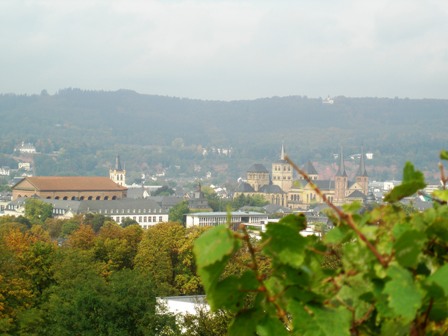
The wine city of Trier (from the Petrisberg side)

According to the website www.riesling.de the annual wine auction of the “grosser Ring” (freely translated as ‘big ring’) a subdivision of the regional section of the Association of German Prädikat Wine Estates (that is how on the website of the association, the German title: “Verband der Deutschen Prädikatsweingüter” is translated) was a full success. The association has about 200 members German wide. About 13,000 bottles of wine were auctioned off. The sale brought in an amount of € 1.3 million.

The top prices were earned by wines from Weingut Egon Müller (Saar), Weingut Joh. Jos. Prüm, and Weingut Dr. Loosen, all top producers of the Mosel wine region.

The most expensive wine of the auction was a single bottle of a ‘1959 Wehlener Sonnenuhr Riesling Trockenbeerenauslese’ by Weingut Joh. Jos. Prüm which was sold for € 5.097.96. Wow, isn’t that amazing.

But also prices for recent vintages were quite high. A ‘2007 Scharzhofberger Auslese Goldkapsel’ by Weingut Egon Müller sold for € 582.62 , a ‘2007 Graacher Himmelreich Auslese Lange Goldkapsel’ by Weingut Jo. Jos. Prüm for € 485.52 and a ‘2007 Erdener Prälat Auslese Lange Goldkapsel’ by Weingut Dr. Loosen for € 449.11

Wine bar Kesselstadt in Trier just opposite the church of Liebfrauen

The auction lasted for more than 5 hours much longer than a marathon run. The general trend as far as bottle size is concerned seems to be heading towards magnum bottles. For wines filled in such size bottles premiums were paid.

The tasting prior to the auction revealed the very high quality standard of the 2007 vintage Rieling wines. On www.riesling.de you can find the detallied rating of the individual wines and the prices paid for the various lots sold.

Even for ordinary mortals like me, the auction is good news. The superior quality of the 2007 Mosel Riesling vintage will also apply for more everyday wines which I can afford. Next time in Trier I will indulge myself again. Why don’t you come with me.


Augusta Treverorum – home at last

July 24, 2008

My hometown of Trier (lat.: Augusta Treverorum) from the ‘Kockelsberg’

Alas, we made it. Grandparents were very happy to see us. Blue sky and summer sunshine greeted us. A splendid holiday awaited us. In short, Germany at its best. We are so lucky.

The Mosel river

Margit and I, we went to check out our favourite “watering whole”: the wine bar of Reichsgraf von Kesselstatt opposite the cathedral and the church of “Liebfrauen”.

The ‘garden’ of the wine bar

Riesling was our choice. We had a ‘2007 Kaseler Riesling dry’ (subregion: Ruwer) and a ‘2007 Wiltinger Riesling dry’ (subregion: Saar). Both wines were young and fresh, which make them a delicious drink in a hot summers day. We both preferred the wine from Wiltingen, Saar.

Cheers, and “zum Wohl” as the Germans say.

PS: I am loading this up from a small flat in Madrid which we rented. The internet connection is weak and blogging difficult. Please bear with me.


Mother’s day – lunch at home

May 12, 2008

Normally we go out for lunch at Mother’s day. But on Sunday we stayed home. Margit cooked a beautiful meal. We had prawns and a risotto “arrabiata”, nice and spicy and a fresh green salad.

It was a beautiful tropical day, the beginning of the dry season in Jakarta. Our garden is lush and green, some of my orchids are still in bloom. In short it was wonderful at home, not disturbed by anybody.

The prawns

The risotto “arrabiata”

A bottle of Mosel Riesling from Trier

Well and what did we drink with the food? I raided my little wine cellar and dug our one of my last bottles of Mosel Riesling. This time a wine from Staatliche Weinbaudomäne Trier, a ‘2005 Avelsbacher Hammerstein Riesling Kabinett’.

It was, I would say, a semi-dry Riesling, maybe a bit on the sweet side. Anyway, it was too sweet for me, but matched the spicy risotto perfectly. The wine has only 8.5 % alcohol; it is fruity, spicy and aromatic, with a good body, structure and length. It was awarded a gold medal by the state of Rheinland-Pfalz’ wine show.

A firework for the nose

The Staatliche Weinbaudomäne (it means ‘estate’ or ‘domain’) is owned by the state of Rheinland-Pfalz. Today, it cultivates about 31 ha of vines at various locations near Trier along the Avelsbach stream, a brook of 4.6 km length which flows into the Mosel river.

In 1996 the estate celebrated its 100 anniversary. It was founded in 1896 by the then Prussian State government and covered about 200 ha under vines consisting of three separate estates, Avelsbach, Ockfen and Serrig, two of which were located at the Saar, another tributary of the Mosel.

The Avelsbach is divided into five ‘terroirs’ (locations), Altenberg, Herrenberg, Kupp, Hammerstein and Rotlay (the last of which is not in production any more).

Interesting is that this wine must appeal to Japanese consumers because of the dozen wine sites a search leads you to, at least 50% were in Japanese characters.

Address
Staatliche Weinbaudomäne Trier
Deworastrasse 3
54290 Trier


Dr. Loosen, I presume

May 11, 2008

Last night we went to dinner with our dear old friends Liz and Walter. After nibblies (as we say in Australia) at their home we proceeded to Cork and Screw, the very hip and extremely trendy restaurant in Jakarta.

The food was excellent as always. We had an Australian Shiraz with the meals and moved on to dessert. Three of us had crème brûlé; Liz had some kind of chocolate dessert. There were only three wines to choose from, two “half bottles” and a Riesling Spätlese and can you imagine from where? The Mosel!.

And what was it? I could not believe my eyes, a ‘2006 Dr. Loosen Wehlener Sonnenuhr Riesling Spätlese’ for only about 33 €. We needed to have this wine. What a bargain. Usually one cannot get any Mosel wine here in Jakarta. I could have kissed the people from Cork and Screw and Vin +, the wine shop associated to the restaurant.

The empty bottle ‘2006 Wehlener Sonnenuhr Riesling Spätlese’, Dr. Loosen, Bernkastel, Mosel

I must admit that though I come from the Mosel, I have never had a bottle of Dr. Loosen’s wine (www.drloosen.com). He is such a famous vintner, sitting on all kinds of wine juries, all over the world. It had to come to that. I tasted his wine in Jakarta, a couple of thousand miles from home. The major German Riesling portal (www.riesling.de) lists him as the top vintner of their top 10 wineries.

“Wehlener Sonnenuhr” is one of the prime terroirs (about 65 ha) on the Mosel, all on steep slopes. A sundial is to be found right among the vines and that gave the location its name.

Wehlener Sonnenuhr (source: www.drloosen.com)

The wine has only 8% alcohol and was the perfect match with our dessert. Of course we drank it too young, but we had no choice, waiting was just not feasible. The wine displays and expressive nose, shows apple, lemon, almonds and nuts. The acids were well balanced and the full sweetness gives it a round and lingering finish. We all loved the wine.

When the waiter wanted to clear the table I told him my story: that I was from Trier, Mosel , not far away from where this wine came from and that I wanted to take the empty bottle home. “Tidak apa apa”, the kind man said, meaning “no worries” in Australian, and he gave me a Cork and Screw bag to carry the bottle.

How wonderful. If you happen to be in Jakarta one of these days, have a meal there; it’s certainly worth it: great place, great service, great food, great wines.


Country Inns in Germany – Klostermühle, Ockfen, Saar

May 5, 2008

When I am visiting my hometown Trier I always try to arrange an outing to the Saar, my most favourite tributary of the Mosel (the other one I love very much, is the river Ruwer).

One day in March my mother, my friend Heinz and I, we went for lunch in the countryside. It was March. Spring was waiting in the wings, but could not get through as yet. However, it was a beautiful day. We choose the Klostermühle in Ockfen, Saar, as our destination, a winery cum hotel and restaurant (www.bockstein.de).

Winery-Hotel-Restaurat Klostermühle in Ockfen, Saar

Pork tenderloin with Spaetzle, a German type of noodle dumplings

The food was delicious, typical country inn style, rustique, big portions, in short: value for money type of food. I had one of their Rieslings with my food. Ockfener Bockstein is the name of the most famous location (terroir) in this neck of the wood. It was a very typical Saar Riesling, low in alcohol but zippy and fruity, with complex acids, a good structure and a long and intense finish.

After lunch we drove though the vineyards of Ockfen. On our way to Schoden where Heinz together with some friends is renting a hunting ground, we passed by the “Bockstein” which you can see in the picture below (where the tree line on the hill in the background is ending).

Ockfener Bockstein, one of the most famous “terroirs” of the Saar

The Saar is a very picturesque wine region and tourist destination in southwestern Germany and certainly worth a visit. Do it regularly as I do. The Riesling wines are among the best of Germany.

Address
Weingut – Hotel – Restaurant Klostermühle
Fam. Minn
54441 Ockfen, Saar
+49-6581-9293-0


“Ze Lawen – Zur Lauben – At the arbour” – Trier at its best

April 18, 2008

In the dialect of Trier “Ze Lawen” translates into high German as “Zu den Lauben” which can be transcribed into “At the arbour” in English.

What is it, you might ask.

Well, it is a part of the city of Trier. In the 18th century it was a small fishing village at the outskirts of the city just beyond the ancient city walls. Later it was transformed into garden arbours used by city folk to spend their Sundays where they relaxed in the shade of their small garden houses.

Today, “Ze Lawen”, located directly north of the Kaiser-Wilhelm bridge, consists of a small stretch of beautiful historic buildings along a very picturesque strip of the Mosel river. Over the years many of the fishermen’s houses were turned into small country inns, eateries, bars and restaurants with a great variety of local foods and drinks on offer. Actually if you look for a culinary delight in Trier you have to visit this part of the city. Needless to say that you can enjoy all the many famous Riesling wines produced along the Mosel and the surroundings valleys of Saar and Ruwer.

I will take you on a quick walk around this part of town (only a 200 meters stretch). Below, thats what it may look like in summer, in the background the Mosel and the red sandstone cliffs.

With friends eating out in “Ze Lawen”

During my recent visit to Trier I took some more photos. One can, for instance, find some stone mason work depicting scenes from Roman times, usually the delivery of rental payments as below.

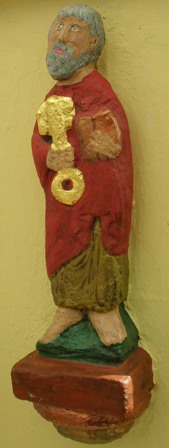
The patron saint of Trier is St. Peter. He is usually depicted holding the city keys and the bible as below.

Now we enter from the north. The first “Wirtshaus” cum restaurant is the “Schwarzbierhaus” to the left. Further on is another well known restaurant: “Pfeffermuehle”.

Other must visit places are “En de Lauben”, “Alt Zalawen”, “Mosellied” and “Bagatelle” (bistro/cafe), a restaurant where we had the most amazing food and wine degustation last year (a summary you will find in this blog).

The entry to the “Schwarzbierhaus”

The old lintels of the door frames shown belwo, usually also in stone, demonstrate that it was fishermen who once lived in these old houses. The most popular motives are fish or gear from fishing boats.

I hope this enticed you to put the city on you map. See you again in “Ze Lawen” one of these days. Its always worth a visit.


Wine Bars in Trier – Palais Walderdorff’s

April 12, 2008

There are so many good wine bars in Trier. This time I would like to introduce you to the Palais Walderdorff’s just across the cathedral in the heart of town. Its consist of a wine bar, a cafe and a restaurant and is a great place to visit.

The Walderdorff’s entry in summer 2007

I was pleasantly surprised to also find a wireless internet access, free of charge which made it even more convenient to drop by have a drink and surf the net.

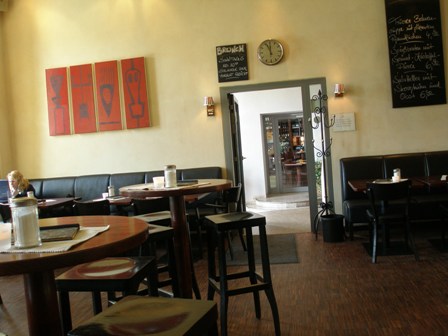
The inside of the Cafe, opposite the entry to the Vinothek

Espresso

The Vinothek has a great selection of local Mosel, other German and international wines. I drank a local Rielsing which was delicious of course.

Address:
Palais Walderdorff’s
Domfreihof 1a
54290 Trier


Homecoming – Trier, Mosel

April 8, 2008

Vineyards in Trier

Vineyards on left side of the Mosel near Trier

I listened to Keith Urban’s “Once in a lifetime” on my i-pod when riding into Trier on the train from Koblenz. It was the first day of April.

“But you’ve never been this loved (mm hmm)”, says the forth line of the first stanza and it seemed to summarise my feelings.

I was very happy to have reached the place where I grew up.

Spring greeted me and the sun bathed the hills surrounding the old Roman city. What a perfect day, I thought; how lucky I was. And it turned out later that it should be the only ‘spring day’ during my short visit. Snow and ice should clebrate a comeback a couple of days later.

Behind me lay a wonderful train trip through the charming settlements and small towns of the Mosel river valley: Winningen, Kobern-Gondorf, Alken, Moselkern, Treis-Karden, Cochem (a long tunnel ride depriving me of any view of my beloved Mosel), Ediger-Eller (crossing the river into yet another tunnel) and into Bullay. More tunnels were to follow and we crossed into the Eifel hills leaving the river behind us. The next vineyards would re-emerge in Schweich, near Trier.

It was a glorious morning ride on the train. The Mosel river valley showed its best side and the train trip from Winningen to Bullay is the most enjoyable part. I was listening to music from Sting “Songs from the labyrinth”, a collection of songs from the 16th century. What perfect music for such an historic ride along the shores of the Mosel river.

I followed it up by listening to Alan Stivel and his Celtic Music collection and in my inner eye I could see the original settlers of the area, the Celtic Treverer working the valley and the steep vineyard slopes. This was the perfect music for a homecoming. Here and there castles and ruins thereof greeted us from the hilltops.

Spring had just arrived. Fruit trees were in flowers, apples, pears and cherries in white or a soft pinkish white, peach trees in dark pink. Nature is ready to rock; just a few more warm days and everything will be covered in soft green colours. The willow trees pushed already their sprouts. All other trees, the birches, beech and oak trees on the hills were bare.

The train went along the river through meadows and paddocks, fields and forests. Thousands of years the Mosel flowed through this landscape. River barges made their way down or uphill through the brownish water. White swans working on their nests. The sun blinded me while riding along in the train. Who would have know that these hills would mean so much to me one day?

The vineyards were well tended, immaculate, only some belated vintners were busy binding the canes to the wires or the stakes; soon the buds of the leaves would burst.

Only the dirty train windows prevented me from taking pictures.

At my mothers house a delicious lunch would wait for me (and some Two Hills Merlot of course). Homecoming, it was the second time for 2008, that I had the opportunity to come back to the town I was born in. What a joy.
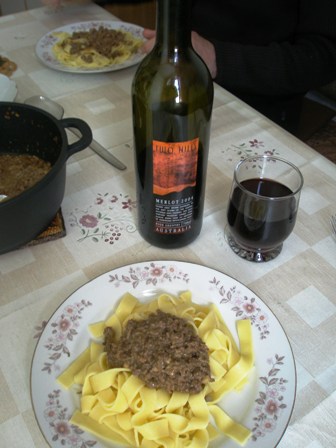
Noodles and Two Hills Merlot