The Treverer

February 4, 2007

The first time the river Mosel is mentioned in a written document is the account of Gajus Julius Caesar in his De Bello Gallico, IV in 55 B.C. where he describes his battle and the subsequent victory over two German tribes, the Usipeter and Tencterer. Around the same time we also learn about the original settlers in the Mosel river valley and around Trier, the Celtic Treverer.

“The Treverer are cleverer” sounds a line in a popular song of a local rock music group called “Leiendecker Bloas”. But not only that. The Treverer were feared by the Roman invaders as well.

Treviros vites censeo. Audio, “capitales” esse; mallem, auro, argento aeri essent.

This is what Marcus Tullius Cicero wrote to a friend during Caesar’s war against the Treverer in about 55 B.C. In a free translation that reads as “better avoid the Treverer; they go for your throat. I wish those guys would rather work as silver and gold smiths”. The Romans in fact had some troubles in controlling the Celtic population of the Mosel valley. In 69/70 A.D. the Treverer revolted against the imperialists from Rome but were defeated again. The Roman general Petilius Cerealis did not lose his composure in battle despite the fact that his cavalry was already wiped out, his camp fortification destroyed and the walls overrun by the fierce Celtic fighters from the Mosel.

But over the decades that followed the Celtic swineherds were transformed into vintners and the people thanked the god of wine – Sucellus – for this. The Treverer were known to be hungry for fame, quarrelsome and rowdy. They were also known to be big drinkers, more so than even the Germans. The many drinking competitions they held are ample proof of their favourite pastime. The ones who could not drink were despised as weaklings. That people could call themselves lucky if they got away alive from those fierce drinking competitions, was a common notion. That’s how it was: The good old days. These times have long gone and modern man does of course some drinking here and there but we are all more or less domesticated in some way or another. We go to work 5 days a week. We do sports in our free time, watch TV, send sms and e-mail, write blogs and so on.

Joseph Roth in “The Radetzky March” describes the changes at the turn of the 19th to the 20th century but his description can certainly also be applied to earlier times and ages.

Everything that grew took long to grow
and everything that ended took a long time to be forgotten.
Everything that existed left behind traces of itself
and people then lived by their memories,
just as we nowadays live by our capacity to forget,
quickly and comprehensively.
Schale

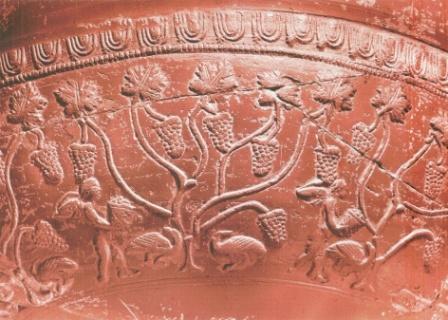
Terra Sigillata bowl found in Trier (Karl-Josef Gilles: Bacchus and Sucellus, Briedel 1999)

Vinum vires is what the Romans said, wine gives power! My suggestion for the day: open a bottle of your favourite wine and enjoy the Sunday.

Bene tibi sit “Wohl bekomms” or To your health, salute, cincin and so on

————————
Reading tip: Edgar Christoffel: “Mosel und Wein – Stimmen aus zwei Jahrtausenden”, Trier 2003


Sunday Lunch with Riesling from the Saar River

January 29, 2007

What a wonderful weekend this was. It goes without saying that I had “to weber” some of our food; to be precise it was my task to barbecue Sunday’s lunch. As our house guest David is vegetarian it meant that I had a lot of “veggies” (as Australians commonly call vegetables) to prepare. But we had also fresh fish, a Pomfret as it is commonly known. There are two varieties, the white and the black pomfret. The Indonesians call the former “Bawal Putih”. White pomfret has an excellent flavour and is commonly used for a dish called Ikan Asam Manis (sweat & sour fish); needless to say that it is very delicious either steamed or grilled.

The White Pomfret

The White Pomfret (from Kaarin Wall “A Jakarta Market”, page 53)

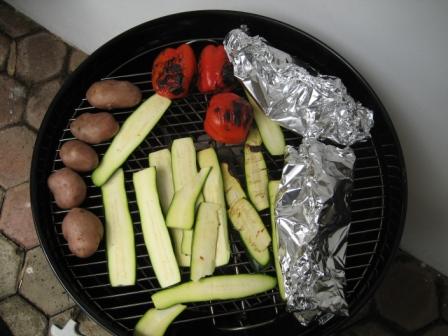
First, I grilled the vegetables: potatoes (after they were boiled), onions, capsicum, green peppers, and zucchini. The fish was marinated with black olives and capers and wrapped in aluminum foil to keep it moist. I put it on for only about 20 minutes. The food was delicious and we had the right wine to go with it.

misha2-097w.jpg

My Weber with the vegetables

We drank one of my last two bottles of Van Volxem Saar Riesling 2003. This wine estate is located in Wiltingen (www.wiltingen.de), a village about 20 km south of Trier at the Saar River, a cool climate region belonging to the Mosel-Saar-Ruwer area. The lower Saar is a very small winegrowing region but has some of the best Grand-Cru locations for Riesling (for instance Schwarzhofberg) on which its reputation is based.

misha2-111w.jpg

The 2003 Van Volxem Riesling

Van Volxem is the oldest estate in the Saar. Formerly a monastery, the estate belonged to the Van Volxem family for four generations. In 1999 it was purchased by Roman Niewodniczanski of the beer brewing Bitburger family. Based on old tax records, many excellent and sometimes forgotten vineyard sites were newly acquired when the estate was expanded. Most of the more than 20 ha are planted with Riesling vines. The first vintage was bottled in 2000 and ever since elegant wines with excellent ratings were produced under a system that avoids the German “Praedikat system”. Unfortunately, the estate’s internet presentation is still under construction. Therefore, we have to wait a while longer until you can visit www.vanvolxem.de.

sa500041w.JPG

A typical Saar vineyard

The soils of the Saar are based on blue-black slates and very stony. The vineyards are located at steep southerly slopes. The key for the Van Volxem Estate’s success are late harvests and low yields, environmental friendly practices (no pesticides) and low input cultivation techniques (no chemical fertilizers), relying in the cellar on natural yeasts fermentations and maturation in oak barrels. The 2003 dry Riesling blend has 12% alcohol. It was the first vintage producing dryer wines. 2003 was a ripper year as regards the weather and this might explain the higher than usual alcohol content of the 2003 vintage. Some of the wines are produced from more than 100 years old vines. The 2003 Riesling is medium bodied, had a buttery aroma and displayed some sweetness. It showed some mineral characteristics, had a fruity nose and a long finish. It is terrible that I have only one more bottle left of this excellent vintage (www.riesling.de). Wines do not age well in the tropics, even if you keep them properly refrigerated. There is always the odd power failure which destroys your well thought through cellaring program.

The drinking of Saar wine reminds me of my youth when my father and his friends used to go hunting in Schoden, a village further upriver. Often groups of hunters would descend on the Saar villages after successful campaigns and dine in one of the old rural inns (Gasthoefe). When at home with my mother in Trier, we often set out for long walks in the forests covering the hills above the Saar. From there one has a magnificent view of the lovely countryside.

From Schoden

Vineyards in a distance

sa500039w.JPG

The Saar Valley, the village of Biebelhausen in front on the left side of the Saar, behind the terroir “Ayler Kupp”, and to the left further back the famous village of Ayl.


Wine Mythology

January 11, 2007

There are various mythical stories about the god of wine in different cultures. For the Greeks it was Dionysos, for the Romans Bacchus and for the Celtic Treverer in the Mosel river valley it was Sucellus. Sucellus was not the god of the wine consumer as were Bacchus and Dionysos, but the god of the grape and wine producers, the vintner, the cooper, and the winemaker.

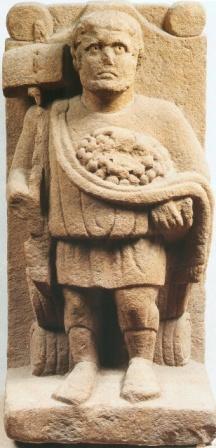
The picture below shows this Celtic god as he is usually depicted, with a sledge (or long-shafted hammer), grapes and some barrels. The statue was found in 1976 in a Roman villa near Kinheim in the district of Bernkastel-Kues, 50 km from Trier downriver on the Mosel (www.bernkastel-kues.de). You can see it in a wonderful book by Karl-Josef Gilles with the title “Bacchus and Sucellus” . The book gives a wonderful insight into grape and wine cultivation along the Mosel river during Roman times.

Sucellus