German Wine Regions: The Saar

June 28, 2008

One of the premium Riesling producing wine regions in Germany is the Saar, which is part of the Mosel region (the English usually call it Moselle, using the French word for the river). In fact the Mosel Wine Region used to be called (until 2007) “Mosel-Saar-Ruwer”, the latter two being small tributaries to the larger Mosel river. Along the three rivers about 13,400 ha are under vines these days, most of the vineyards are to be found on steep slopes, offering breathtaking views.

The village of Wiltingen, home to many famous wine producers along the Saar

Along the river Saar vine cultivation goes back a long long time, roughly 2,000 years only. Until Napoleon conquered this part of the various German lands, most wineries were in possession of the catholic church, monasteries, and other clerical institutions. Napoleon secularized the administration and with it most vineyards and wineries came into private hands.

The area between Serrig and Konz is the main production base of the Saar. Further upriver only small and singular plots are planted with vines. The most renown wine producing villages along the Saar are
Serrig, Saarburg, Irsch, Ockfen, Ayl, Schoden, Wiltingen, Kanzem, and Wawern. Moreover we find vineyards along one of the smaller side valley’s Filzen, Koehnen, Nieder- and Obermennig, Krettnach and Oberemmel.
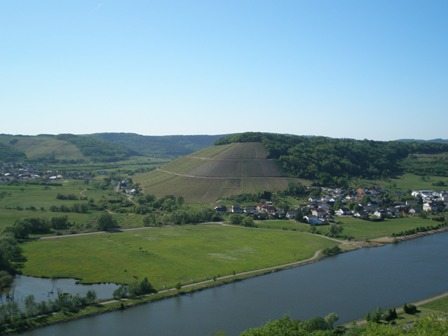
Ayler Kupp, one of the prime ‘terroirs’ of the Saar

The dominant variety is, of course, Riesling. The total area under vines is about 1,500 ha, mostly on steep slopes with gradients of up to 55 per cent. Other but minor varieties are Pinot Noir, Dornfelder, Pinot Gris, Rivaner, Kerner and Pinot Blanc. The soil consist mainly of blue Devon slate soils. The alcohol content of the wines is usually low (between 8 and 12 %), but the acidity of the wines shows excellent structures and compositions and this is why the wines can be cellared for long periods of time.

Steep vineyards in Ockfen
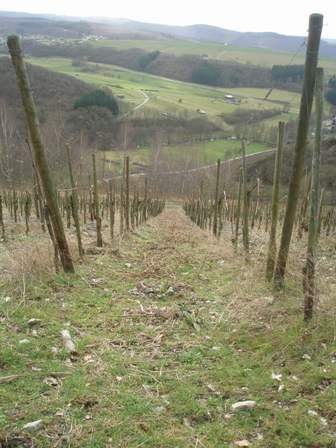
The vineyards are ready for spring to come

The two photos above were taken in Ockfen, showing vineyards in the location ‘Ockfener Bockstein’, one of the prime ‘terroirs’ in that village.

Springtime and lots of work to do to make the season a success. Lime is distributed by hand in the vineyards, here in Schoden.

There are many prime wine producers along the Saar. The top estate is probably Weingut Egon Mueller (also called the godfather of Saar Riesling) – Scharzhof in Wiltingen. Among the highest rated Riesling wines in Germany (on www.riesling.de) Egon Mueller has three of the top eight wines.

But there are many other prime producers. I can only mention a few. For instance Weingut Fortsmeister Geltz-Zilliken in Saarburg, or Schloss Saarstein in Serrig. Then there is the rising star, Roman Niewodniczanski and his team at Van Volxem in Wiltingen. His wine maker, Dominik Voelk, is young and ambitious, and by the way is a native of Franconia, a wine region with long traditions in excellence. When I visited the estate in March, he had completely sold out all his wines. I am now waiting for the release of the newest vintage in September (grand cru only). Then there is Weingut Dr. Siemens in Serrig and Weingut Peter Lauer in Ayl.

Also other producers are worth mentioning. Weingut Reichsgraf von Kesselstatt, which operates a wine bar just across the cathedral in Trier (Trierer Dom), possess vineyards in Wiltingen. Four star ratings were awarded to Weingut von Orthegraven in Kanzem and Weingut von Hoevel in Konz-Oberemmel but there are many others who produce excellent Saar wines.

I love the Saar Rieslings with their well balanced, “filigree like” acid compositions. I love them for their explosiveness, zest, intensive aromas; they have structure and balance, are low in alcohol and usually impress with a long finish, lingering on your tongue’s taste buds like ballerinas which you can still see before your inner eye long after they left the stage.

I encourage you to visit the Saar and sample as many wines as you can, it’s worth it, definitely. This time of the year should be perfect, as the pictures below demonstrate. I hope they can entice you to give it a go and lure you to the Saar.

Explore the beauty of my home region, do not forget to visit Trier, its just around the corner.

Vineyards in Schoden

The ‘terroir’/location ‘Herrenberg’ in Schoden

Near Schoden the Saar is most picturesque. The hills, the forests, the river and the small villages offering local food and wines make the Saar a prime destination for tourism.


Mother’s day – lunch at home

May 12, 2008

Normally we go out for lunch at Mother’s day. But on Sunday we stayed home. Margit cooked a beautiful meal. We had prawns and a risotto “arrabiata”, nice and spicy and a fresh green salad.

It was a beautiful tropical day, the beginning of the dry season in Jakarta. Our garden is lush and green, some of my orchids are still in bloom. In short it was wonderful at home, not disturbed by anybody.

The prawns

The risotto “arrabiata”

A bottle of Mosel Riesling from Trier

Well and what did we drink with the food? I raided my little wine cellar and dug our one of my last bottles of Mosel Riesling. This time a wine from Staatliche Weinbaudomäne Trier, a ‘2005 Avelsbacher Hammerstein Riesling Kabinett’.

It was, I would say, a semi-dry Riesling, maybe a bit on the sweet side. Anyway, it was too sweet for me, but matched the spicy risotto perfectly. The wine has only 8.5 % alcohol; it is fruity, spicy and aromatic, with a good body, structure and length. It was awarded a gold medal by the state of Rheinland-Pfalz’ wine show.

A firework for the nose

The Staatliche Weinbaudomäne (it means ‘estate’ or ‘domain’) is owned by the state of Rheinland-Pfalz. Today, it cultivates about 31 ha of vines at various locations near Trier along the Avelsbach stream, a brook of 4.6 km length which flows into the Mosel river.

In 1996 the estate celebrated its 100 anniversary. It was founded in 1896 by the then Prussian State government and covered about 200 ha under vines consisting of three separate estates, Avelsbach, Ockfen and Serrig, two of which were located at the Saar, another tributary of the Mosel.

The Avelsbach is divided into five ‘terroirs’ (locations), Altenberg, Herrenberg, Kupp, Hammerstein and Rotlay (the last of which is not in production any more).

Interesting is that this wine must appeal to Japanese consumers because of the dozen wine sites a search leads you to, at least 50% were in Japanese characters.

Address
Staatliche Weinbaudomäne Trier
Deworastrasse 3
54290 Trier


Row spacing and trellis systems in Germany

May 10, 2008

While traveling in Germany last year, I took quite a few photos of vineyards and the way vines were grown there. While visiting the Ahr, Rhine, Mosel and Saar I notices that row spacing and trellising could showed a wide variety of different spaces and systems.

This slope on the Ahr shows “planting with the slope” and planting “parallel to the slope”, and also the width between rows shows variations.

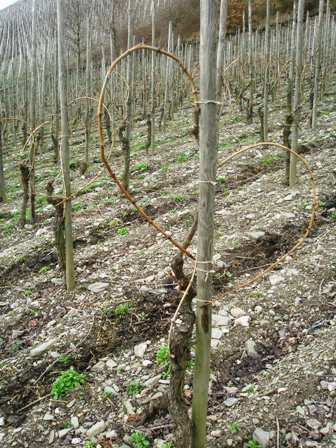
Here (photo above from the Ahr) sticks have been put between the individual vines in order to make it easier to move in the vineyards and to prevent stones and earth to be washed down the rows. Every vine has its own individual post and no wires are required. One finds this system also along the Mosel and the Saar.

Individual vines and the post after pruning (Saar)

After pruning, two canes are bound to the post on the individual post system. I wonder if spur pruning can be applied to it too?

Usually movable fruit wires, as we have them in Australia (VSP = vertical shoot positioning), are not a feature of these trellis systems. This is not surprising. On the steep slopes of the Mosel, Ahr and Rhine rivers moving fruit wires would be suicidal.

In my own vineyard in Glenburn, we use a simple VSP-trellis system. The move of the fruit wires is usually not a difficult job, especially along the gentle slopes as we have them. However, when the rows are long, the wire gets heavier and heavier the longer the day lasts.

Three fixed wires on vines in Olewig, Trier/Mosel

One finds also more and more metal posts, here also with three wires (Olewig)

In some of the locations, even if they are steep, caterpillar tractors are used to work the land. These tractors are small but still need narrow rows between the vines in order to operate.

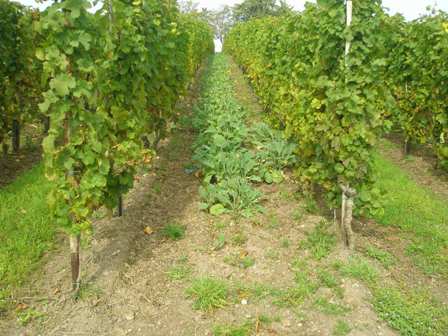
Below, two rows have been planted close to each other (and no vehicle can work between them), but the next rows a planted at a wider distance so that the caterpillar tractor can be used.

Even cabbage is grown between the rows (Olewig/Trier, Mosel)

In my blog entry titled “Along the Mosel River”, of September 12th, 2007 I showed some of the elevators used on steep slopes to carry material up and down the vineyard. Have a look and check it out; it’s an interesting system, one can observe on many steep vineyard slopes on the Mosel.


Country Inns in Germany – Klostermühle, Ockfen, Saar

May 5, 2008

When I am visiting my hometown Trier I always try to arrange an outing to the Saar, my most favourite tributary of the Mosel (the other one I love very much, is the river Ruwer).

One day in March my mother, my friend Heinz and I, we went for lunch in the countryside. It was March. Spring was waiting in the wings, but could not get through as yet. However, it was a beautiful day. We choose the Klostermühle in Ockfen, Saar, as our destination, a winery cum hotel and restaurant (www.bockstein.de).

Winery-Hotel-Restaurat Klostermühle in Ockfen, Saar

Pork tenderloin with Spaetzle, a German type of noodle dumplings

The food was delicious, typical country inn style, rustique, big portions, in short: value for money type of food. I had one of their Rieslings with my food. Ockfener Bockstein is the name of the most famous location (terroir) in this neck of the wood. It was a very typical Saar Riesling, low in alcohol but zippy and fruity, with complex acids, a good structure and a long and intense finish.

After lunch we drove though the vineyards of Ockfen. On our way to Schoden where Heinz together with some friends is renting a hunting ground, we passed by the “Bockstein” which you can see in the picture below (where the tree line on the hill in the background is ending).

Ockfener Bockstein, one of the most famous “terroirs” of the Saar

The Saar is a very picturesque wine region and tourist destination in southwestern Germany and certainly worth a visit. Do it regularly as I do. The Riesling wines are among the best of Germany.

Address
Weingut – Hotel – Restaurant Klostermühle
Fam. Minn
54441 Ockfen, Saar
+49-6581-9293-0


Wiltingen Saar – the best of Riesling wines in Germany

March 31, 2008

The little village of Wiltingen, Saar , about 9 km southwest of Trier, is one of the most famous “terroirs” for Saar Wine. It has about 1400 inhabitants and is the heart of Riesling production. The area under vines is 160 ha only and rather small one might say but these vineyards produce excellent wines.

The location (terroir) ‘Scharzhofberg’, for instance, produces outstanding Rieslings which are world renown and regularly win international awards as best wines.

Wiltingen is home to many famous wineries. I cannot name them all. There is for instance the “Riesling pope” Egon Müller who has his family business there, so has Roman Niewodniczanski’s winery Van Volxem, and many others.

wiltingen2.jpg

Wiltingen at the Saar river in March, photo taken from the Schoden side

wiltingenschild.jpg

Wiltingen is a jewel also for tourism

It was a rainy day when we visited Wiltingen. However, we wanted to pay a visit to Van Volxem and maybe purchase a couple of bottles of the finest Saar Riesling. Well, we met the winemaker, a very friendly young man from Franconia, as I could identify from his accent, and he invited us in, mentioning in passing that if we came to buy wines, we would have to come again, because they sold out completely. Nonetheless, he made us sit down, served us a very good cup of coffee and told us the story of the Van Volxem wines.

Spring is a busy time in the vineyards. We were told that Van Volxem has about 30 ha under vines and that they are in the process of planting another 6 ha in prime locations, usually on very steep slopes along the Saar river.

Also Ms. Niewodniczanski showed up and took her time fro a friendly chat; she urged us to come again later in the year when they new vintage would be released. She promised she would show us around, not only to the cellars but also the vineyards could be part of our visiting program. We left our addresses and promised to come again. Who could resist such friendliness, a treatment so warm, only expected to be extended to family members.

vanvolxem.jpg

Van Volxem, entry to the cellar door

vanvolxem2.jpg

In the historic tasting room

Postscript: A couple of days later, I sat in the Weinhaus, one of my favorite wine bars in Trier, and witnessed the sale and hand over of two 6-bottle boxes of Van Volxem Riesling wines to customers.

Well, I thought, I cannot complain since I still have some bottles in my “cellar” in Jakarta, and the next vintage will certainly make a wonderful buy.

Address
Weingut Van Volxem
Roman Niewodniczanski
Dehnstrasse 2
54459 Wiltingen, Saar
Ph.: +49-6501-16510
e-mail: vanvolxem@t-online.de

The estate is member of the VDP (Verband deutscher Praedikats- und Qualitaetsweingueter), the association of German prime wine estates (www.vdp.de). Today the Association has 200 members and covers about 3% of the German viticultural area.
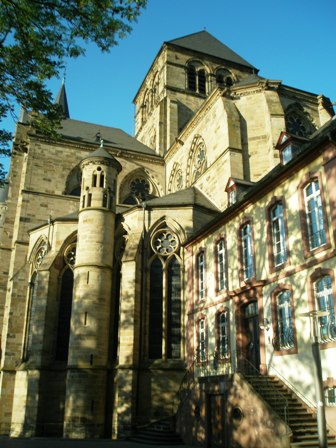

German Vineyards in March

March 18, 2008

March is a great time of the year in the Northern hemisphere. Nature is ready to go, buds are almost bursting, waiting for the right temperature, the hours of sunshine which make the difference, warm the soil and the plants. As every year another miracle is in the making.

The vineyards are neatly pruned and ready to go shortly before the new growing season begins. The following pictures from the Saar Wine Region might give you an idea.

vineyardin-march.jpg

The colour scheme is still dominated by greys and dark winter colours but here and there we can see greenish spots, and soon spring will have driven winter away.

The slopes are steep and every vine has its own post. This one is very well tended, not a single stem or blade of grass can be detected.

pruned3.jpg

The pruning is of a special kind too. In Australia we hardly see this kind of binding the canes.

pruned1.jpg

It is not easy to spread organic manure in the vineyards at these steep slopes.

menure1.jpg

A metal sledge is used to bring the manure to the vines.

pruned2.jpg

Apart from the well tended vineyards (as above in Ockfen, Saar) we also find here and there a neglected one or one in a rather ‘chaotic stage’ but they are the exception rather than the rule.

chaoticvineyard.jpg

The neglected vine garden


Along the Mosel River

September 12, 2007

I have often traveled along the Mosel River by train. Last weekend I decided to abolish the train and drive by car from Kobern-Gondorf to Trier. Unfortunately, the sun did not shine. But despite this handicap it was one of the most marvelous trips I have recently made.

The Mosel River valley was buzzing with visitors and tourists. Groups of cyclists, tour buses, camper vans as well as people on foot, motorcyclists and others were cruising along the river and swarming the small towns and villages. Almost every settlement advertised its ongoing or imminent wine festival and vintners’ fair. Everywhere one could buy wines, have a meal or stay overnight. Vintage was in full swing in many places and the young fermented grape juice, in German called “Federweisser” was everywhere on offer.

rivermosel.jpg

Barges and a ferry on the river and a castle in the background

moselriver2.jpg

Steep slopes and a narrow valley, vines on “Graywacke” slate plates

The appelation of the wine region “Mosel-Saar-Ruwer” is the result of the Wine Act of 1909. From 1936 onwards wine labels could show this designation. In 2006 the German Parliament passed a new law abolishing “Mosel-Saar-Ruwer” and simply replacing it with “Mosel” and since August 1st, 2007 the region is officially called “Mosel” only.

The region consists of six sub-regions with 19 locations (Grosslagen) and 524 individual locations (Einzellagen). 5,500 wineries and vineyards are spread over 125 settlements, villages and towns. The total area under vines is about 9,000 ha, which produce annually about 850,000 hectoliters of wine (including 75,000 hectoliters of red wine). The largest wine producing acreages can be found in the settlements of Piesport, Zell (Mosel), Leiwen, Konz, Neumagen-Drohn, Mehring, Bernkastel-Kues and Trittenheim. I passed through some very famous vineyard locations such as “Bremmer Calmont”, “Wehlener Sonnenuhr”, “Erdener Treppchen”, “Ürziger Würzgarten”, “Piesporter Goldtröpfchen”, “Bernkasteler Doctor” and many others.

steepslopes1.jpg

The elevator “sledge”

steepslopes2.jpg

The “rail” for the “elevator”

The region has the largest extent of vineyards on steep slopes (inclinations range from 30% till 60%) in Germany. The Mosel region is also the biggest Riesling producer in the world (with about 5.000 ha acreage). Recently some of the more extreme locations have fallen fallow. Traditionally vines were planted on the steep slopes using single posts. In recent times they have been gradually replaced by modern trellis systems. For transport purposes, elevator systems were installed in some locations, as shown on the photos below. I was very surprised to find a lot of red grapes planted in the flat lands near the river. Most of them are Pinot Noir and Dornfelder grapes. There is an increasing trend to extend the acreage for red varieties and the Mosel has once again become a superb producer of red wines, especially Pinot Noir.

redgrapes1.jpg


Country Inns in Germany: Asparagus and river perch

May 18, 2007

While travelling in Germany recently, I had a lot of fish and seafood dishes, the reason for this being that I accompanied a group of visiting Indonesians to a number of coastal towns on the East and the North Sea. Since Germany had a splendid spring, this was the more enjoyable.

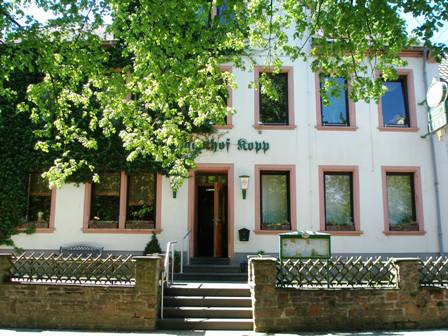
Later, together with my brother and my old folks in Trier, I visited one of the traditional German country inns so prevalent in my home area, the Mosel River Valley, the Landgasthof Kopp (www.landgasthofkopp.com) in Hentern, a small village between the Mosel tributaries Ruwer and Saar.

p4300582web.jpg

Landgasthof Kopp main entrance

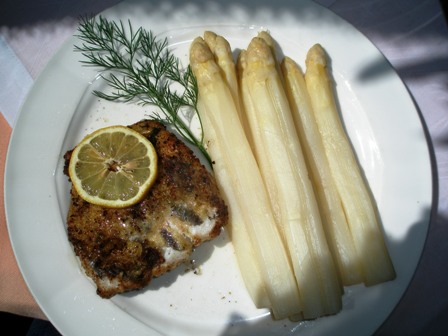
Springtime in Germany is ‘asparagus time’. Everywhere the lush white sticks can be purchased or consumed. All four of us ordered some kind of an asparagus dish. I had asparagus with perch (German: Zander).

p4300579web.jpg

River perch with asparagus

With this delicious meal, I drank the house wine, Ockfener Scharzberg Riesling, a local product from a small village on the Saar river called Ockfen (www.ockfen-home.de). Ockfen has about 700 inhabitants and of the agricultural used land of 246 ha about 90 ha are under vines on very steep slopes. The most famous terroir is ‘Ockfener Bockstein’ which is among the best wines from the Saar. The wines from this location are very dry, minerally and fruity with a good structure.

From the Middle Ages onwards it was the monasteries along the Saar river that cultivated vines and promoted the wine industry. The wealth and prosperity of Ockfen was almost exclusively based on its wine industry. The many small villages and towns along the Saar river are worth visiting (among them Saarburg, Ayl, Kanzem, Oberemmel, Serrig, Wiltingen to name only a few. I highly recommend this very beautiful part of Germany.

As regards the inn, the Landgasthof Kopp, this place is a must, not only because of the superb quality of the food and the service. The price too was a pleasant surprise, unbeatable, I must say. For the four of us, including drinks, we spent a total of only 60 Euro for a memorable family lunch.


Mama’s kitchen: tender bighorn fillet with mushrooms

May 11, 2007

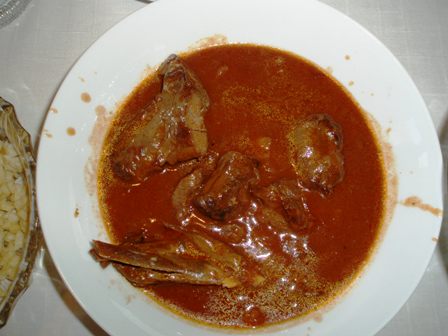
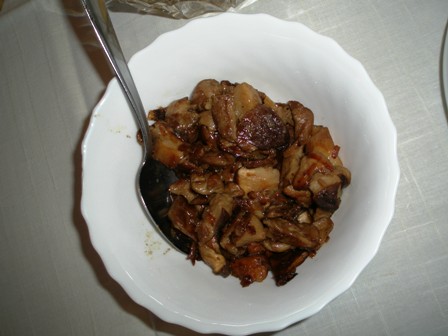
Because I am from a hunter’s family, we have from time to time dished with meat from wild animals at home. During my recent visit to Trier, my mother prepared a tender fillet of a young bighorn sheep (Mufflon in German). The young Mufflon was shot in Schoden at the Saar river by my friend Heinz. She served it with freshly collected wild mushrooms (Steinpilze also from Schoden), a cabbage salad and spaetzle (literally translated: little sparrow), a kind of tiny noodles or dumplings made with flour, eggs, water or milk, salt and sometimes nutmeg mainly used in the South German (my mother comes from Franconia), Austrian, Alsace and Swiss cuisine. I took some photos of the delicacies so that one gets a better idea. It was such a wonderful meal.

p5020662web.jpg

The bighorn fillet

p5020661web.jpg

The mushrooms

p5020664web.jpg

The old folks

When I raided my mother’s wine cellar, I found a bottle with the picture of Karl Marx, one of the most famous sons of my home town Trier. Agreed, the application (or the interpretation hereof) of his ideas has brought much misery to the world. However, now mankind knows for sure that planning economies do not work, but that market based economic co-ordination systems are much better for us all.

p5020656web.jpg

This bottle was given to me for my 50th birthday a couple of years ago. It contained a 2002 Eitelsbacher Marienholz Pinot Noir (Spaetburgunder) from the von Beulwitz Estate (www.von-Beulwitz.de), now owned by the Weis family in Mertesdorf, one of the villages at the Ruwer river, a small tributary to the Mosel (and part of the Mosel-Saar-Ruwer denomination). The Ruwer terroir has about 300 ha under vines in various locations (Ruwer/Eitelsbach, Mertesdorf, Kasel, among others). Some of the best German Riesling is grow here since Roma time. In fact the earliest findings of vine cultivation date back to the 2nd century. A stone relief called “The vintner in his wokshop” is the one of the oldest historical relicts (the other one is the wine ship of Neumagen).

p5010602web.jpg

Ruwer vineyards

The von Beulwitz estate goes back about 140 years and produces mainly Riesling wines, many of which have won international awards and trophies. The most recent one is the “Trophée d’excellence” “Riesling du monde”/Strassbourg for it’s 2003er Kasler Nies’chen, Riesling Auslese, “Alte Reben” (old vines). The 2005 Riesling Spaetlese from this location gained 97 points.

The estate grows vines on about 5 ha, mainly in steep locations in Kasel and Eitelsbach. Yields are kept low in order to produce wines of great elegance and finesse. Unfortunately, the Pinot Noir of 2002 did not fall into this superb category, it was a rather ordinary wine. But despite this, we enjoyed the meal and the wine and had a good time at home. I promised myself to try some of the award wines next time.


My hometown: Augusta Treverorum – a short visit to Trier

May 5, 2007

It was four busy days in Trier, running from appointment to appointment. Spring this year in Germany is most beautiful. Temperatures almost like in summer, sunshine, blue skies and very dry, no rains (bad for all the farmers and vintners). The four days included among others a family gathering with brother Wolf and my old folks, visits of old friends, meals in country pubs and at home, long walks in Trier, barbecues, afternoon coffee and cake, a Riesling wine tasting with the winemaker, a hunting trip in the forests of the Saar river, and a birthday party of my niece Adriane who turned 24!. When I finally had my train ticket to Frankfurt in my hands, I knew the time had come to say good bye. I payed a short visit to my favourite wine bar, Kesselstatt, opposite the cathedral (Trierer Dom) and had a last drink, a fine and dry 2005 Wiltinger Riesling. Then I went to an internet cafe near the train station but could not enter this text into my blog so I had to defer it to later. “Good byes” as always in the hope that you meet again and off I went on the train to catch my plane in Frankfurt for Jakarta.

Weinstube Kesselstatt

Weinstube Kesselstatt in Trier

The train trip makes the farewell easier. Along the Mosel river to Koblenz I could enjoy the beautiful Mosel valley with its steep vineyards, old castles, small settlements, and lovely countryside. After a change of trains follows the middle Rhine river valley with magnificent castles, stepp slopes covered in vines, the narrow valley, and the beautiful and winding river. When I had passed Bingen and entered Mainz, the long farewell had almost come to an end. From the familiar to the unfamiliar, the known to the unknown; the ancient, rural, pituresque and wine producing land gave way to industrial landscapes, big cities and finally the airport. My time in Germany had come to an end. So long, farewell, Auf Wiedersehen, good bye and the promise to return in September with more time on my hands for family and friends and the tasting of fine wines from the Mosel-Saar-Ruwer.

Trierer Dom

Trierer Dom and Liebfrauenkirche