Along the Mosel River

September 12, 2007

I have often traveled along the Mosel River by train. Last weekend I decided to abolish the train and drive by car from Kobern-Gondorf to Trier. Unfortunately, the sun did not shine. But despite this handicap it was one of the most marvelous trips I have recently made.

The Mosel River valley was buzzing with visitors and tourists. Groups of cyclists, tour buses, camper vans as well as people on foot, motorcyclists and others were cruising along the river and swarming the small towns and villages. Almost every settlement advertised its ongoing or imminent wine festival and vintners’ fair. Everywhere one could buy wines, have a meal or stay overnight. Vintage was in full swing in many places and the young fermented grape juice, in German called “Federweisser” was everywhere on offer.

rivermosel.jpg

Barges and a ferry on the river and a castle in the background

moselriver2.jpg

Steep slopes and a narrow valley, vines on “Graywacke” slate plates

The appelation of the wine region “Mosel-Saar-Ruwer” is the result of the Wine Act of 1909. From 1936 onwards wine labels could show this designation. In 2006 the German Parliament passed a new law abolishing “Mosel-Saar-Ruwer” and simply replacing it with “Mosel” and since August 1st, 2007 the region is officially called “Mosel” only.

The region consists of six sub-regions with 19 locations (Grosslagen) and 524 individual locations (Einzellagen). 5,500 wineries and vineyards are spread over 125 settlements, villages and towns. The total area under vines is about 9,000 ha, which produce annually about 850,000 hectoliters of wine (including 75,000 hectoliters of red wine). The largest wine producing acreages can be found in the settlements of Piesport, Zell (Mosel), Leiwen, Konz, Neumagen-Drohn, Mehring, Bernkastel-Kues and Trittenheim. I passed through some very famous vineyard locations such as “Bremmer Calmont”, “Wehlener Sonnenuhr”, “Erdener Treppchen”, “Ürziger Würzgarten”, “Piesporter Goldtröpfchen”, “Bernkasteler Doctor” and many others.

steepslopes1.jpg

The elevator “sledge”

steepslopes2.jpg

The “rail” for the “elevator”

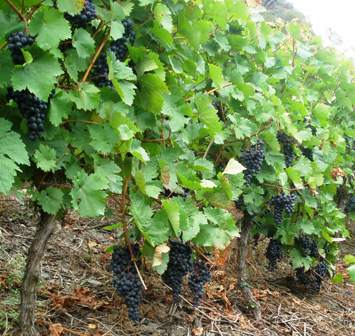
The region has the largest extent of vineyards on steep slopes (inclinations range from 30% till 60%) in Germany. The Mosel region is also the biggest Riesling producer in the world (with about 5.000 ha acreage). Recently some of the more extreme locations have fallen fallow. Traditionally vines were planted on the steep slopes using single posts. In recent times they have been gradually replaced by modern trellis systems. For transport purposes, elevator systems were installed in some locations, as shown on the photos below. I was very surprised to find a lot of red grapes planted in the flat lands near the river. Most of them are Pinot Noir and Dornfelder grapes. There is an increasing trend to extend the acreage for red varieties and the Mosel has once again become a superb producer of red wines, especially Pinot Noir.
redgrapes1.jpg


Country Inns in Germany: Asparagus and river perch

May 18, 2007

While travelling in Germany recently, I had a lot of fish and seafood dishes, the reason for this being that I accompanied a group of visiting Indonesians to a number of coastal towns on the East and the North Sea. Since Germany had a splendid spring, this was the more enjoyable.

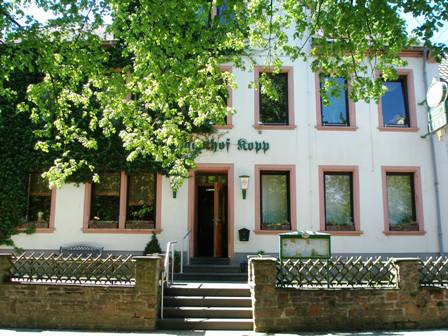
Later, together with my brother and my old folks in Trier, I visited one of the traditional German country inns so prevalent in my home area, the Mosel River Valley, the Landgasthof Kopp (www.landgasthofkopp.com) in Hentern, a small village between the Mosel tributaries Ruwer and Saar.

p4300582web.jpg

Landgasthof Kopp main entrance

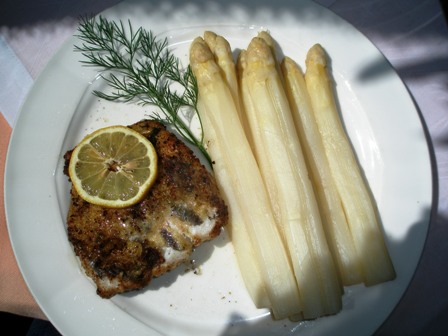
Springtime in Germany is ‘asparagus time’. Everywhere the lush white sticks can be purchased or consumed. All four of us ordered some kind of an asparagus dish. I had asparagus with perch (German: Zander).

p4300579web.jpg

River perch with asparagus

With this delicious meal, I drank the house wine, Ockfener Scharzberg Riesling, a local product from a small village on the Saar river called Ockfen (www.ockfen-home.de). Ockfen has about 700 inhabitants and of the agricultural used land of 246 ha about 90 ha are under vines on very steep slopes. The most famous terroir is ‘Ockfener Bockstein’ which is among the best wines from the Saar. The wines from this location are very dry, minerally and fruity with a good structure.

From the Middle Ages onwards it was the monasteries along the Saar river that cultivated vines and promoted the wine industry. The wealth and prosperity of Ockfen was almost exclusively based on its wine industry. The many small villages and towns along the Saar river are worth visiting (among them Saarburg, Ayl, Kanzem, Oberemmel, Serrig, Wiltingen to name only a few. I highly recommend this very beautiful part of Germany.

As regards the inn, the Landgasthof Kopp, this place is a must, not only because of the superb quality of the food and the service. The price too was a pleasant surprise, unbeatable, I must say. For the four of us, including drinks, we spent a total of only 60 Euro for a memorable family lunch.


Mama’s kitchen: tender bighorn fillet with mushrooms

May 11, 2007

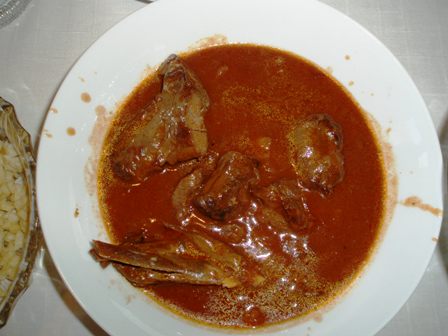
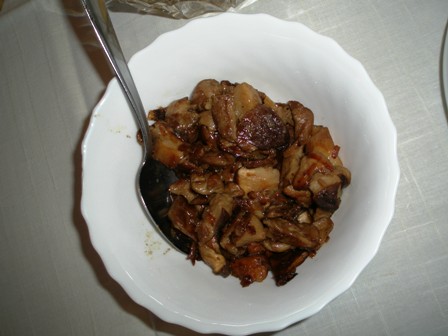
Because I am from a hunter’s family, we have from time to time dished with meat from wild animals at home. During my recent visit to Trier, my mother prepared a tender fillet of a young bighorn sheep (Mufflon in German). The young Mufflon was shot in Schoden at the Saar river by my friend Heinz. She served it with freshly collected wild mushrooms (Steinpilze also from Schoden), a cabbage salad and spaetzle (literally translated: little sparrow), a kind of tiny noodles or dumplings made with flour, eggs, water or milk, salt and sometimes nutmeg mainly used in the South German (my mother comes from Franconia), Austrian, Alsace and Swiss cuisine. I took some photos of the delicacies so that one gets a better idea. It was such a wonderful meal.

p5020662web.jpg

The bighorn fillet

p5020661web.jpg

The mushrooms

p5020664web.jpg

The old folks

When I raided my mother’s wine cellar, I found a bottle with the picture of Karl Marx, one of the most famous sons of my home town Trier. Agreed, the application (or the interpretation hereof) of his ideas has brought much misery to the world. However, now mankind knows for sure that planning economies do not work, but that market based economic co-ordination systems are much better for us all.

p5020656web.jpg

This bottle was given to me for my 50th birthday a couple of years ago. It contained a 2002 Eitelsbacher Marienholz Pinot Noir (Spaetburgunder) from the von Beulwitz Estate (www.von-Beulwitz.de), now owned by the Weis family in Mertesdorf, one of the villages at the Ruwer river, a small tributary to the Mosel (and part of the Mosel-Saar-Ruwer denomination). The Ruwer terroir has about 300 ha under vines in various locations (Ruwer/Eitelsbach, Mertesdorf, Kasel, among others). Some of the best German Riesling is grow here since Roma time. In fact the earliest findings of vine cultivation date back to the 2nd century. A stone relief called “The vintner in his wokshop” is the one of the oldest historical relicts (the other one is the wine ship of Neumagen).

p5010602web.jpg

Ruwer vineyards

The von Beulwitz estate goes back about 140 years and produces mainly Riesling wines, many of which have won international awards and trophies. The most recent one is the “Trophée d’excellence” “Riesling du monde”/Strassbourg for it’s 2003er Kasler Nies’chen, Riesling Auslese, “Alte Reben” (old vines). The 2005 Riesling Spaetlese from this location gained 97 points.

The estate grows vines on about 5 ha, mainly in steep locations in Kasel and Eitelsbach. Yields are kept low in order to produce wines of great elegance and finesse. Unfortunately, the Pinot Noir of 2002 did not fall into this superb category, it was a rather ordinary wine. But despite this, we enjoyed the meal and the wine and had a good time at home. I promised myself to try some of the award wines next time.


Up North

April 8, 2007

I travelled north, from Jakarta to Taoyuan, Taiwan where I am going to teach for a week at the International Center for Land Policy Studies and Training (ICLPST). The flight was very comfortable in the business class of China Airlines. The menu I chose was all seafood. Boiled baby prawns with tomato and lettuce leaves as entrée and fish and prawn satay in ginger light soya sauce with Shanghai noodles as main course. On top of the wine list I found to my surprise a German Riesling from the Mosel-Saar-Ruwer, my home region in Germany where also Trier, my hometown, is located (www.trier.de). Home sweet home, and out of this melancholy, I asked for it.

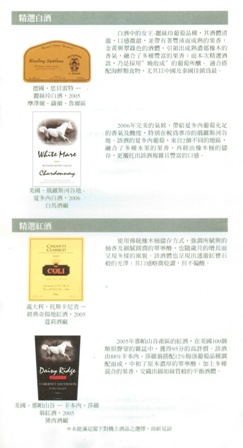
menu-taiwan-small.jpg

It said: 2005 Spaetlese, but I could not resist! The description claimed the wine is “rich, buttery layered with flavours of orange zest, Asian pears and golden delicious apples, with a subtle, smoky back note”. I could not taste any of this. For me it was “sugary” and the steward was so kind to let me have the second white wine on the menue: a Chardonnay from the US. 2006 White Mare Russian River Valley (Sonoma County), depicting a white horse on the label, not my type of label but what could I do. I did not know the winery. There was also a red (Cabernet Sauvignon), 2005 Daisy Ridge with the same white horse label.

The second red wine was from Italy, a Chianti Classico 2005 from Coli in Tuscany. After a couple of glasses of the Chardonnay, which I quite liked, I moved on to the Italian wine and stayed with it for the rest of the flight. By the way, the service was great at this flight, so many nice stewards and stewardesses, unbelievable. I can only recommend China Airlines. The wine list, though, could be changed. OK, I did not try the champagne, a Drappier Brut which got 89 point from the wine spectator. There are much better Rieslings from the Mosel or the Saar to choose from. I would also replace one of the US wines with an Australian Shiraz maybe or a Merlot.

I watched a movie, read in my Tim Winton book (The Turning) and arrived in Taoyuan in no time, well rested, fed and happy.

temple-small.jpg