Wine bars in Trier: Weinstube Kesselstatt

April 10, 2011

Wine bar Kesselstatt in Trier

A place I just love to visit while in my home town Trier, Mosel is a cosy wine bar-cum-restaurant near the cathedral, called Weinstube (wine bar) Kesselstatt.

It is housed in the historic administrative building of the Estate Reichsgraf von Kesselstatt, a well known winery with a long tradition (more than 600 years – difficult for us Australians to comprehend).

In front of the building is a replica of a tomb stone called the “Roman wine ship” found in Neumagen-Drohn, a village at the Mosel river, in 1878. In 220 it used to be one of two stones marking the grave of a Roman wine merchant. Honestly, I would love to get such a tombstone set on my own grave. What a hoot.

Today the winery is owned by the Reh family. Annegret Reh-Gartner manages the 36 ha of prime vineyards located along the rivers: Mosel (12 ha), Saar (12 ha) and Ruwer (12) ha. 98% of the area is under Riesling. The estate calls itself “the Riesling winery”.

When I strolled through the town at the end of March, I could not resist its magnetism and dropped in for a quick glass of wine.

The inside of wine bar Kesselstatt

Because the Kesselstatt estate owns vineyards along the three rivers constituting the former wine region of Mosel-Saar-Ruwer, one has a great choice of different Riesling wines.

I ordered a semi-dry Riesling from Scharzhofberg, a grand-cru of the outstanding Saar Riesling wines. Normally I avoid semi-dry wines but because of the early hours of my visit I just could not go for a dry Riesling.

2010 Scharzhofberger Riesling semi-dry, Reichsgraf von Kesselstatt

What a delight this wine is! I dissolved, so to say, this is Riesling at its best, and I tend to argue that none in the world is better. Lush and full, round but with zest, a titillating pleasure for the palate.

Below you will find pictures of the inside of the bar. There are old barrels filled with bottles, a old wooden press, and a side room with a map of the estates’ vineyard locations and other interesting wine paraphernalia.
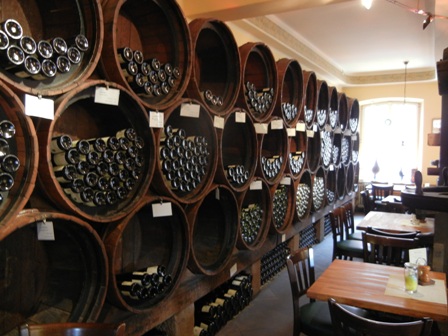
Wine bottles in old barrels

A huge wooden wine press with a church bench in front

The function room

When I left the Kesselstatt wine bar revitalized and in high spirits, I walked out to a cherry tree in full blossom with a splendid view of the adjacent church of St. Liebfrauen and the cathedral (Dom, left).


The Old Man with the Beard

February 9, 2010

Famous last words

As a native of Trier, I treasure the most famous son of our city, Karl Marx, though he left rather early and spent most of his time in exile in London. He used to love wine, especially Riesling from the Ruwer where the Marx family used to own a vineyard and of course my beloved Mosel.

I like the poster above (this is why I took a shot through the window to get a glimpse of it), but unfortunately these were not his last words. he did not say: “Sorry folks, it was just an idea.” Only later generations could come to that conclusion. As family gathered around the dying Marx awaiting his final utterance. It is reported that he barked at them and said: “Go on, get out! Last words are for fools.”


The best German vintners and wine makers

June 1, 2009

Threewinegods

The wine gods (photo taken from a building in Berlin)

Its certainly a great honour to be called “vintner of the year”. Since 1994 Gault Millau, Germany’s wine guide and major authority regarding wine, wine business and the wine sector, is awarding the “vintner of the year” award.

Today the total number of vintners of the year is 16, seven of which come from the Mosel wine region. The current one, however, comes from the Pfalz (Knipser brothers).

But in the years 2007 (Theo Haart, Mosel), 2005 (Kartaeuserhof, Ruwer), 2001 (Loosen, Mosel), 1998 (Mueller-Scharzhof, Saar), 1996 (Joh. Jos. Pruem, Mosel), 1995 (von Schubert, Ruwer) and 1994 (Fritz Haag, Mosel) the vintner of the year came from my home, the Mosel river and its tributaries.

(Remark: the Mosel wine region was originally called: Mosel-Saar-Ruwer)

No other German wine region has provided that many “champions”. So far the Nahe and Pfalz wine regions had two vintners of the year; and Rheinhessen, Rheingau, Frankonia, Ahr and Baden had one each (for the names of the vintners of the year: Gault Millau).

I came about this fact only by accident while researching a story, I was going to write. I have to find more Mosel wines here in Bangkok, I guess. Wish me luck.


Riesling, Riesling….heaven on a stick

March 16, 2009

wildpig

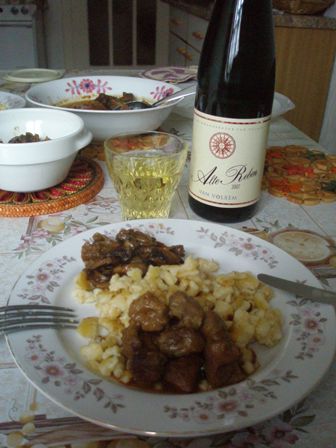
My welcome meal consisted of wild boar goulash, mushrooms and Suebian dumplings (Spaetzle). What a treat, so delicious. I washed it down with a bottle of my house wine, a ‘2007 Alte Reben, Van Volxem Riesling’ from Wiltingen, Saar river. I just love the Van Volxem wines.

wildpig1

The very same day, a parcel arrived for me containing a bottle of wine which I won when participating in an opinion survey of a German wine magazine, Weinwelt (www.weinwelt.info). I could not believe it. What a pleasant surprise this was. The wine is a “grand crue” (GG: Grosses Gewaechs) from the Pfalz, a ‘2007 Forster Ungeheuer GG, Reichsrat von Buhl in Deidesheim, Rheinpfalz. I decided to taste this wine another time and cellared it in my “treasure trove”. Thank you Weinwelt.

wildpig2

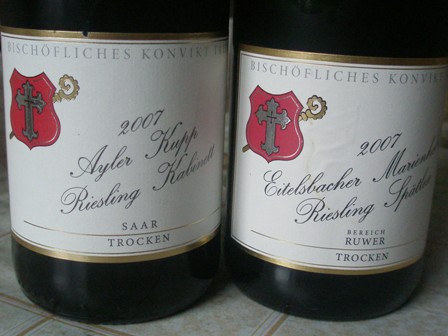
However, I could not resist to buy some more bottles of Mosel Riesling. I decided to try wines from Bischoefliches Konvikt. The two terroirs are very famous, one is Ayler Kupp at the Saar, the other is Eitelsbacher Marienholz from the Ruwer, another tributary of the Mosel.

The ‘2007 Eitelsbacher Marienholz Riesling’ I had with another serve of wild boar goulash the next day. It had all the zest I expected from a fresh Riesling from the Ruwer. The wine from the Saar I packed into my suitcase. Destination: Bangkok and reserved for a leisurely Sunday family meal in the tropics. I can only say: visit the Mosel and its tributaries. Here you’ll find heavenly Riesling wines. Cheers and zum Wohl.


The Christmas Market in Trier

December 15, 2008

weihtrier0

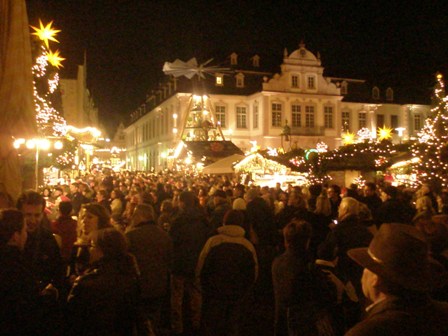
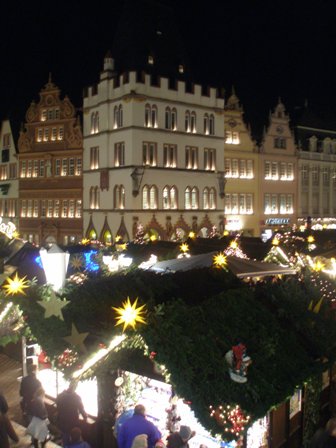
The main market square – Hauptmarkt in Trier

I had only about 24 hours for a family visit in Trier, my beloved home town. This is not much time and I needed to buy urgently some supplies. I was in a hurry which is not good when you end up in a Christmas market. Gee it was crowded. I had not expected so many people. After all the media lamented the economic crisis, the downturn, the loss of jobs and income in short a dark and insecure future. Nothing of that could be felt at the Christmas market in Trier. It was packed with people. I was pushed through the masses. One could hear many languages, French, English, Dutch, Luxembourgian and various German dialects.

weihtrier1

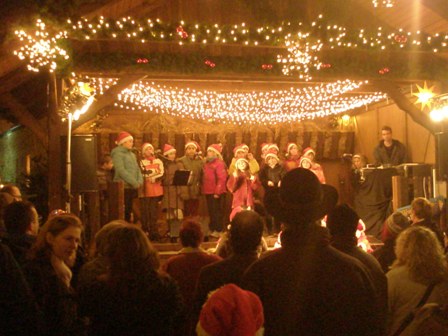
Children sing Christmas carols

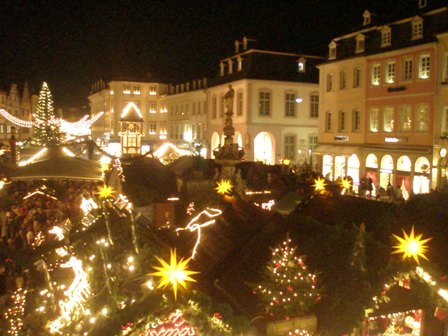
We have learned from other economic crises that people try to forget the dire circumstances by celebrating even more and more intensely than in “normal’ times. Well, that must have been the case in Trier as well. Everywhere people were drinking mulled wine which is good against the cold but also beer and “normal” wines were on offer. It was a cheerful mood; joyous and happy faces wherever I looked. The pictures above and below give you an idea.

weih-trier2

Main market square towards Porta Nigra

weih-trier3

Steipe – the old town hall

weih-trier4

The St. Peter fountain

St. Peter must have been happy too with all these many cheerful Christmas shoppers. After a bath in the crowd I sought refuge in a quiet place and escaped to one of my favourite watering wholes, the wine bar Kesselstatt. I ordered a ‘2007 Kaseler Nies’chen Riesling’ from the Ruwer river, a tributary of the Mosel and listened to the conversations of my neighbours.

It’s good to be home and Christmas is an auspicious time. I let myself be taken in and my mind flowed through the narrow lanes and back streets of the old Roman town. I could smell the smells of my youth and saw faces of people long gone. I dreamt myself away for a while before strolling home. It’s s pity that 24 hours have only 1440 minutes.


Karl Marx and Chinese Grape Wine

November 28, 2008

To state it from the outset, Karl Marx never ever tasted Chinese grape wine in his lifetime. However, Karl Marx, the most famous son of my home town Trier, used to own for some time some of the better vineyards properties along the Ruwer river, a tributary of my beloved Mosel river.

The Marx family vineyard was found in the location “Viertelsberg” a medium quality terroir near the castle ‘Gruenhaus’. In 1857 the family sold its vineyards in Mertesdorf. Karl not only invested in vineyards and the wine industry but he also loved to drink Mosel wine. I frankly do not understand how Marx could survive those many years in London where good Mosel wines were certainly hard to come by in the latter half of the 19th century.

Marx would have enjoyed the samples of “College Wine” produced by the Chinese Agricultural University (CAU) oenology department. The wine is produced for purely non-commercial reasons. The bottles were presented to me by an old friend. We enjoyed it over a meal which marked our reunion. The wine went very well with the Chinese food on offer. Later at home in Bangkok we would have it with an Italian pasta. But in this case I felt that some depth and ‘strength’ was lacking.

collegewine2

The grapes for this wine come from Changli in Hebei province and were supplied to the oenology department by the well known Huaxia Winery. When I lived in Beijing in the early 1990s, it was marketed as Great Wall wine.

swirling-college-wine

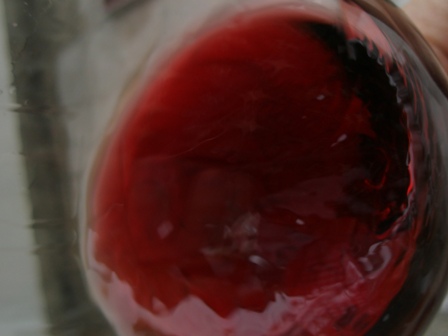
Swirling in the glass – what a beautiful ruby-red colour

The wine displays the typical varietal character of a Cabernet Sauvignon but is medium to lights bodied. At 12% alcohol it’s a bit “thin”/”light” for my taste. In comparison, it went well with Chinese but not Italian food.

collegewine3

A somehow classic design

Afterthought
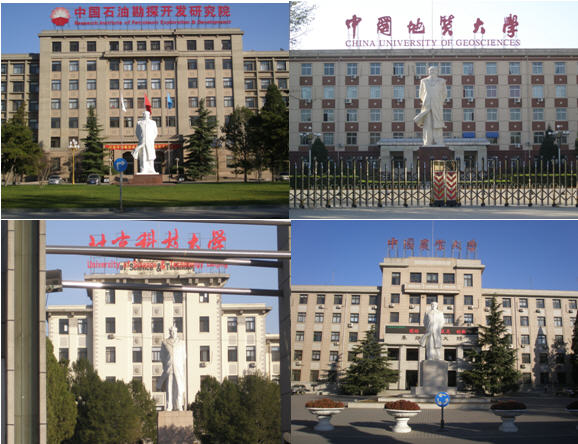
PS: Despite the fact that the CAU is a modern university, at the entrance to its eastern campus, one of the few statues of Mao Zedong graces the gate. When I lived in Beijing in the early 1990s, my friend David McGrath (al marhum), chased the remaining Mao statues still standing in the capital city. He took photos of all of them. If I remember correctly David identified 8 statues. Around ‘Xue Yuan’ road where I stayed, I found 4 of these 8 in no time. All were to be found at the entrances of universities or other academic institutions.

the-4-maos

The four Mao statues

F.l.t.r. and up to down: Research Institute of Petroleum Exploration and Development, China University of Geosciences, University of Science and technology, China Agricultural University.


As the river….

October 24, 2008

Most German wine regions (not all) take their name from the river which runs through the territory planted with grape vines. This is true for the Mosel, Saar, Ruwer, Rhine, and Nahe to name but a few. Vine growing in my native Germany is intrinsically linked to rivers and river systems which is partly due to the availability of steep slopes catching the last beams of sun.

The village of Schoden at the Saar river, in the background, the location Ayler Kupp (photo taken from the location “Herrenberg”)

Recently my writing style has been characterized as “meandering” (by David Harden, thanks David) and meandering I do. In fact the purpose of my whole blog is meandering. Meandering between the old and the new world and its wines, meandering between my actual live in a big Asian metropolitan city and my desired live in a rural place in Victoria, Australia, meandering between the many identities I have acquired over the years working in Asia and my future as an Australian vintner and wine maker.

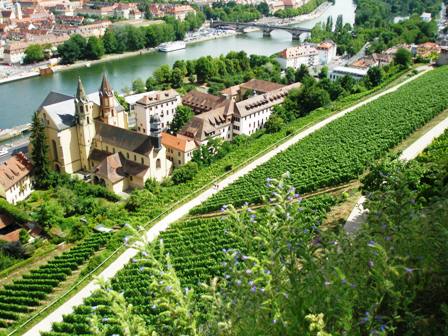
Wuerzburg at the Main river and its vineyards

The second part of the title sentence goes as follows: “…so the wine”. This is certainly true for Germany. I have to find a similar “alliteration” for Glenburn and the Upper Goulburn Wine Region.


Augusta Treverorum – home at last

July 24, 2008

My hometown of Trier (lat.: Augusta Treverorum) from the ‘Kockelsberg’

Alas, we made it. Grandparents were very happy to see us. Blue sky and summer sunshine greeted us. A splendid holiday awaited us. In short, Germany at its best. We are so lucky.

The Mosel river

Margit and I, we went to check out our favourite “watering whole”: the wine bar of Reichsgraf von Kesselstatt opposite the cathedral and the church of “Liebfrauen”.

The ‘garden’ of the wine bar

Riesling was our choice. We had a ‘2007 Kaseler Riesling dry’ (subregion: Ruwer) and a ‘2007 Wiltinger Riesling dry’ (subregion: Saar). Both wines were young and fresh, which make them a delicious drink in a hot summers day. We both preferred the wine from Wiltingen, Saar.

Cheers, and “zum Wohl” as the Germans say.

PS: I am loading this up from a small flat in Madrid which we rented. The internet connection is weak and blogging difficult. Please bear with me.


Country Inns in Germany – Klostermühle, Ockfen, Saar

May 5, 2008

When I am visiting my hometown Trier I always try to arrange an outing to the Saar, my most favourite tributary of the Mosel (the other one I love very much, is the river Ruwer).

One day in March my mother, my friend Heinz and I, we went for lunch in the countryside. It was March. Spring was waiting in the wings, but could not get through as yet. However, it was a beautiful day. We choose the Klostermühle in Ockfen, Saar, as our destination, a winery cum hotel and restaurant (www.bockstein.de).

Winery-Hotel-Restaurat Klostermühle in Ockfen, Saar

Pork tenderloin with Spaetzle, a German type of noodle dumplings

The food was delicious, typical country inn style, rustique, big portions, in short: value for money type of food. I had one of their Rieslings with my food. Ockfener Bockstein is the name of the most famous location (terroir) in this neck of the wood. It was a very typical Saar Riesling, low in alcohol but zippy and fruity, with complex acids, a good structure and a long and intense finish.

After lunch we drove though the vineyards of Ockfen. On our way to Schoden where Heinz together with some friends is renting a hunting ground, we passed by the “Bockstein” which you can see in the picture below (where the tree line on the hill in the background is ending).

Ockfener Bockstein, one of the most famous “terroirs” of the Saar

The Saar is a very picturesque wine region and tourist destination in southwestern Germany and certainly worth a visit. Do it regularly as I do. The Riesling wines are among the best of Germany.

Address
Weingut – Hotel – Restaurant Klostermühle
Fam. Minn
54441 Ockfen, Saar
+49-6581-9293-0


Karl Marx and Mosel wine

September 26, 2007

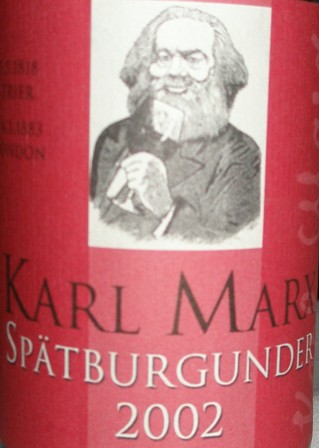
When I visited my hometown Trier recently, I also went to the place where Karl Marx, the most famous of our citizens, was born in 1818 (the Karl Marx Haus). What I did not know about him was his relationship to wine and the Mosel wine industry. From a leaflet collected at the tourist paraphernalia shop I learned that the parents of Karl Marx were vineyard owners along the Ruwer in Mertesdorf where they owned several parcels. It was quite common for bourgeois families of the times to acquire vineyards either for their own wine consumption and/or for investment and old age security reasons. The Marx family vineyard was found in the location “Viertelsberg” a medium quality terroir near the castle ‘Gruenhaus’. Today, the ‘Weingut Erben von Beulwitz’ produces a 2002 Spaetburgunder (Pinot Noir) wine with a Karl Marx label to commemorate this famous “son” of Trier. The wine is not exactly from the old Marx family vineyard but derived from vineyards nearby. Some time ago I had tasted this wine with some delicious venison (big horn sheep) which my mother had prepared for me.

karlmarxweb.jpg

The label with Karl Marx

Marx himself was fond of drinking wine and appreciated the value of it. More interesting is the fact that among others the misery of the Mosel wine producers inspired Marx to study and research economic issues in general. In various newspapers Marx reported about the problems of the Mosel vintners. He criticized the Prussian government for its lack of support which in the end brought him into conflict with the authorities in the 1840ies which in the end led to his exile first in Paris, later in Brussels and finally in London.

After Napoleon lost the war and with it the once occupied lands west of the Rhine river, these territories were given to the Kingdom of Prussia after the peace congress of Vienna in 1815 and administered as the Prussian Province of the Lower Rhine. This marked the beginning of a golden age for Mosel wine producers since they benefited from tax-free export of their wines to Prussia. Unfortunately, the phenomenon was short lived when, with the introduction of the German Customs Union (Zollverein) in 1834, vintners from the southern German states were in the position to successfully displace their competitors from the Mosel. This in turn brought wine prices down. An unfavourable Prussian tax policy coupled with bad harvests led to the pauperization of many vintners at the Mosel. Marx was appalled by their suffering, criticized the government, violated press censorship requirement and in the end had to leave into exile.

In 1857 the Marx family sold its vineyards in Mertesdorf. But due to the efforts of the Weiss family (the owners of the Weingut Erben von Beulwitz, www.hotel-weiss.de), we can enjoy today a Pinot Noir depicting the face of Karl Marx on the label. These bottles can also be bought at the aforementioned shop (7.5 €/0.75 l bottle).

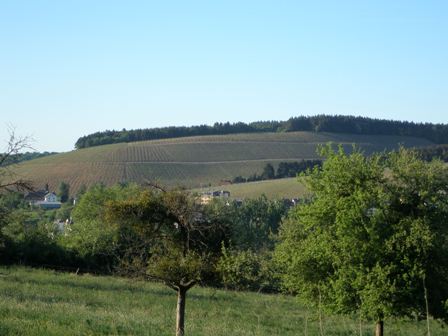
mertesdorf-ruwer.jpg

Ruwer vineyards near Mertesdorf in spring

PS: I personally think that it is a pity that the wide adoption of his ideas in Eastern Europe, Vietnam and China for instance brought so much misery to mankind. Less emphasis on the collective and more on individual freedom would have gone a fair bit. Marx should have stayed with drinking and enjoying wine and give up writing in the first place, one is tempted to argue.

In a letter to the father-in-law of his daughter he mentioned that “a man who does not love wine will never achieve anything good for mankind”. Unfortunately, wine drinking is not a guaranty for such deeds as his own life showed.