Roman Villa Urbana in Longuich, Mosel

August 27, 2012

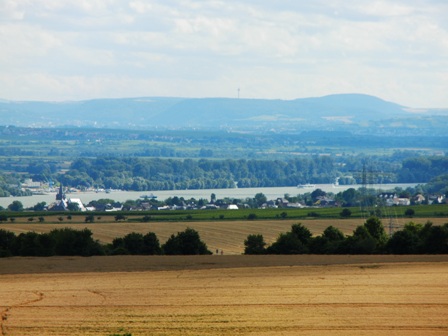
Vineyards near Longuich – Opposite the steep slopes of the Mosel

The cultivation of grapes along the Mosel river and its tributaries Saar and Ruwer is more than 2,000 years old. For the Romans wine was an important commodity. All along the Mosel river one can find traces of the Roman wine industry, among them wine presses and fermentation tanks, vineyard implements, residues of grapes, statues of gods and godesses etc.

Among the treasures are the ruins and foundations of many Roman rural villas. One of them can be found in Longuich-Kirsch, just a few kilometers downstream from my hometown Trier. Various types of these villas can be distinguished. Some of them contain large mosaics as the villa in Nennig.

The villa in Longuich is a “villa urbana”, the seat of a retired high official. It is very large (110 x 28 meters). It was built in the 2nd century after Christ and includes an extensive Roman bath consisting of a Caldarium (hot bath), Tepidarium (warm bath), Sudatorium (sauna), Frigidarium (cold bath) and Praefurnium (fire and heating system).

The foundations of the villa were accidentally discovered during land consolidation and reconstruction work in 1984. Next to the villa some agricultural buildings we found as well.

The villa urbana was restored and is today open to the public. Various billboards inform the casual visitor about various aspects of roman life including the two thousand years of grape and wine production.

Imagine that so long ago people were working in vineyards and wineries in the very same places where also todays wine is produced. Amazing. The work was even harder than today, I guess.

The production techniques of the Romans are well researched. The billbords explain todays challenges and how they were mastered recently. I loved the way ancient history was linked to contemporary modern life. I highly recommend visiting these villas. The view over the valley and its vineyards is another great experience.

Fortunately, the vineyards in the vicinity of the villa are still productive, and many wineries and vintners are happy to welcome visitors and introduce them to their excellent Riesling wines.


Von Othegraven Winery in Kanzem, Saar

August 25, 2012

Regular readers of my blog will have noticed that I usually abstain from writing negative comments about any wine experience. Today I will break with this tradition making a slight dent in my otherwise immaculate positivism.

Summertime in Germany is also the time of wine festivals and the time of visiting wineries and cellar doors. And keeping in the spirit of things, my family and I, we set out on a beautiful day in July to pay a visit to one of the wineries along the Saar river.

I needed a birthday gift for a dear friend of mine and I intended to honor him with a first class bottle of wine from a first class winery. Since my friend lives in the Ruwer valley, a location with excellent Riesling terroir, I wanted to contrast the Ruwer wines with a specimen from the Saar, the other tributary of the Mosel where excellent Riesling wines are produced.

My choice was the Von Othegraven winery in Kanzem, a small hamlet on the banks of the Saar river. This winery is quite well known in Germany because Guenther Jauch, a celebrity TV moderator and talk show host, is the owner of the place.

I could not have been more wrong in my choice.

We rocked up without an appointment (which we would regret), drove into the courtyard of the estate at the outskirts of Kanzem at the bottom of the steep vineyards of the Kanzemer Altenberg, the grand cru vineyard of the area.

We innocently rang the bell of the manor house but where greeted by a very grumpy vintner (it was the manager, not the wine-maker), who let us know immediately and in a very impolite way that we were not welcome, and should “buzz” off.

Uff, we were mentally not prepared for such a rude reception, and deeply regretted that we had bothered to come in the first place.

So my recommendation to the casual wine tourist is not to visit Von Othegraven. It is a waste of time. If you are still interested in their wines, go to my favourite wine bar, Weinsinnig in Trier, and buy a bottle of the outstanding Altenberg Riesling.


Kloster Eberbach, Rheingau

August 7, 2012

The Rheingau wine region

Because of a flight delay we had a couple of hours on our hands with nothing to do. This provided us with an unexpected but welcome opportunity to visit the Rheingau wine region. So where to go and what to do?

Some years ago I had been to Eltville, one of the many small and pretty settlements with extensive wine culture and history. Last year in November I met a couple of professors from the famous wine institute in Geisenheim, Rheingau at the 3rd International Symposium on Tropical Wine in Chiang Mai, which further nurtured my curiosity in the Rheingau wine region.

So I typed “Kloster Eberbach” into the navigation system of the hired car and off we went to this place near Eltville which I had always wanted to visit. We were looking for some mix of culture and wine. In no time we were cruising the country roads of the Rheingau.

Vineyards and farm buildings

The region on the right side of the Rhein river between Wiesbaden and Assmannshausen is like a Garden Eden of the modern world. The slopes of prime vineyard land descend gently towards the Rhein river. The land is very fertile and the climate very suitable for the production of first class wines, mainly Riesling.

The top of the mountain ridges of the southern Taunus are crowned with deep forests. Many of the villages and settlements are very beautiful. Every year millions of tourist flock to places like Ruedesheim, Geisenheim, Erbach and Eltville.

The Eberbach monastery

Our destination, the Eberbach Monastery, formerly a Cistercian Abbey, is a kind of museum today. We had a look at the old church, the cloister and the various rooms used by its monks from the 12th century until the French revolution and the secularization of church property under Napoleon.

Fortunately, the grape-growing and wine-making tradition of the monks has been preserved. Today the state of Hessia is the owner of the vineyards and winery “Kloster Eberbach”. The monastery offers a range of programs related to wine, special tastings for instance in the historic wine cellar, and has a “vinothek”, a kind of cellar door or wine shop.

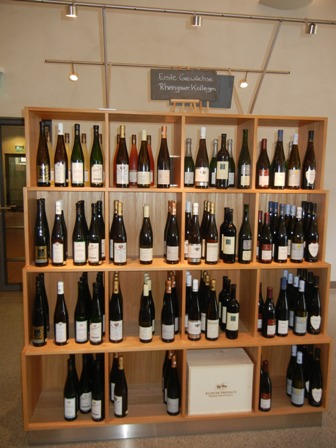
The wine shop of Kloster Eberbach

The “vinothek” wine shop does not only offer the wines of Kloster Eberbach but also of vintners and wineries of the surrounding villages and terroirs. The shop was packed with buyers on this Sunday afternoon. I browsed through the various shelves with wines from different locations and of different quality categories. I tried to stick to a certain budget which did not allow for grand cru wines.

My selection

In the end I settled for three wines only, one Riesling and two Pinot Noir wines. The Riesling came from the most famous and oldest terroir called “Steinberg” (stone mountain) right behind the monastery. The Pinot Noir Spaetlese from Assmannshausen was a bit pricier (17.40 EURO). It should turn out to be the best Pinot Noir I drank while holidaying in good old Germany.

Address:
Kloster Eberbach Winery
65346 Eltville am Rhein
Tel.: +49-6723-6046-0
www.kloster-eberbach.de

PS: When I studied agricultural economics at Bonn University, my master thesis was (among others) also dealing with the farming activities of the Cistercian monasteries and how they influenced land markets. I had visited Himmerod Abbey, a Cistercian monastery near Trier, but had never visited the equally famous Eberbach Abbey.


“Weinsinnig” – wine bar in Trier

August 4, 2012

One of my favourite wine bars in my home town Trier is “Weinsinnig”, located right in the center of town.

The name of the bar is a kind of word play on “Wahnsinnig” (in English “mad” or “crazy”), and composed of two parts, a nomen, “Wahn” or “mania” (in English) and an adjective “sinnig” which can be translated as “plausible”, “make sense”, “evident”, “sensible” or “witted”. In the combination with “Wein”/”wine” it becomes something new, a compound with a new meaning which could be translated as “in the mood to enjoy wine”, “wine is sensible” or “crazy for wine”.

Weinsinnig is also a kind of cellar door for wineries from the Mosel. Moreover, it offers selected culinary delights, for instance “Flammkuchen”, a tarte flambe. And last but not least, Weinsinnig offers various activities related to wine and the people making it.

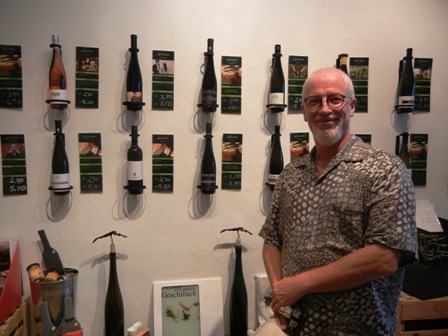
In front of the ‘walk along wine list’

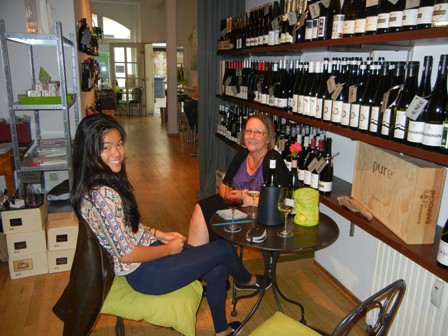
It was a rainy summer’s evening when we visited and therefore we sat inside. Weinsinnig offers also a couple of chairs and tables outside. One sits on the pavement on a narrow street. Fortunately, warm blankets are on offer.

My choice: a dry Riesling from the Ruwer

I love their selection of local wines, many of them produced by young and innovative vintners. I chose a ‘2011 Maximin Gruenhaeuser dry Riesling’ by one of the top producers from the Ruwer valley, von Schubert’sche Gutsverwaltung. I also bought some more of this wine and will only say that this is a Riesling to die for.

2011 Maximin Gruenhaeuser dry Riesling

Inside

By the way TripAdvisor rated it 4 of 5 on 16 Jun 2012 and ranked Weinsinnig as 69 out of 182 restaurants in Trier. In my view Weinsinnig belongs to the “must visit” category in Trier. Check it out.

Address:
Weinsinnig
Palaststraße 12
54290 Trier, Germany
Tel.: +49-651 9790156


The Nahe wine region: Schaefer-Froehlich Winery in Bockenau, Nahe

August 1, 2012

A vineyard in Bockenau, Nahe

Every year when we visit Germany in summer, we start our family vacation with a hearty breakfast in Bad Sobernheim, Nahe. We drive to this picturesque little town on the banks of the Nahe river right from Frankfurt airport.

After we have fortified ourselves, we usually pay a visit to one of the wineries in the vicinity. This year’s choice was the family winery of Schaefer-Froehlich in Bockenau, Nahe.

Regular readers of my blog know how fond I am of the Nahe wine region. Family tradition and my own history somehow tie me to this very diverse grape growing region. I nurture these emotional links through the enjoyment of the region’s excellent Riesling wines.

The Schaefer-Froehlich winery is highly decorated and its outstanding wines regularly win awards in national and international wine events. In 2010 Tim Froehlich was selected by Gault Millau as the wine-maker of the year. And Eichelmann awarded it the winery-of-the-year award in 2011.

The entrance to the vintner’s house

I called the winery to make sure that someone was there to receive us. Very often I just go and take my chances. It was good that I called, the voice on the other side told me that they were very busy with the bottling of the last vintage, and that it was not a good time to visit. But I was able to convince the person to welcome us since we came from far away and because we would not stay long.

Bottling in full swing at Schaefer-Froehlich winery

We were received by Nicole Froehlich. She led us to the cosy tasting room up on the first floor, where we started right away with serious business. Wine tasting so early in the morning has its challenges.

Nicole Froehlich introducing the wines

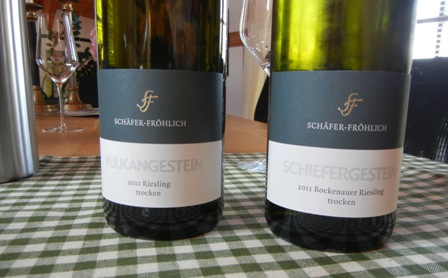
I did not want to waste the host’s time and overstay our welcome. Therefore I restricted the tasting to two wines only, both dry Riesling wines, one grown on volcanic soil, the other one on slate. Both are excellent wines, young and exhilarating with aging potential and great character. This is Riesling as I like it.

The two dry Riesling wines by Schaefer-Froehlich

Interestingly enough the volcanic one appealed to me more than the Riesling grown on slate, despite its greater complexity and finesse. My wife preferred the “slate Riesling”.

I wonder what the grand-cru wines are like when the “ordinary wines” of Schaefer-Froehlich are such delicacies. Guess what” I will tell you after my next visit to this wonderful place.

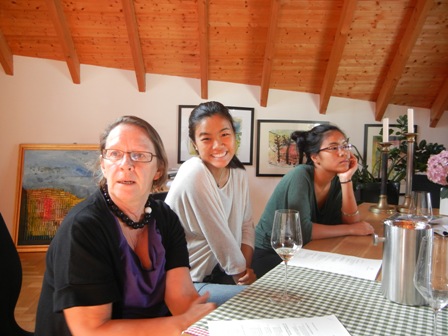
The wine tasting crew from down under

I highly recommend this winery, it’s wines are outstanding and service is just great. Please call them before you rock up.

Address:
Weingut Schäfer-Fröhlich
Schulstraße 6,
55595 Bockenau, Nahe
Tel.: +49 6758 6521
Fax: +49 6758 8794
www.weingut-schaefer-froehlich.de


Restaurant review: Brasserie, Gendarmenmarkt, Berlin

July 30, 2012

The other day in Berlin I had a hearty meal at Brasserie Gendarmenmarkt, one of the most lovely public squares in the German capital.

The weather was very nice so we sat outside on the pavement but the inside of the restaurant is worth having a look at.

The salmon with the cream cheese was a wonderful starter. Since it was an unusual hot day, a light meal was just the right choice.

The main course was a pasta. Is the photo of the pasta with the red pepper and the greens not nice?

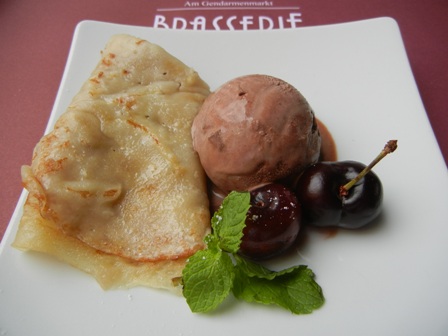
And I could not resist the dessert, some ice cream with a pancake. All very delicious.

I had a glass of white wine with the meal. I selected the dry Riesling from the Rheingau. It was a ‘2009 Riesling QbA dry’ by the Debus Winery in Gau-Odernheim, Rheingau.

This Riesling wine is for easy drinking, ideal on a hot summer’s day. I decided to visit the Rheingau wine region and learn more about the wines produced in this very famous part of Germany.


The art of blogging and wine from Caves Alianca Dao, Portugal

July 11, 2012

No blog entry for two weeks, goodness me. Why I am so busy? It seems this is a terible time. No time for my blog. Moroever, I am going on an extended trip to my hometown Trier, Germany (this time on vacation), where I have very ittle access to the internet. Therefore the prospects are grim. Please bear with me. I plan to continue my blog despite the odds.

Today I have a last entry before the blog-free seasons starts. The good news is that I will be visiting the Mosel and its tributaries. This also means that I will probably visit some wineries and taste some delicious wines. I should come back to Bangkok with many more stories to tell and share.

A beautiful dark red colour

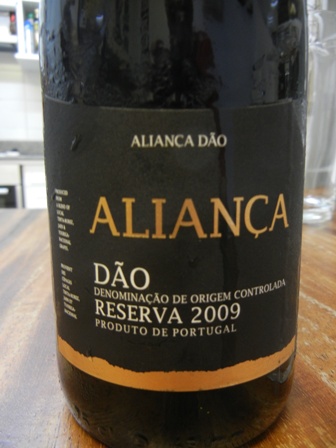
Last night, we had with our meal a beautiful red. It was a ‘2009 Caves Alianca Dao Reserva’, a blend of various Portuguese grape varieties (the label says: Tinta Roriz, Alfrocheiro, Jaén, Touriga Nacional).

The Dao wine region is consistently producing outstanding wines. Ever since our holiday along the Douro river, I am a big fan of Portuguese wines.

Caves Alianca Dao Reserva

With 14% alcohol this wine is big and mighty. It is also very smooth with lots of forest fruit. There is some hint of vanilla (from the oak). The wine has a good mid-pallet weight and a long finish.

The back label of the Alianca Dao

In Europe the wine retails for about 7 Pounds.

We had this beautiful and delectable wine with very spicy green beans and a beef fillet. Woh, that meal was super delicious and the wine was just a perfect match. I wish we had more of it. Well.

Soon we will be at the shores of the Mosel river and ive into the tasting of Riesling. What a consolation.


Dr. Loosen Riesling from the Mosel and spicy prawn pasta

June 24, 2012

While in transit at Frankfurt airport I picked up a bottle of German Riesling. I just could not help it.

The ‘2011 Dr Loosen Blue Slate Riesling Kabinett’ was just too tempting. i forcked out eleven EURO and the bottle was mine.

It only has 8% alcohol which is pretty low. This off-dry wine would go very well with spicy Asian food, I thought. And so it was.

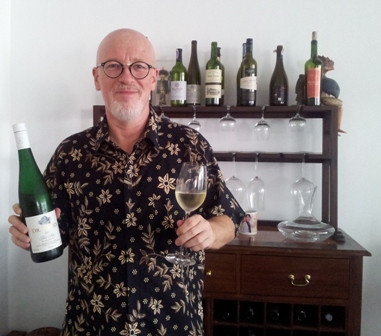
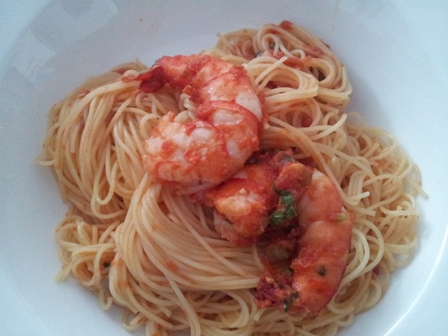
In the end I had it with a spicy prawn pasta. What a wonderful sensation. This mineral driven semi-dry Riesling from my native and beloved Mosel river was the perfect match to the soft chillies used for the pasta.

The fine acidity with the remaining sweetness of the Riesling was mouth watering, refreshing and extremely pleasant on the palate. I was glad that I did not go for a bone dry wine but instead opted for a “Kabinett”. And I have to add that I usually avoid off-dry wines.

A salute to Dr Loosen and his fine wines from the Bernkastel region along the “Mittelmosel”.


2010 Steingarten Riesling by Jacob’s Creek

June 12, 2012

2010 Steingarten Riesling by Jacob’s Creek

The other day I picked up two bottles of Australian wine at Beijing International Airport. I was in transit and browsed through the duty free shops when I saw them. First I thought them a bit pricy, but then I decided to take two, one white, one red.

The white wine was a ‘2010 Steingarten Riesling’ by Jacob’s Creek. Some wine critics call this wine a ‘benchmark of Australian Riesling’.

Usually, I avoid buying Jacob’s Creek because my wife hates the brand. For her it stands for cheap mass-produced wine. During our time in Beijing in the early nineties there was only cheap Jacob’s Creek available in some selcted shops. Ever since she does not like the producer.

However, I had heard about “Steingarten”, maybe one of the best Riesling terroirs in Australia. And because I am still searching for my favourite Australian Riesling, I thought to give it a try. The original Steingarten vineyard is located at Trial Hill in the Eden Valley, South Australia.

“Steingarten” is German and means “garden full of stones”, but in the case of Jacob’s Creek its a brand name. The wine is “cool climate” and the grapes come from selected locations at higher altitudes of the Barossa Valley.

The bottle had even an individual number (I bought bottle number 22947); and it was low in alcohol (12.5 %). I paid about 25 EURO for it which is not cheap. In my native Mosel valley there is plenty of first class Riesling around for such a price.

The wine was not bad. It had the normal Riesling aromas (lime, citrus and green apple in this case), a solid structure, fine acidity and a good finish. However, I must be spoiled by the German kind of this wine so that also this one did not trigger my enthusiasm.

Needless to say, the search for an Australian Riesling which satisfies me is going on.

The bigger disappointment was to come: the food.

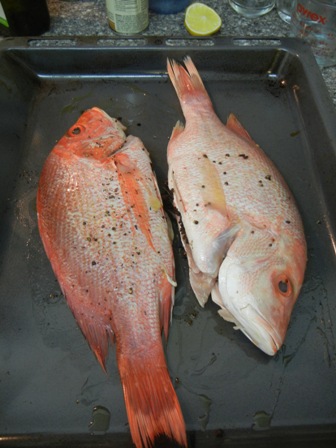
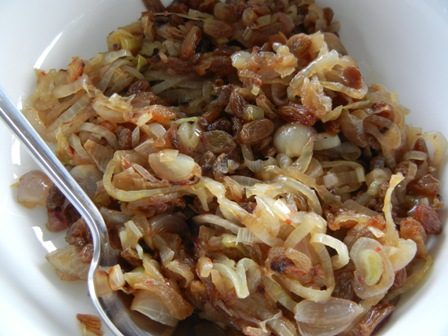
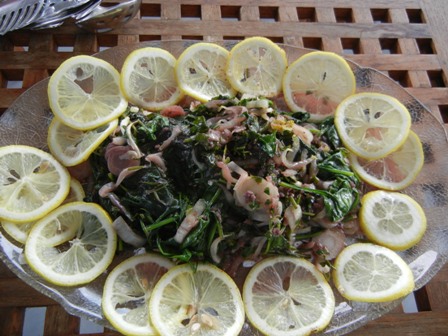
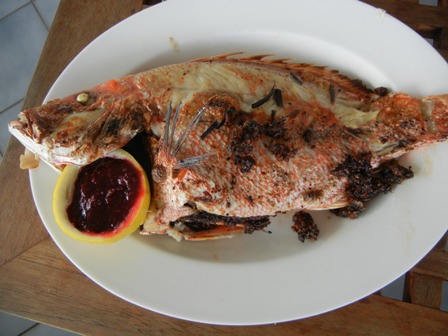
Of course we had the wine with food. Shakespearean cuisine was the go, which is a rather sweet affair with lots fo figs and raisin. Every individual dish tasted interesting. But we made a basic mistake: the various dishes did not harmonize at all with each other. I will just show some pictures and spare you the details of the dishes.

Here is what we had:

The fish

The raisins

Raisin-onion dish

Other veggies

…and the fish with jam


Summer lunch with Vinho Verde in Bangkok

May 21, 2012

Casal Mendes Vinho Verde

At the end of the dry season in tropical Bangkok temperatures reach above the 40 Celsius. Fortunately, the humidity is rather low at this time of the year, at least before the casual tropical rain shower goes down. These showeres become more and more frequent over the next weeks until the transition to the rainy season is completed.

Therefore, light lunches are the go. Nobody wants rich and filling food but instead prefers salads, grilled vegetables and maybe something fresh from the water.

Regarding the wine selection low alcohol Riesling wines are my preferred choice. But another wine which is ideally suited to the conditions are whites from Portugal, especially Vinho Verde. Fortunately for us in Bangkok some Casal Mendes Vinho Verde is available.

We had such a lunch last Staurday, with grilled green asparagus, an insalata caprese, and some grilled scampi. The olive oil we are using is of first quality. Needless to say the disheses were just delicious.

Green asparagus

Mozzarella with organic tomatoes

Grilled scampi

What a meal