Family meals and the emptying of my wine “cellar”

July 4, 2008

Our last 60 days in Jakarta have started. Soon we will be moving to Bangkok. We try to enjoy every day. Apart from sorting out things, we are spending our time at home with family meals and drinks.
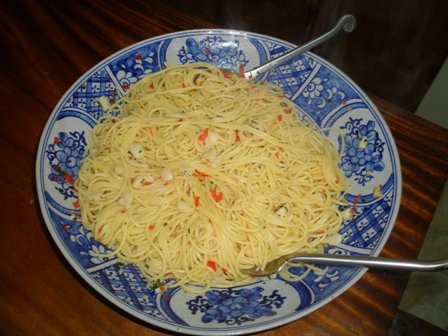
A delicious seafood pasta

I do not have a large supply of fine wines left but some of the bottles I have kept for special occasions. So what did we drink over the last couple of days? Here is a quick run-down:

‘2002 Léon Baur Gewürztraminer Grand Cru Pfersigberg’, alc. 13.5 % Vol.
We drank it before lunch as an aperitif. This is an aromatic wine, very generous in its flavours. It comes from a limestone “terroir” and is the gem of the Léon Baur collection. Low yields make great wines. It’s rather high in alcohol and has 15.2 g/l in sugar. A very enjoyable Gewürztraminer typical for this grape variety (www.leon-baur.com)

‘2003 Wiltinger Gottesfuss, Riesling Kabinett Feinherb, Reichsgraf von Kesselstatt’ , alc. 11 % Vol.
As you know, I love wine from the Saar River, and Wiltingen is one of the major location to produce first class Riesling wines. “Feinherb” is the German word for semi-dry. “Gottesfuss” is one of the best locations in Wiltingen, a very steep, stony slate ground which produces a fine, acidic, and balanced wine. Normally I prefer dry Rieslings but with a spicy Asian meal, the semi-dry version does very well. (www.kesselstatt.com)


‘2005 Hollick Coonawarra Reserve Chardonnay’,
alc. 13.5% Vol.
We had it with a seafood pasta. What a delicious Chardy this was. Although cellaring for up to 7 years is recommended, the bottle did not last that long. It displayed aromas of white peach, had crisp acidity and balanced creamy overtones. Though the wine was matured in French oak for 10 month, it was not “over-wooded”. Beautiful (www.hollick.com).

‘1999 Mildara Coonawarra Cabernet Sauvignon’, alc. 13.5% Vol.
The Mildara brand belongs to the Fosters Group (www.fosters.com). Liz and Walter brought it with them and we had it with all kinds of cheeses, salamis, coleslaw, salads and all kinds of “nibblies”. Despite its age, it displayed all the freshness of a typical Coonawarra wine. The colour was a deep purple. The intense aromas ranged from cassis, to dark berries and plum with hints of mint and herbs. The 18 months in oak have given the wine great depth and bony tannins, mellowed by age. The wine had an excellent structure. It was well aged.

‘2004 Knappstein Clare Valley Enterprise Vineyard Cabernet Sauvignon’, alc. 14.5% Vol.
The bottle retailed for US$ 26.50 at the Jakarta duty free store in Jalan Fatmawati. I had it reserved for a special evening. the wines is Clare Valley Cabernet Sauvignon at its best. Wonderful creamy, cassis, blackberry and mulberry flavours. A big Australian wine, full and complex but heavy which lingers on long after you swallowed the last drop. The fruit is grown on the “terra rossa” soils. Low yields guarantee the quality of the fruit. 2005 was an excellent year with a long ripening season. We had it after a meal just for enjoyment. This is a great wine indeed. (www.knappsteinwines.com.au)

The farewell dinner with our Australian friends (Brett, Janie, John and Dhanya) last night was a delight. We drank some very good wines. I only mention them in passing. Hope you don’t mind. We started with a pre-dinner drink, a ‘2006 Vasse Felix, classic dry white’ from Margaret River, Western Australia. The entreés we washed down with a ‘2007 Yarra Burn Sauvignon Blanc Semillon’ from the Yarra Valley, Victoria. We switched to red before the main course (a pasta bolognese), first to a ‘2004 Cape Mentelle Cabernet Merlot’ and then a ‘2003 Vasse Felix, classic dry red’. Three Margaret River wines stood against the cool climate SB form the Yarra Valley. It was a wonderful evening. No sadness was to find only the joy of being together and having a good time. I love this Australian attitude to life.


German Wine Regions: The Saar

June 28, 2008

One of the premium Riesling producing wine regions in Germany is the Saar, which is part of the Mosel region (the English usually call it Moselle, using the French word for the river). In fact the Mosel Wine Region used to be called (until 2007) “Mosel-Saar-Ruwer”, the latter two being small tributaries to the larger Mosel river. Along the three rivers about 13,400 ha are under vines these days, most of the vineyards are to be found on steep slopes, offering breathtaking views.

The village of Wiltingen, home to many famous wine producers along the Saar

Along the river Saar vine cultivation goes back a long long time, roughly 2,000 years only. Until Napoleon conquered this part of the various German lands, most wineries were in possession of the catholic church, monasteries, and other clerical institutions. Napoleon secularized the administration and with it most vineyards and wineries came into private hands.
The area between Serrig and Konz is the main production base of the Saar. Further upriver only small and singular plots are planted with vines. The most renown wine producing villages along the Saar are
Serrig, Saarburg, Irsch, Ockfen, Ayl, Schoden, Wiltingen, Kanzem, and Wawern. Moreover we find vineyards along one of the smaller side valley’s Filzen, Koehnen, Nieder- and Obermennig, Krettnach and Oberemmel.

Ayler Kupp, one of the prime ‘terroirs’ of the Saar

The dominant variety is, of course, Riesling. The total area under vines is about 1,500 ha, mostly on steep slopes with gradients of up to 55 per cent. Other but minor varieties are Pinot Noir, Dornfelder, Pinot Gris, Rivaner, Kerner and Pinot Blanc. The soil consist mainly of blue Devon slate soils. The alcohol content of the wines is usually low (between 8 and 12 %), but the acidity of the wines shows excellent structures and compositions and this is why the wines can be cellared for long periods of time.

Steep vineyards in Ockfen

The vineyards are ready for spring to come

The two photos above were taken in Ockfen, showing vineyards in the location ‘Ockfener Bockstein’, one of the prime ‘terroirs’ in that village.

Springtime and lots of work to do to make the season a success. Lime is distributed by hand in the vineyards, here in Schoden.

There are many prime wine producers along the Saar. The top estate is probably Weingut Egon Mueller (also called the godfather of Saar Riesling) – Scharzhof in Wiltingen. Among the highest rated Riesling wines in Germany (on www.riesling.de) Egon Mueller has three of the top eight wines.

But there are many other prime producers. I can only mention a few. For instance Weingut Fortsmeister Geltz-Zilliken in Saarburg, or Schloss Saarstein in Serrig. Then there is the rising star, Roman Niewodniczanski and his team at Van Volxem in Wiltingen. His wine maker, Dominik Voelk, is young and ambitious, and by the way is a native of Franconia, a wine region with long traditions in excellence. When I visited the estate in March, he had completely sold out all his wines. I am now waiting for the release of the newest vintage in September (grand cru only). Then there is Weingut Dr. Siemens in Serrig and Weingut Peter Lauer in Ayl.

Also other producers are worth mentioning. Weingut Reichsgraf von Kesselstatt, which operates a wine bar just across the cathedral in Trier (Trierer Dom), possess vineyards in Wiltingen. Four star ratings were awarded to Weingut von Orthegraven in Kanzem and Weingut von Hoevel in Konz-Oberemmel but there are many others who produce excellent Saar wines.

I love the Saar Rieslings with their well balanced, “filigree like” acid compositions. I love them for their explosiveness, zest, intensive aromas; they have structure and balance, are low in alcohol and usually impress with a long finish, lingering on your tongue’s taste buds like ballerinas which you can still see before your inner eye long after they left the stage.

I encourage you to visit the Saar and sample as many wines as you can, it’s worth it, definitely. This time of the year should be perfect, as the pictures below demonstrate. I hope they can entice you to give it a go and lure you to the Saar.

Explore the beauty of my home region, do not forget to visit Trier, its just around the corner.

Vineyards in Schoden

The ‘terroir’/location ‘Herrenberg’ in Schoden

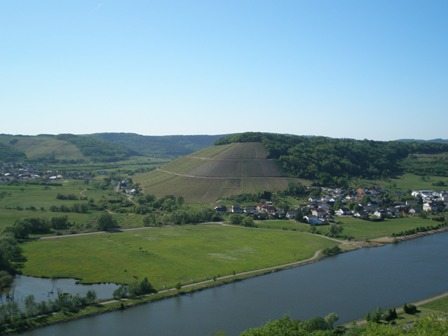
Near Schoden the Saar is most picturesque. The hills, the forests, the river and the small villages offering local food and wines make the Saar a prime destination for tourism.


Restaurants in Germany – Hotel Prinzregent, Munich-Riem

June 25, 2008

Bavaria is just such a beautiful place. I just cannot get enough of it. Especially at this time of the year travelling around Upper Bavaria is truly enjoyable. Even sub-urban places such as Riem have their charm. I stayed in a small hotel at the outskirts of Munich to attend a conference at the Messe Zentrum (the fair).

The very first evening, I asked the receptionist where one could have a decent bite of food, preferable Bavarian style and I was pointed into the direction of the Hotel Prinzregent (www.prinzregent.de), in fact a country inn style place along the main street in Riem. The ‘guest room’ of the public bar part was fairly busy at a Friday evening.

The Bavarian country inn – Hotel Prinzregent

As it was my first evening back in Germany I could not resist ordering a pork roast Bavarian style with ‘Semmelknoedeln’, a kind of cooked carbohydrates made from leftover bread crumbs. It was so delicious I completely forgot to take pictures for my blog. I drank wheat beer with the meal though the Prinzregent has a nice wine list available. For dessert, which I usually do not have, I had ‘Apfelkuechle’, a kind of apple backed in a doe and seasoned with raisin. After that mighty meal I was exhausted and went to bed early.

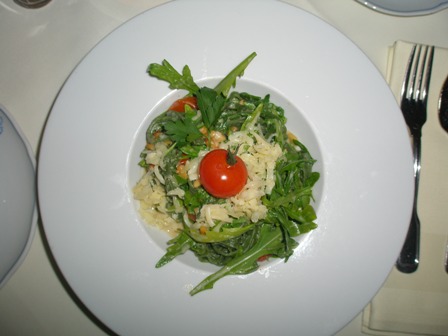
The pasta

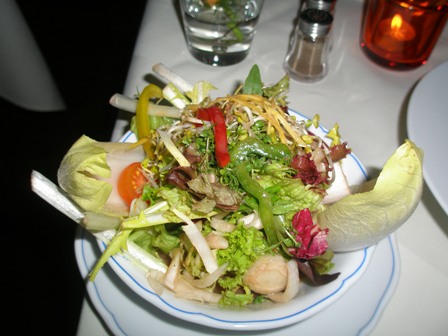
The very next day I came back to enjoy some more of the delicious food at the Prinzregent. Unfortunately, I did not order the roasted pork again (I should have) but went for a vegetarian pasta dish. It was ok but could not match the pork. The side salad was fresh and tasty.

The salad

This time I tried some of the white wines with my food. First I ordered a Riesling from, of course, the Mosel. A ‘2006 Weingut Schmitges dry Riesling from grey slates’ was my choice. It is a young but very enjoyable wine, typical for the region, elegant, displaying aromas of citrus and green apples, a fruity, minerally kind of wine.

For my second glass I choose a Sylvaner from the native lands of my mother, Franconia (the most northerly part of Bavaria). Horst Sauer is one of the icons of the vintners and winemakers from Franconia. His ‘2006 Eschendorfer Lump’ is just divine. The Germans like to describe a wine as “filigran”, which my dictionary says means “lacy” or “filigree”. I do not know if that makes sense to you. Anyway, the wine shows the typical Franconian character, is complex and fine, well balanced, has a good structure and a lingering finish. The prices for the wines were not on the cheap. The fellow at the next table turfed the idea of having a glass of wine after he saw the prices. Well, I was in a festive mood that day and did not bother.

White sausages Bavarian style, isn’t this beautiful?

My last meal at this wonderful place I enjoyed sitting in the large beer garden under very old chestnut trees reminiscing about the wonderful time I had in Bavaria. It was rather a late breakfast than lunch and therefore I ordered the typical Bavarian “white sausages” which is eaten with sweat mustard. A wheat beer matches that perfectly. Sorry you wine folks.

Address:
Hotel Prinzregent an der Messe
Riemer Strasse 350
81829 Munich
Te.: +49-89-94539-0
http://www.prinzregent.de


Mother’s day – lunch at home

May 12, 2008

Normally we go out for lunch at Mother’s day. But on Sunday we stayed home. Margit cooked a beautiful meal. We had prawns and a risotto “arrabiata”, nice and spicy and a fresh green salad.

It was a beautiful tropical day, the beginning of the dry season in Jakarta. Our garden is lush and green, some of my orchids are still in bloom. In short it was wonderful at home, not disturbed by anybody.

The prawns

The risotto “arrabiata”

A bottle of Mosel Riesling from Trier

Well and what did we drink with the food? I raided my little wine cellar and dug our one of my last bottles of Mosel Riesling. This time a wine from Staatliche Weinbaudomäne Trier, a ‘2005 Avelsbacher Hammerstein Riesling Kabinett’.

It was, I would say, a semi-dry Riesling, maybe a bit on the sweet side. Anyway, it was too sweet for me, but matched the spicy risotto perfectly. The wine has only 8.5 % alcohol; it is fruity, spicy and aromatic, with a good body, structure and length. It was awarded a gold medal by the state of Rheinland-Pfalz’ wine show.

A firework for the nose

The Staatliche Weinbaudomäne (it means ‘estate’ or ‘domain’) is owned by the state of Rheinland-Pfalz. Today, it cultivates about 31 ha of vines at various locations near Trier along the Avelsbach stream, a brook of 4.6 km length which flows into the Mosel river.

In 1996 the estate celebrated its 100 anniversary. It was founded in 1896 by the then Prussian State government and covered about 200 ha under vines consisting of three separate estates, Avelsbach, Ockfen and Serrig, two of which were located at the Saar, another tributary of the Mosel.

The Avelsbach is divided into five ‘terroirs’ (locations), Altenberg, Herrenberg, Kupp, Hammerstein and Rotlay (the last of which is not in production any more).

Interesting is that this wine must appeal to Japanese consumers because of the dozen wine sites a search leads you to, at least 50% were in Japanese characters.

Address
Staatliche Weinbaudomäne Trier
Deworastrasse 3
54290 Trier


Dr. Loosen, I presume

May 11, 2008

Last night we went to dinner with our dear old friends Liz and Walter. After nibblies (as we say in Australia) at their home we proceeded to Cork and Screw, the very hip and extremely trendy restaurant in Jakarta.

The food was excellent as always. We had an Australian Shiraz with the meals and moved on to dessert. Three of us had crème brûlé; Liz had some kind of chocolate dessert. There were only three wines to choose from, two “half bottles” and a Riesling Spätlese and can you imagine from where? The Mosel!.

And what was it? I could not believe my eyes, a ‘2006 Dr. Loosen Wehlener Sonnenuhr Riesling Spätlese’ for only about 33 €. We needed to have this wine. What a bargain. Usually one cannot get any Mosel wine here in Jakarta. I could have kissed the people from Cork and Screw and Vin +, the wine shop associated to the restaurant.

The empty bottle ‘2006 Wehlener Sonnenuhr Riesling Spätlese’, Dr. Loosen, Bernkastel, Mosel

I must admit that though I come from the Mosel, I have never had a bottle of Dr. Loosen’s wine (www.drloosen.com). He is such a famous vintner, sitting on all kinds of wine juries, all over the world. It had to come to that. I tasted his wine in Jakarta, a couple of thousand miles from home. The major German Riesling portal (www.riesling.de) lists him as the top vintner of their top 10 wineries.

“Wehlener Sonnenuhr” is one of the prime terroirs (about 65 ha) on the Mosel, all on steep slopes. A sundial is to be found right among the vines and that gave the location its name.

Wehlener Sonnenuhr (source: www.drloosen.com)

The wine has only 8% alcohol and was the perfect match with our dessert. Of course we drank it too young, but we had no choice, waiting was just not feasible. The wine displays and expressive nose, shows apple, lemon, almonds and nuts. The acids were well balanced and the full sweetness gives it a round and lingering finish. We all loved the wine.

When the waiter wanted to clear the table I told him my story: that I was from Trier, Mosel , not far away from where this wine came from and that I wanted to take the empty bottle home. “Tidak apa apa”, the kind man said, meaning “no worries” in Australian, and he gave me a Cork and Screw bag to carry the bottle.

How wonderful. If you happen to be in Jakarta one of these days, have a meal there; it’s certainly worth it: great place, great service, great food, great wines.


Row spacing and trellis systems in Germany

May 10, 2008

While traveling in Germany last year, I took quite a few photos of vineyards and the way vines were grown there. While visiting the Ahr, Rhine, Mosel and Saar I notices that row spacing and trellising could showed a wide variety of different spaces and systems.

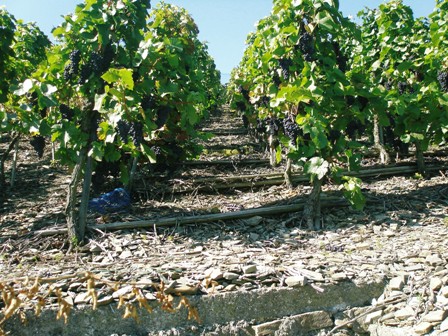
This slope on the Ahr shows “planting with the slope” and planting “parallel to the slope”, and also the width between rows shows variations.

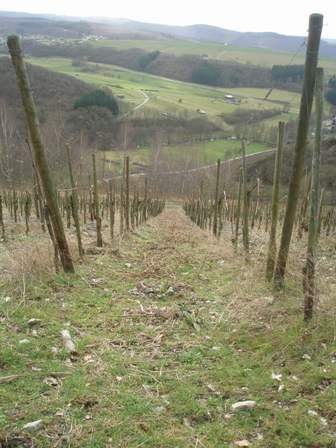
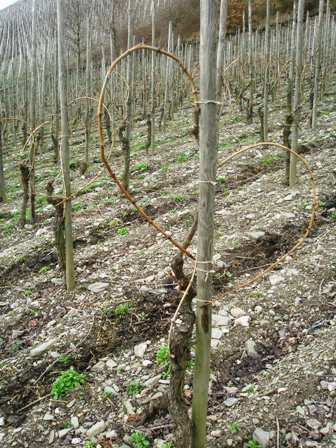
Here (photo above from the Ahr) sticks have been put between the individual vines in order to make it easier to move in the vineyards and to prevent stones and earth to be washed down the rows. Every vine has its own individual post and no wires are required. One finds this system also along the Mosel and the Saar.

Individual vines and the post after pruning (Saar)

After pruning, two canes are bound to the post on the individual post system. I wonder if spur pruning can be applied to it too?

Usually movable fruit wires, as we have them in Australia (VSP = vertical shoot positioning), are not a feature of these trellis systems. This is not surprising. On the steep slopes of the Mosel, Ahr and Rhine rivers moving fruit wires would be suicidal.

In my own vineyard in Glenburn, we use a simple VSP-trellis system. The move of the fruit wires is usually not a difficult job, especially along the gentle slopes as we have them. However, when the rows are long, the wire gets heavier and heavier the longer the day lasts.

Three fixed wires on vines in Olewig, Trier/Mosel

One finds also more and more metal posts, here also with three wires (Olewig)

In some of the locations, even if they are steep, caterpillar tractors are used to work the land. These tractors are small but still need narrow rows between the vines in order to operate.

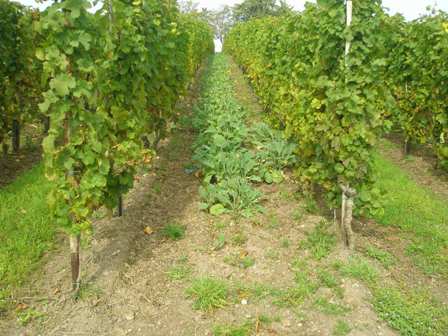
Below, two rows have been planted close to each other (and no vehicle can work between them), but the next rows a planted at a wider distance so that the caterpillar tractor can be used.

Even cabbage is grown between the rows (Olewig/Trier, Mosel)

In my blog entry titled “Along the Mosel River”, of September 12th, 2007 I showed some of the elevators used on steep slopes to carry material up and down the vineyard. Have a look and check it out; it’s an interesting system, one can observe on many steep vineyard slopes on the Mosel.


Country Inns in Germany – Klostermühle, Ockfen, Saar

May 5, 2008

When I am visiting my hometown Trier I always try to arrange an outing to the Saar, my most favourite tributary of the Mosel (the other one I love very much, is the river Ruwer).

One day in March my mother, my friend Heinz and I, we went for lunch in the countryside. It was March. Spring was waiting in the wings, but could not get through as yet. However, it was a beautiful day. We choose the Klostermühle in Ockfen, Saar, as our destination, a winery cum hotel and restaurant (www.bockstein.de).

Winery-Hotel-Restaurat Klostermühle in Ockfen, Saar

Pork tenderloin with Spaetzle, a German type of noodle dumplings

The food was delicious, typical country inn style, rustique, big portions, in short: value for money type of food. I had one of their Rieslings with my food. Ockfener Bockstein is the name of the most famous location (terroir) in this neck of the wood. It was a very typical Saar Riesling, low in alcohol but zippy and fruity, with complex acids, a good structure and a long and intense finish.

After lunch we drove though the vineyards of Ockfen. On our way to Schoden where Heinz together with some friends is renting a hunting ground, we passed by the “Bockstein” which you can see in the picture below (where the tree line on the hill in the background is ending).

Ockfener Bockstein, one of the most famous “terroirs” of the Saar

The Saar is a very picturesque wine region and tourist destination in southwestern Germany and certainly worth a visit. Do it regularly as I do. The Riesling wines are among the best of Germany.

Address
Weingut – Hotel – Restaurant Klostermühle
Fam. Minn
54441 Ockfen, Saar
+49-6581-9293-0


“Ze Lawen – Zur Lauben – At the arbour” – Trier at its best

April 18, 2008

In the dialect of Trier “Ze Lawen” translates into high German as “Zu den Lauben” which can be transcribed into “At the arbour” in English.

What is it, you might ask.

Well, it is a part of the city of Trier. In the 18th century it was a small fishing village at the outskirts of the city just beyond the ancient city walls. Later it was transformed into garden arbours used by city folk to spend their Sundays where they relaxed in the shade of their small garden houses.

Today, “Ze Lawen”, located directly north of the Kaiser-Wilhelm bridge, consists of a small stretch of beautiful historic buildings along a very picturesque strip of the Mosel river. Over the years many of the fishermen’s houses were turned into small country inns, eateries, bars and restaurants with a great variety of local foods and drinks on offer. Actually if you look for a culinary delight in Trier you have to visit this part of the city. Needless to say that you can enjoy all the many famous Riesling wines produced along the Mosel and the surroundings valleys of Saar and Ruwer.

I will take you on a quick walk around this part of town (only a 200 meters stretch). Below, thats what it may look like in summer, in the background the Mosel and the red sandstone cliffs.

With friends eating out in “Ze Lawen”

During my recent visit to Trier I took some more photos. One can, for instance, find some stone mason work depicting scenes from Roman times, usually the delivery of rental payments as below.

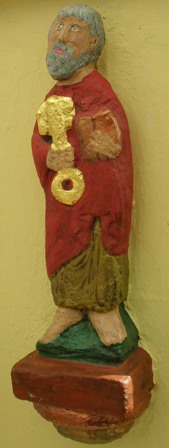
The patron saint of Trier is St. Peter. He is usually depicted holding the city keys and the bible as below.

Now we enter from the north. The first “Wirtshaus” cum restaurant is the “Schwarzbierhaus” to the left. Further on is another well known restaurant: “Pfeffermuehle”.

Other must visit places are “En de Lauben”, “Alt Zalawen”, “Mosellied” and “Bagatelle” (bistro/cafe), a restaurant where we had the most amazing food and wine degustation last year (a summary you will find in this blog).

The entry to the “Schwarzbierhaus”

The old lintels of the door frames shown belwo, usually also in stone, demonstrate that it was fishermen who once lived in these old houses. The most popular motives are fish or gear from fishing boats.

I hope this enticed you to put the city on you map. See you again in “Ze Lawen” one of these days. Its always worth a visit.


Wine Bars in Trier – Palais Walderdorff’s

April 12, 2008

There are so many good wine bars in Trier. This time I would like to introduce you to the Palais Walderdorff’s just across the cathedral in the heart of town. Its consist of a wine bar, a cafe and a restaurant and is a great place to visit.

The Walderdorff’s entry in summer 2007

I was pleasantly surprised to also find a wireless internet access, free of charge which made it even more convenient to drop by have a drink and surf the net.

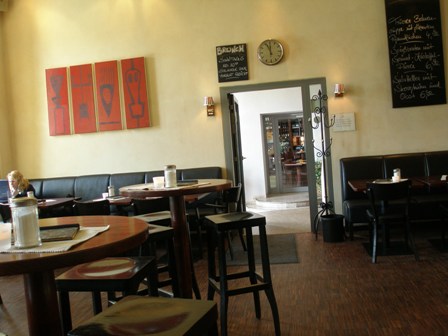
The inside of the Cafe, opposite the entry to the Vinothek

Espresso

The Vinothek has a great selection of local Mosel, other German and international wines. I drank a local Rielsing which was delicious of course.

Address:
Palais Walderdorff’s
Domfreihof 1a
54290 Trier


Homecoming – Trier, Mosel

April 8, 2008

Vineyards in Trier

Vineyards on left side of the Mosel near Trier

I listened to Keith Urban’s “Once in a lifetime” on my i-pod when riding into Trier on the train from Koblenz. It was the first day of April.

“But you’ve never been this loved (mm hmm)”, says the forth line of the first stanza and it seemed to summarise my feelings.

I was very happy to have reached the place where I grew up.

Spring greeted me and the sun bathed the hills surrounding the old Roman city. What a perfect day, I thought; how lucky I was. And it turned out later that it should be the only ‘spring day’ during my short visit. Snow and ice should clebrate a comeback a couple of days later.

Behind me lay a wonderful train trip through the charming settlements and small towns of the Mosel river valley: Winningen, Kobern-Gondorf, Alken, Moselkern, Treis-Karden, Cochem (a long tunnel ride depriving me of any view of my beloved Mosel), Ediger-Eller (crossing the river into yet another tunnel) and into Bullay. More tunnels were to follow and we crossed into the Eifel hills leaving the river behind us. The next vineyards would re-emerge in Schweich, near Trier.

It was a glorious morning ride on the train. The Mosel river valley showed its best side and the train trip from Winningen to Bullay is the most enjoyable part. I was listening to music from Sting “Songs from the labyrinth”, a collection of songs from the 16th century. What perfect music for such an historic ride along the shores of the Mosel river.

I followed it up by listening to Alan Stivel and his Celtic Music collection and in my inner eye I could see the original settlers of the area, the Celtic Treverer working the valley and the steep vineyard slopes. This was the perfect music for a homecoming. Here and there castles and ruins thereof greeted us from the hilltops.

Spring had just arrived. Fruit trees were in flowers, apples, pears and cherries in white or a soft pinkish white, peach trees in dark pink. Nature is ready to rock; just a few more warm days and everything will be covered in soft green colours. The willow trees pushed already their sprouts. All other trees, the birches, beech and oak trees on the hills were bare.

The train went along the river through meadows and paddocks, fields and forests. Thousands of years the Mosel flowed through this landscape. River barges made their way down or uphill through the brownish water. White swans working on their nests. The sun blinded me while riding along in the train. Who would have know that these hills would mean so much to me one day?

The vineyards were well tended, immaculate, only some belated vintners were busy binding the canes to the wires or the stakes; soon the buds of the leaves would burst.

Only the dirty train windows prevented me from taking pictures.

At my mothers house a delicious lunch would wait for me (and some Two Hills Merlot of course). Homecoming, it was the second time for 2008, that I had the opportunity to come back to the town I was born in. What a joy.

Noodles and Two Hills Merlot