Karl Marx and Chinese Grape Wine

November 28, 2008

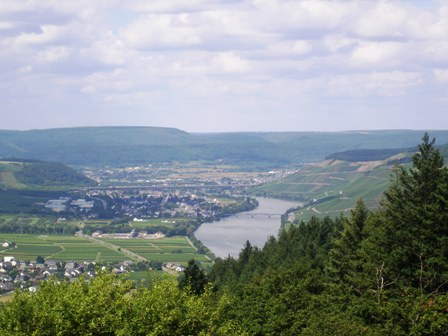
To state it from the outset, Karl Marx never ever tasted Chinese grape wine in his lifetime. However, Karl Marx, the most famous son of my home town Trier, used to own for some time some of the better vineyards properties along the Ruwer river, a tributary of my beloved Mosel river.

The Marx family vineyard was found in the location “Viertelsberg” a medium quality terroir near the castle ‘Gruenhaus’. In 1857 the family sold its vineyards in Mertesdorf. Karl not only invested in vineyards and the wine industry but he also loved to drink Mosel wine. I frankly do not understand how Marx could survive those many years in London where good Mosel wines were certainly hard to come by in the latter half of the 19th century.

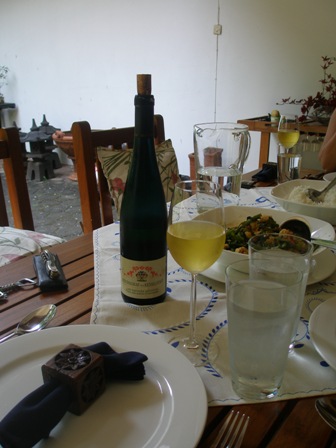
Marx would have enjoyed the samples of “College Wine” produced by the Chinese Agricultural University (CAU) oenology department. The wine is produced for purely non-commercial reasons. The bottles were presented to me by an old friend. We enjoyed it over a meal which marked our reunion. The wine went very well with the Chinese food on offer. Later at home in Bangkok we would have it with an Italian pasta. But in this case I felt that some depth and ‘strength’ was lacking.

collegewine2

The grapes for this wine come from Changli in Hebei province and were supplied to the oenology department by the well known Huaxia Winery. When I lived in Beijing in the early 1990s, it was marketed as Great Wall wine.
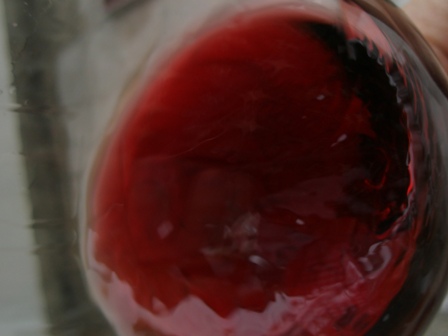
swirling-college-wine

Swirling in the glass – what a beautiful ruby-red colour

The wine displays the typical varietal character of a Cabernet Sauvignon but is medium to lights bodied. At 12% alcohol it’s a bit “thin”/”light” for my taste. In comparison, it went well with Chinese but not Italian food.

collegewine3

A somehow classic design

Afterthought
PS: Despite the fact that the CAU is a modern university, at the entrance to its eastern campus, one of the few statues of Mao Zedong graces the gate. When I lived in Beijing in the early 1990s, my friend David McGrath (al marhum), chased the remaining Mao statues still standing in the capital city. He took photos of all of them. If I remember correctly David identified 8 statues. Around ‘Xue Yuan’ road where I stayed, I found 4 of these 8 in no time. All were to be found at the entrances of universities or other academic institutions.
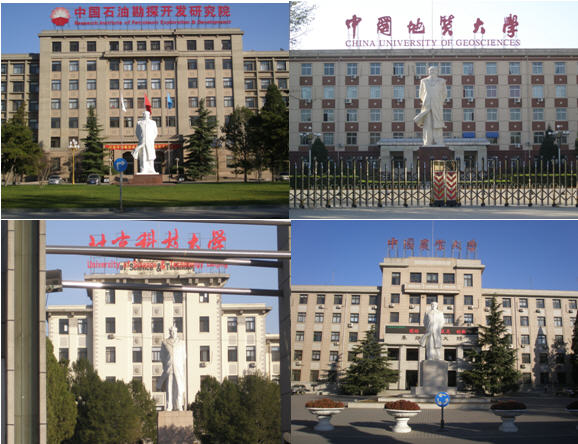
the-4-maos

The four Mao statues

F.l.t.r. and up to down: Research Institute of Petroleum Exploration and Development, China University of Geosciences, University of Science and technology, China Agricultural University.


Sunday Family Lunch in Bangkok

November 23, 2008

Sunday lunch is our favourite family affair. Usually the girls are doing their homework, Margit does the magic in the kitchen and I try to set the table, prepare the wines and do some of the supporting cast work.

In the morning we went to the Villa Market to buy the ingredients. Asia is great in this respect. Shops are open seven days a week and the Villa Market is just around the corner from our flat in Thong Loh, Bangkok.

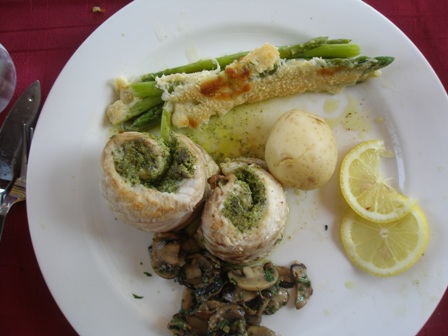
“Sole with Walnuts in Parchment” from my favourite cook book –“The Philosophers’s Kitchen” by Francine Segan – was on the agenda. We could not get sole but grouper was available. Parchment paper was also on hand. The adventure could begin. And the recipe goes like this (page 110 of the above book):

Ingredients:
– 1 cup shelled walnuts (have you ever had unshelled walnuts in a dish?)
– 1 cup fresh parsley leaves
– 1 cup fresh mint leaves
– 1 garlic clove, minced
– 1 tablespoon honey
– 1/2 teaspoon ground cumin
– 2 tablespoons walnut or olive oil (we had the latter)
– sea salt and freshly milled five-colour peppercorns (we took fresh green ones)
– 4 lemon sole fillets (in our case grouper), about 8 ounces each
– four 12 by 12 inches sheets of parchment paper
– 2 tablespoons unsalted butter, softened
– lemon wedges

How to do the magic:
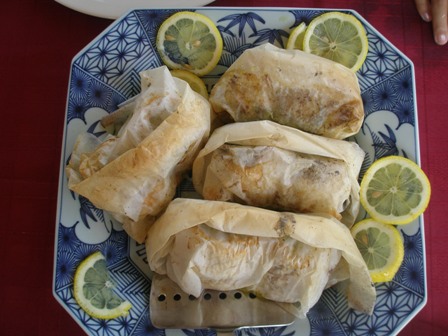
Well, first heat the oven to about 220 centigrades. Grind the walnuts finely, add the parsley, the mint, garlic, the cumin, the honey, the oil, the salt and the pepper. Puree this mesh until it is well blended. Divide the stuffing in four parts and spread it on the top of the four fish fillets. Then roll the fillets with the stuffing inside. Put two fillets on one sheet of parchment, dot the top of each with some butter, close the packet folding the parchment in pleads. Tuck the ends under the fish and put it into the oven. After about 15 minutes they are ready.

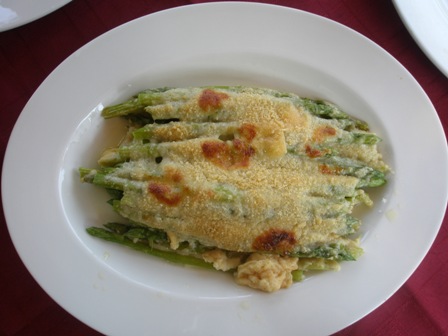
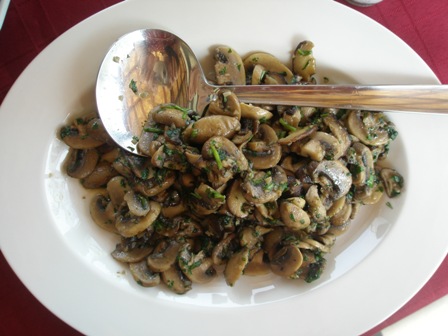
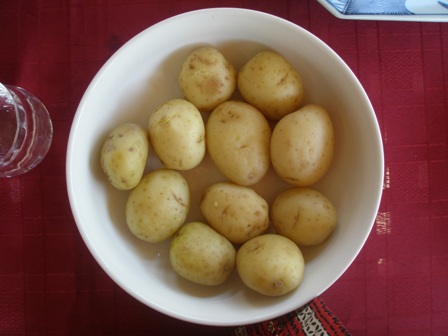
We had green asparagus grilled with parmesan on top, mushrooms and potatoes with it. Have a look at the dishes below. I love Francine’s recipes.

sunday-bkk2

The grouper in parchment

sunday-bkk3

Green asparagus with parmesan cheese

sunday-bkk4

The mushrooms

sunday-bkk5

The potatoes

sunday-bkk6

Voila: the Sunday meal

You will ask what wine we had with this delicious meal. Well, we are still experimenting with the wines here in Bangkok. I choose a Thai wine (a rose). Unfortunately I tried the lower price end. It did not work. Nothing to report on the wine front. Sorry.

Wines are not cheap in Thailand. The lower price range starts at about 6-7 EURO/bottle, minimum prices for mass wines are 10-12 EURO. For a decent drop you have to fork out the minimum of 20 EURO. This situation is not conducive to extensive wine tastings. There is a great variety of wines from all over the world to chose from but the prices hinder you somehow.

I should have chosen a Sauvignon Blanc from New Zealand or a Riesling from the Mosel (but had nothing at hand).

Source:
The Philosopher’s Kitchen
Recipes from Ancient Greece and Rome for the Modern Cook
by Francine Segan
Random House, New York 2004


Wine economists unite

October 30, 2008

A couple of weeks ago, Karl Storchmann made me aware of the American Association of Wine Economists (AAWE). I somehow got sidetracked, visited the website once but that was it. Now I revisited the AAWE and found out that they held their first ever congress in my dear home town of Trier in 2007. I couldn’t believe it. Their second conference was held in Portland, Oregon in 2008 and for 2009 they have selected Reims/Epernay in France as venue. This makes me somehow proud to come from this small town tucked away in the Mosel river valley in the far West of Germany.

The AAWE (please do not confuse it with the American Association of Wind Engineering or the Association of American Wives of Europeans) is a private, non-profit, educational association open to members from all over the world. The Association publishes a semi-annual journal – the Journal of Wine Economics, organises scholarly conferences and forums for wine economics research.

On the website you can also find a very interesting blog (http://wine-econ.org) and I strongly recommend visiting, brousing through it will give you many insights in the wonderful world of wine, this time from an economics perspective. Have fun.


As the river….

October 24, 2008

Most German wine regions (not all) take their name from the river which runs through the territory planted with grape vines. This is true for the Mosel, Saar, Ruwer, Rhine, and Nahe to name but a few. Vine growing in my native Germany is intrinsically linked to rivers and river systems which is partly due to the availability of steep slopes catching the last beams of sun.

The village of Schoden at the Saar river, in the background, the location Ayler Kupp (photo taken from the location “Herrenberg”)

Recently my writing style has been characterized as “meandering” (by David Harden, thanks David) and meandering I do. In fact the purpose of my whole blog is meandering. Meandering between the old and the new world and its wines, meandering between my actual live in a big Asian metropolitan city and my desired live in a rural place in Victoria, Australia, meandering between the many identities I have acquired over the years working in Asia and my future as an Australian vintner and wine maker.

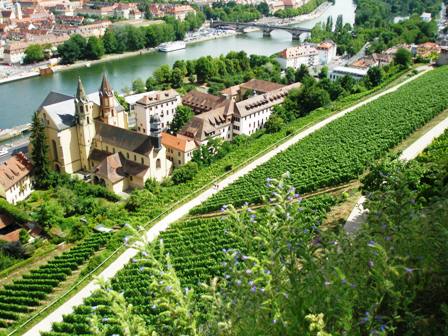
Wuerzburg at the Main river and its vineyards

The second part of the title sentence goes as follows: “…so the wine”. This is certainly true for Germany. I have to find a similar “alliteration” for Glenburn and the Upper Goulburn Wine Region.


Trier, Mosel: Wine Auction 2008

October 4, 2008

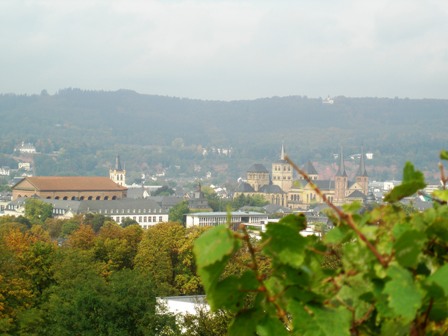
The wine city of Trier (from the Petrisberg side)

According to the website www.riesling.de the annual wine auction of the “grosser Ring” (freely translated as ‘big ring’) a subdivision of the regional section of the Association of German Prädikat Wine Estates (that is how on the website of the association, the German title: “Verband der Deutschen Prädikatsweingüter” is translated) was a full success. The association has about 200 members German wide. About 13,000 bottles of wine were auctioned off. The sale brought in an amount of € 1.3 million.

The top prices were earned by wines from Weingut Egon Müller (Saar), Weingut Joh. Jos. Prüm, and Weingut Dr. Loosen, all top producers of the Mosel wine region.

The most expensive wine of the auction was a single bottle of a ‘1959 Wehlener Sonnenuhr Riesling Trockenbeerenauslese’ by Weingut Joh. Jos. Prüm which was sold for € 5.097.96. Wow, isn’t that amazing.

But also prices for recent vintages were quite high. A ‘2007 Scharzhofberger Auslese Goldkapsel’ by Weingut Egon Müller sold for € 582.62 , a ‘2007 Graacher Himmelreich Auslese Lange Goldkapsel’ by Weingut Jo. Jos. Prüm for € 485.52 and a ‘2007 Erdener Prälat Auslese Lange Goldkapsel’ by Weingut Dr. Loosen for € 449.11

Wine bar Kesselstadt in Trier just opposite the church of Liebfrauen

The auction lasted for more than 5 hours much longer than a marathon run. The general trend as far as bottle size is concerned seems to be heading towards magnum bottles. For wines filled in such size bottles premiums were paid.

The tasting prior to the auction revealed the very high quality standard of the 2007 vintage Rieling wines. On www.riesling.de you can find the detallied rating of the individual wines and the prices paid for the various lots sold.

Even for ordinary mortals like me, the auction is good news. The superior quality of the 2007 Mosel Riesling vintage will also apply for more everyday wines which I can afford. Next time in Trier I will indulge myself again. Why don’t you come with me.


From North to South

September 28, 2008

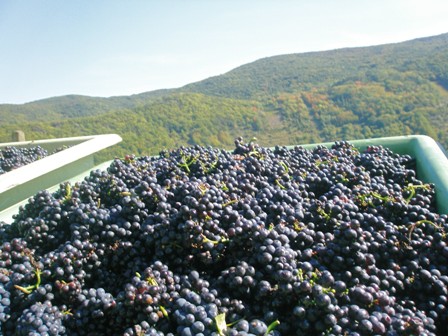
Pinot Noir grapes at the Ahr.

It’s vintage time in my native Germany. Reports I am reading about the harvest conditions seem to indicate that everything is going well. Also my German wine blogger colleagues seem to be content.

Down under in Victoria, we have springtime. Spring is usually Victoria’s wettest season. However, weather reports indicate that this September will be one with the lowest precipitation in history of Victoria.

Melbourne recorded only 16 mm of rain in September, the lowest since recording began in 1855. The long-term average is about 59 mm. Also average day temperature was well above the long-term average (19 instaed of 17 degrees celsius) which make September 2008 the warmest September since 2001. The same trend could be observed regarding night temperatures.

Reservoirs around the state are at a record low as well. That’s no good news for vintners and grape growers.

I wonder how full our two dams at Two Hills Vineyard are. So far we had always had sufficient water to bridge the 4-6 weeks of high summer. Last year we had hoped that the draught would be finally broken. That seems not to be the case.

But as always, we hope for a good harvest.

Lake Eildon low on water (only 23% of capacity, 09/2008)


Germany’s Best Riesling Wines 2007

August 30, 2008

Riesling vineyards in Olewig, Trier

The wine magazine – Weinwelt (Aug./Sept. edition) – I picked up at Frankfurt Airport when leaving Germany in August carried an article on the best Riesling wines in 2007.

About 1.500 wines were entered into this tasting and the overall winner (with 93 points) was

● Weingut Geheimer Rat Dr. von Bassermann-Jordan, Pfalz wine region with a
‘2007 Auf der Mauer Riesling QbA, dry’

Among the top seven wines were 4 from Pfalz, one from Austria, one from Rheinhessen and one from Franconia. For someone like me, a native of the Mosel, it is devastating that no wine from my home region was among the best seven.

Another Riesling competition in Bingen/Rhein in July had a record entry of almost 2,000 wines (1,937 to be exact) from 754 producers from almost all wine producing regions in Germany and from Austria, Canada, Australia, Luxembourg, France, USA, and New Zealand. Most of the non-European Riesling wines came (surprise), of course, from Australia.

The show is conducted every two years and 160 judges of an international jury assesses wines according to the international wine bureau (OIV) standards. The full report of this tasting can be found on www.riesling.de under the rubric “best of Riesling 2008”. In the category “dry Riesling wines”, the winner came from the Rheingau wine region:

● Weingut W.J. Schaefer in Hochheim for the
‘2007 Hochheimer Kirchenstueck Spaetlese’.

Number 2 came from the Mosel:

● Weingut Frank Brohl, Puenderich for the
‘2007 Puendericher Nonnengarten Spaetlese’

and from Pfalz,

● Weingut Emil Zimmermann in Wachenheim for the
‘2007 Wachenheimer Koenigswingert Spaetlese’.

In the “semi-dry Riesling category” wines from Rheinhessen, Mosel and Nahe could be found among the three top wines. However, the “sweet wine category” was dominated by Mosel wines.

There will be many more shows and wine tastings in the coming months. In July this year, when we tasted the 2007 vintage at Van Volxem Winery (Wiltingen, Saar), the “grand cru” wines were not yet presented because their release was scheduled for fall.

Given the fact that most wineries have not yet officially released their “gand cru” or, as the Germans say, “grosse Gewaechse”-wines, we will witness great quality Riesling wines of the 2007 vintage hitting the market later this year. That’s what I call wonderful prospects for us wine lovers.

My favorite Riesling from the Saar

PS: From October 14-18, 2008 the 2008 Canberra International Riesling Challenge will be conducted. For the first time in the history of the event, the number of entries has surpassed 500 wines (506 total entries), with a record number from Germany (99 entries). Let us see what the outcome may be.


Asian Food and Riesling Wines

August 17, 2008

The Riesling wines I selected for Sunday lunch were just the right complement to the Asian food we were having for the last joint family lunch in our Jakarta home. Tomorrow our girls will be laving for Bangkok to attend the opening of the new school year at their new school.

The lunch consisted of a typical Indonesian composition of Kankung (a green water vegetable) with prawns. We ate it with rice using spoons and forks only as it is the custom in Indonesia. The wine we had with the meal was of course not an Asian invention but a Celtic one.

The semi-dry Riesling (“Feinherb” as the Germans say) from the Saar was a perfect match for the food. We had the last bottle of ‘2003 Wiltinger Gottesfuss Riesling Kabinett Feinherb’ , (alc. 11% vol.) from Reichsgraf von Kesselstatt in Trier (www.kesselstatt.com). The spicy food was just the right dish to have with this Riesling wine from my home region.

The sun was shining, my garden green and lush despite the dry season, and so 10 years came to a beautiful end for the four of us.

PS: As “dessert” we had a second bottle of German wine (which was also the last one in my possession), one coming from the Nahe wine region where my grandfather used to live, ‘2003 Sitzius Kreuznacher Rosenberg Spaetlese, Scheurebe’ (with only 9.5 alc./vol.) from Weingut Alfred Sitzius in Kreuznach-Bosenheim (www.weingut-sitzius.de). The variety is mainly found in Germany and Austria and produces highly aromatic wines often made into sweet wines but also available in its dry incarnation. It shows honey, blackcurrant and grapefruit flavors but retains also some of the Riesling character, though it is less acidic, in short beautiful wine can be produced from this grape variety.


Bye bye Europe – welcome home in Jakarta

August 15, 2008

It was the last time that we should return to our home in Jakarta after a summer holiday in Europe. We are moving countries. After ten years in beautiful Indonesia we are packing up all our belongings. A new beginning awaits us in Bangkok/Thailand.

You can imagine that the emotions of our various family members are on a roller coaster, it ranges from one extreme to the other, varies between the sadness of leaving everything behind to the euphoria of a new beginning in another place.

The hectic of the preparations related to administrative and organizational matters pertaining to the move will not allow me to share with you all the exciting things I experienced in German and Portuguese wineries. I will try to slip in here and there some short notes and some of the many pictures we took on the way. More might come somehow someday.

Please bear with me.

The Mosel valley and its vineyards near Schweich with the “wine villages” of Riol (left) and Longuich, photo taken from the freeway opposite Mehring in August 2008


Augusta Treverorum – home at last

July 24, 2008

My hometown of Trier (lat.: Augusta Treverorum) from the ‘Kockelsberg’

Alas, we made it. Grandparents were very happy to see us. Blue sky and summer sunshine greeted us. A splendid holiday awaited us. In short, Germany at its best. We are so lucky.

The Mosel river

Margit and I, we went to check out our favourite “watering whole”: the wine bar of Reichsgraf von Kesselstatt opposite the cathedral and the church of “Liebfrauen”.

The ‘garden’ of the wine bar

Riesling was our choice. We had a ‘2007 Kaseler Riesling dry’ (subregion: Ruwer) and a ‘2007 Wiltinger Riesling dry’ (subregion: Saar). Both wines were young and fresh, which make them a delicious drink in a hot summers day. We both preferred the wine from Wiltingen, Saar.

Cheers, and “zum Wohl” as the Germans say.

PS: I am loading this up from a small flat in Madrid which we rented. The internet connection is weak and blogging difficult. Please bear with me.