The top German Vintners or the VIP club of German wineries: VDP

March 1, 2010

The logo of the VDP

VDP stands for “Verband Deutscher Praedikatsweingueter”. The German can be freely translated as “Association of German Wineries of Excellence”. The VDP is a club-like organisation with 196 member wineries.

It was founded in 1910 and celebrates this year its 100th anniversary. According to its website, VDP is the oldest association of the top quality wine estates. membership requirement is to adhere to the standards of the association which includes among others the strict limitation of yields. There is an inspection and certification process in place which members must submit to in oder to not loose the membership status. It is supposed to uphold the high quality of the produce.

The sign of quality are the eagle (no surprise for Germans who have made it part of their national insignia) and the cluster of grapes, usually embossed on the bottles of their “Erstes Gewaechs” comparable to France’s “premier cru”, wine made from grapes from the best terroir or locations.

The members of the association sell about 35 million bottles per year, for an average price of about 9 Euro /bottle. 80% of their production is sold on the domestic market, 20% is exported. Almost half of the bottles are sold directly to consumers.

The members come from all German wine regions. More than half of them (acounting for about 6% of all Riesling plantings worldwide) produce the finest Riesling wines Germany has to offer. In 1990 it had 161 members. Since then 73 wineries have left and 108 have joined the association.

According to www.riesling.de it’s newest three members are:

Klaus Zimmerling, Saxonia
Konrad Schloer, Taubertal
Thomas Seeger, Baden

Some of my favourite producers are members of the association, for instance Van Volxem Wine Estate in Wiltingen at the Saar.


The Australian Wine Industry: oh boy!

January 7, 2010

The new year has started slow for me as a wine blogger. I have a couple of pieces in the making, for instance on my winery tour in Thailand where we visited three wineries and tasted their produce. But reading through the mail on the internet does not lend itself to optimism if you are an Australian vintner like me.

Here are some of the facts, suggestions and ideas for 2010 and beyond:

– rip out 35,000 ha of vineyards to restore a balance between demand and supply

– overproduction of 20-40 million cases of wine equivalent to 300,00 to 500,000 tonnes of fruit, ergo the need to rip out between 20,00 and 40,000 ha

– “clean skin” bottled wine available for A$ 1.99 or “two buck chuck”

– wine surplus being sold for 50 cent a litre

– grape prices of around A$ 150-200 per tonne of fruit

– in only seven years, I guess from 1995 to 2002, Australians planted 75,000 ha which was meant to be planted over a 25 year period

– estimated financial losses in the Australian wine industry of about A$ 124 million in 2009

-medium-sized producers such as De Bortoli Wines (our neighbour in the Yarra Valley) posted a loss of A$ 1.6 million in 2008-2009

– vineyards are unsellable, Cockatoo Ridge Wine, for instance, could not sell its Monash Winery (valued at $14.3 million) in Riverland

– more than 300 grape-grower contracts cancelled in the Murray

– Murray Valley Winegrowers removed about 2,000 ha of vineyards.

I could continue this list of bad news (for instance mentioning the strong Australian dollar) but do not want to depress you further. However, there is good news too. Consumers can finally enjoy good quality wines at much more affordable prices. I can feel this even in my Bangkok supermarket where Australian wines sell cheaper than last year.

I personally think that Australian wine prices were too high in the past. In my native Germany, many family wineries survived on much lower producer prices for many years. In my hometonw Trier you can get an excellent Riesling wine bought from the producer directly for about 5-8 EURO/bottle (A$ 8-12). These are Riesling wines from ultra steep cliffs, and everything is done by hand. On an aggregate, of course, German farmers and vintners are supported by various government subsidy schemes which we (alas) do not have in Australia.

Peolpe who say, that “the Australian wine industry did not know where to stop” are of course mistaken in their analysis. In a market economy the “overshooting” is punished by declning prices and unsold produce which in turn will lead to the reduction in production capacity. But since wine is an agricultural good which relies on a three to four year growing period before you can have additional grapes, the delay in decision-making can be costly.

The “irrational excuberance” was in fact the result of rational decision-making. Investors wanted to make a profit. That some of it was tax-fuelled is proof of irrational government interference by providing wrong incentives (tax credits). The second group party blamed for the glut is “lifestyle winemakers and vintners” to which I also belong. I still hope that my long-term view will “save” me and that I can indulge in grape growing and wine making after my retirement for a couple of more years. Since there is no succession plan, our enterprise might be short lived but such is life.

Cheers folk, after such heavy stuff I need a drink. Maybe, as Jancis Robinson suggest in her latest column, a German Riesling. How about a Forster Ungeheuer from the Pfalz or a Van Volxem Riesling from the Saar?

2007 Forster Ungeheuer, Grosses Gewaechs


Let there be wine in 2010

December 31, 2009

Pokal of German Riesling

Another year is coming to an end. And what a year this was. We were almost wiped out by the wild fires in February. We had no vintage and no income from the grapes but bought a new traktor. We had sufficient rains but grape prices in Australia promise to be the lowest in recent history which does not bode well for Two Hills our little boutique vineyard in Gelburn, Victoria. So what will 2010 bring for us small vintners?

Many grape growers have pulled out their vines. Thousands of hectares of vines are no more. This is most likely not enough to save the price slide. Many more of us will have to give up and/or supplement their incomes with off-farm work.

There are quite a few “lifestyle” people among us. They will have to decide if the price of “their hobby” is still affordable for another year. Then there are the pure investors, some of them lured into grape growing out of taxation reaons. They will be the first to abondon the industry for greener pastures or just walk away from their losses.

Some of us are the ever optimists banking on the future such as myself. “It will all come good”, one day or not at all, but we hang in there for the love and the passion and the satisfaction growing a good product which will reward our efforts. “Bring it on”, one more time, and let the wheel of life run another circle.

This is my last post for 2009. I will end my three years of wine and food blogging with a total of 401 blog entries. Uff, I made it. This means that every 2.6 days I prepared a new piece during the last 36 months. I am chuffed but not sure if I can keep this up. I have still not found an answer to the question: Shall I continue or do something else? Would that mean to stop drinking wine and eating good food?

I will keep on contemplating about this conundrum.

Another year in Bangkok is coming to an end. The last 16 months since our arrival were quite busy, full of change and excitement. We have not seen much of Thailand as yet but there is, god willing, still some time for that.

Tonight, the four of us will join the Bangkok St. Patricks Society’s New Years Eve party on a boat on the Chao Phraya river. I guess we will have a couple of drinks, maybe dance, and we will celebrate the end of another year on this plante and welcome 2010.

I will let you know how it went. But let me say: Happy New year to all of you. God bless you.


“Second-Christmas-Day” Party

December 27, 2009

The 26 December is called the “2nd Christmas day” in my native Germany. Since my father’s birthday fell on the 25 and was not celebrated because of Christmas, the 2nd Christmas day was usually the day his friends came to visit and congratulate him for his birthday.

Well, in this quasi tradition, we invited friends and acquaintances to our humble home for a Christmas barbecue, merging German and Australian customs of our family. I was very busy grilling pork and chicken, therefore no photos of the results of my labour at my “Weber grill”. Moreover, I grilled some veggies for the vegetarians among us (I was commended for the quality and the good taste). Margit had made various potato and bean salads; we had greens and white bread.

There are also no photos of the wines we consumed. Just two of the desserts. But a heck of a party it was. The 9 adults and the 9 children had a good time, as the two photos below show.

The “long” table

From 4 to 58 years old, 18 people around the table

The desserts:

Le Notre, the best dessert maker in town

The home made Pawlowa, Australian delight

Matthias and Beatrice had provided most of the wine (and the Le Notre dessert). We drank some beautiful drops. Here are the highlights:

‘2005 Rocky Passes Syrah’ (our last bottle) was perfect for the event: a Christmas party Australian style. It’s a beautiful example of cool climate Shiraz from our Upper Goulburn Wine Region. Vitto Oles makes great wines. James Halliday gave the 2005 Syrah 94 points.

‘2007 Altenkirch dry Riesling’, Lorch, Rheingau/Germany. Friedrich Altenkirch is a very well known vintner. Some of his wines were just rewarded silver and bronze medals at the International Wine Challenge and the 2009 Decanter World Wine Awards. The 2007 Riesling is young and fizzy, a solid German wine. The wine-maker, Tomoko Kuriyama, comes from Japan not a common trait of German wineries.

‘2005 Château La Raze Beauvallet, Cru Bourgeois’ from Medoc, Bordeaux, France. The château (45 ha) is owned by the Sourice family and has retained the original ‘cru Bourgeois’ classification from the 1930s because of the wine quality. The wine style is fruity and soft, easy to drink.

Needless to say, we had some bubbly as well, mostly from Taltarni, Australia. We will do this again.


Weinhof Herrenberg – Loch Riesling, Schoden, Saar

October 8, 2009

My friend Heinz was kind enough to help me out. He dropped by the Weinhof Herrenberg in Schoden, Saar, on his way back from the hunt and bought three bottles of Loch Riesling. I had planned to visit the Loch family winery for some time but never managed to get there. There was always something else when visiting Trier, my hometown nearby, a birthday, a visit, a train to catch etc.

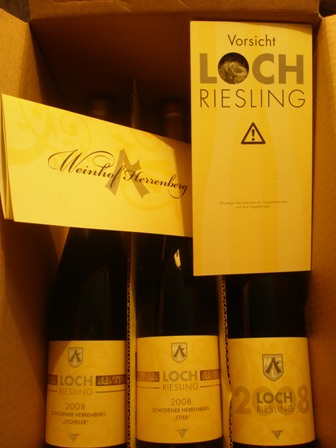
Heinz brought back the box shown below and three different Loch Riesling wines, all of the 2008 vintage. Regular visitors of my blog know that I am a Riesling lover, especially if they were grown along the Saar, my favorite provenance of German Riesling wines.

LochRiesling2

The treasures from Weinhof Herrenberg and the two brochures

The three wines were a ‘2008 LochRiesling’ (8.90 Euro/bottle), a blend of Riesling grapes from various vineyards, a ‘2008 Schodener Herrenberg “Stier”‘ (12.90) and a ‘2008 Schodener Herrenberg “Stoveler”‘ (13.90), both wines from my favorite ‘terroir’, a very steep vineyard called “Herrenberg” bordering a forest and enticing large groups of wild pigs and deer to visit and taste the sweet grapes during vintage time. I had walked the vineyard and heard about the Loch wines but never tried a single drop. It was high time to change that.

LochRiesling3

2008 Loch Riesling wines from Schoden, Saar

I also love the brochure with the “whole” (the “Loch” in German) explaining the philosophy of Claudia and Manfred Loch, the proprietors and vintners of the boutique winery “Weinhof Herrenberg”, which is the basis for their wine-making. In short, the Loch’s aim for authenticity, uniqueness, they reject designer wines but quest for a unique character and truthfulness.

The brochure is a very unusual one, telling people why to keep their hands off LochRiesling wines and what the weaknesses of the wines are: for instance that their wines are unknown, consumer hostile, old fashioned, egoistic, lawless, dangerous and limited (in numbers of bottles!). I like this brochure.

LochRiesling5

The “Loch” brochure with a whole in it

The wine list also includes wines from locations in Ockfen and Wiltingen, two famous Saar wine villages. The “Beerenauslese” wines are not available any longer. The Loch’s also produce a dry, sparkling wine. All wines are reasonably priced.

LochRiesling4

The current wine list

You might wonder what they taste like? Well, I will tell you more about this at a later blog entry. But if you are near Schoden or in the vicinity of the Saar, please visit the Loch family vineyard at Weinhof Herrenberg. If you cannot visit in person, visit the website which is very informative.

Address:
Claudia and Manfred Loch
Weinhof Herrenberg
D-54441 Schoden/Saar
Tel.: +49-6581-1258
Fax: +49-6581-995438
info@lochriesling.de
www.lochriesling.de


Reichsrat von Buhl: ‘2007 Forster Ungeheuer Grand Cru dry Riesling’

August 31, 2009

UngeheuerGG1

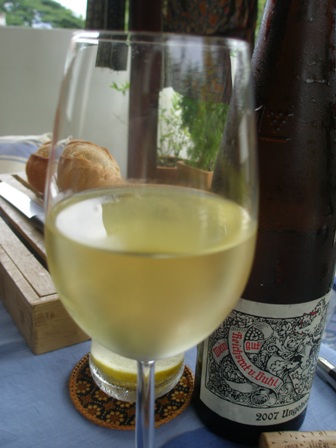
Embossed on the bottle the sign for ‘Grosses Gewaechs’

I had not had a Grand Cru (or as the Germans say: Grosses Gewaechs) wine for a while. Fortunately, I had participated in a wine quiz of the German wine magazine “Weinwelt” some time ago and won a bottle of Riesling. Not any Riesling, it turned out, but a ‘2007 GG Forster Ungeheuer dry Riesling’ produced by Reichrat von Buhl, Pfalz.

I was completely taken aback when my mother handed me the packet. I could not believe my luck: first time participate, first time win a price. I carried my treasure back to Bangkok and stored it carefully for a special occasion.

UngeheuerGG2

The freshly opened bottle

The occasion came faster than expected. Although the cellaring potential of this wine is 12 to 18 years (!), it only lasted a couple of months in my care. Sunday family lunch was just the right time and place for a treat.

UngeheuerGG3

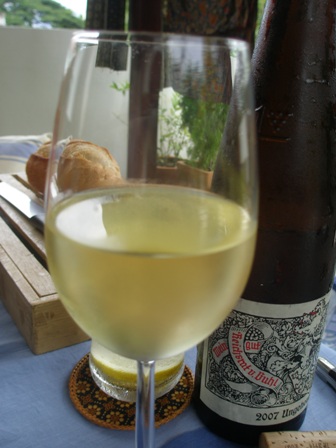
A beautiful straw colour in the glass

This is a beautiful wine, powerful, complex and dense, with citrus and mineral characters. It did not overpower the food, though it could just stand on its own, enjoyed just as a glass of wine. The peccorino Sardo on the fish was the right match for the dry Riesling (12.6%).

UngeheuerGG4

Flounder with Peccorino Sardo

UngeheuerGG5

The salad

Needless to say, one bottle was not enough. That’s why I recommend if you have the opportunity stock up on this noble drop, buy a crate, a dozen or whatever, in any case more than one bottle. The whole Sunday the taste lingered on my palate and could not be deleted from my mind.

Reichsrat von Buhl has a long tradition of excellence, family-owned since more than 150 years, it was leased in 1989 to an operating company owned by two Japanese businessmen. I found this fact quite remarkable, I must say. Another remarkable fact is that it was also owned for some time by the family of the grandfather of the current German Economics Minister, Dr. Karl-Theodor Freiher zu Guttenberg.

The commitment to excellence, however, has remained the same or is even stronger than ever, I guess.

Address:
ReichsratvonBuhl
Source: from the website www.reichsrat-von-buhl.de/english/kontakt.htm


Riesling-Traminer Cuvée from Saale-Unstrut, Germany

April 6, 2009

saale1

“In all things there is something of the marvellous”, Aristotle, 384-322 B.C.

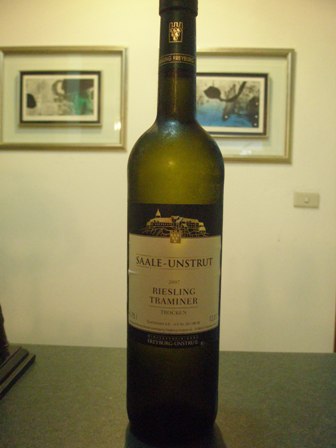
Four days ago my colleague and friend Christian brought us a bottle of Riesling Cuvée from Saale-Unstrut, the most northern wine region of Germany. It did not last long. The first occasion was excuse enough for us to open this rare bottle of German wine. The ‘2007 Riesling Traminer Saale-Unstrut’ from the Winzervereinigung Freyburg-Unstrut (a type of co-operative) was a most amazing wine, a treasure here in Bangkok.

saale5

Saale-Unstrut is not only the most northern wine region of continental Europe but also one of the smallest in size (below 700 ha). It takes it’s name from two rivers: Saale and Unstrut. Grpae growing and wine production, though, go back a long way. The earliest prove dates from around 998 A.D. and covers the wines from Memleben Abbey.

The climate in the region is generally rough and very cold. Only in very warm years can good wines (Spaetlese, Auslese) be made. Yields are usually very low in comparison with other German wine regions. About 75% of the grapes grown are white varieties, among them Mueller-Thurgau, Silvaner, Pinot Blanc, Riesling, Traminer and other white varieties. However, given global warming more and more wines from Saale-Unstrut are of outstanding quality and find eager consumers.

saale6

We had this Riesling-Traminer Cuvée with Sunday lunch. I must admit that I never before heard of such a cuvée blending Riesling, my favourite white wine, with Traminer. Both are aromatic varieties but of a very different nature. The Cuvée displayed a honey aroma and tasted like peaches and apricots. The finish was acidic and sharp but not unpleasant. The wine has 12% alcohol, is very young but well balanced. Unfortunately, we had only this one bottle. It matched the food perfectly. So what was the food?

Well, it was a recipe from my favourite cooking book, the Philosopher’s Kitchen by Francine Segan which contains recipes from ancient Greece and Rome.

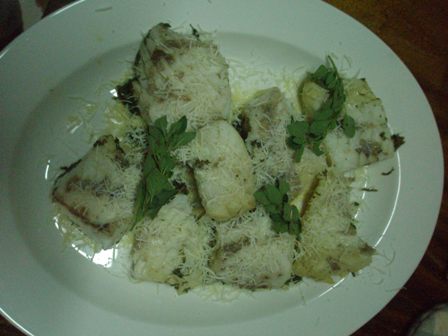
“Grouper with herbs and pecorino” (originally the fish in the recipe was ray fish, Francine uses skate, but any white fish will do) was the plate of the day.

The dish is accented with fresh fragrant marjoram, a herb that “Aristotle believed was an antidote to most poisons”. You take the following ingredients:

– 1 ½ cups of white wine
– 2 pounds skinned grouper, cut into 4 pieces
– Salt and freshly milled pepper
– 2 tablespoons minced assorted fresh herbs, such as parsley, mint, dill, and chives, lots of majoram
-1 tablespoon extra virgin olive oil
– 2 tablespoons grated pecorino cheese

How is it done?
Well, first bring white wine to a boil over high heat until reduced to half (5-6 minutes); season the fish with salt and pepper.
Then add marjoram and minced herbs, oil and mix with the hot wine, add fish and cook until firm, about 3 minutes. Serve topped with the cheese and a sprig of marjoram. The recipe can be found in the above book of Francine Segan page 97 (From Life of luxury, Archestratus).

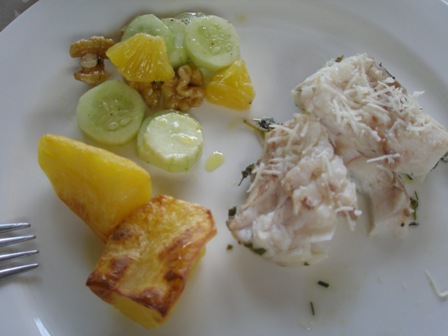
We had it with potatoes and a salad (cucumber with orange and walnuts).

saale2

The potatoes

saale31

The fish with the herbs

saale4

On the plate

Needless to say, the food was very yummy. The four of us gobbled it up in no time. Especially my children were amazed (usually they prefer meat) that fish can taste that good. It is only the second recipe I know of where fish and cheese are successfully matched together.

saale9

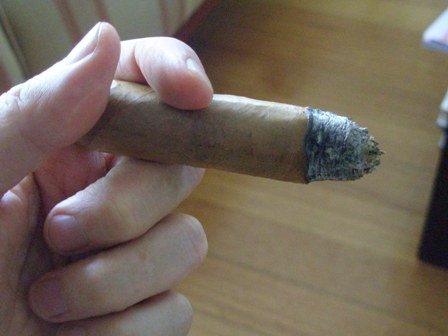
After lunch it was espresso and Averna and some Belgian chocolates. I followed up with a cigar (a Casa de Torres, CT, Nicaragua, hand made).

saale10

What a beautiful smoke!


Riesling, Riesling….heaven on a stick

March 16, 2009

wildpig

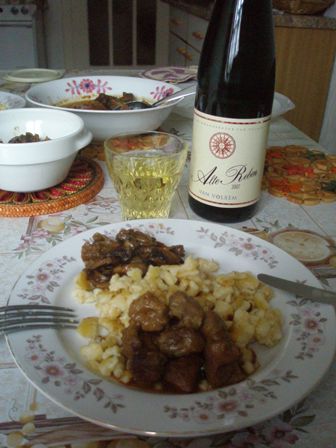
My welcome meal consisted of wild boar goulash, mushrooms and Suebian dumplings (Spaetzle). What a treat, so delicious. I washed it down with a bottle of my house wine, a ‘2007 Alte Reben, Van Volxem Riesling’ from Wiltingen, Saar river. I just love the Van Volxem wines.

wildpig1

The very same day, a parcel arrived for me containing a bottle of wine which I won when participating in an opinion survey of a German wine magazine, Weinwelt (www.weinwelt.info). I could not believe it. What a pleasant surprise this was. The wine is a “grand crue” (GG: Grosses Gewaechs) from the Pfalz, a ‘2007 Forster Ungeheuer GG, Reichsrat von Buhl in Deidesheim, Rheinpfalz. I decided to taste this wine another time and cellared it in my “treasure trove”. Thank you Weinwelt.

wildpig2

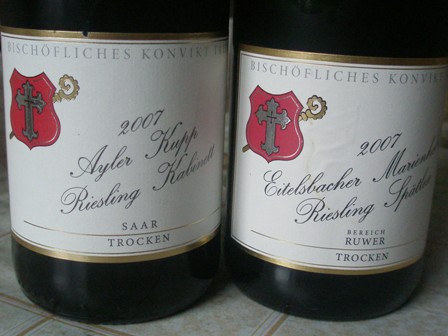
However, I could not resist to buy some more bottles of Mosel Riesling. I decided to try wines from Bischoefliches Konvikt. The two terroirs are very famous, one is Ayler Kupp at the Saar, the other is Eitelsbacher Marienholz from the Ruwer, another tributary of the Mosel.

The ‘2007 Eitelsbacher Marienholz Riesling’ I had with another serve of wild boar goulash the next day. It had all the zest I expected from a fresh Riesling from the Ruwer. The wine from the Saar I packed into my suitcase. Destination: Bangkok and reserved for a leisurely Sunday family meal in the tropics. I can only say: visit the Mosel and its tributaries. Here you’ll find heavenly Riesling wines. Cheers and zum Wohl.


Riesling from the Upper Goulburn

January 23, 2009

dont-tell-dad1

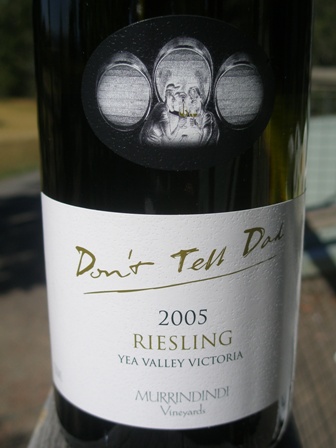
‘2005 Don’t Tell Dad Riesling’, Murrindindi Vineyards, Upper Goulburn Wine Region

Being a Man from the Mosel I love Mosel Riesling wines and find it hard at times to appreciate other styles of Rieslings. Australia produces out standing Riesling wines. Most of them are of the Alsatian style, they are thick bodied and coat the palate. Moreover, petrol is the dominant nose when you sniff it. Although finding petroleum notes is a common occurrence in aged Riesling wines, it is usually not to be found in young wines coming from the Mosel. And this might be why, though appreciative of those Rieslings from Alsace and Australia, I usually prefer a Mosel Riesling. Here I like the young freshness, the balance between acidity and minerality, the zest, and the exuberance.

But in my meandering search for new experiences, I always give Australian Rieslings a go, often reluctant I admit. The best Australian Rieslings come from Eden Valley and Clare Valley in South Australia.

In his 2009 edition of ‘The Australian Wine’, Jeremy Oliver, a famous Australian wine writer, ranks a Riesling from Victoria, the ‘2007 Seppelt Drumborg’ from Henty (98 points) as the best for the year. Henty, a little known wine region outside Australia, is located in South Western Victoria near the border to South Australia, between Hamilton and Portland. Henty has about 25 vineyards including 12 wineries. The nine Rieslings which follow in the rankings of Jeremy Oliver all come from Eden (4) and Clare (5).

The more I was pleased when James Halliday recently ranked a Riesling from our own wine region, the Upper Goulburn Wine Region, quite highly and gave 87 points to the ‘2006 Barwite Upper Goulburn Riesling’.

While browsing the shelves of the supermarket in Yea , I bought the above bottle of the ‘2005 Don’t Tell Dad Riesling’ from Murrindindi Vineyards, also a member of our wine growers association. Wines from Murrindindi Vineyards have won accolades of praise by wine critics and judges. To cite James Halliday again, he awarded the ‘2006 Murrindindi Don’t Tell Dad Shiraz’ 89 points, the ‘2006 Murrindindi Chardonnay’ 88 and the ‘2005 Murrindindi Family Reserve Cabernet’ 88. The 2005 Riesling even got 89 points.

I brought the above bottle to a dinner with my friends Hillary (from the end of our street), Beth and Richard and was amazed. The petroleum note was not as dominant as with some Rieslings, the wine has elegance and length which I liked. The ‘2005 Don’t Tell Dad Riesling’ retails for about 15 A$ and is a bargain. Check it out. I will drink it again when back in Glenburn.

PS: The Top 10 Australian Riesling wines according to Jeremy Oliver 2009:

1. 2007 Seppelt Drumborg, Henty, 98
2. 2007 Mountadam, Eden Valley, 96
3. 2003 Peter Lehman Reserve, Eden Valley, 96
4. 2005 Leasingham Classic Clare, Clare Valley, 96
5. 2002 Pewsey Vale Vineyard, Eden Valley, 96
6. 2007 Grosset Polish Hill, Clare Valley, 96
7. Kilikanoon Mort’s Reserve, Clare Valley, 95
8. 2005 Taylors St. Andrews, Clare Valley, 95
9. 2007 Grosset Springvale, Clare Valley, 95
10. 2008 Leo Buring Leonay DW L17, High Eden, 95


Connoisseurs delight: a wine tasting in Berlin of a special kind

January 15, 2009

schlau0

While in Berlin an old friend of mine, Gerhard Schlaudraff, had invited me spontaneously to join and celebrate his birthday in his new home near Warschauer Platz. Since Gerhard is not only a wine lover but a real wine expert, the feast promised to be something special. And indeed, it turned out to be a wine tasting of a special kind.

schlau1

I was about an hour late and many wines had been already swallowed up by gay drinkers. I came just in time for the two reds, the ‘1995 Corton Grand Cru Domaine Bonneau du Martray and the ‘1996 Grand Vin Château Beychevelle Saint-Julien’.

We all agreed that the two wines should have been drunk some time ago, they had, unfortunately, already passed their prime. That’s why we moved on swiftly without loosing too much time.

schlau21

The ‘2003 Kuenstler Reichestal Spaetburgunder’ from the Rheingau was a ripper of a wine. It can hold itself against the best Pinot Noirs from Burgundy. The wine was well balanced despite the “horror” announcement of 15% alcohol on the label. So forget about France and Burgundy and explore this wonderful drop from the Rheingau. More and more Germany is showing itself as a Pinot Noir producer of high distinction. My tip: get a bottle of this wine now and enjoy it, preferably over a good meal, with family and friends.

schlau3

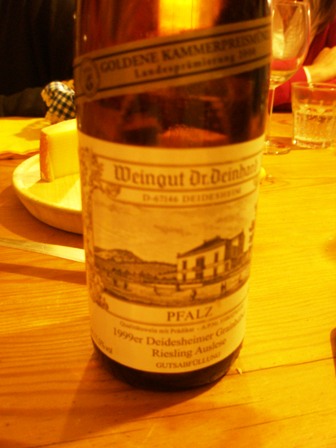
After that we moved on to sweet wines for dessert. We started with a ‘1999 Deidesheimer Grainhübel Riesling Auslese’ from Weingut Dr. Deinhard, Pfalz. This wine was “heaven on a stick”, a dessert Riesling which you want to try. Our eyes rolled in their sockets with delight and our taste buds were exposed to an opulence and richness from which mere human palates are often excluded.

schlau4

The last wine came from my adopted home, Victoria, Australia. It was a Muscat from Rutherglen, a wine region about three hours north from our own place in Glenburn.

The ‘Chambers Rosewood Vineyards Grand Muscat’ was the highlight of the evening. Chambers produces outstanding Muscat wines of superior quality. The average age of its Grand cuveés is about 70 years.

The Chicago Wine Company gives the wine 98 out of a 100 and has given up to describe the wine, because tasting notes would read the same year after year.

For me this wine was the perfect ending to an utterly enjoyable wine and birthday celebration. From here on only spirits with a much higher alcohol content could be taken. I left the diners to it when I made my way home on the subway.