Kloster Eberbach, Rheingau

August 7, 2012

The Rheingau wine region

Because of a flight delay we had a couple of hours on our hands with nothing to do. This provided us with an unexpected but welcome opportunity to visit the Rheingau wine region. So where to go and what to do?

Some years ago I had been to Eltville, one of the many small and pretty settlements with extensive wine culture and history. Last year in November I met a couple of professors from the famous wine institute in Geisenheim, Rheingau at the 3rd International Symposium on Tropical Wine in Chiang Mai, which further nurtured my curiosity in the Rheingau wine region.

So I typed “Kloster Eberbach” into the navigation system of the hired car and off we went to this place near Eltville which I had always wanted to visit. We were looking for some mix of culture and wine. In no time we were cruising the country roads of the Rheingau.

Vineyards and farm buildings

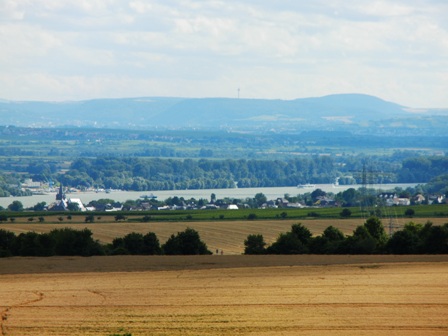
The region on the right side of the Rhein river between Wiesbaden and Assmannshausen is like a Garden Eden of the modern world. The slopes of prime vineyard land descend gently towards the Rhein river. The land is very fertile and the climate very suitable for the production of first class wines, mainly Riesling.

The top of the mountain ridges of the southern Taunus are crowned with deep forests. Many of the villages and settlements are very beautiful. Every year millions of tourist flock to places like Ruedesheim, Geisenheim, Erbach and Eltville.

The Eberbach monastery

Our destination, the Eberbach Monastery, formerly a Cistercian Abbey, is a kind of museum today. We had a look at the old church, the cloister and the various rooms used by its monks from the 12th century until the French revolution and the secularization of church property under Napoleon.

Fortunately, the grape-growing and wine-making tradition of the monks has been preserved. Today the state of Hessia is the owner of the vineyards and winery “Kloster Eberbach”. The monastery offers a range of programs related to wine, special tastings for instance in the historic wine cellar, and has a “vinothek”, a kind of cellar door or wine shop.
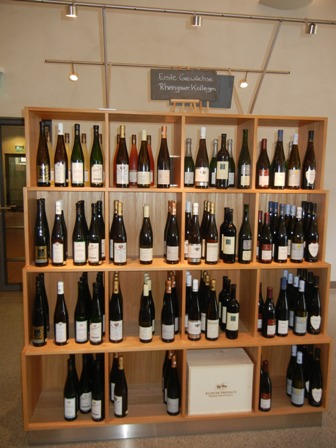
The wine shop of Kloster Eberbach

The “vinothek” wine shop does not only offer the wines of Kloster Eberbach but also of vintners and wineries of the surrounding villages and terroirs. The shop was packed with buyers on this Sunday afternoon. I browsed through the various shelves with wines from different locations and of different quality categories. I tried to stick to a certain budget which did not allow for grand cru wines.

My selection

In the end I settled for three wines only, one Riesling and two Pinot Noir wines. The Riesling came from the most famous and oldest terroir called “Steinberg” (stone mountain) right behind the monastery. The Pinot Noir Spaetlese from Assmannshausen was a bit pricier (17.40 EURO). It should turn out to be the best Pinot Noir I drank while holidaying in good old Germany.

Address:
Kloster Eberbach Winery
65346 Eltville am Rhein
Tel.: +49-6723-6046-0
www.kloster-eberbach.de

PS: When I studied agricultural economics at Bonn University, my master thesis was (among others) also dealing with the farming activities of the Cistercian monasteries and how they influenced land markets. I had visited Himmerod Abbey, a Cistercian monastery near Trier, but had never visited the equally famous Eberbach Abbey.


Rheingau Riesling

July 31, 2012

When traveling through Frankfurt, I always try to pick up a bottle of German wine on the airport. This time it was a ‘2011 Riesling Classic dry’ by the Kloster Eberbach winery in the Rheingau.

Little did I know at the time that I would be visiting this place during my holidays a few weeks later. In fact I would return to this wine region twice within two weeks time.

To say it in a nutshell, Kloster Eberbach is a fabulous place.

It used to be a Cistercian Monastry (by the way in my master thesis I wrote about Cistercian monastries and their farming enterprises which were quite modern as regards organization and management).

Grape production and wine-making have a long tradition in this place. Today it is owned and operated by the state of Hessia.

This is their “normal” Riesling wine brand, nothing fancy but just a solid German Riesling, the way I like it. The wine is crisp and fresh with great aromas and a good body.

I will tell you more about Kloster Eberbach soon,


Mosella – home of the best Riesling wines in the world

February 5, 2012

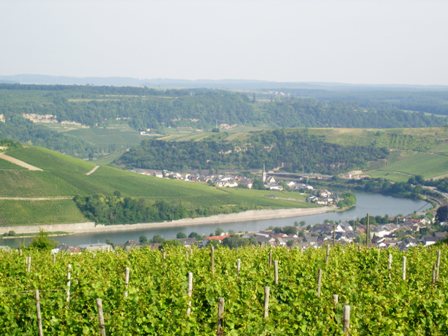
The Mosel valley with the hamlets Riol and Longuich

Maybe because it is Sunday, maybe because that lends itself to some introspection, maybe because I am abstaining from consuming wine for a couple of days, maybe because I have not been to my beloved Mosel for such a long time, maybe…who knows.

Anyway, on this beautiful tropical Sunday in Bangkok and while my Thai vintner friends in Khao Yai, about two-three hours north-east of Bangkok, are busy harvesting their grapes, I am exploring the writings of Decimus Magnus Ausonius (310-393 AD), a Gallic-Roman government official, educator of princes and poet who lived for some years in my home-town Trier.

The Mosel, photo taken from Nittel, the Luxembourg side to the left

Have you heard about Ausonius? No? Well, let me tell you that he was born in Buldigana, which it called Bordeaux today, and where he also died. He had studied rhetoric in Toulouse.

In 365 Valentinian I, emperor of the West-Roman empire, called Ausonius to Trier (yes, my home-town which was the capital of the West-Roman empire for a while) or Augusta Treverorum, as it was called in those days, to educate his eldest son, Gratian, the heir-apparent.

The wine village of Alken, Mosel river and castle
In 371 Ausonius published his impressions (early travel writing) from a trip in 368 which brought him from Mogontiacum (Mainz) through Bingium (Bingen) and Noviomagnus (Neumagen) to Augusta Treverorum (Trier). This work is know as “Mosella” and consists of 483 hexameters describing the land and its people along the road which now carries the name of the poet: Via Ausonius.

The “Mosella” is the only known poem from antiquity describing a single German river: the Mosel. In his poem Ausonius praised the beauty of the river, the lands surrounding it, the fertility of its soils and the industriousness of its people.

The poem has inspired endless other poets, writers and bards until the present times. I like for instance the CD “Mosella” with songs praising the Mosel region by the folk music group “Woltaehr”.

The Mosel river, photo taken from the train near Puenderich

So far so good, you might say, but what about the wine, the famous Riesling you adore so much?

Unfortunately, I did not drink that many Riesling wines from my native Mosel in 2011. I do not know how it happened. I must have explored other wines more often than usual.

However, the ones I tasted where really special and of the highest quality. I fondly remember my visits to Leiwen where I visited Grans-Fassian and St. Urbans Hof in November 2010.

Both wineries produce beautiful Riesling and other wines of the finest quality. Both belong to the association of the top German wine producers (Called VDP). Both win regularly awards. Usually the top wines are in the range of 88 to 96 Parker points, just so that you have a general idea.

Most of the wines I brought with me then, were consumed in 2011, either here in Bangkok or at my mum’s home in Trier. I admit they were the 2009 and 2010 vintages only.

I have written about the two wineries which you can find in earlier blog entries (Grans-Fassian, St. Urbans Hof).

Feel free to explore Riesling wines from the Mosel. It’s worth it.


My life as a blogger – good bye 2011

December 15, 2011

I am terribly frustrated right now. Sorry folks. After traveling in China where there is no access to my blogging site, wordpress.com, I have finally reached free Mongolia. I was looking forward to finalize and present a couple of stories to you which I carry with me since our holidays in Canada and wanted to share with you some notes on the excellent wines I brought back with me.

However, the internet in the hotel is so slow that I can hardly up-date my beloved the Man from Mosel River blog. At least the photos cannot be uploaded and what’s the point without them?

Alas, the other functions seem to work. So let me share some thoughts about the year which is soon coming to an end. 2011 was a very busy year for me. My job required more and more traveling, mostly in Asia. This brought me to interesting places. That was the good news. But it also left me less time on my hands for writing up my posts.

In the past, I usually had some time for further research and consequently could beef up my little stories with some additional facts and figures. These times are over, it seems. My stories are becoming shorter and shorter. I try to make up for this by adding more pictures. But is this a solution? No.

I noticed with surprise that I have almost completed my 5th year as a blogger. There were occasions when I wanted to call it a day and move on, do other things in my life. So far I have returned to my blog and tried my best to keep it up. Giving up is not an issue any more. I might have to change a few things.

When I visit blogs and websites produced by the professional wine and food writers I feel utterly inadequate. Goodness me, how poor is my writing, how limited my knowledge? I should add fancy stuff, little video clips here and there. In fact I do have some, but just not the time to cut and edit them so that they become interesting. But I enjoy visiting blogs of other, non-professionals but enthusiastic wine bloggers.

My own little vineyard in Australia, Two Hills Vineyard in Glenburn, was not successful from a commercial point of view. It has become a hobby, an expensive one, I freely admit. But we are hanging in there and hope that the mothballing can one day be lifted.

Well, I was warned. You all know the joke, how to make a million dollars in the wine industry: invest ten million. Well, we sold out our 2004 vintage of Merlot, the best one we ever made. The 2006 vintage is doomed, it seems. We might “resurrect” the 2008 Merlot; finally label the bottles and bring some on their way to Germany.

My feelings of the running hamster in the wheel were mitigated by the moments of glory, the moments when I sat and enjoyed good food and fine wine, among friends and family mostly or at times in a far away place all by myself. I just love to eat and drink fine stuff.

The comments I receive are of course also encouraging. It seems that some people are reading my stuff. Some of them like what I write and let me know about this. My stats are not bad in my view. I have moved up all the time over the last five years.

So what was my highlight of 2011? Let me select three issues.

1. the Rieslings from my native Mosel land
I had the opportunity to taste more fine Riesling wines from the Mosel, the Saar and the Ruwer, and actually I cannot get enough of them. They are the best for me, no doubt. The quality of these wines has gone up over the last years. The producers experienced one excellent vintage after the other. It is such a pleasure to indulge in these wines. Unfortunately, these wines are difficult to get where I live. Since wine is heavy I carry these Rieslings bottle by bottle when returning from trips to Germany.

2. my visit to Prince Edward County, Ontario and Canadian wines in general
The family vacation to Canada in July this year gave me the opportunity to explore some of the wine regions there, particularly Prince Edward County. I was very surprised by the high quality of these wines, especially the Chardonnays and the Pinot Noirs. The islands is very picturesque, the hospitality of its people is great, there is good food and excellent wines. the number of wineries is sizable but many of them are family businesses and not agro-industrial complexes of huge size. But Canadian wines you cannot get hold of overseas, except maybe for the sweet desert wines on offer in some airport duty free shops.

3. the attendance of my first ever wine conference, the 3rd international symposium on tropical wine in Chiang Mai, Thailand
Thailand is more famous for its beaches, its cuisine and its nightlife than its fine wines. But let me tell you that the quality of its wines in general is very good and that many wines are just excellent. There are fewer than 10 wineries in the country, and not all of them have a resident wine-maker. But the people behind the wines, the vintners, winery owners, vineyard managers and oenologist, are passionately loving their soils and grapes and produce wines of international standards. The number of international awards won by Thai wines has multiplied in 2011. The good news is, that these wines are available in Bangkok where I live.

Next Monday morning I will be on my flight to Melbourne for a three week Christmas vacation. I already know that instead of blogging I will spend most of my time on the farm, in the vineyard, planting trees (one of my passions) and enjoy the tranquility of the Victorian countryside. I will take long walks, and spend hours among family and friends. I will just be there and relax. I will not think too much of the future of my little vineyard neither of my professional future.

I would like to thank all my readers and the casual visitors for coming by and having a look. I hope you come again. Let me know if you like or dislike something and share with me your own experiences and stories. A good story is always worth to be shared.

Cheers folks, happiness, good health and long life also in 2012.


Wine bar Kesselstatt, Trier – Mosel

October 28, 2011

The main market place in Trier

My favourite wine bar: Kesselstatt

The view from the Kesselstatt garden

Pinot Noir from the Mosel

If you visit my home town Trier, please explore the wine bars in this beautiful old Roman town. Kesselstatt should be among them. Apart from the Mosel Riesling wines, you should also try the Pinot Noirs. The Mosel produces some of the finest Pinot Noir wines in Germany.


Restaurant review: Wine bar Rutz, Berlin

March 10, 2011

Inside Wine Bar Rutz, Berlin (before renovation)

Well, lent has just started, so why not write about the good life? Since a long time I wanted to tell you about “Weinebar Rutz”, a gourmet restaurant in the middle of Berlin.

My wine-lover-gourmet-wine blogger friend Swetlana Kittke took me there on a beautiful evening. We had a meal together and enjoyed a wonderful German Riesling wine. At the time, I thought I will never forget the wine, but now 3-4 years later I admit that I do not remember which Riesling we had chosen (and I cannot find my notes any more). Nonetheless, the Wine Bar Rutz is a fabulous place.

While surfing the internet today, I learned that the wine bar and restaurant was closed for renovations. It will open again on April 1st. But the event of the year will be its 10 anniversary celebration on April 9th with a special offer of a gourmet meal (249 EURO/person, I hope the wine is included) called “10 years -10 courses – 10 star cooks”.

The modern cuisine

I am usually not a fan of the “designer cuisine” (as a true country boy I like the rustic food of the Mediterranean better) but I must admit that the taste of the dish above, though difficult to identify, was just marvellous.

The team at Wine Bar Rutz is composed of Marco Mueller, a one-star Micheline cook, one of the most innovative cooks in Germany, it is said, Billy Wagner, sommelier and Carsten Schmidt, the general manager. Last year the wine and food guide Gault Millau awarded 17 of 20 point to the restaurant. The wine list with about 600 different wines is very impressive too. Most of my favourite Rieslings can be found there.

Address:
Wine Bar Rutz Restaurant
Chausseestrasse 8
10115 Berlin Mitte, Germany
Tel.:+49-30-24628760
info@weinbar-rutz.de
www.weinbar-rutz.de


The five best Riesling wines of 2010

February 18, 2011

Riesling the queen of white wine

Well, let’s be clear from the outset: this is not the result of an orderly wine tasting. I am reminiscing about the most remarkable Rieslings I drank in 2010. The five wines below are the ones I selected, and I call them “my best Rieslings in 2010 – the Man from the Mosel selection”.

As you might know, any recall from memory about events past is a tricky and challenging thing. I also do not have the opportunity to drink these wines parallel to each other (what a shame). But here is my top five list:

1. ‘2009 Dhron Hofberg Riesling GG’, by Grans-Fassian Estate, Leiwen, Mosel.

This is a marvellous Riesling. The 2009 vintage was great. Grans-Fassian is a top Riesling producer from the Mosel. With 95 Parker points the Dhron Hofberg Riesling is just divine. I could not believe my luck when I casually strolled into the cellar door and picked up these treasures.

2. ‘2008 Schieferterrassen Riesling’ by Heymann-Loewenstein, Winningen, Mosel.

Weingut Heymann-Loewenstein is another of the great Riesling producers from the Mosel. The wines are made in a different style from the mainstream. They show great character and have funk. Only on April 30, 2011 the 2009 vintage will be released. I am very excited and cannot wait to taste the 2009 Riesling.

3. ‘2008 Monzinger Halenberg Riesling trocken’ by Emrich-Schoenleber, Monzingen, Nahe

The wines made from fruit grown at Monziger Halenberg are among the best Riesling wines in Germany. The Nahe is the region where my maternal grandfather started to introduce me to wine when I was just a boy. Ever since I love this very diverse region.

Monzingen is a small village next to Martinstein where I spent time with my grand parents. I walked all the different hills and slopes in the vicinity. Emrich-Schoenleber is one of the top producers at the Nahe, a lovely family too where father and son make the wine together.

4. ‘2009 Riesling Leiwen Laurentiuslay GG’ by St. Urbanshof, Leiwen, Mosel

Another wonderful wine from the Mosel. Weingut St. Urbans Hof is located in Leiwen, Mosel. Recently we had a bottle of this Riesling with Sunday lunch. Goodness me what a treat that was. I had only one bottle with me when I came back from Germany in November. The good news is: I will be in Trier in mid March and guess what…..

5. ‘Dr. Mayer Riesling Kabinett trocken’ by Timo Mayer, (Yarra Valley), Remstal, Wuerttemberg

Timo Mayer is an Australian boutique wine maker of the Yarra Valley and a native of Grossheppach, Remstal. He made this wine while travelling in Europe. The grapes come from his brother and the family vineyard. The 2009 vintage was ideal for making this wine. Timo shipped about 60 cases back to Australia. We were so lucky to have access to a few bottles.

You might say, all these wines are German Rieslings, did you not drink others? Well, I did. I tried quite a few Australian ones but that’s usually not my cup of tea. But I am undeterred. My to to list (to drink list) is long.

I admit that I also love Riesling from the Alsace, France. Though they are creamer, heavy, earthy.

I also love Riesling from Rheingau und Rheinhessen, in fact there are so many good German Rieslings it is very difficult to say which one to drink first.

Please let me know what your best Riesling was in 2010.


Wine village Leiwen at the Mosel River

January 18, 2011

The wine village Leiwen at the Mosel river

Last November I had the opportunity to visit Leiwen just about 30 minutes down the Mosel river from my hometown Trier.

Grape press

Leiwen (about 1,600 inhabitants) is not only a village known as a holiday destination but it is also a famous wine village. Here quite a few of the top Mosel wineries and members of VDP, the association of the top producers are located.

Leiwen got it’s name from Livia, the wife of the Roman emperor Augustus and has a long tradition in grape growing and wine making.

Riesling vineyards

Vineyards on the flats

Riesling, the aromatic grape of the Mosel, is the dominant variety here. Many of the vineyards are located on extremely steep slopes which are hard to cultivate. The ground is mainly gray, blue and sometimes red slate.

Many signs indicate the way to the various wineries

Many, mainly small and family owned wineries call Leiwen their home. The tasting rooms and wine cellars are usually located in the middle of the village. Space is certainly an issue.

On a quiet Saturday morning, the village was almost deserted. No tourist can be found during these times of the year. Vintners were in the vineyards busy pruning their vines. But I went to taste some wines of which I will tell you more soon.

But visit if you can, next spring or summer, any time is a good time. The wines are worth it.


4. Sunday of Advent with German Riesling

December 19, 2010

It was my time to cook Sunday lunch. Anyway, the three gorgeous women I share my life with were due to travel to Australia later today. In order to give them time to pack, I prepared lunch. I admit, however, that Margit helped me quite a lot. Otherwise, I guess, I would not have accomplished the task.

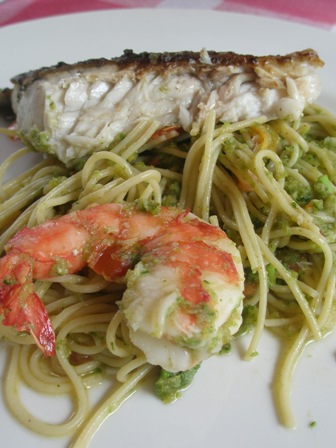
So what did I cook? A strange dish, I must say, straight out of the Jamie Oliver cookery book titled “Jamies does…”. It is a recipe from the Maghreb, Marrakesh to be precise. It consists of spicy vermicelli stuffed with prawns in a courgettes-tomato kind of sauce and on top a large fish is positioned (sea bass, snapper, etc.). Since we did not have a whole fish, we used fillets of sea bass.

The whole process is too complicated to be recited here. The recipe can be found on the internet, one of Jamie’s websites. Boy that dish is delicious, just wonderful. I would like to encourage you to try it, especially if you like spicy food.

The prawn-stuffed spicy vermicelli with fish

The fish is succulent but crisp

On the plate

As the title of this blog entry suggest, Riesling was the wine of my choice. German Riesling is my favourite. Wine does not age in my care here in Bangkok in the tropics. I selected a ‘2008 Riesling Kabinett’ by Schloss Johannisberg, one of the oldest Riesling producers in the Rheingau and Germany as a whole.

2008 Riesling Kabinett Schloss Johannisberg

A Kabinett was just the right wine because of its relative high “rest sugar” it’s off-dry or semi-dry, “halbtrocken” or “feinherb”, as the Germans say. However, the label did not say if the wine was dry or semi-dry. But my palate told me the sugar level must be at about 9 grams or so. Alcohol was 11.5%.

In any case the wine went extremely well with the very spicy vermicelli. I just love the bouquet, this slight petrol note on the nose. This is a wonderful rich wine, with a fine balanced acidity, the taste of apples and peaches are prominent.

2008 Riesling Kabinett Schloss Johannisberg

I wish we had more of this drop

If you buy this wine directly from the producer, you have to spend 17 Euro for a 0.75 litres bottle.

The meal with this wine was just perfect for the occasion. Time fly’s. Christmas is approaching fast and soon I will be back in Glenburn, Australia and taste many new-world wines.

Address:
Fürst von Metternich-Winneburg’sche Domäne
Schloss Johannisberg

D-65366 Geisenheim
Tel.: +49 (0) 6722-7009-0
E-Mail info@schloss-johannisberg.de
Restaurant
Tel:. +49 (0)6722 96090
E-Mail restaurant@schloss-johannisberg.de
www.schloss-johannisberg.de


Sunday lunch in March

March 14, 2010

Since the beginning of this year, we have a new rule as regards the family cooking: every Sunday another member of our family is preparing the family feast. It was my turn last Sunday (more about this another time) and today my daughter Lucy (15) took on the role of the chef.

She presented us with salmon with salsa and a guacamole. In addition we had a fresh salad which is very nice in 35 Celsius heat. Mama helped a little but not much. It was delicious, as you can see from the photos below. What a great lunch this was.

The recipe came from the delicious magazine (December 2005/January 2006): Cajun salmon with corn salsa.

One mixes a table spoon each of coriander, dried tyme and oregano, cumin, and dried garlic, adds two table spoons of pimento (sweet smoked paprika) and olive oil and mixes this in high heat in a pan. The salmon fillets are rubbed with the mix, then cooked for about two minutes on one side and one minute on the other. After that you transfer them to a heated oven of about 180 Celsius where they are cooked for about 3-5 minutes. Serve with the salsa and guacamole.

The salad

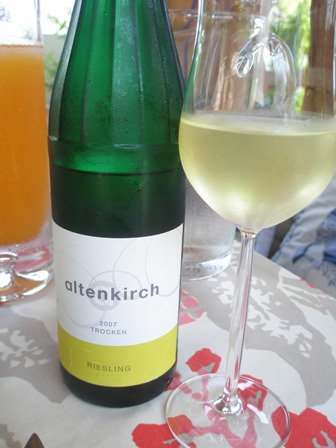
The wine, however, was my department. Thanks to Mathias and Beatrix we still had a bottle of ‘2007 altenkirch Rieling, trocken’ by Friedrich Altenkirch in Lorch, Rheingau, Germany.

The wine is German Riesling at its best. With only 12% alc. vol. it has zest and finesse and the typical citrus flavours. It is a blend from different locations and made to be enjoyed young. The single vineyard wines from very steep slopes the winery produces are regularly awarded all kinds of medals. Altenkirch is worth a visit if you are visiting the Rhine river.

Address:
Winery Friedrich Altenkirch
Binger Weg 2
D-65391 Lorch /Rheingau
Germany
Tel: +49 67 26 / 83 00 12
Fax: +49 67 26 / 24 83
www.weingut-altenkirch.de
www.altenkirch-winery.com