Les Ormes de Cambras – Merlot from France

May 9, 2010

I grabbed the bottle from the supermarket shelve. Just like that. Again, I liked the label. This time a traditional one, with some trees, an alley. Later I learned that they were elm trees. I also liked the price, below 450 Bath (about 11 EURO) which is cheap for Thai conditions. That of course also meant that this wine was a “cheap” one, considered the many import duties and the exorbitantly high Thai alcohol taxes.

‘Les Ormes de Cambras Merlot’, the wine is called (2008 vintage). It’s alcohol content is quite low (12.5%), the colour is a beautiful dark red. Since we produce Merlot ourselves, I am often intrigued to buy other peoples Merlot to see what it is like.

The website of Les Ormes de Cambras told me that the Merlot could be had for 2.30 EURO/bottle in France if you also buy the three other wines produced by this enterprise (a Cabernet Sauvignon, a Sauvignon Blanc and a Cinsault).

2.3 versus 11 EURO for the bottle. I wonder how much the producer of the wine gets from this? What is his profit? 20 cents? 30 cents?

Since the website does not say anything about a vineyard, I assume this is a mass wine of industrial dimensions. But it tasted much nicer than expected. I might consider to get some more bottles.

‘2008 Les Ormes de Cambras Merlot’, Vin de pays d’Oc, France

We always have food with our wine. It was a light dinner, just the celery salad with olives, carrots, peppers and garlic and some self-baked white bread. Delicious, and so healthy.

The Merlot was sufficiently well balanced, not heavy, a fruity almost elegant wine which went well with the salad.
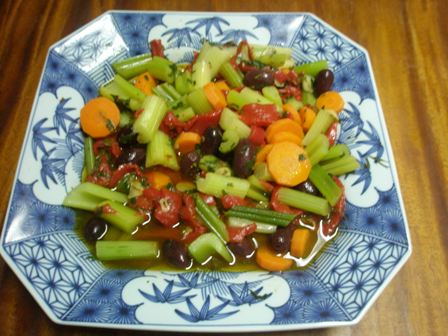
A salad for dinner

The celery salad

By the way, Les Ormes de Cambras is located near the city of Béziers in Languedoc in the South-west of France.


“To die for”: Argentinian wine

September 5, 2009

Last night we went out for a drink with friends. “To die for” was our aim, a fashionable hang-out place with the mildly decadent décor of sofa beds (divans) in the back yard in Thonglor, Bangkok. I chose a bottle of red from Argentina, a ‘2004 Trumpeter Reserve’ by Rutini Wines.

Rutini

What a pleasant surprise this wine was. Full-bodied, succulent with a good finish. Great drop from the new world. The wine is a blend of Tempranillo and Malbec to equal parts and the rest (about 30%) is Cabernet Sauvignon, a well rounded affair. 35 Euro in a restaurant in Bangkok is an OK price, I think.

We relaxed on the divan and watched the young fashionable Thais socializing. What a great end to a busy working week. Cheers folks


German wines: delight in red and white

July 4, 2009

Traveling in Germany I had the opportunity to taste some marvelous wines with some of my friends. Two of these I would like to briefly present to you, one red, one white wine, one from the Pfalz and one from my native land, the Mosel or to be precise the Saar.

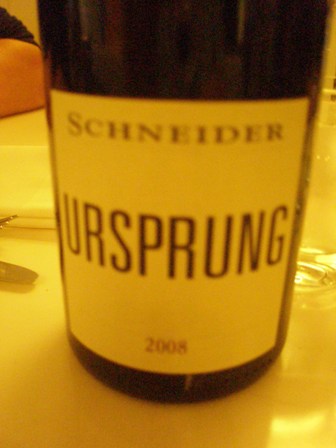
Over a dinner at “Schneeweiss”, a fashionable restaurant in the eastern part of Berlin offering “cuisine from the Alp mountain lands”, we had a bottle of ‘2008 Schneider Ursprung’, a cuveé made of Cabernet Sauvignon, Merlot and Portugieser by Markus Schneider.

Markus Schneider is one of the young but accomplished vintners who earned the highest praise from wine critics and experts from the wine and hospitality industry. This cuveé is made from grapes grown on a rather warm location at the “Feuerberg”, a terroir known for its capacity of heat retention by the local gravel stones which allows the grapes to fully ripen.

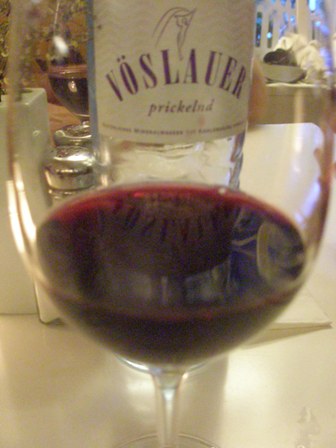
The wine is of a deep purple colour. It displays flavours of a lot of fruit, plum, some mint, chocolate and shows some peppery notes. The wine is very round and extremely smooth, for me just a bit too perfect in the mouth, I must say. It went extremely well with the food that I had ordered (Italian pasta filled with mushrooms). The wine is perfect and was a good choice. It retails for about 8 to 11 EURO but is worth the money.

Schneider Ursprung

A very simple label on the bottle: “Schneider Ursprung”

Schneider ursprung2

What a beautiful deep purple colour

Later the same evening, we tasted a dessert wine from my native lands, the Mosel, actually from the Saar river. It was a ‘1992 Ockfener Bockstein Riesling Spaetlese’ from “Staatliche Weinbaudomaene Trier”.

OckBockRiesAus

What a delight this wine was, a drop from heaven. It had aged well, was fresh and round. Although low in alcohol (only 8%), the acids were vibrant so that the wine was extremely well balanced, honey sweet, just wonderful. Only my friend Gerhard can wait for a wine like this to ripen in the cellar and patiently await the right moment to open a treasure like this.

I know the terroir quite well, Ockfener Bockstein, just a couple of meters away from the boundaries of the hunting grounds of my friend Heinz in Schoden, Saar which borders on Ockfen. The vineyards here are extremely steep and all work in manual. The 1992 vintage of this Riesling Auslese is just wonderful. I have no words to describe this nectar and do justice to the wine.

Address:
Schneeweiss
Kern Ranogajec GbR
Simplonstraße 16
10245 Berlin
Proprietors: Denis Ranogajec and Ralf Kern
Tel.: +49-30/29 04 97 04
Fax: +49-30/29 04 97 05

Weingut Markus Schneider
Am Hohen Weg 1
67158 Ellerstadt
(near Wachenheim, Pfalz)
Tel.: +49 (0)62…
Fax.: +49 (0)6237 – 977230

Administration:
Georg-Fitz-Straße 12
67158 Ellerstadt
info@black-print.net
http://www.black-print.net

Staatliche Weinbaudomänen Trier
Deworastr. 3
54290 Trier, Germany
+49 651 97598-0
www.staats
weingueter.rlp.de


Salve da Firenze

March 8, 2009

tignanello00

Our friends Lucija and Giuseppe came by on Saturday afternoon to treat us to a special treat. They brought with them a bottle of ‘2005 Antinori Tignanello’ from the Toscana.

tignanello0

Lucija and Giuseppe

Friends from Firenze had given them this wonderful wine and they wanted to enjoy it with us, and enjoy we did this heavenly drop. We sat on our terrace, I grabbed a couple of wine glasses and opened the bottle. Immediately, the djin was out: what a “profumo”. You could smell the scent from a distance.

My nose registered forest berries, dark fruit, moss and forest floor, hmm. In the mouth it felt round and silky. I loved the intense flavours of fresh fruit. The wine is full-bodied with very fine balanced tannins, a treat indeed.

tignanello1

2005 Tignanello

Later on the internet I found that Robert Parker had awarded 92 points to this wine. This blend of Sangiovese, Cabernet Sauvignon and Cabernet Franc is a wonderful wine from Antinori which I can highly recommend. The Wine Spectator says it should be drank after 2011. We could not wait that long.

tignanello2

Captured by a wine

One bottle for four does not last long. But we had memorable minutes of utter pleasure. Thank you folks for this wonderful treat.

PS: Later that day we were joined by about 10 more people and had a barbecue on our terrace. It was a jolly good day with lashings of food and drink.

At about 10 at night I found myself laying on the terrace tiles, feeling the heat emitting, my head on a pillow which I shared with my two daughters Lucy and Charlotte, the crown of our heads touching and our bodies radiating out like the spokes of a wheel. We were watching the night sky of Bangkok, the moon and the clouds travelling fast elsewhere. We talked about life and the universe and our thoughts attached themselves to the clouds. Our dreams carried us away, and in a heartbeat we were gone into other worlds.


Jean-Paul’s Vineyard, Yea

January 30, 2009

Recently I had the opportunity to taste wines from Jean-Paul’s Vineyard in Yea, Victoria, a boutique vineyard owned and operated by Will de Castella. The de Castella philosophy is, “it’s all about the fruit”. The vineyard is organic/biodynamic certified. Will produces hand crafted, award winning wines of excellent quality. Jean-Paul’s Vineyard also recently joined our association, the Upper Goulburn Winegrowers Association.

jean-pauls12

‘2006 Jean-Paul’s Vineyard Shiraz’

I bought a bottle of ‘2006 Jean-Paul’s Shiraz’ and a bottle of ‘2004 Jean-Paul’s Bold Colonial Red’ from the Yea super market. Recently the ‘2005 vintage Shiraz’ was awarded 94 and the ‘2005 Bold Colonial Red’ 88 points by James Halliday. I guess that the different vintages might not have been significant as regards the quality of the wine. Who can taste a one or two point difference anyway.

Both wines were consumed together with friends over hearty Australian country meals. To say it from the outset, I loved both wines; they were delicious. Since I am more of a Shiraz than a CabSav drinker, I personally prefer the Shiraz.

If you are in the vicinity of Yea, grab some bottles of these wines, it’s a bargain. I also recommend to visit the Jean-Paul’s Vineyard website and order from there directly.

jean-paulss11

‘2004 Jean-Paul’s Vineyard Bold Colonial Red’

By the way: Will de Castella’s great grandfather was Hubert de Castella, the pioneer of the wine industry in the Yarra Valley establishing vineyards such as St Hubert’s near Yarra Glen.

Will and his wife Heather live since 1988 near Yea and produce small quantities of fruit from which distinct wines are made which won accolades for their outstanding quality.

Address:
Jean-Paul’s Vineyard
Post: RMB 6173
YEA VICTORIA 3717
AUSTRALIA
Phone: 03 57972235
Email: william@jeanpaulsvineyard.com.au
http://www.jeanpaulsvineyard.com.au


D’Arenberg

August 29, 2008

The ‘2001 The Coppermine Road Cabernet Sauvignon’ from d’Arenberg winery in McLaren Vale, South Australia should be the last bottle of wine we drank with a proper meal, sitting on our Indian garden furniture on the back terrace overlooking our lush tropical garden. The next day, all should be packed away. Interestingly, the food was also Indian. After all, we came from India to Indonesia in 1998, ironically everything seemed to revert back.

The ‘2001 The Coppermine Road Cabernet Sauvignon’ from d’Arenberg

In January 2005 we had visited d’Arenberg winery with our friend Sylvan Elhay from Adelaide. The photo above was taken in the car park. We tasted some wines in the tasting room (of which I have no picture) and enjoyed, apart from the wines, the beautiful valley view, depicted in the photo below.

The ‘2001 The Coppermine Road Cabernet Sauvignon’ has a beautiful dark, almost blue/black) red colour (almost like blood). The wine has won many gold medals in various wine shows, for instance the 2003 Pacific Rim International Wine Competition, the Perth Royal Wine Show and the Sydney International Wine Competition. The latter awarded d’Arenberg also the title of “most successful winery” in 2003 and the San Francisco International Wine Competition followed with the “Winery of the Year” award the same year. So “gold” was all over the bottle. It retailed for about US$ 40 in the Fatmawati duty free shop in Jakarta and I had reserved the bottle for a special occasion.

The vineyard where the grapes for this wine are grown has a long and interesting history (www.darenberg.com.au). D’Arenberg’s new website design includes an introductory video worth watching. Among others the winemaker, Chester Osborn, fourth generation of the founder family, explains the philosophy of their wine-making style.

The Coppermine Road wines belong to the category “icon wines”. The grapes come from a Cabernet Sauvignon clone which is almost extinct. The wines show an intense flavour of blackcurrant, cassis, some chocolate notes. The wine critic Robert Parker suggest a cellaring of 5 to 7 years. So, the 2001 vintage we drank was just perfect. Ang guess what? According to the website and the label on the bottle, even traditional foot-treading is used prior to modern pressing techniques. Not many wines enjoy such treatment these days. The wine had an excellent balance of oak and tannins and we thoroughly enjoyed it with a meal of “left-over” Indian dishes. It was a wine for a special occasion, and a special occasion it was.


Family meals and the emptying of my wine “cellar”

July 4, 2008

Our last 60 days in Jakarta have started. Soon we will be moving to Bangkok. We try to enjoy every day. Apart from sorting out things, we are spending our time at home with family meals and drinks.

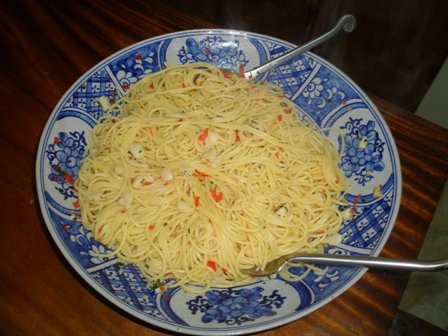
A delicious seafood pasta

I do not have a large supply of fine wines left but some of the bottles I have kept for special occasions. So what did we drink over the last couple of days? Here is a quick run-down:

‘2002 Léon Baur Gewürztraminer Grand Cru Pfersigberg’, alc. 13.5 % Vol.
We drank it before lunch as an aperitif. This is an aromatic wine, very generous in its flavours. It comes from a limestone “terroir” and is the gem of the Léon Baur collection. Low yields make great wines. It’s rather high in alcohol and has 15.2 g/l in sugar. A very enjoyable Gewürztraminer typical for this grape variety (www.leon-baur.com)

‘2003 Wiltinger Gottesfuss, Riesling Kabinett Feinherb, Reichsgraf von Kesselstatt’ , alc. 11 % Vol.
As you know, I love wine from the Saar River, and Wiltingen is one of the major location to produce first class Riesling wines. “Feinherb” is the German word for semi-dry. “Gottesfuss” is one of the best locations in Wiltingen, a very steep, stony slate ground which produces a fine, acidic, and balanced wine. Normally I prefer dry Rieslings but with a spicy Asian meal, the semi-dry version does very well. (www.kesselstatt.com)


‘2005 Hollick Coonawarra Reserve Chardonnay’,
alc. 13.5% Vol.
We had it with a seafood pasta. What a delicious Chardy this was. Although cellaring for up to 7 years is recommended, the bottle did not last that long. It displayed aromas of white peach, had crisp acidity and balanced creamy overtones. Though the wine was matured in French oak for 10 month, it was not “over-wooded”. Beautiful (www.hollick.com).

‘1999 Mildara Coonawarra Cabernet Sauvignon’, alc. 13.5% Vol.
The Mildara brand belongs to the Fosters Group (www.fosters.com). Liz and Walter brought it with them and we had it with all kinds of cheeses, salamis, coleslaw, salads and all kinds of “nibblies”. Despite its age, it displayed all the freshness of a typical Coonawarra wine. The colour was a deep purple. The intense aromas ranged from cassis, to dark berries and plum with hints of mint and herbs. The 18 months in oak have given the wine great depth and bony tannins, mellowed by age. The wine had an excellent structure. It was well aged.

‘2004 Knappstein Clare Valley Enterprise Vineyard Cabernet Sauvignon’, alc. 14.5% Vol.
The bottle retailed for US$ 26.50 at the Jakarta duty free store in Jalan Fatmawati. I had it reserved for a special evening. the wines is Clare Valley Cabernet Sauvignon at its best. Wonderful creamy, cassis, blackberry and mulberry flavours. A big Australian wine, full and complex but heavy which lingers on long after you swallowed the last drop. The fruit is grown on the “terra rossa” soils. Low yields guarantee the quality of the fruit. 2005 was an excellent year with a long ripening season. We had it after a meal just for enjoyment. This is a great wine indeed. (www.knappsteinwines.com.au)

The farewell dinner with our Australian friends (Brett, Janie, John and Dhanya) last night was a delight. We drank some very good wines. I only mention them in passing. Hope you don’t mind. We started with a pre-dinner drink, a ‘2006 Vasse Felix, classic dry white’ from Margaret River, Western Australia. The entreés we washed down with a ‘2007 Yarra Burn Sauvignon Blanc Semillon’ from the Yarra Valley, Victoria. We switched to red before the main course (a pasta bolognese), first to a ‘2004 Cape Mentelle Cabernet Merlot’ and then a ‘2003 Vasse Felix, classic dry red’. Three Margaret River wines stood against the cool climate SB form the Yarra Valley. It was a wonderful evening. No sadness was to find only the joy of being together and having a good time. I love this Australian attitude to life.


From the Old to the New World: My Vineyard in Glenburn, Victoria

January 10, 2007

Today I want to take you to a small place in Central Victoria Glenburn, between Yarra Glen and Yea, about one hour northeast of the capital city of Melbourne. From there we drive about 5 km up north and turn right into Two Hills Road, a gravel road which will lead us to our vineyard.

The vineyard
Our vineyard facing north

It’s all grazing land here surrounded by gum forests of the national park. Most residents are retirees; many are weekenders. The vineyard is located on the right hand side on a 50 acres block (about 21 ha). It consists of about 1 ha Sauvignon Blanc (planted in 1996), 1 ha of Pinot Noir (planted in 2002) and 1.3 ha of Merlot (planted in 1997). The rest of the land is grassland with some small patches of gum trees and a small forest. A small river, Katy’s Creek, builds the boundary on one side.

Second Hill

Two Hills Vineyard towards our second dam

In 2001 we had our first vintage. Our Sauvignon Blanc of 2002 even won us a bronze medal at the Singapore Wine Show.The wines are available in Melbourne at the Old England Hotel in Heidelberg (bottle shop; www.oldenglandhotel.com.au), at the Berry Cafe in Dixons Creek (on the way from Yarra Glen to Yea) and in the Alexandra supermarket chain. In Germany my friend Dr Ulrich Hillejan (Gesellschaft fuer Unternehmensentwicklung mbH, www.s-h-r.de) sells our Merlot to other friends and family. At the moment we have only Merlot 2004 for sale. All the other wines have sold out which is of course good news for the producer and bad news for the consumer. 2006 was our most successful year so far. We had a good harvest (after a complete loss in 2005 due to adverse weather conditions), sold all our grapes, and most of our wines. The 2006 vintage of Merlot is ripening in French and American oak and will be bottled in March 2007.
We are selling most of the fruit to other wineries. Living abroad is not very conducive to wine marketing. Another friend, Steve Sadlier of Vineadvice from Yarra Glen, takes care of the vineyard management. He is our viticulturist. Our wines are made by another friend, Alan Johns, owner and winemaker of Yering Farm Wines (please visit their website at: www.yeringfarm.com.au).

The wine region is called the Upper Goulburn Wine Region Victoria (formerly Central Victorian High Country) and is promoted by various organisations among them the Upper Goulburn Winegrowers Association of which we are also a member (please visit their website: www.uppergoulburnwine.org.au). I took the map from this website. Unfortunately, it’s not up to date (we are not yet listed as members for instance) but it gives some idea of the location.
ugmap2.jpg