News from Glenburn, Victoria

February 4, 2008

I usually do not hide my liking of globalization. While strolling through my hometown Trier in fall last year, I discovered on one of my long walks around town an Australian restaurant. Greetings from ‘down under’ in this 2000-year-old town of Trier. Isn’t it wonderful? Emperor Constantine would have been very pleased.

emu-bar-in-trier.jpg

The Emu restaurant in Trier

I also found a cafe just next to the Karl Marx house (the birthplace of the great philosopher) opposite one of my favourite wine bars, the ‘Das Weinhaus’, where you could enjoy the smoke of a shisha (or water pipe). If Karl would have known, he would have been delighted, I hope.

Michael my brother-in-law, who lives in Healesville, a beautiful little country town in Victoria about 3/4 of an hour northeast of Melbourne, used to buy Bitburger Beer for me. He knows that I love this brew from my home region. During his recent wedding I could enjoy some more of it. Great feeling to be so far from my birthplace, and to be able to drink the same beer thousands of kilometers away, far south on the other side of the earth. Goodness me.

bitburger-ad.jpg

bit-bier.jpg

Country folks need a drink from time to time, and vintners do not always drink wine!

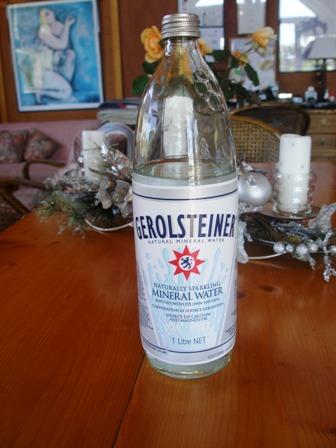
Another product from my home region has found its way to Australia, Gerolsteiner mineral water. The name ‘Gerolsteiner’ was made famous in sport enthusiastic Australia through the sponsorship of the cycling team with the same name. But now you can buy this wonderful drink (good after a hangover or in case of gastroenteritis).
gerolsteiner.jpg

The sparkling water from Germany

Let me follow this up with some ‘news’ or observations of what has changed since we last visited Glenburn and its surroundings.

● The Yarra Glen Grand Hotel had been finally sold by John Lithgow and we found the pub full of people enjoying the new atmosphere created by the new owners.

● The old Henkel Vineyards (descendents of the German sparkling producers) cellar door was sold and is now called Mandala Wines which is owned by the Smedly family (www.mandalawines.com.au). Henkel is erecting its signpost a couple of kilometers further north of the old place near Dixon’s Creek.

mandala.jpg

Mandala Wines, the new cellar door in the making

● The Wine Hub at the Yarra Valley Dairy (www.yvd.com.au) has gone out of business and with it we lost one of our retail outlets.

● Cheese Freaks in Yarra Glen is gone and has become a nice little restaurant.

● David left the local Healesville band the “Heartstarters”.

Giant Steps Winery (www.giants-steps.com.au) in Healesville, owned by Phil Sexton and his family, is in full operation (bar, coffee house, restaurant, bakery, winery, etc.) and has been also adopted by the locals who patronize it in great numbers.

Steve Webber of ‘De Bortoli Wines’ in Dixon’s Creek (www.debortoli.com.au) was awarded the very prestigious “Winemaker of the Year” by the wine magazine ‘Gourmet Traveller’ (www.gourmettravellerwine.com.au). Congratulations!

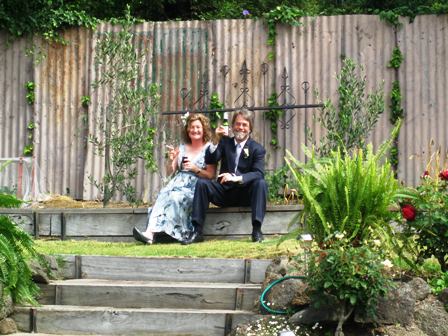
Michael and Helen got married of course. Congratulations again. Cheers.
pc160326.jpg

There are of course more news to report, but the above is what jumped into my eye while touring the beautiful Victorian countryside. Needless to say, we sampled quite a few local wines from the Upper Goulburn and the Yarra Valley.


News from Two Hills Vineyard

January 23, 2008

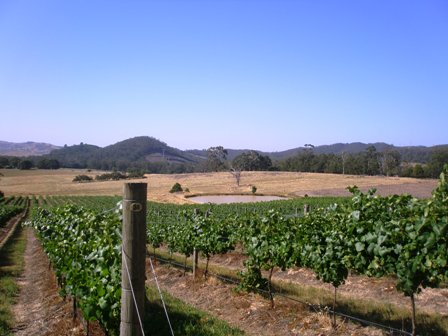
twohillsinjanuary.jpg

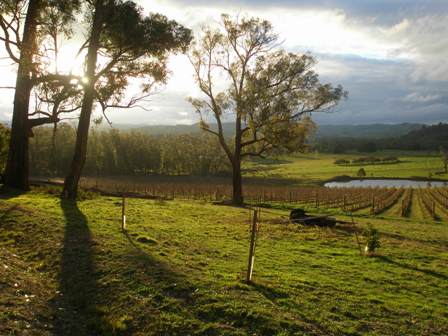
In the back, you can see the two hills which gave the vineyard it’s name.

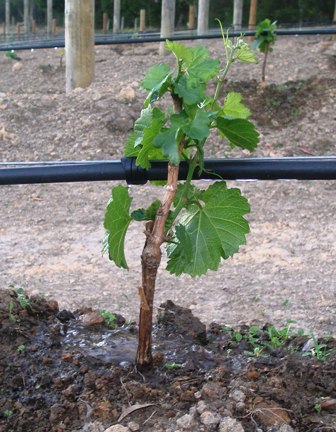
2008 promises to become our best year ever in the almost 13 years history of Two Hills Vineyard. A new block of Chardonnay has been successfully planted in early December 2007 and with this we will be able to produce on site one more ‘single vineyard wine’ in a couple of years from now, to be precise in about 2013. I will hopefully have retired by then from my work overseas.

chardy-1.jpg

Young Chardonnay plant

chardy-2.jpg

Morning in the Chardonnay

chardy-3.jpg

Chardonnay block

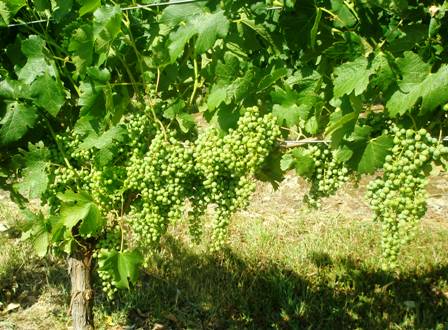
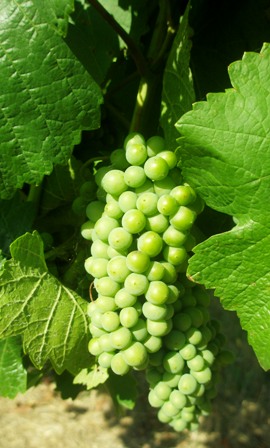
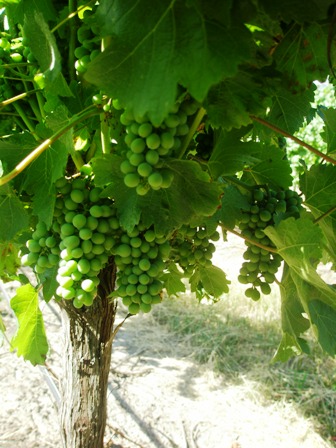
The fruit on the vines of the other three varieties looks really good (as the pictures below show). Despite the already mentioned freak hail storm on December 22nd, the fruit is healthy and in abundance. We expect to harvest about 25 tonnes of fruit from 3.5 ha under vines this year.

Because of the extreme heat we had in early January, vintage time might be earlier than in previous years, maybe in late February; usually it is in the middle or end of March. We in the Upper Goulburn Wine Region (www.uppergoulburnwine.org.au) are usually starting to harvest our grapes later than the colleagues in the Yarra Valley further south.

young-merlot-grapes.jpg

Young Merlot grapes

young-pinot-grapes.jpg

Young Pinot Noir grapes

young-sb-grapes.jpg

Young Sauvignon Blanc grapes

Our old Fiat tractor will be retired in 2008. Because of a generous donation from my mother it can be replaced with a newer model with some more horse power. We will also retire our old Mazda 626 car which is not exactly a useful farm vehicle but which served us well as a means of transport during the short months we spend on the vineyard during the last 12 years.

We will hopefully also get around in sowing one of the front paddocks with a horse loving grass mixture. Then we will have the plot fenced in by Peter Thwaites and turned into a horse paradise where our horse enthusiastic daughters, Lucy and Charlotte, can keep their ponies and other horses when we visit Glenburn.

We have started to irrigate our vines. I hope their will be no large bushfires as in 2007 when extensive smoke tainted many grapes. If the high temperatures persist, the likelihood of fires will rise too.

Finally, we have decided to extend our dwelling on the vineyard. We plan to link the old shed with a new wing to become our house, a proper residence so to speak.

Let us see what 2008 has up its sleeves.


Vineyard news – Two Hills in winter

August 21, 2007

thwinter07.jpg

Victorian winter and Two Hills Vineyard

I would like to bring you up to date on some recent developments. The dry season seams to be over in our neck of the wood. When we arrived at Two Hills Vineyard our small dam was full and the larger “irrigation” dam was slowly collecting runoff water from the surrounding hills. However, when I was digging out some blackberry roots I quickly discovered that the ground was still rather dry. Only about the first 5 cm of soil showed some moisture but below there were hardly any to find; not quite dry as a bone but still too dry. We will need much more rain in order to refill the ground.

unproonedwines.jpg

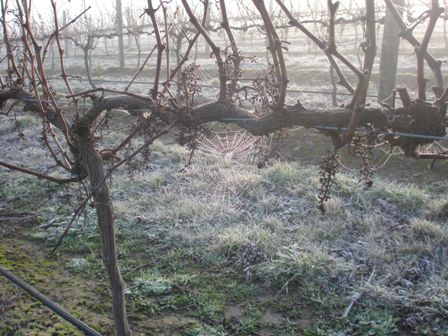
The un-pruned vines

Another exciting news is, that we are extending our vineyard. We are in the process of planting 1 ½ acres of Chardonnay (clone P 58). The posts are almost in. Peter Thwaites could not finish the job because it was too boggy. The spacing is 3 meter between the rows and 6 meter between the panels. Pro panel we will plant 4 vines (1.5 m per vine). We have 20 new rows of different length but about 1200 vines should find a new home at Two Hills Vineyard. We have to be patient though. Experience suggests that we will have to wait another four to six years before we can drink the first drop from this site.

postschardonnay.jpg

neblock.jpg

The new Chardonnay block in the making


Sauvignon Blanc

July 10, 2007

My morning newspaper, the International Herald Tribune, carried the other day an article summarising the tasting of 25 Sauvignon Blanc wines from New Zealand. Sauvignon Blanc is one of my most favourite white wines. The results were interesting. Only about 10 of the 25 wines found the approval of the tasting panel (it was a New York Times event of the dining section). For the judges, the tasting was a disappointment. They were looking for the bold, pungent refreshing SB but found that too many wines were dull, too sweet or simply wishy-washy or as Eric Asimov put it “commercially inoffensive”. My favourite SB from New Zealand, Cloudy Bay came up third (behind “Villa Maria” in number one position), described as “quieter than the top wines” but still “bold, zesty and delicious”. In my bottle shop in Jakarta it retailed for 40 US$ the bottle last week. Gone are the days when I had to pay only 18 US$ for this most delicious white.

Mr. Asimov is of the opinion that many producers have decided to push quantity at the expense of quality and that they are over cropping (too high yields per acre). I learned something else from the article: that in New Zealand wine producers are allowed to add sugar or acid to make up for “green” (not fully ripened) grapes, as we say. In Australia, we are not allowed to engage in this technique or should I say “manipulation”. Next time in the bottle shop it will be much easier for me to walk away from the dear SB from Marlborough and turn to some cool climate Sauvignon Blanc of Australian provenance. I might be enticed to make some Two Hills Sauvignon Blanc again in 2008. Kinloch Wines (www.kinlochwines.com.au) Sauvignon Blanc of 2006 is sold out, as I learn from their website. Guess who provided some of the fruit for this most delicious wine from the Upper Goulburn River (www.uppergoulburnwine.org.au)?


Wine Industry in Crisis

May 17, 2007

Today I received information from the Upper Goulburn Wine Growers Association, of whichTwo Hills Vineyard is also a member, about the current problems in the North-East Victorian wine industry. As you all know, the 2007 vintage was volumewise much smaller than earlier vintages. In fact the crushed tonnage was 65% less than average. Because of the adverse conditions (late frosts among them) in 2007, the tonnage projections for the 2008 vintage are about 50% of normal times. This has a far reaching impact on the region, the councils, growers, wineries, consumers, tourists and the people in rural Victoria’s North-East. The livelihood of many producers, wine grape growers as well as wine processors, is threatened.

The Victorian Wine Industry Association has come up with a hands-on training program for those affected. This modular program looks at four main areas:

1. Vineyard Management
2. Business Sustainability
3. Market Development
4. Winery Tourism

For a boutique vineyard such as Two Hills all of these are very important. I am particularly interested in the possibility of future wine grape sales online. As an absentee owner, I appreciate more information about potential sales, demand and prices. Of course this year we had no problem in selling our fruit. Just that we did not have enough of them, and that’s made 2007 a bad year so far, the volume was just no there. It was good news for the receiving wineries, they got first class fruit from Two Hills. The online sales mechanism is most likely to be housed atwww.winesofvictoria.com.au

I also expect that I will have good use for the planned benchmarking guide for small wine businesses and the standardised Gross Margin Calculator. Though we are already exporting some wine, I hope to benefit from the country specific export market guide kit. If anybody of my readers knows any reliable importer, for instance in Germany but also elsewhere, please let me know. Our volumes at Two Hills Vineyard are small. Our single site vineyard does not allow blending with other fruit, which makes the special character of our products. Moreover, ‘exciting to drink a wine every year, for instance Merlot, from the same location and it always tastes different: one tastes the specific year, its climate, the soil….

I am an unlikely beneficiary of the training itself. Have I told you that we have booked our flights to Australia and that we will be in Glenburn from 11 July till 15 August? Come and visit us and have a glass of Two Hills wine.

picture-384web.jpg

Lunching together with family and friends


Upper Goulburn Wine Region – Vintage celebrations

April 17, 2007

On Saturday, 28th April, 2007 at Delatite Winery in Mansfield, Victoria, a great new festival will be brought to you by the Upper Goulburn Wine Growers Association (www.uppergoulburnwine.org.au).

Come along and enjoy new and museum vintages of elegant and aromatic cool climate wines.
The region is ideally located for the production of crisp and racy aromatic white and sparkling wines and elegant textural red wines.

The following fruit and wines are grown and made: Riesling, Gewuerztraminer, Pinot Gris, Sauvignon Blanc, Chardonnay, Marsanne, Viognier, Pinot Noir, Pinot Meunier, Merlot, Shiraz, Cabernet Sauvignon and Temperanillo.

Taste the flavours of the Upper Goulburn, listen to music from Connie Lansberg, enjoy a balloon flight chill out in the high country!

Showcasing
– A variety of aromatic whites and elegant reds – over 20 labels
– Gourmet food from the region’s best restaurants and cafes
– Regional products – olives, oils, breads, trout
– Art and sculpture
– Vintage cars
– Fun activities for the kids – puppet shows, face painting
– Balloon flights over the Delatite Vineyard
– Musical entertainment (sponsored by Crazy Johns): Jazz n Shiraz featuring Connie Lansberg

picture-077blog.jpg

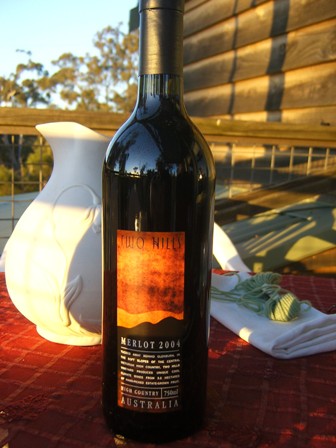
Two Hills Merlot 2004


Old Friends and Good Wine

April 6, 2007

According to Plato “only philosophers have what it takes to venture outside of the cave into the sunlight”. And what do they do there (apart from eating as we know from my last blog entry)?

They drink good wine of course!

When our friend Alan Wall came over from Canberra they other day, he brought with him, as usual, some bottles of good wine. Alan is one of these people who has forgotten more about wine then many of us will ever learn. He has a fine collection of about 3,000 bottles which are stored in his insulated garage.

We started with a single vineyard wine, a Mount Pleasant 2000 Lovedale, Hunter Valley Semillion. The bottle was decorated with five trophies of gold and top gold medal signs. What a wine this was. It displayed honeyed toast and hay aromas but it also showed some lemon and grapefruit character as many young wines do. It could have easily be cellared for much longer but when old friends meet, good wine has to flow. Of course we had food with it, a delicious seafood pasta.

The Hunter Valley, one of the oldest wine regions in Australia, is famous for its Semillions and its Shiraz. Whoever plans to visit Sydney should also include into their program a trip to the Hunter Valley just a 2 hours drive north of cosmopolitan Sydney.

The main dish was grilled beef (on my Weber) and with it we drank a Coonawarra Rymill Shiraz of 1996, a very well aged and harmonious wine of great depth and with a long finish. What a delight this was with it’s spicy peppery character and the blackcurrant flavours.

After the desert we continued with a wine from Sonoma County, a Chateau St. Jean Merlot of 2004 which displayed all the good Merlot charactereristics which we are looking for, deep cherry and plum aromas, with good texture, some weight in the mid-pallate and a long finish.

Of course the company was what really counted. Drinking wine we discussed about electoral systems, political party and democracy development and the future of the young Indonesian democracy. Life is just too short to drink bad wine.

sa500267forbloga.jpg

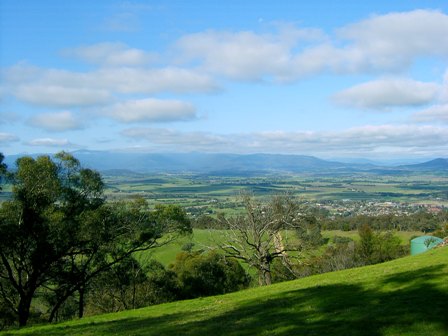
The Yarra Valley in Victoria


What we were drinking: South Australia

March 23, 2007

David, the son of our mutual friend John, from Sydney brought two wonderful bottles of wine over the other day. We had them with a beautiful meal for Saturday lunch. With the spicy clam pasta we enjoyed a bottle of 2006 Sauvignon Blanc from Shaw and Smith from the Adelaide Hills (www.shawandsmith.com), a cool climate region in South Australia where my wife comes from. Grapes where planted there as early as 1839 and today there are about 60 wine labels with over 3,000 ha of vineyards planted. This young Sauvignon Blanc is a wine to my taste: fruity (with passionfruit and guava flavours), grassy-herbaceous, flinty and well rounded with a long finish. The wine is unwooded and James Halliday gave it 94 points. Very enjoyable in a tropical climate such as Jakarta.

McLaren vale1

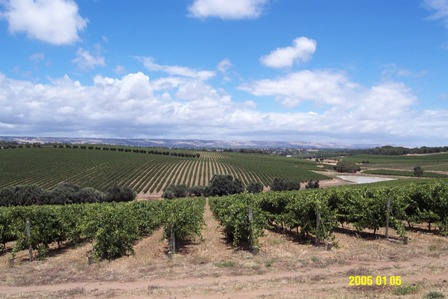
McLaren Vale with vineyards, sea view in the distance

The second bottle we drank with the main dish, a vegetable stew, came from Mitolo Wines (www.mitolowines.com.au), a family owned winery situated in the most southern tip of the McLaren Vale region. I will write more about McLaren Vale in one of the next entries, because we visited the region in 2005 and had a wonderful time visiting some of its vineyards. We drank a 2004 Jester Shriaz. The wine had a deep purple colour. The nose showed intense blackberry, plum and chocolate aromas of rich black fruit. The wine has a good structure, is well rounded and has a long finish. Of course it should have been cellared for 4-5 more years but we could not wait. Both wines made our day which we spent sitting on the terrace and discussing the pleasures of life in general and life in Indonesia in particular. Come and visit us one day.

McLaren Vale 2

Vineyard view in McLaren Vale


A most marvelous fish dish

March 4, 2007

I have been away for a while. Let me tell you about a very memorable dinner I had with my friends Joyce and Rainer and a couple of other friends in Bangkok the other day. It started as a kind of late Chinese New Year celebration. We jointly tossed a special Singapore salad with the most astonishing ingredients of which I cannot give you a run down. Eating this dish together brings you luck of course. We had it as a kind of entree.

The main dish, however, is what I would like to introduce to you today:

Baked Sea bass with Basil-Feta Crust

This is a most amazing creation. I always thought that fish and cheese do not go well together. Wrong. They can build a terrific partnership and create an explosion of your senses in your mouth. The recipe goes as follows (4 serves):

Crust ingredients
– 3 garlic gloves
– feta cheese (one block)
– bread crumbs
– basil leaves
– black pepper, salt
– 4 table spoons of best extra virgin olive oil

Fish
– 4 pieces of Sea bass fillet, but any other “white” fish will do

How to do it
– Grind peeled garlic cloves and basil leaves together into a coarse consistency, mix the olive
oil into it
– put ground basil mixture into mixing bowl together with bread crumbs and Feta cheese. Mix
well together. Add pepper and two more tablespoons of olive oil.
– was sea bass fillet and sprinkle with pepper and salt. Place on oven-proof dish.
– put basil-feta mixture on fish covering the surface.
– bake for 30 minutes in 180 c oven
– serve with vegetables as desired.

We drank a Sicilian white wine with the fish. I would have loved to have a Two Hills Sauvignon Blanc instead; the wine we had at Rainer and Joyce’s wedding some years ago for instance. Of course also a Sauvignon Blanc from another cool climate wine region would do. But Sauvignon Blanc definately be my preferred choice with this dish.


2004 Two Hills Merlot and its DIAM cork

February 20, 2007

Many of our customers might have wondered why we changed from a natural cork as used for the 2001 vintage to one which looks like a compound, glued together closure. Well, let me share with you some of the information which brought us to this change.

Wine industry experts estimated that each year about 200 million bottles of wine worldwide are having a moldy smell coming from defective cork contaminated with Trichloroanisole (TCA). The financial losses to the industry are enormous. If one assumes than on average about 9% of the bottles are contaminated, then any method able to reduce these losses is highly welcome especially by small producers or boutique vineyards such as Two Hills. A French closure company, Sabaté of Oeneo, has developed a new closure, the DIAM cork, which guarantees a 100% cork taint free closure of wine bottles. These corks also offer near perfect seals and no random cork oxidation or leaks.

How is the DIAM cork made?
The procedure is similar to the technique used to produce decaffeinated coffee. The cork is reduced to cork flour, and then washed with carbon dioxide where the TCA is removed. After that the flour is reconstituted and held together by the same polymer that contact lenses are made from. Independent research, for instance by the Australian Wine Research Institute (AWRI; www.awri.com.au), has confirmed that DIAM corks are exceptional in preserving freshness by avoiding oxidation. In 2004 Oeneo Closures has won an international award, the Gold Medal Trophy of Vinitech in Bordeaux, for technical innovation.

We at Two Hills Vineyard had basically three options: (1). buy more expensive conventional cork, (2) put the wine under screw caps and (3) experiment with DIAM cork. I could not bring myself to put red wine under a screw cap. I might be called a romantic by I enjoy opening a bottle with a traditional opener. For white wines, I hold a different view. I am willing to sacrifice the same romantic notion for a guaranteed cork free taste of the wine. I am not so sure about Riesling though, especially those Riesling wines which benefit from aging. In such a case I would be willing to invest in more expensive conventional corks, I guess. This is of course not logical but rather arbitrary, I know. Alas we do not have Riesling grapes at Two Hills so that I do not have to make this decision. But for aromatic wines such as Sauvignon Blanc of which I am especially fond off, I readily accept the screw cap.

In the end we decided to give DIAM a chance. I hope that our customers will be satisfied with this explanation and continue to enjoy the exceptional quality of our wines. For those of you who want to know more about closures, please visit www.winestate.com.au or put DIAM in your search engine.

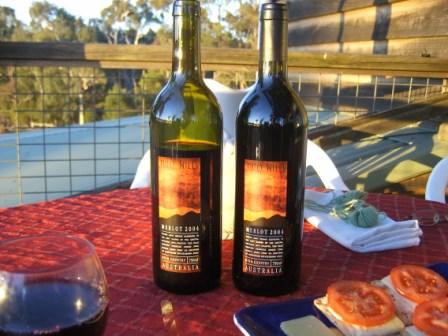
2004 Two Hills Merlot

2004 Two Hills Merlot bottles shortly before consumption on our terrace in Glenburn