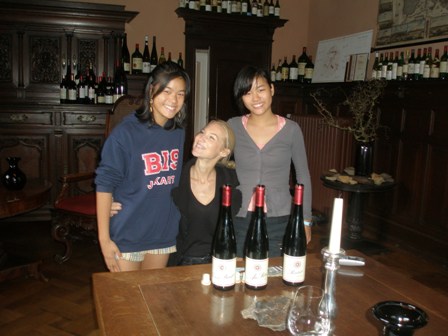
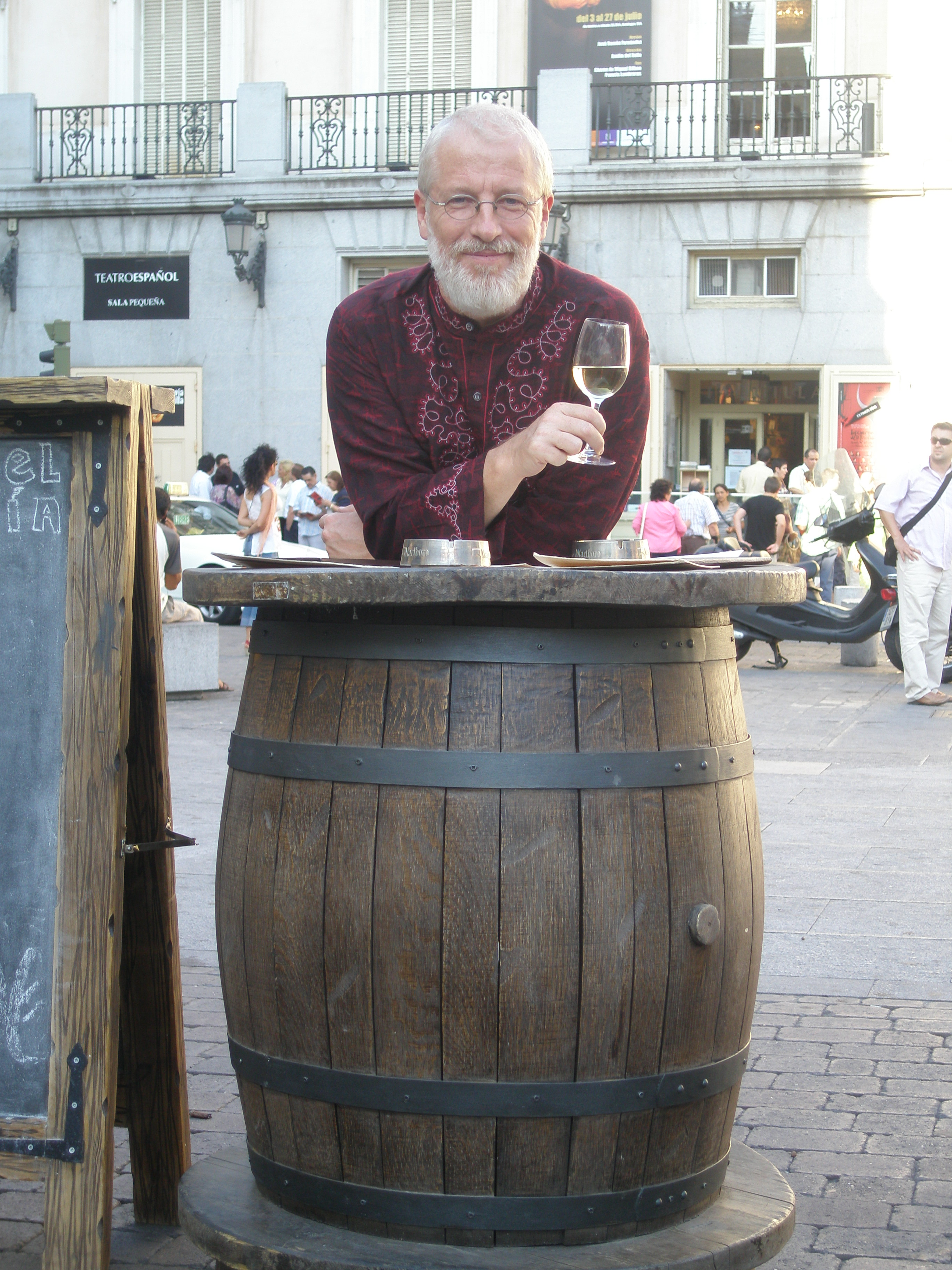
The Gourmet Garage, Jakarta III – Jolly Farewell

September 15, 2008

It was another farewell but one of those were time seems to have stopped. We enjoyed the moment, the pleasure of being together for a memorable meal and we did not think much about parting or not living in the same city again. Any future starts in the present moment, and we were sure we would have lots of it. We were not doubting that we would meet again, as friends do.

Well, were did we go? And who is “we” in the first place? To answer the first question, we met at the Gourmet Garage in Kemang, Jakarta, a very fashionable place. It was also easy to reach for all of us.
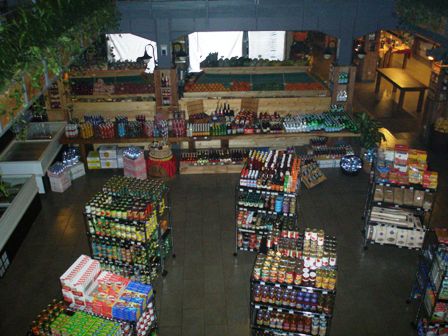
The inside of the Gourmet Garage in Jakarta with various shops on the ground floor and the restaurants upstairs.

The answer to the second question is, there were the five of us: Flo (Florian) and Nelly, Jasmin, Margit and me.
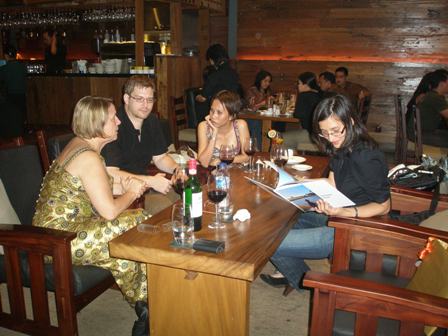
Margit, Florian, Nelly and Jasmin

The three had invited us to spend our last Friday night in Jakarta among friends. They talked us into ordering the four-course Japanese meal. Depending on the day, the chef changes the composition of the dishes of the four courses. Surprise, surprise but since we like adventures, we were eager to wait for things to come. Flo and Nelly ordered other dishes from the Japanese menu. There are two more menus to choose from at Gourmet Garage, a Western menu and an Indonesian menu.

Flo started with an oyster.
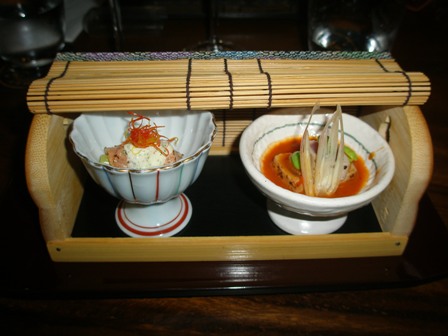
The starters for the four-course menu were beautifully decorated.
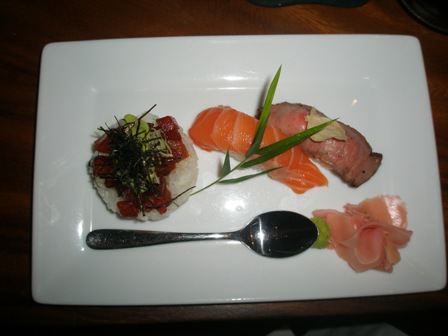
So were other dishes from the menu.

This soup was just delicious.
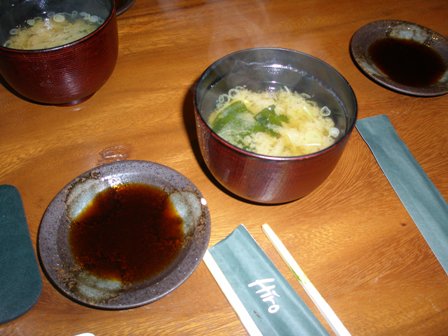
The miso soup came with the four-course meal.

This was part of Nelly’s dish.

And Flo had a similarly decorated meat dish.
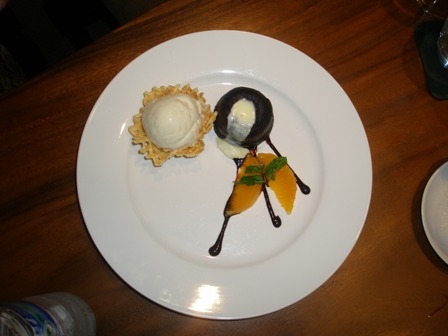
This is one of the desserts we had.

In short, the food was delicious. According to some expat Japanese, Gourmet Garage offers the best Japanese food in town.

You might like to know what wine we drank. Nothing special, I can tell you. Well, we opted for a simple, red wine from Australia. With ‘Penfolds Rawson’s Retreat Shiraz-Cabernet’ you cannot go wrong if you need a wine for every day which is easy to understand and to drink. Gourmet Garage prices these wines very reasonably. The choice was a compromise, of course, but I did not fancy the whites from the wine list. A Mosel or Saar Riesling would have been my preferred choice.

But we had a great time and that was what mattered most. Farewell gifts changed hands (I do not reveal what they were) and at about midnight we parted company as on many other occasions before. See you guys in Bangkok, or on our farm in Glenburn. As you know, you are always welcome; ‘sampai jumpah’ as we say in Indonesia.


I am crazy for vineyard pictures….

September 14, 2008

I love to look at vineyard pictures and do not grow tired of looking at them. I do not know where this comes from. It has certainly also to do with our own vineyard, for sure. When I am in Glenburn I walk my vineyard every day, from left to right, from right to left, from top to bottom and the other way, in the evenings and mornings, even late at night (actually I have to admit that after a rather joyful night, I drove around the vineyard in my old Mazda car, listening to loud music, windows wide open).

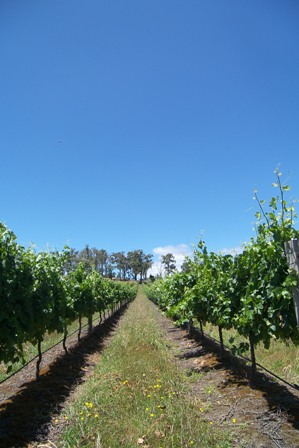
Two Hills Vineyard in Glenburn, Victoria, picture taken from the east by Nelly A. Kemur-Witt, December 2007

In the picture above you can see my treasure: Two Hills Vineyard in Glenburn, Victoria. First comes Merlot, then Pinot Noir, then Sauvignon Blanc, and to the left you can see the posts for the Chardonnay block, all in all 4 ha under vines.

Two Pinot Noir rows (photo by Nelly A. Kemur-Witt)

Pinot Noir fruit (photo by Nelly A. Kemur-Witt)

On some of the wine and vintner blogs and web pages which I regularly visit, there are stunning pictures of vines, vineyards, grapes, and nature in general. I would like to introduce to you a small selection of only three blogs you should visit and browse through their photo collections (and of course also their stories).

I start with the blog of Iris and her Weingut Lisson in southern France. The Winery (Weingut) has also a web page (www.olargus.info) in three languages including English, but I usually visit Iris’s personal blog where she tells interesting stories (in words and pictures). The language is German. She also bloggs in French. I love the slide shows and the photo albums.

The second blog is from Germany posted by the owners of the Weingut Steffens-Kess in Reil, Mosel. Also in this case there is a proper website for the winery (www.steffens-kess.de), and a blog called “Bildergeschichten aus dem Weingut Steffens-Kess” (in English: Stories in pictures from the Steffens-Kess Estate). Again, great pictures around vineyards and vines are to be found.

The third blog with great photos comes from California, USA. It is the Tablas Creek Vineyard blog. The blog won the American Wine Blog Awards in the winery category in 2008. Since Tablas Creek specialises in Rhone varieties you can find wonderful photos of Mourvedre, Roussanne and Grenache among others.

All three blogs have more than nice vineyard photos. They are delightful to read and contain heaps of useful information about the wine industry, the ecology and the every-day-life of people who’s hearts are buried deep in their respective vineyards and wineries.

If you got nothing to do right now, click a bit around and discover exciting new worlds.


Vinho Verde – Portuguese delight

September 11, 2008

Vinho Verde wines are unique among the blended white wines of Portugal (and the world) attempting to harmonize delicate aromas and flavours. The name, Vinho Verde, is somehow misleading. Vinho Verde wines are not made of “unripe” grapes as some people say, but are rather “young” wines in contrast to “aged” wines. There are red and white Vinho Verde wines available. The red ones are often a challenge to our culturally determined palates. During my recent trip to Porto, Portugal I had ample opportunity to taste and explore the wines of Northern Portugal. Among them the famous Vinho Verde wines of the Minho wine region.

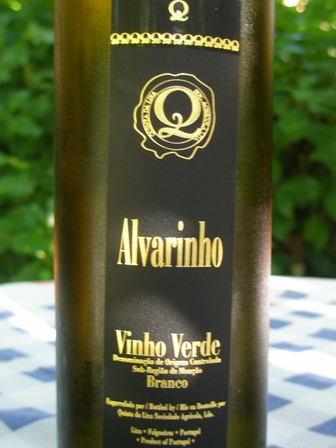
It is not easy to find a “pure”, varietal wine in the Minho wine region of Portugal. Traditionally Vinho Verde is a blend consisting of several grape varieties (www.vinhoverde.pt) such as Alvarinho, Arinto, Azal, Avesso, Trajadura and Loureiro.

However, with a bit of luck I found some bottles in the café next to the cathedral in Amarante, a small town at the (Rio) Tamega river, about 50 km east of Porto. The wines came from Quinta da Lixa (www.quintadelixa.pt), a well known producer located in the village of Vila da Lixa about 20 minutes northwest of Amarante.

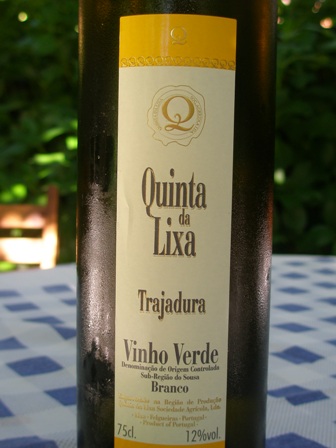
From left to right: 2007 Quinta da Lixa Loureiro, Alvarinho and Trajadura

The tasting notes for the three wines you can find on the websites which I mentioned above. Average production for the three varieties at Quinta da Lixa is bout 7 tons per hectare. The wines are low in alcohol (10 to 11.5%) and show an acidity of about 6.5 g/l.

The Trajadura grape has, in contrast to Alvarinho and Loureiro, a rather plush character and is less acidic than the other two varieties. It is often used to soften the blended Vinho Verde wines.

The Loureiro grape provides the fragrant character of the blended Vinho Verde wines. The single varietal wine of Quinta da Lixa which I tasted was slightly “sparkling” and very aromatic (more aromatic than the other two single varietal wines of Quinta da Lixa). All three wines showed citrus, lime and green apple aromas. They were very fresh and clean, served at the right temperature they are wonderful summer wines. Earlier vintages of Quinta da Lixa Loureiro and Trajadura received 89 and 90 points by some tasters. I loved them as single varietals as well as in the blended incarnation.


Wine tasting at Van Volxem Estate in Wiltingen, Saar

September 8, 2008

In April this year, my friend Heinz and I, we had visited the Van Volxem Winery (www.vanvolxem.de) in Wiltingen, Saar for the first time. Unfortunately, all wines were sold out then. Dominik Völk, the wine maker, served us a delicious coffee instead and we were invited to visit again in the month of July when part of the new vintage would be released.

Steep slopes for maximum exposure to the sun at the Saar

And that’s what we did. This time I brought my whole family (mother, wife, children). Our appointment was at 14 h in the afternoon on a rainy summers day. Ms. Niewodniczanski, the wife of the owner Roman Niewodniczanski, served us six newly released wines, all of which were excellent representatives of the Saar region. Van Volxem calls these wines ‘classic dry wines’, though residual sugar in Van Volxem Riesling wines may go up to 9 g./l.. For Franconian vintners, for instance, 7.5 g./l. is the agreed maximum. Van Volxem, however, believes that the higher residual sugar content contributes to the overall harmony of its wines. The only exception to the dry wines we tasted was a semi-dry ‘2007 Rotschiefer Riesling Kabinett’.

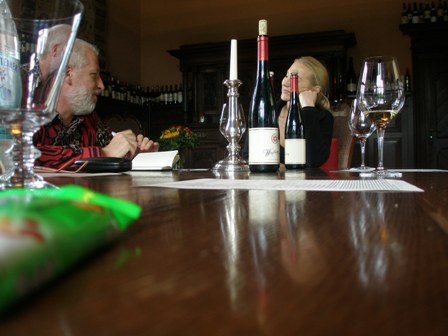
Contemplating about Riesling wines with Ms. Niewodniczanski

Five of the six were Riesling wines, one was a Pinot Blanc. The following list shows the six wines:

– ‘2007 Weissburgunder’ (Pinot Blanc), 9.90 Euro/0.75 l
– ‘2007 Schiefer Riesling’ (“slate” Riesling), 8.60 Euro/0.75 l
– ‘2007 Saar Riesling’, 9.80 Euro/0.75 l
– ‘2007 Wiltinger Braunefels Riesling’ (a single location/vineyard wine), 12.50 Euro/0.75 l
– ‘2007 Alte Reben Riesling’ (from old vines), 13.80 Euro/0.75 l
– ‘2007 Rotschiefer Riesling Kabinett (red slate), semi-dry, 9.90 Euro/0.75 l

We liked all of them but some more than others. Heinz bought some bottles of Saar Riesling and the semi-dry Rotschieder Riesling Kabinett. Apart from Saar Riesling I bought some bottles of ‘Alte Reben’ (old vines).

The Van Volxem tasting room is a wonderful place, with old wooden furniture and beautiful old maps on the walls.

The estate will release the Grand Cru wines later this summer. We were to early to taste them.

Farewell, but we will come back (my daughters Lucy and Charlotte with the vintner’s wife).

If you are interested in German Riesling, you have to visit the Saar region. Wiltingen is a must, so is Van Volxem Estate. Have fun tasting the best German Riesling has to offer.

Address:
Van Volxem Estate
Dehenstr. 2
54459 Wiltingen, Saar
Te.: +49-6501-16510
e-mail: vanvolxem@t-online.de
www.vanvolxem.de


What is “rustic”?

September 6, 2008

In yesterdays International Herald Tribune, I stumbled across an article by Eric Asimov on a Côtes du Rhône wine tasting. In this context the author contemplated the use of the word “rustic” and its meaning in describing wine styles. Eric rightly pointed out that “rustic” means different things to different people which in the end leads to quite a degree of confusion.

Does “rustic” mean “rough” and “simple” as some users imply thereby giving the term a negative connotation? Or is it meant positively in admiration for wines that show true character of a regional nature, wines that cannot come from elsewhere but this one place, made under the specific conditions pertinent to the location. Whatever the intended meaning, one might better understand the complexity of the term if contrasting it with the opposite meaning.

For “rough” and “simple” one could think of “elegant” or “refined” and “complex”, “sophisticated” maybe “urbane”. And for “regional character” the opposite might be “national”, “placeless”, “cosmopolitan”, “pan-something”. Some of my vintner-winemaker friends use another term to describe the opposite of “regional character” wines. They call it “industrial” wines often faultless products, technically well made but lacking in “character”. In this case a “hand made” wine is contrasted with a “technical” product.

Another aspect of an “industrial” wine is the consistency of the taste. One knows what to expect, its predictable. In contrast we have the small single vineyard with the variability of season where you “drink” the terroir, the site and its climate of that particular year. Whereas the former wines are for the “layperson” and the “conservative” who does not want to make a “mistake” in the choice of the wine, the latter are for the “connoisseur” and the adventurer.

We as small and/or boutique vintners want of course to make “faultless” wines but at the same time our main selling point possibly lies in our “fault lines”, our uniqueness, our authenticity, our character, our variability, our unpredictability. The “roughness” and “simplicity” of our artisan efforts in producing great wines of character becomes the backbone of our art of wine-making and as long as there are enough adventurers out there, our life and work will be interesting and rewarding.

Whatever it is, the wine I had, was just delicious (July 2008 in Madrid)


Germany’s Best Riesling Wines 2007

August 30, 2008

Riesling vineyards in Olewig, Trier

The wine magazine – Weinwelt (Aug./Sept. edition) – I picked up at Frankfurt Airport when leaving Germany in August carried an article on the best Riesling wines in 2007.

About 1.500 wines were entered into this tasting and the overall winner (with 93 points) was

● Weingut Geheimer Rat Dr. von Bassermann-Jordan, Pfalz wine region with a
‘2007 Auf der Mauer Riesling QbA, dry’

Among the top seven wines were 4 from Pfalz, one from Austria, one from Rheinhessen and one from Franconia. For someone like me, a native of the Mosel, it is devastating that no wine from my home region was among the best seven.

Another Riesling competition in Bingen/Rhein in July had a record entry of almost 2,000 wines (1,937 to be exact) from 754 producers from almost all wine producing regions in Germany and from Austria, Canada, Australia, Luxembourg, France, USA, and New Zealand. Most of the non-European Riesling wines came (surprise), of course, from Australia.

The show is conducted every two years and 160 judges of an international jury assesses wines according to the international wine bureau (OIV) standards. The full report of this tasting can be found on www.riesling.de under the rubric “best of Riesling 2008”. In the category “dry Riesling wines”, the winner came from the Rheingau wine region:

● Weingut W.J. Schaefer in Hochheim for the
‘2007 Hochheimer Kirchenstueck Spaetlese’.

Number 2 came from the Mosel:

● Weingut Frank Brohl, Puenderich for the
‘2007 Puendericher Nonnengarten Spaetlese’

and from Pfalz,

● Weingut Emil Zimmermann in Wachenheim for the
‘2007 Wachenheimer Koenigswingert Spaetlese’.

In the “semi-dry Riesling category” wines from Rheinhessen, Mosel and Nahe could be found among the three top wines. However, the “sweet wine category” was dominated by Mosel wines.

There will be many more shows and wine tastings in the coming months. In July this year, when we tasted the 2007 vintage at Van Volxem Winery (Wiltingen, Saar), the “grand cru” wines were not yet presented because their release was scheduled for fall.

Given the fact that most wineries have not yet officially released their “gand cru” or, as the Germans say, “grosse Gewaechse”-wines, we will witness great quality Riesling wines of the 2007 vintage hitting the market later this year. That’s what I call wonderful prospects for us wine lovers.

My favorite Riesling from the Saar

PS: From October 14-18, 2008 the 2008 Canberra International Riesling Challenge will be conducted. For the first time in the history of the event, the number of entries has surpassed 500 wines (506 total entries), with a record number from Germany (99 entries). Let us see what the outcome may be.


D’Arenberg

August 29, 2008

The ‘2001 The Coppermine Road Cabernet Sauvignon’ from d’Arenberg winery in McLaren Vale, South Australia should be the last bottle of wine we drank with a proper meal, sitting on our Indian garden furniture on the back terrace overlooking our lush tropical garden. The next day, all should be packed away. Interestingly, the food was also Indian. After all, we came from India to Indonesia in 1998, ironically everything seemed to revert back.

The ‘2001 The Coppermine Road Cabernet Sauvignon’ from d’Arenberg

In January 2005 we had visited d’Arenberg winery with our friend Sylvan Elhay from Adelaide. The photo above was taken in the car park. We tasted some wines in the tasting room (of which I have no picture) and enjoyed, apart from the wines, the beautiful valley view, depicted in the photo below.

The ‘2001 The Coppermine Road Cabernet Sauvignon’ has a beautiful dark, almost blue/black) red colour (almost like blood). The wine has won many gold medals in various wine shows, for instance the 2003 Pacific Rim International Wine Competition, the Perth Royal Wine Show and the Sydney International Wine Competition. The latter awarded d’Arenberg also the title of “most successful winery” in 2003 and the San Francisco International Wine Competition followed with the “Winery of the Year” award the same year. So “gold” was all over the bottle. It retailed for about US$ 40 in the Fatmawati duty free shop in Jakarta and I had reserved the bottle for a special occasion.

The vineyard where the grapes for this wine are grown has a long and interesting history (www.darenberg.com.au). D’Arenberg’s new website design includes an introductory video worth watching. Among others the winemaker, Chester Osborn, fourth generation of the founder family, explains the philosophy of their wine-making style.

The Coppermine Road wines belong to the category “icon wines”. The grapes come from a Cabernet Sauvignon clone which is almost extinct. The wines show an intense flavour of blackcurrant, cassis, some chocolate notes. The wine critic Robert Parker suggest a cellaring of 5 to 7 years. So, the 2001 vintage we drank was just perfect. Ang guess what? According to the website and the label on the bottle, even traditional foot-treading is used prior to modern pressing techniques. Not many wines enjoy such treatment these days. The wine had an excellent balance of oak and tannins and we thoroughly enjoyed it with a meal of “left-over” Indian dishes. It was a wine for a special occasion, and a special occasion it was.


The best restaurant in Northern Portugal: Quinta da Lama

August 27, 2008

The red entrance of the country inn Quinta da Lama

Quinta da Lama is not easy to find. If our host of Quinta de Gatão, Mr. Jorge Coelho da Silva, would not have guided us. He drove with his big BMW motorcycle in front of us so that we could find it otherwise we would not have a chance to experience this unique place.

Quinta da Lama is located in Vila Meã, near Peñafiel, the centre of Vinho Verde in northern Portugal.

Outside the main entrance construction is still going on

The restaurant is domiciled in an old olive oil mill and renovations are still ongoing. The millstone is at the centre of the restaurant and very picturesque. Rural equipment including tools from an old distillery can also be found. The interior is simple country style, extremely charming and very appealing. Rural folk all over the world will recognize its authenticity immediately.

The mill stone

One of the three female proprietors is Susana, an energetic young woman who speaks perfect English. The day we visited, she took our orders and served us the food. She made us feel at home. And as at home, we ate splendidly. To say it from the outset: this was quality food; fantastic rural dishes you won’t find elsewhere.

It was our last evening in rural Portugal and we had cause to celebrate. Looking back on a wonderful week in the countryside east of Porto.

The starter platter of Quinta da Lama

As customary in Portugal, a platter of appetizers is put in front of the diners. It consisted of home produced ham, local cheese, a sausage made from chicken and beef, melon and olives, all very delicious. We devoured the home made sausage made from chicken and beef. We drank the house red with the meal, a solid “Landwein” (table wine) as the German say.

The size of the portions is for (very) hungry workers

Our girls ordered a mixed grill type of dish with potatoes. I had a pork dish with chestnuts. As customary in Portugal rice and potatoes are consumed simultaneously. We had various desserts. I show you two of them, a ‘Crême brulée’ and the “secret” of the house, Papa’s D’Anjo.

The pork in chestnut

Crême brulée

Papa’s D’Anjo

Papa’s D’Anjo is a local dessert made of eggs and sugar syrup as far as I can recollect. It is very intense and one needs a lot of stomach space left to leave the plate behind empty. But what a delight this dish is. The fruit flavours are just incredible.

The end of the meal was celebrated with a “digestivo” which was equally a local invention. It’s the “trademark” of Quinta da Lama and is called Xiripiti, consisting of brandy home-distilled, with honey and cinnamon.

There is only one thing I can say, come to rural Portugal and visit Quinta da Lama in Vila Meã near Peñafiel just about an hour east of Porto in the Minho Region.

I will let you know more about rural Portugal soon. There are so many wonderful things we saw and experiences we were able to make. The hospitality of the people is just unbelievable, especially at Quinta da Lama.

Address
Quinta da Lama
Restaurante Tipico
Real
4605-348 Vila Meã
Tel.: 255-733-548


Songs of farewell

August 26, 2008

The last days in any one place, one is inclined to romanticize things.

But never forget “one man’s joy is another man’s torment”. It seems that the Chatib (in some places one calls them muezzins, the ones who call the faith to prayers) of the little mosque nearby is not calling for night and morning prayers as he used to. Maybe someone made a generous donation to the mosque to shut them up.

We did not sleep much the last couple of days in our little paradise in Lebak Bulus IV, No.9 C. In the past we used to struggle against the sound of the Chatib keeping us awake. Nonetheless, we long for the farewell signals of the call to prayer as we lie awake wondering about the life to come.

Our little mosque


The last Mohican

August 24, 2008

A Diam cork, the cork of the last ‘2004 Two Hills Merlot’

The last Sunday lunch in our Jakarta home was a ripper of a lunch. The lamb stew (Australian lamb) with green beans and the mushed potatoes (Bandung potatoes are stunning for mashing) were such a delight. My taste buds were exploding. This is ‘orgasmic food’ at its best, I might add. The recipe came from Marcella Hazan’s “Classical Italian Cooking Book” of course.

The lamb stew

This time I was right with the choice of wine. The last bottle of ‘2004 Two Hills Merlot’ went.

I quote from the tasting notes of my friend and wine connoisseur Thomas Weber. He wrote about the 2004 Merlot some time ago:

The ‘2004 Two Hills Merlot’ also displays ripe wild berry fruit but not the liquorice and nuts flavours. The wine is very subtle, elegant with great finesse. It is medium bodied, dry, with good acidity, and a long finish. Its tannins are firm and give the wine a fine balance.

The wine was just a perfect match for the meat stew. We could not have spend our last Sunday in our Jakarta home in a better way.

The last Mohican (bottle) of 2004 Two Hills Merlot

Farewell, so long, auf Wiedersehen, good bye!

PS: The good news is that we have a reasonable supply of ‘2006 Two Hills Merlot’ which we are going to release in fall 2008. Friedel Engisch (in Wuerzburg) and Gert Kueck (in Leipzig) are the only ones in possession of some bottles of our 2004 Merlot. Lucky you.