Max Allen, Australian wine writer, and the Upper Goulburn Wine Region

January 26, 2011

Max Allen’s book and three wines from the Upper Goulburn

One of my Christmas presents was a book on wine. I am now the proud owner of Max Allen’s latest book, titled “The Future makers – Australian Wines for the 21st Century”.

So far, I had not had the time to read it, but I glanced at the chapter dealing with our wine region, the Upper Goulburn Wine Region.

Wines from Rees Miller Estate and Jean Paul’s Vineyard

Only three of our vineyards in the region are described in the book. They are: Delatite Winery, Jean Paul’s Vineyard and Rees Miller Estate.

The latter two of these three are practicing biodynamic-organic viticulture which is, in the perception of many conventional vintners, a very complex, complicated and generally difficult way of producing wine. If you talk to biodynamic vintners that’s not at all the case; it’s different of course.

Many conventional vinters have great respect for their biodynamic colleagues. At our recent “welcome of the year 2011 party” at Two Hills Vineyard, the wine-makers and vintners present discussed the challenges of producing healthy grapes at length.

How can they (the bioynamic/organic producers) control the many fungal and other diseases, was one of the pertinent questions? How do they deal with mildew? How about the work in the winery?

Undoubtedly, many of their wines are of outstanding quality. This is also what Max Allen shows in his book. It is certainly worth to explore the production methods of the biodynamic and organic growers. In recent years also many of the larger wineries and vineyards have started to convert to more environmentally friendly methods of production.

Max Allen interviewed Will de Castella, owner and wine-maker of Jean Paul’s Vineyard, how he does it. I highly recommend the study of his answers.

Happy Australia Day veryone.


Grans-Fassian Estate in Leiwen, Mosel

January 22, 2011

Grans-Fassian Estate in Leiwen

When I drove along the Mosel on a grey Saturday morning last November, I was heading to Leiwen to buy some good Riesling wines.

There were three reasons for this trip. It all started at Frankfurt airport when I bought the December issue of “Weinwelt” (World of Wine), the German wine magazine.

1. I had looked at the results of a wine tasting of grand cru (GG = Grosses Gewaechs) Rieslings: two of the top wines from the Mosel came from Leiwen; one of them was a ‘2009 Dhroner Hofberg’ by Grans-Fassian Estate.

2. Leiwen is just a 30 minutes drive from my mothers home in Trier at one of the most beautiful bights of my beloved Mosel.

3. I love German Riesling especially if it comes from the Mosel river and I wanted to know what a 95 point wine would taste like.

The original Grans-Fassian Estate manor house with the cellar door

So off I went by car and cruised along down the Mosel. I was lucky, the cellar door was open. Here I met Catherina, one of the two daughters of the owner, Gerhard Grans who had taken over the estate from his father Matthias in 1982.

We had a bit of a chat about wine, life and the universe. Catherina is a charming young lady. She is going to be an oenology student at Geisenheim soon.

Catherina Grans showing me the top wines

I tasted two of the wines (the ones mentioned in the magazine): the ‘2009 Riesling Dhroner Hofberg’ (95 points) and the ‘2009 Riesling Leiwener Laurentiuslay’ (92 points). I tell you these are Rieslings how I like them. Wonderful wines indeed. Tropical fruit the first wine, and a kind of a citrus bomb the second. Both with a good structure, young, minerally, powerful with a long finish.

The treasure box with Grans-Fassian wines

Furthermore, I learned that the estate has about 10 ha under vines. Some of the vineyards are lokated in the best terroir of the region, for instance Dhroner Hofberg, Leiwener Laurentiuslay, Piesporter Goldtroepfchen, and Trittenheimer Apotheke.

About 88% of the vines are Riesling, 10% Pinot Blanc and 2% Pinot Gris. The brochure shows the steep slopes of some of the vineyards, most of them with a southern or western aspect. The micro climate is ideal for Riesling. The soils consisting of red, grey and blue slate.

I bought a couple of the two wines I had tasted. By the way for someone like me who pays obscene prices for wine in Bangkok, these top wines were very reasonably priced, in fact they were a true bargain. It’s a pity that wine bottles are so heavy. I knew that I could only take one, maximum two of them with me on my long journey back to Thailand. What a pity, I thought.

The wine bloggers delight

Here is another hot “secret” for your next trip to the Mosel river: Grans-Fassian Estate in Leiwen should be your destination. Trust me, you will not regret it.


November at the Mosel river
January 21, 2011

It’s beautiful to drive along the Mosel river, even in the month of November. I had this opportunity last year and thoroughly enjoyed it.

The Mosel wine route (Mosel Weinstrasse) is a fine example of a scenic drive along the vineyards and wine villages in this part of Germany which I still call home.

The winding Mosel with the slopes covered in vineyards

Steep slopes promise hard work and exquisite wines

Vines on blue slate soils

Blue slate ideal for Riesling grapes

Every individual vine got one stake

Low lying vineyards at the river bank

As many as you like

Famous terroir: Poelicher Held

Famous terroir: Kluesserather Bruderschaft

The Roman wine route

The country I come from is just beautiful. Visit the Mosel and remember the Romans did this too about 2000 years ago. Spring (and Mosel Riesling) is waiting for you.


Wine village Leiwen at the Mosel River

January 18, 2011

The wine village Leiwen at the Mosel river

Last November I had the opportunity to visit Leiwen just about 30 minutes down the Mosel river from my hometown Trier.

Grape press

Leiwen (about 1,600 inhabitants) is not only a village known as a holiday destination but it is also a famous wine village. Here quite a few of the top Mosel wineries and members of VDP, the association of the top producers are located.

Leiwen got it’s name from Livia, the wife of the Roman emperor Augustus and has a long tradition in grape growing and wine making.

Riesling vineyards

Vineyards on the flats

Riesling, the aromatic grape of the Mosel, is the dominant variety here. Many of the vineyards are located on extremely steep slopes which are hard to cultivate. The ground is mainly gray, blue and sometimes red slate.

Many signs indicate the way to the various wineries

Many, mainly small and family owned wineries call Leiwen their home. The tasting rooms and wine cellars are usually located in the middle of the village. Space is certainly an issue.

On a quiet Saturday morning, the village was almost deserted. No tourist can be found during these times of the year. Vintners were in the vineyards busy pruning their vines. But I went to taste some wines of which I will tell you more soon.

But visit if you can, next spring or summer, any time is a good time. The wines are worth it.


College Red – Sevenhill Cellars

January 16, 2011

Sevenhill Cellars ‘2007 College Red’

When I opened the bottle of ‘2007 College Red’ by Sevenhill Cellars from the Clare Valley and had the first sip I thought how awful. But after a short while only, my perception changed. The wine “opened up” so to say.

I just had to get used to the blend: one of Cabernet Franc with Malbec. Unusual somehow with dense aromas, a full palate of red and black fruit, weighty with a long finish. In Argentina Malbec is blended with many other red varieties but not so in Australia.

Beautiful. I immediately regretted that we had only one bottle of it. It came as part of a special order pack. We will have to order more from Sevenhill Cellars. At A$ 12 per bottle the wine is quite affordable.

Very dark coloured 2007 College Red

The back label

Agnolotti pasta

The blend of Cabernet Franc-Malbec went very well with the food: Agnolotti (originating from the Piedmont region of Italy) with mushrooms. It made a very pleasant lunch on a warm summers day on our farm in Glenburn.


Red snapper with Sevenhill Inigo Riesling

January 5, 2011

What a beautiful red snapper

My friend Brett Travis had given us the above red snapper before leaving on a fishing trip to Samoa. This was a wonderful opportunity for another wonderful lunch at our vineyard. We prepared the fish for a six persons meal.

Yummy veggies

It was a beautiful summers day. The fish was “crying” for a white wine too. We took the opportunity to open one of the recently acquired bottles from Sevenhill Cellars in the Clare Valley in South Australia where our mate Neville Rowe is the general manager.

The ‘2009 Inigo Riesling’ is a typical Clare Valley wine. It is young and fresh and lively. Of course I prefer German Riesling wines, and it is my view that Australian Riesling cannot reach that ultimate Riesling level which I love so much.

Sevenhill Cellars is the oldest wineries in the Clare Valley. It was founded by Jesuits in 1851 to produce sacramental wines. We enjoyed the “sacrament” with the delicious fish, and thank all our benefactors. Cheers mate.

2009 Inigo Riesling by Sevenhill, Clare Valley


4. Sunday of Advent with German Riesling

December 19, 2010

It was my time to cook Sunday lunch. Anyway, the three gorgeous women I share my life with were due to travel to Australia later today. In order to give them time to pack, I prepared lunch. I admit, however, that Margit helped me quite a lot. Otherwise, I guess, I would not have accomplished the task.

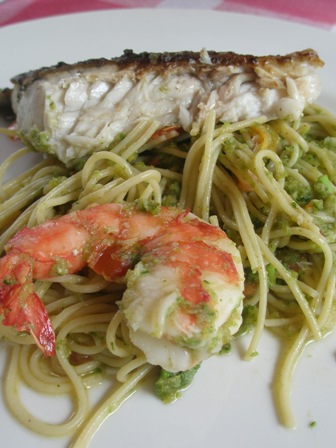
So what did I cook? A strange dish, I must say, straight out of the Jamie Oliver cookery book titled “Jamies does…”. It is a recipe from the Maghreb, Marrakesh to be precise. It consists of spicy vermicelli stuffed with prawns in a courgettes-tomato kind of sauce and on top a large fish is positioned (sea bass, snapper, etc.). Since we did not have a whole fish, we used fillets of sea bass.

The whole process is too complicated to be recited here. The recipe can be found on the internet, one of Jamie’s websites. Boy that dish is delicious, just wonderful. I would like to encourage you to try it, especially if you like spicy food.

The prawn-stuffed spicy vermicelli with fish

The fish is succulent but crisp

On the plate

As the title of this blog entry suggest, Riesling was the wine of my choice. German Riesling is my favourite. Wine does not age in my care here in Bangkok in the tropics. I selected a ‘2008 Riesling Kabinett’ by Schloss Johannisberg, one of the oldest Riesling producers in the Rheingau and Germany as a whole.

2008 Riesling Kabinett Schloss Johannisberg

A Kabinett was just the right wine because of its relative high “rest sugar” it’s off-dry or semi-dry, “halbtrocken” or “feinherb”, as the Germans say. However, the label did not say if the wine was dry or semi-dry. But my palate told me the sugar level must be at about 9 grams or so. Alcohol was 11.5%.

In any case the wine went extremely well with the very spicy vermicelli. I just love the bouquet, this slight petrol note on the nose. This is a wonderful rich wine, with a fine balanced acidity, the taste of apples and peaches are prominent.

2008 Riesling Kabinett Schloss Johannisberg

I wish we had more of this drop

If you buy this wine directly from the producer, you have to spend 17 Euro for a 0.75 litres bottle.

The meal with this wine was just perfect for the occasion. Time fly’s. Christmas is approaching fast and soon I will be back in Glenburn, Australia and taste many new-world wines.

Address:
Fürst von Metternich-Winneburg’sche Domäne
Schloss Johannisberg

D-65366 Geisenheim
Tel.: +49 (0) 6722-7009-0
E-Mail info@schloss-johannisberg.de
Restaurant
Tel:. +49 (0)6722 96090
E-Mail restaurant@schloss-johannisberg.de
www.schloss-johannisberg.de


Bodega Berberana – Wine from Rioja

December 12, 2010

Pasta ai funghi porcini

A pasta ai funghi porcini needs a strong wine as accompaniment. Therefore I selected a ‘2003 Carta de Oro Crianza Rioja’ by Bodega Berberana, one of the oldest Rioja wine producers.

The ‘2003 Carta de Oro Rioja’ by Berberana

I believe it is high time that the 2003 vintage is consumed. The wine’s colour is already changing from dark red to the brick brown. But it has still the strength, the flavour and the body which makes this Rioja wine so superb. This blend of 80% Tempranillo and 20% Grenache is just the perfect wine for a “heavy” pasta. It is velvety and smooth with a long finish, a complex wine for every day drinking. Just honest and good stuff.

The back label of the Berberana Rioja

The colour is slowly changing


Red Mountain Estate – Wines from Burma

December 11, 2010

Pinot Noir by Red Mountain Estate

My friend Moritz brought some bottles of wine from a trip to Burma back to Bangkok. He gave me a ‘2009 Pinot Noir Taunggyi Wine’ by Red Mountain Estate which is located in the Southern Shan State at the picturesque Inle lake. The vineyard was planted in 2003 at about 1000 meters altitude.

When I opened the bottle and found a plastic “cork” my enthusiasm declined rapidly. Well, what will the wine taste like, I thought, with such an enclosure?

To say it from the outset, the wine is a project in the making. The technology used by Red Mountain Estate may be ultra modern. All equipment is imported from Europe and the wine is aged in Hungarian oak. However, the tropical conditions, as customary to New Latitude wines, is still a challenge.

The colour of the wine is a dark red. It is medium bodied and has 12.5 % alcohol. The taste is a mixture of saw dust and rubber, not unpleasant though, and perfectly drinkable.

I had the chance to taste some more of the Red Mountain Estate products at Moritz’s house. I liked the Chardonnay best followed by the Rose. The reds were not particularly strong, a bit thin, for my taste. As I said, work in progress.

Front label of Red Mountain Estate Pinot Noir

The location of Red Mountain Estate is very beautiful, almost spectacular. Photos of the Inle Lake, the vineyard and the winery can be found on the estate’s webpage (Moritz has some on his facebook site). I should visit this region and have a look myself.

The back label of the Pinot Noir by Red Mountain Estate

PS: We had some antipasti – fried salami – before the main course, a pasta. The recipe is from a Jamie Oliver cookery book. Wonderful, so tasty, with olive oil and fresh Parmesan cheese.

The fried salami antipasti

Address:
Red Mountain Estate
Taung Chay Village Group, Nyaungshwe Township,
Southern Shan State, Myanmar.
Tel: +95-081-209366 begin_of_the_skype_highlighting              +95-081-209366      end_of_the_skype_highlighting
      +95-081-209554
Fax: +95-081-209475
Mobile: +95-09-5174312
www.redmountain-estate.com


Gianni Masciarelli – Villa Gemma Montepulciano d’Abruzzo

November 26, 2010

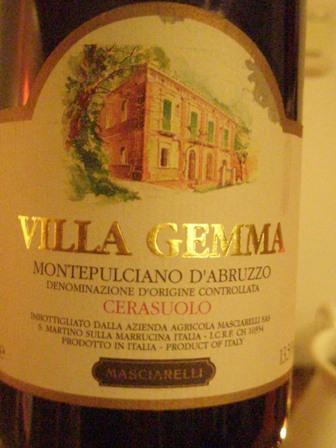
Villa Gemma Montepulciano d’Abbruzzo

Another very nice wine which I tasted recently is the ‘2007 Villa Gemma Montepulciano d’Abruzzo’ by Masciarelli.

More than twenty years, Gianni Masciarelli started to produce grapes and wine from a 2.5 ha vineyard which has “grown” to more than 220 ha under vines today. Also the yield level with about 10 tonnes/ha is not particularly low.

However, I liked this fruity wine which shows the characteristic of the Montepulciano grape. The wine is round and smooth with lots of black fruit but also vanilla and spicy notes. It also went very well with the Asian food we had it with.

In the tropics we tend to drink wine young (very young indeed), because storage can be a problem. It is a pity that Gianni died in 2008 at the tender age of only 53.

Try is wine with Asian cuisine, you will not regret it.