Family dinner – Little Yering Cabernet Sauvignon

May 13, 2011

To find a wine for every day which goes with many different dishes, nothing fancy, just for a family meal, can be challenging. To my great surprise, Yering Station Winery from Yarra Glen in the Yarra Valley in Victoria produces just that kind of stuff with its “Little Yering” brand. Moreover, here in Bangkok you can get a bottle of Yering wine for a decent price.

Established in 1838 Yering Station was Victoria’s first vineyard. That’s a awful long tradition in an Australian context. I like the place, the winery and the cellar door as well as the restaurant. Despite the fact that the vineyards are mostly planted on flat lands, one has a good view from the terrace.

2008 Little Yering Cabernet Sauvignon Shiraz

The ‘2008 Little Yering Cabernet Shiraz’ is a blend of the two red grape varieties, an Australian classic so to say. It cost about 18 A$ if bought at the cellar door. In Bangkok you can have it from Villa Market for about 560 Bath, about 13 Euro.

The wine is aged in mainly old oak casks after it has undergone a malolactic fermentation. The vines are of medium age (7-11 years). I like the intense taste of red berries and the spiciness provided by the Shiraz grapes.

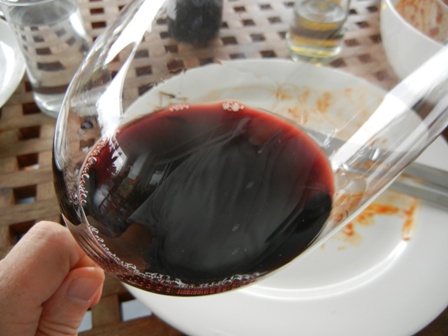
Dark red colour

We had ‘malanzane alla parmigiana’ for dinner. The photo below does not do justice to this delicious Italian dish.
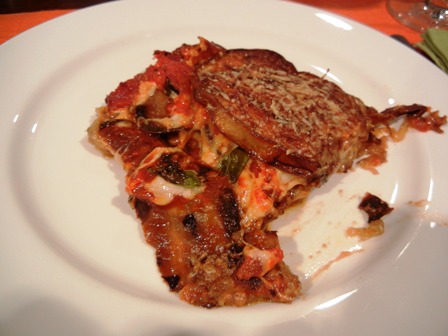
Melanzane alla parmigiana


Alamos – Cabernet Sauvignon from Argentina

May 11, 2011

2008 Alamos Cabernet Sauvignon

We had beautiful gnocchi for my farewell dinner at home before leaving for Taiwan again. On my way home from the office I dashed into a wine shop and bought a bottle of red. I selected a ‘2008 Alamos Cabernet Sauvignon’ from Mendoza, Argentina. I just wanted something else.

It turned out to be a good choice. The wine complemented the meal and harmonized well with the gnocchi in tomatoes. I loved the fine aroma of the wine, the long finish and the intense fruit flavours of red berries with some spicy notes.

Bodega Alamos produces a wide range of wines. The grapes are sourced from the Catena family vineyards in Mendoza located on high-altitude sites (3,000 to 5,000 feet). The chief wine-maker of Bodega Alamos is Felipe Stahlschmidt. I could not think of a more German name.

The price of the wine in Bangkok was, as are all wine prices, ludicrous (25 EURO/bottle). However, given the Catena family legacy regarding the production of the Malbec variety, I will try their Malbec wines next.


Progressive dining experience – do we need culinary art?

May 6, 2011

In today’s Bangkok Post a novel cuisine was described which is currently offered at the “Plaza Athenee Bangkok and Fin”, a place I have never heard of. According to the paper “Progressive dining experience” is a new gastronomic concept involving pop-up venues and somthing called “molecular cuisine”.
It promises an inventive, novel culinary adventure, something unique in Bangkok. The originators, Daniel Bucher and Axel Herz, are two young award winning chefs from Le Meridien in Hamburg.

But what is “molecular cusine”, “molecular cooking” or “molecular gastronomy”? Well, of course any cooking is “molecular” so to speak. According to Daniel Bucher it is “avant-gard culinary art combined with hard-core food science” presented in pop-up (impromptu) venues.

It is supposed to be what modern city dwellers want: sustainable, environment friendly, highest quality food for a competitive price in an environment with low overheads. It is supposed to provide creative freedom, fun and laughing and even “to make you love” food, I suppose.

The newspaer article does not provde any information about the price of the five course menu and the five wines which were part of the dinner.

Well, for an Epicurean like myself that should be the ultimate, should’nt it? If you eat for pleasure alone and not for nurishment, isn’t that the good life we are all striving for?

Despite the fact that I spent more time dwelling in big Asian cities than in rural areas, I am a country boy, and thanks god that. My type of food is not the deigner stuff you get in those modern restaurants. I want real food and not art.

You can find many of the meals I treasure here on my blog. But I am afraid that I have to go and taste for myself otherwise my criticism lacks a certain edge and the profoundness necessry to be credible.

As compensation, let me invite you to a glass of wine instead. My recommendation is, surprise surprise, a German Riesling, a ‘2009 Grans-Fassian Laurentiuslay GG’ by Grans-Fassian Estate in Leiwen, Mosel.

This is the best Riesling wine I tasted this year.


Mediterranean cuisine

April 30, 2011

Skewers of lamb on the “home” grill

Lamb is not necessarily everybody’s favourite. In my native Germany the consumption of lamb is about less than one kilogram per capita. Only in the 18th century lamb and mutton was the main meat consumed in German lands. Sheep meat has a bad reputation because most people do not know how to properly prepare it. That;s at least my understanding of the matter.

Since I marries Margit I have learned my lesson about lamb. It can be a wonderful dish, you just have to cook it in the right way and, I might add, with the right spices.

The finished lamb skewers

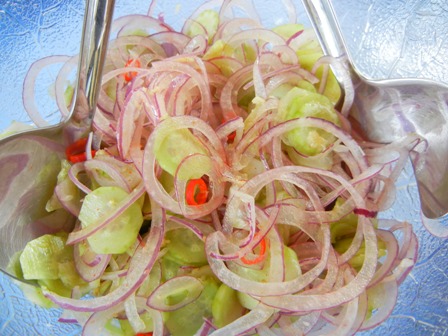
A nice salad with onions and some chilies

Also some rice

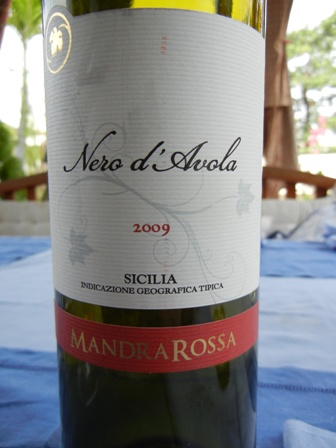
The coriander and the other “Southern” spices as well as the lamb itself call for a Mediterranean wine. So why not a Nero d’Avola from Sicily?

This red grape variety is the most important one of the island. The grape is used in blends and for the production of fortified wines. The ‘2009 MandraRossa Nero d’ Avola, IGT’ was just the right wine for that meal.

A beautiful colour of the Nero d’Avola

Wines made from the indigenous Nero d’Avola grape is sometimes referred to as the ‘godfather’ of Sicilian wine. The MandraRossa Estate is located near Menfi in the southwest of the Island. When I visited Sicily in 1988 (oh god that’s so long ago), my first and last visit of this splendid place, we did not go that far West.

The front label

The wine shows beautiful flavours of plum, is spicy and richly textured. The MandraRossa is not a blend but a single variety wine. In my view this is a wine for every day consumption. In the “Timo Mayer classification”, it would qualify as an “umpf” wine: a wine with guts. My verdict: get a bottle and enjoy.

The back label


Easter Sunday: Lunch at Bacco, Bangkok

April 26, 2011

No better place to go for a Sunday Easter family lunch than Ristorante Bacco, our favourite Italian restaurant in Thonglor, our old neighbourhood. We like real food with rustic charm and not the designer stuff, small bits of food looking like works of art on big plates.

Below you can see what we ate. First are the three antipasti we selected. Delicious.

Melanzane alla parmigiana

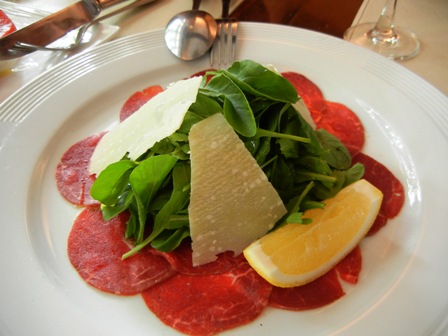
Carpaccio

Insalata caprese

All three antipasti on my plate

Our family consists of “traditionalists”. Three of us ordered gnocchi, the other main dish was tagliatelle with mushrooms in a creamy sauce.

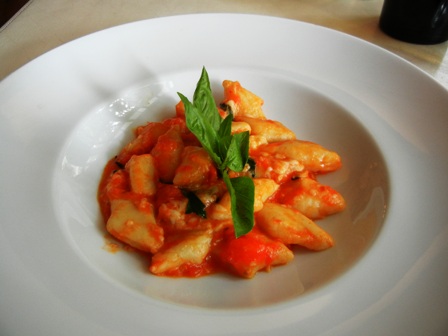
Gnocchi

Tagliatelli delicata

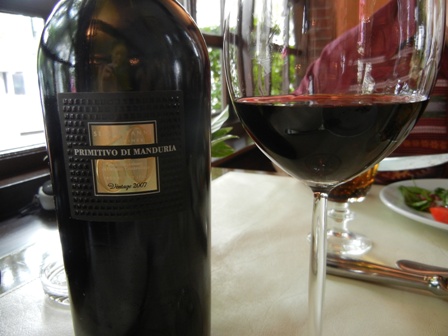
How about the wine, you might ask. I love to order a simple ‘Primitivo’ (called “Zinfandel” in the USA) from Apulia. This time I selected a pricier wine than normal, a Primitivo made from 60 year old vines.

It turned out to be an excellent choice. The ‘2007 Primitivo di Manduria DOC’ by Feudi di San Marzano is a big wine (with 14.5% alcohol). The intense fruit aromas, plums mainly but also with earthy and spicy notes, had me forget that I was in the tropics.

Manduria is a town of about 30,000 inhabitant, about 30 km east of Taranto and about 14 km north from the Apulian coast. The place has a very warm climate.

The wine is made from 100% Primitivo grapes. One can sense that the vines are old, very old (sixty years, is what the label says). The bottles are also very heavy and old fashioned. I liked it, not wasting any thought about the carbon footprint.

2007 Primitivo di Manduria DOC

The back label of the Primitivo by Feudi di San Marzano

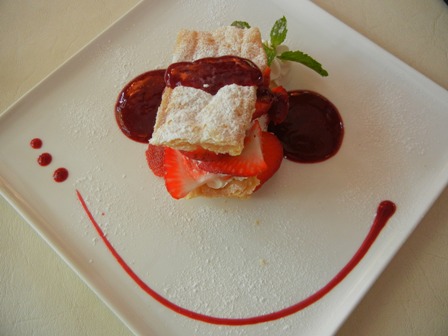
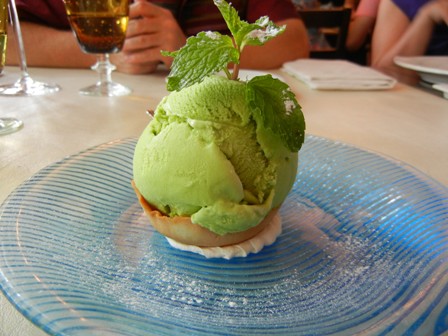
And after all this delicious food came the sweets or dolce as they are called in Italian.

Strawberries and cream

Pistaccio ice cream

Tirramisu

This was a very memorable Easter Sunday lunch. We had a great time with yummy food and delicious wine at Bacco. I will remember the wine and order it again.

If you need something special, and you do not want any more Thai food, have a break and eat Italian at Bacco. You will not regret it.

Address:
Bacco Osteria da Sergio
Sukhumvit Soi 53, Bangkok,
Thailand
Tel.: +66-2-662-4538
http://bacco-bkk.com


How about some bubbly?

April 25, 2011

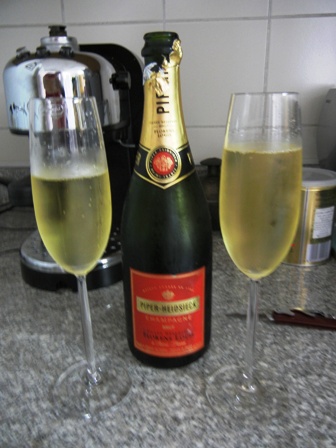
Easter, as any Christian holiday, lends itself for a treat and why not celebrate with some “bubbly” as we say in Australia. I had just the right stuff in my wine fridge, a bottle of ‘Piper-Heidsieck Champagne Brut Cuvée Réservée’ by Florens-Louis Heidsieck from Reims, France.

Florens-Louis Heidsieck was the founder of the champagne house Heidsieck (in 1785). He was the son of a Lutheran minister who had migrated from Westphalia to France. In October 1839 the name of Piper, another descendent of Florens-Louis, was added to the band name.

Great fizz from the Piper-Heidsieck Champagne Brut Cuvée Réservée

The bottle was a present from our friends Emmie and Rob. We had kept it for for some time, for a special occasion of course. This had just arrived, I guess.

The champagne is a non-vintage but very classy sparkling wine with 12% alcohol. It is a blend of 55% Pinot Noir, 15% Chardonnay and 30% Pinot Meunier. The nose shows some citrus notes. The acids are finely balanced. I just loved the fact that the bubbles were “big,round and slow”.

This is a highly recommendable drop. Great stuff this Piper-Heidsieck.

The front label of the Piper-Heidsieck Champagne Brut Cuvée Réservée


The “philosophers fish” with a St. Urbans-Hof Riesling

April 17, 2011

I love fish in all variations. “The Philosophers Kitchen”, a cookery book by Francine Segan offers great fish recipes. The red snapper in parchment recipe you can also find in my blog entry of 2007 titeled: A philosopher’s lunch.

Fish with olive and capers

Potato wedges

I had brought from Germany a great wine for exactly such an occasion, a ‘2009 Laurentiuslay GG Riesling’ by St. Urban’s Hof Estate in Leiwen, Mosel.

Refreshing 2009 Laurentiuslay GG Riesling

This grand cru Riesling is just wonderful. It not only scores high on Parker points but is a great example what top Riesling producers from the Mosel can do with this grape variety. The 2009 Laurentiuslay Riesling GG was one of the five best Riesling wines I tasted in 2010.

I can do only one more thing: suggest to you to get a bottle, soonest I would say.

The front label

The good news is that I have one more bottle in my fridge here in Bangkok, reserved for another special lunch with great food. Unfortunately, my fridge has no “magical properties”. I will have to bring more bottles from Germany via suitcase which is not very commodious.

Address:
St. Urbans-Hof Estate
Urbanusstraße 16
D-54340 Leiwen/Mosel
Germany

Tel.: +49 65 07 / 93 77-0
Fax: +49 65 07 / 93 77-30
www.urbans-hof.de

Winery’s opening hours:
Monday – friday: 9 am – 5 pm
Saturday: 9 am – 3 pm (on appointment)
Sundays and on holidays: closed


Mother’s cooking: Venison with a Grans-Fassian Riesling, Leiwen, Mosel

April 13, 2011

I love nothing more than when my mother cooks venison or other game meat for me. She does not eat it herself because she does not like game meat at all. But my friend Heinz, a passionate hunter, and me, we just love it.

Mushrooms, Swabian “Spaezle” and venison from a ‘red deer’

In his freezer Heinz has stored all kinds of beautiful pieces of hare, roe deer, red deer, moufflon and wild boar from his hunting expeditions. And when I am home in Trier, we have a feast. This time they prepared a fillet from red deer for me.

And that’s the meal

No better wine with this al of game than a wine from the Saar river, I thought. Because the red deer was shot in Schoden, Saar where Heinz used to hunt. “Used to” because he lost his hunting territory. From the first of April other tenants has taken possession of it. The association of landowners, ‘Gehoeferschaft’ called in German, has decided to award the six year lease contract to another group of hunters.

But I had no wine from the Saar at hand. So what to drink with the delicious venison?

Well, there are plenty of good Riesling wines around. My choice then was a ‘2009 Laurentiuslay GG (grand cru) Riesling’ by Grans-Fassian a top Riesling producer from from Leiwen, Mosel.

Though I am not a “point drinker”, and this wine scores in the mid 90ies, is a ripper of a Riesling. As expected, it did not disappoint me. This is a “must buy” wine. I just love it. I even got a bottle here in my wine fridge in Bangkok.

So if you are traveling along the Mosel, visit Leiwen and buy a couple of cases from Grans-Fassian Estate. You will not regret it.

2009 Laurentiuslay Riesling GG by Grans-Fassian Estate

Address:
Weingut Grans-Fassian
Römerstraße 28
54340 Leiwen, Mosel

Tel.: +49- 6507 -3170
Fax: +49-6507 – 8167
E-Mail: weingut@grans-fassian.de

Monday-Friday
8.00-12.00 und 13.30-16.30 Uhr
or on prior appointment


Wine bars in Trier: Weinstube Kesselstatt

April 10, 2011

Wine bar Kesselstatt in Trier

A place I just love to visit while in my home town Trier, Mosel is a cosy wine bar-cum-restaurant near the cathedral, called Weinstube (wine bar) Kesselstatt.

It is housed in the historic administrative building of the Estate Reichsgraf von Kesselstatt, a well known winery with a long tradition (more than 600 years – difficult for us Australians to comprehend).

In front of the building is a replica of a tomb stone called the “Roman wine ship” found in Neumagen-Drohn, a village at the Mosel river, in 1878. In 220 it used to be one of two stones marking the grave of a Roman wine merchant. Honestly, I would love to get such a tombstone set on my own grave. What a hoot.

Today the winery is owned by the Reh family. Annegret Reh-Gartner manages the 36 ha of prime vineyards located along the rivers: Mosel (12 ha), Saar (12 ha) and Ruwer (12) ha. 98% of the area is under Riesling. The estate calls itself “the Riesling winery”.

When I strolled through the town at the end of March, I could not resist its magnetism and dropped in for a quick glass of wine.

The inside of wine bar Kesselstatt

Because the Kesselstatt estate owns vineyards along the three rivers constituting the former wine region of Mosel-Saar-Ruwer, one has a great choice of different Riesling wines.

I ordered a semi-dry Riesling from Scharzhofberg, a grand-cru of the outstanding Saar Riesling wines. Normally I avoid semi-dry wines but because of the early hours of my visit I just could not go for a dry Riesling.

2010 Scharzhofberger Riesling semi-dry, Reichsgraf von Kesselstatt

What a delight this wine is! I dissolved, so to say, this is Riesling at its best, and I tend to argue that none in the world is better. Lush and full, round but with zest, a titillating pleasure for the palate.

Below you will find pictures of the inside of the bar. There are old barrels filled with bottles, a old wooden press, and a side room with a map of the estates’ vineyard locations and other interesting wine paraphernalia.

Wine bottles in old barrels

A huge wooden wine press with a church bench in front

The function room

When I left the Kesselstatt wine bar revitalized and in high spirits, I walked out to a cherry tree in full blossom with a splendid view of the adjacent church of St. Liebfrauen and the cathedral (Dom, left).


2006 Leonardo Chianti Riserva

April 7, 2011

The vegetable pastry

My twin daughters had prepared the antipasti (vegetable pastry, in Swabian: Maultaschen) and after that we had a chicken cacciatore.

Chicken cacciatore with potatoes

I had deliberately selected a red wine, a ‘2006 Leonardo Chianti Riserva’ by Cantine Leonardo da Vinci in Vinci, near Florence.

Normally, I try to avoid wine co-operatives and their produce but instead go, if I can, for single vineyard wines, small boutique wineries and family vineyards. More often than I want, I end up with what I call industrial wines, standard blends of grapes from many locations and different grape varieties.

The wine is a blend of Sangiovese 85%, Merlot 10% and some other red grapes 5% which are not specified. It has a beautiful colour, and a fruity aroma of red berries with notes of vanilla, a bit spicy. The wine is matured for about 10 months in French oak but the oak is not overpowering. The tannins are well balanced.

Leonardo Chianti Riserva

I admit that I bought the bottle because of its label. Who does not like Leonardo da Vinci and his famous drawing of the Vitruvian Man. I am a Renaissance man myself, a polymath, a jack of all trades and a master of none.

Beautiful dark red colour

Address:
Cantine Leonardo da Vinci
Via Provinciale di Mercatale, 291
50059 Vinci (FI) – ITALY
www.cantineleonardo.it