SIP – My favourite wine bar in Bangkok

June 21, 2012

SIP Wine Bar and Tasting

Since a long time I want to write about my favourite “watering hole” in Bangkok. It is a small and unassuming place in Soi Ekamai, just a couple of meters from my office. I pass by there every day when walking to and from work.

It’s name is SIP Wine Bar and Tasting. Victor, the owner and manager is a great guy, passionate about wines and extremely knowledgeable. SIP offers value for money. So it is no wonder that tripadvisor gives it 4 1/2 stars out of five.

No space to hide

The other day when we were dropping in for a quite evening sip, we found ourselves in a large group of customers. The place was choker blocker full because the Bangkok Wine Club and about 30 of it’s members had flocked to SIP for their monthly get together.

Our wine

We met some interesting people and had some interesting conversations. The ‘2011 Yellowwood Tree Pinotage’ from the Western Cape in South Africa was a medium bodied wine with nice fruit aromas, a wine for easy drinking.

Victor has a good collection of wines from all over the world. Moreover, given the fact that wine prices in Thailand are astronomical (among other because of the high taxes), SIP offers value for money. You will not regret it. I suggest you check it out yourself.

Address:
SIP Wine Bar and Tasting
33/32 Sukhumvit Soi 63 Ekamai
Klongton-nua, Wattana,
Bangkok 10110, Thailand
Tel.: +66-27142223
Mobile: +66-816998748
e-mail: victor2sipwinebar.com
www.sipwinebar.com


PB Valley Chenin Blanc 2010 – Wines from Thailand

June 16, 2012

2010 PB Valley Chenin Blanc

One of my favourite Thai wines is the ‘2010 PB Valley Chenin Blanc’ by PB Valley Khao Yai Winery in Khao Yai, Thailand. This wine was awarded a Bronze medal by Decanter earlier this year.

It has a good acidity and a nice freshness. The tropical fruit flavours are refined and not overpowering. It is amazing that this grape variety from the Loire Valley in France is growing so well here in the tropics.

Fish and veggie salad

We had it with a white fish and a salad made from various vegetables. The wine was a perfect complement.

Look out for this wine. It’s very good value for your money. You can buy it here in Bangkok at the Great Hornbill Bistro in Soi Sukhumvit 39.


2010 Steingarten Riesling by Jacob’s Creek

June 12, 2012

2010 Steingarten Riesling by Jacob’s Creek

The other day I picked up two bottles of Australian wine at Beijing International Airport. I was in transit and browsed through the duty free shops when I saw them. First I thought them a bit pricy, but then I decided to take two, one white, one red.

The white wine was a ‘2010 Steingarten Riesling’ by Jacob’s Creek. Some wine critics call this wine a ‘benchmark of Australian Riesling’.

Usually, I avoid buying Jacob’s Creek because my wife hates the brand. For her it stands for cheap mass-produced wine. During our time in Beijing in the early nineties there was only cheap Jacob’s Creek available in some selcted shops. Ever since she does not like the producer.

However, I had heard about “Steingarten”, maybe one of the best Riesling terroirs in Australia. And because I am still searching for my favourite Australian Riesling, I thought to give it a try. The original Steingarten vineyard is located at Trial Hill in the Eden Valley, South Australia.

“Steingarten” is German and means “garden full of stones”, but in the case of Jacob’s Creek its a brand name. The wine is “cool climate” and the grapes come from selected locations at higher altitudes of the Barossa Valley.

The bottle had even an individual number (I bought bottle number 22947); and it was low in alcohol (12.5 %). I paid about 25 EURO for it which is not cheap. In my native Mosel valley there is plenty of first class Riesling around for such a price.

The wine was not bad. It had the normal Riesling aromas (lime, citrus and green apple in this case), a solid structure, fine acidity and a good finish. However, I must be spoiled by the German kind of this wine so that also this one did not trigger my enthusiasm.

Needless to say, the search for an Australian Riesling which satisfies me is going on.

The bigger disappointment was to come: the food.

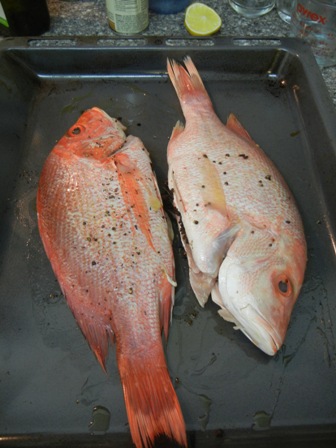
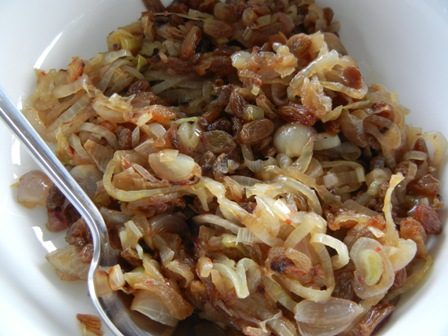
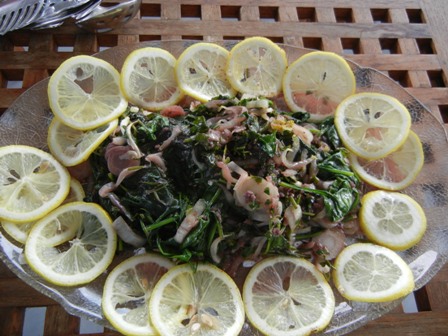
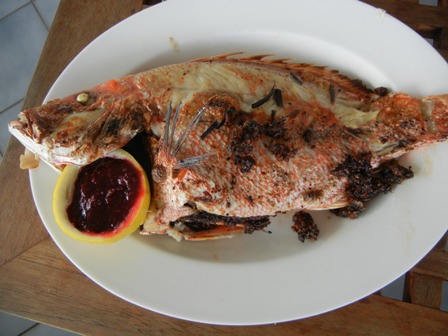
Of course we had the wine with food. Shakespearean cuisine was the go, which is a rather sweet affair with lots fo figs and raisin. Every individual dish tasted interesting. But we made a basic mistake: the various dishes did not harmonize at all with each other. I will just show some pictures and spare you the details of the dishes.

Here is what we had:

The fish

The raisins

Raisin-onion dish

Other veggies

…and the fish with jam


Buddha Enlightenment day – what a lovely lunch

June 7, 2012

It was the first day with the family after an extended absence from Bangkok, and we all enjoyed a hearty meal together. The wine I had brought with me from Brussels. We were looking forward to it. As you know, I am not very knowledgable as regards French wines. But first, let us see about the food.

The main dish

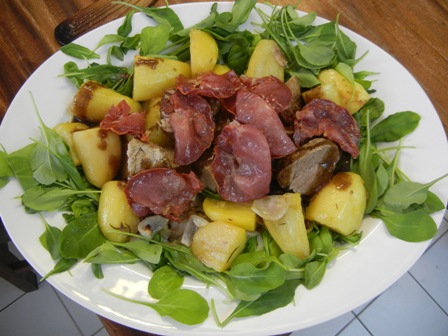
We had some pork loin on a bed of rocket sald and potatoes topped with some bacon. This was super delicious. As side dish we had some assorted vegatables consisting of zucchini, carrots and cualiflower.

The vegetables

On the plate

As mentioned above, the wine came from a supermarket next to my hotel in central Brussels. I choose the most expensive bottle on the shelf, and voila it was a ‘2007 Union des Producteurs de Saint-Émilion Grande Sommellerie’, a blend of the five traditional Bordeaux varieties (Cabernet Sauvignon, Merlot, Cabernet Franc, Petit Verdot and Malbec).

I had no idea who the “Union De Producteurs De Saint-Emilion” was. However, the wine was dark and full, a bit like jam, full of red fruit flavours. It has a good body and a reasobale long finish. In short, it was no disappointment.

The colour of wine

Conclusion: I do not sample sufficient French wines, and should drink more of it.


E. Guigal Estate, Côtes du Rhône, France

May 31, 2012

At a recent dinner function I had the opportunity to taste some wines by Etienne Guigal, the famous wine producer from Côtes du Rhône, founded in 1946 and today managed by the third generation. Marcel and his son Philippe are producing excellent wines.

In 1995 the estate acquired the famous Château d’Ampuis, which has become the headquarters of the Guigal Estate. The Guigal family owns vineyards in Condrieu (about 150 ha) and the Côte-Rôtie (230 ha). So this is not a small family business. In Condrieu the jewel of ths estate is “La Dorianne”, a Viognier. In the Côte-Rôtie area the Guigal Estate has several jewels, for instance “La Mouline”, “La Turque” and “La Landonne” among others.

2009 Côtes-du-Rhône White

The ‘2009 Côtes-du-Rhône White’ is a bled of 55% Viognier, 20% Roussanne, 10% Clairette, 10% Marsanne, 5% Bourboulenc with aromas of white peach and apricots. It was full and round, almost a bit fat.

To say it from the outset, I liked the red much better than the white. It might have to do with the food it was paired (I did not like the food) but somehow I did not find a way to this wine.

2009 Côtes-du-Rhône Red

The red was a different story. I would have served it a bit cooler but I just loved it. The ‘2009 Côtes-du-Rhône Red’ is a blend made from 45% Syrah, 52% Grenache, 3% Mourvèdre.

The intense aromas of red berries, the smoothness of the tannins and the long finish, are something I treasured in this wine. Again it did not match the food (chicken), but it reminded me of similar blends from Southern Australia which I like very much.

This is an elegant wine and I highly recommend it. It is an excellent specimen of a red blend the Côtes du Rhône has to offer.


Wine bottle enclosures – yellow tail bubbly

May 22, 2012

It was quite a surprise when I openen the bottle of yellow tail sparkling the other day. When I peeled off the metal foil I discovered a whole new enclosure. Where I had expected metal, there was only plastic. Moreover, the plastic top could be used to close the bottle after pouring the wine. Great, I thought, and kept the bottle top for future use.

This sparkling wine by yellow tail is very fresh and fruity, a bit sweet as well, I would say. Nonetheless, I enjoyed the cold and bubbly liquid.

A few days later, I even bought some more of it. Cheers to you


Summer lunch with Vinho Verde in Bangkok

May 21, 2012

Casal Mendes Vinho Verde

At the end of the dry season in tropical Bangkok temperatures reach above the 40 Celsius. Fortunately, the humidity is rather low at this time of the year, at least before the casual tropical rain shower goes down. These showeres become more and more frequent over the next weeks until the transition to the rainy season is completed.

Therefore, light lunches are the go. Nobody wants rich and filling food but instead prefers salads, grilled vegetables and maybe something fresh from the water.

Regarding the wine selection low alcohol Riesling wines are my preferred choice. But another wine which is ideally suited to the conditions are whites from Portugal, especially Vinho Verde. Fortunately for us in Bangkok some Casal Mendes Vinho Verde is available.

We had such a lunch last Staurday, with grilled green asparagus, an insalata caprese, and some grilled scampi. The olive oil we are using is of first quality. Needless to say the disheses were just delicious.

Green asparagus

Mozzarella with organic tomatoes

Grilled scampi

What a meal


Restaurant review: Weintor, Palatinate, Germany

May 12, 2012

My parents in front of the German “Weintor”

My parents came to see me when I was in Karlsruhe for a business meeting a couple of weeks ago. They took me for a drive around the southern Pfalz region, which is a major wine producing area in Germany.

It was a beautiful day in spring with mild temperatures and fast moving clouds. After a short rain, the sun came out for a while.

We ended up at a small village called Schweigen-Rechtenbach to have a look at the German “Weintor”, literally translated as the “German wine gate”.

It was built in 1936 and marks the starts of the German wine route which ends in about 85 km further north in a village called Bockenheim.

The terrace

We planned to have lunch in the restaurant at the “Weintor”. The large terrace was very inviting but it was still too cold to sit outside.

The foyer

The stone building looks very traditional from the outside. However, the foyer of the restaurant has a kind of post-modern funky look, “retro” one could also call it.

The entrance to the restaurant

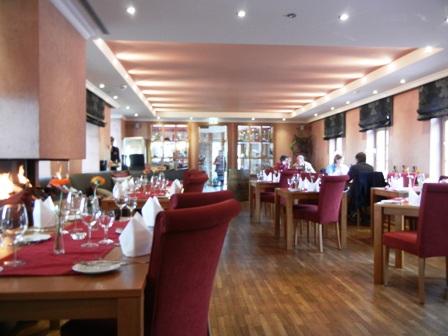
The inside of the restaurant

We sat near the fire place. The staff was very friendly, and convinced us to get started with a sparkling Pinot Meunier, or in German “Schwarzriesling”.

Sparkling Schwarzriesling – Pinot Meunier

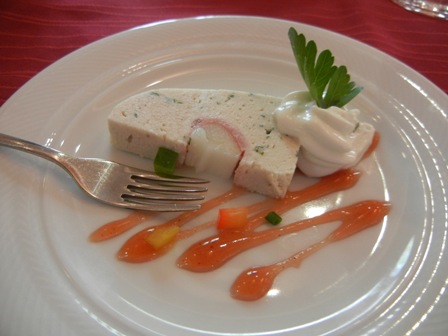
This was followed by “greetings from the cook”: a delicious pate, which was just the right starter. It wetted our appetite.

Courtesy of the cook

I could not resist and ordered the house Riesling, a dry wine from the Pfalz region.

Dry Riesling from the Pfalz

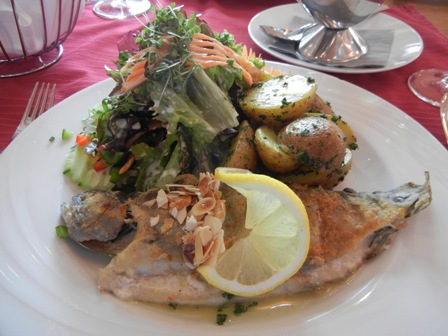
My main dish was a trout with almonds, with potatoes and salad. Just wonderfully delicious. It was the right hearty meal which made me forget my jet-lag. I had arrived the very same morning from Bangkok and needed some stimulation to stay awake. That’s why I could not resist the ice cream either.

Trout with almonds

Dessert

Espresso

We had a jolly good time. The food was delicious, the staff extremely friendly, the spring outside inspiring and the company just great. I could not imagine a better welcome to Germany.

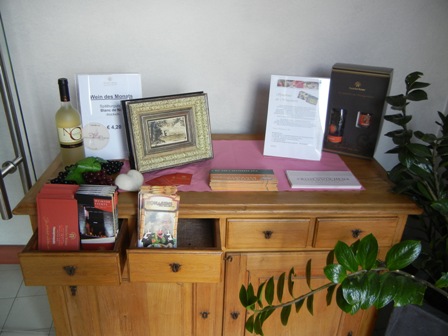
On our way out, I noticed the table with the informations about wine events and other local festivities. It was a pity that I could not stay a couple of days longer. The wine route through the Pfalz/Palatinate has so much to offer.

Address:
Deutsches Weintor Restaurant
Weinstraße 4
D-76889 Schweigen-Rechtenbach
T +49 (0) 6342 – 922 788 8
F +49 (0) 6342 – 922 788 9
www.weintor.de/restaurant.html


Wissembourg, jewel of northern Alsace

May 10, 2012

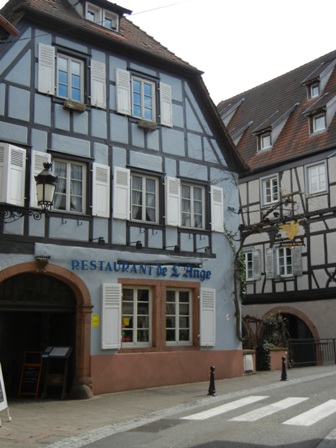
Half-timbered houses in Wissembourg opposite the cathedral of St Pierre and Paul

One of the loveliest little towns in northern Alsace is Wissembourg. During my recent visit to the Palatinate (Pfalz), the German wine region just north of Alsace, we did a side trip to see this picturesque place.

We had come after lunch just to have a little walk around town. It was a pleasant spring day with mild temperatures and some sunshine although heavy rain clowds graced the sky.

Wissembourg has about 8,000 inhabitents and was the location of various battles fought in the French revolutionary wars in 1793 between French and Austrian, Prussian, Bavarian, Hessian and other German forces. After the second battle of Wissembourg, France was able to take over the whole of Alsace. In 1870 the tables were turned. This time the Prussian forces won and made their way to Paris.

I remember that during my student days at Bonn University I once attended a play by a theatre group from Alsace. The play depicted the history of the region and how it moved from being indpendent to becoming a part of France and Germany, but that the people remained the same.

The following pictures will give you a rough idea about Wissembourg, but I suggest you go and see for yourself, stay a couple of days to also indulge in the food and wines of Alsace.

Another well preserved half-timbered house

About twenty years ago when I came to Wissembourg for the first time with my wife Margit, we almost bought a half-timbered house. We were so enchanted by these houses, that we almost could not resist to invest in such a house. They were not expensive at the time, 80-90.000 Deutschmark only. Since my brother lived and worked jsut a little north of France in southern Palatinate, we thought he and his family could live in the house. But it did not work out and we discarded the idea.

The stream crossing the town is called the “Lauter”

I would have loved to enter this restaurant but we just came from lunch

Medieval music was presented by these two bards

“Winstub” is what the sign says in the local dialect. It means wine bar

The wine bar wedged between two houses

Spring invites everybody to buy fresh flowers

Various types of bread and cake were on offer

Wine for sale

Of course wine was everywhere. I did not buy any since I had to travel and drag my suitcae around. And wine is, unfortunately, very heavy.

But I will come back to Wissembourg, that’s for sure. Maybe next July when I spend some time in my home town Trier. Not far from Wissembourg is my favourite restaurant, “Auberge du Cheval Blanc” in Lembach in the Vosges mountains.

Spring blossoms all over the place


Boetzinger, wine from Baden, Germany

May 5, 2012

Boetziner wine co-operative

When I attended the party convention of the German Free Democratic Party (FDP) in Karlsruhe a couple of week ago, I was not so sure that I would have the time for some wine tasting. Alas, the Saturday night party of the FDP showed that there was no reason to worry.

Karlsruhe is located on the right side of the Rhine river in Baden, one of the smaller German wine regions in the South-west, just across the Rhine river from another famous German wine region: the Pfalz (Palatinate).

It goes without saying that wine from Baden was the choice of the organizers, and a good choice it was. One does not expect a “grand cru” to be served at such an occasion. After an excruciating day of debate and discussion the hundreds of party delegates just want to get on with their lives.

However, a decent drop of wine is very much appreciated. Two wines were on offer, a ‘2011 Boetzinger Pinot Gris, Kabinett dry’ and a ‘2011 Boetzinger Pinot Noir, Kabinett dry’, both in their dry variant.

Boetzinger is a wine co-operative, the oldest wine co-operative at the Kaiserstuhl in Baden. It has about 500 vintner members who produce first quality grapes.

We started with the white and followed through with the red, both wines were very pleasant, clean and crisp for easy drinking and dry: in short excellent specimen of their kind.

We drank lots. The waiters kept bringing the stuff. When we got up at about two o’clock in the morning we had a good fill.

And the next morning, you might ask? Well, just fine. The wine not only had a decent taste, it showed its quality also after a huge consumption.

From the Boetzinger website I found that the bottle of Pinot Gris costs only EURO 5.75 and the bottle of Pinot Noir is EURO 6.30, both very decent prices especially when you are dealing with the exorbitant wine prices here in Thailand.

Try the wines of Boetzinger.