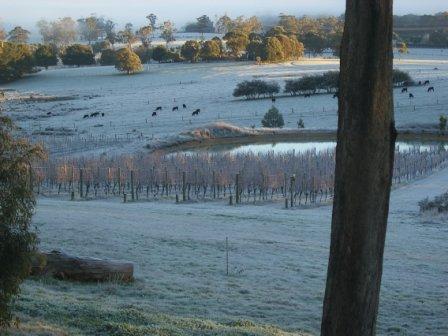
Wine made in India

March 16, 2007

When I openend my morning newspaper today – for insiders it’s the International Herald Tribune, (IHT) delivered at about 6-6:30 h every morning to my home in Jakarta so that I can read it while having breakfast and after my children have left for school – I was quite surprised to find on page 2 an article with the headline: “Days of wine and roses, sobered by high tariffs” desribing the situation of the infant wine industry and increasing wine consumption in India.
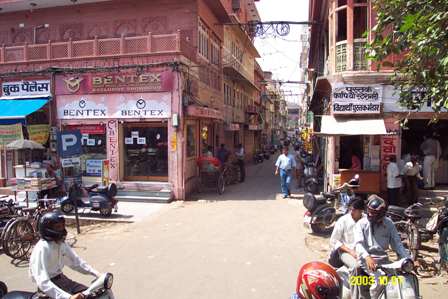
Jaipur

Jaipur street in 2003

It reminded me of our two years in New Delhi, almost 10 years ago. It was hard to get access to wine, any wine. We needed a personal reference from a friend so that a wine dealer would accept us as his new clients. This took quite some time. Only white and/or red where the choices available to us. The stuff was delivered after nightfall. A van drove into our driveway with turned off headlights. Then the bottles were delivered in secret, tucked into inconspicuous boxes. When we openend them the very first time, we found to our surprise the cheapest of French white wines, which might have costs a dollar or two in France but for which we had to surrender about 15 US$ of our hard earned money to our mysterious benefactor. I remember how happy we were. Over time and with the approprite consumption level, the quality of the wine and the choices available to us would improve. However, we never quite made it to get our true choice of wine delivered. But better ordininary wine with a delicious meal than no wine at all, became our daily and pragmatic attitude.

Ten years later, not much seems to have changed in New Delhi. The article in the IHT calls our mysterious benefactor a “bootlegger” which he certainly might have been. And despite a surge in domestic demand, wine cunsumption seems to be still hampered by a series of religious, cultural and bureaucratic hindrances. When I attended an international seminar in Jaipur in 2003 we had some very delicious Indian reds. Unfortunately, I did not take a photo of the bottle at the time but the three “dancing derwishes” are proof that we had great fun at the event. If you want to learn more about wines made in India please visit www.sommelierindia.com.
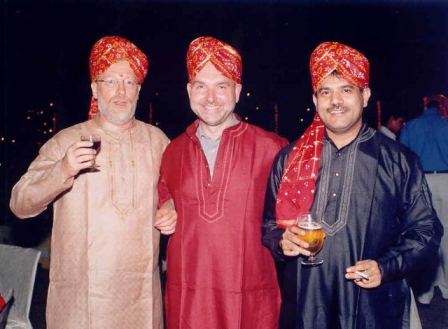
Derwishes

With my friends

In the long run, I feel, prospects for Australian wine in India should be good. My two daughters, if they should take over the family vineyard after I have “transcended” my earthly existance, might be the beneficiaries of this. 30% growth of wine sales as we can observe today will have subsided but the total bottles sold will go into the millions. When I think of the values, I become dizzy: total wine exports value of the US to India stands at only 1 Million US$ today. With an ever increasing number of consumers and average income increasing even faster, a small family vineyard as Two Hills should have a chance to sell to a few boutique wine shops in Mumbai, Delhi, Kolkata and Chennai. How I love the future.

Jaipur 2


Upper Goulburn Food, Wine + Cultural Group

February 19, 2007

Apart from the Upper Goulburn Winegrowers Association (UGWA), there is also a group promoting food, wine and culture, named Upper Goulburn Food, Wine and Culture Group. The group began working in 2000 driven by enthusiatic producers in Murrindindi and has expanded ever since now including people from Mansfield, Marrysville, Kinglake, Strath Creek and Merrijig among others.

UGE

Around vintage time the group is involved in quite a few promotional wine and food activities. Whoever plans to visit Victoria in the coming weeks should take note of the following events:

♦25th February – Troutarama – Wine and Food Festival – Gallipoli Park Marysville
♦03rd March – High Country in The High Rise – Federation Sq, Melbourne
♦10th March – Mansfield Bush Market
♦16th March – Upper Goulburn Marysville’s Longest Lunch – Marylands, Marysville
♦18th March – Yea Autumn Festival
♦24th March – Merrijig Hall Bushfire recovery celebration – UG Wine Tastings
♦28th April – Upper Goulburn Vintage Celebrations – Delatite Winery, Mansfield

These are only some of highlights. If your are interested in more details, please contact the website of the group (www.uge.asn.au).


Murrindindi

February 15, 2007

What is “Murrindindi”, you might ask? This is a location in central Victoria along the Murrindindi River. It is also the name of the shire where Two Hills Vineyard is located (www.murrindindi.vic.gov.au).

According to Wikipedia the Woiwurrung people lived in these parts of the Upper Goulburn when the first white settlers arrived in 1837. In the Woiwurrung language Murrindindi means “living in the mountains” and indeed this part of the Upper Goulburn Wine Region (www.uppergoulburnwine.org.au) is quite hilly and mountainous. It was all covered by forests.

There has never been a Murrindindi town. The first settlers (squatters as they are called in Australia) cleared the forests and farming and timber became the main industries in this region. A short lived gold rush began in 1868.

Murrindindi

Mountain view in Murrindindi

Although most of the area was deforested by the early 20th century, systematic protection and re-planting of trees has occurred and today the eastern part of the Melba Highway from Glenburn to Yea is in some parts quite densely forested again with Mountain Ash and other gum varieties.

Tourism is on the rise (www.murrindinditourism.com.au). Accommodation is easily available. There are good opportunities for trail riding, fishing, trail biking, and bush walking, specially along the Wilhelmina Falls and along the Murrindindi River.

Also the wine industry has made Murrindindi its home. Since the late 1980ies and the early 1990ies some vineyards were established in the Murrindindi area. In comparison with my native Mosel River, this might seem a rather short history of wine production. Indeed, vintners and winemaker here are true pioneers. There are fours vineyards in the vicinity:

▪ Penbro Estate
▪ Murrindindi Vineyards
▪ Yea Valley Vineyards and
▪ Two Hills Vineyard

All are members of the Upper Goulburn Wine Growers Association but only Penbro Estate has a website (www.penbroestate.com.au). There cellar door used to be the Glenburn Pub in Glenburn. Murrindindi Vineyard’s cellar door is at Marmelades Café in Yea, a small country town about 25 km to the north along the Melba Highway.

Whereas the Celtic Treverer had hundreds of years of site and varietals’ selection opportunities, so that today a rich and extensive knowledge base exists in the Mosel wine industry with well established vineyards and wineries.

The vintners in Murrindindi had only a couple of years of trial and error and are still searching.

We at Two Hills had to pull all our Cabernet grapes out because they would not ripen in the cool and harsh climate with its short autumns. They were replaced with Pinot Noir.

Last year was our first but promising Pinot vintage. The variety seems to be better suited to our conditions then the long ripening Cabernet. We plan to extend our vineyard and plant 0.4 ha of Chardonnay this year.

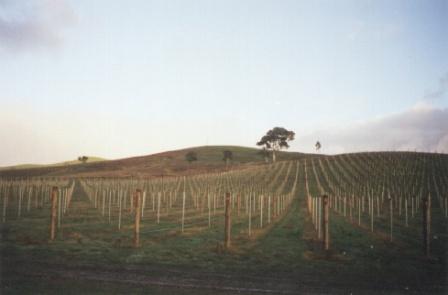
Vineyard in Murrindindi

Vineyard in Murrindindi


The Treverer

February 4, 2007

The first time the river Mosel is mentioned in a written document is the account of Gajus Julius Caesar in his De Bello Gallico, IV in 55 B.C. where he describes his battle and the subsequent victory over two German tribes, the Usipeter and Tencterer. Around the same time we also learn about the original settlers in the Mosel river valley and around Trier, the Celtic Treverer.

“The Treverer are cleverer” sounds a line in a popular song of a local rock music group called “Leiendecker Bloas”. But not only that. The Treverer were feared by the Roman invaders as well.

Treviros vites censeo. Audio, “capitales” esse; mallem, auro, argento aeri essent.

This is what Marcus Tullius Cicero wrote to a friend during Caesar’s war against the Treverer in about 55 B.C. In a free translation that reads as “better avoid the Treverer; they go for your throat. I wish those guys would rather work as silver and gold smiths”. The Romans in fact had some troubles in controlling the Celtic population of the Mosel valley. In 69/70 A.D. the Treverer revolted against the imperialists from Rome but were defeated again. The Roman general Petilius Cerealis did not lose his composure in battle despite the fact that his cavalry was already wiped out, his camp fortification destroyed and the walls overrun by the fierce Celtic fighters from the Mosel.

But over the decades that followed the Celtic swineherds were transformed into vintners and the people thanked the god of wine – Sucellus – for this. The Treverer were known to be hungry for fame, quarrelsome and rowdy. They were also known to be big drinkers, more so than even the Germans. The many drinking competitions they held are ample proof of their favourite pastime. The ones who could not drink were despised as weaklings. That people could call themselves lucky if they got away alive from those fierce drinking competitions, was a common notion. That’s how it was: The good old days. These times have long gone and modern man does of course some drinking here and there but we are all more or less domesticated in some way or another. We go to work 5 days a week. We do sports in our free time, watch TV, send sms and e-mail, write blogs and so on.

Joseph Roth in “The Radetzky March” describes the changes at the turn of the 19th to the 20th century but his description can certainly also be applied to earlier times and ages.

Everything that grew took long to grow
and everything that ended took a long time to be forgotten.
Everything that existed left behind traces of itself
and people then lived by their memories,
just as we nowadays live by our capacity to forget,
quickly and comprehensively.

Schale

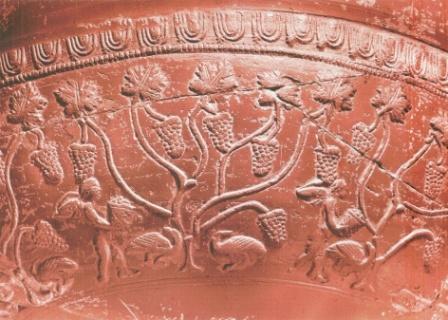
Terra Sigillata bowl found in Trier (Karl-Josef Gilles: Bacchus and Sucellus, Briedel 1999)

Vinum vires is what the Romans said, wine gives power! My suggestion for the day: open a bottle of your favourite wine and enjoy the Sunday.

Bene tibi sit “Wohl bekomms” or To your health, salute, cincin and so on

————————
Reading tip: Edgar Christoffel: “Mosel und Wein – Stimmen aus zwei Jahrtausenden”, Trier 2003


The Upper Goulburn Wine Region

February 1, 2007

Today, after all these Mosel meals, I want to take you back to Australia and write about the wine region in which our vineyard is located: the Upper Goulburn Wine Region. I also would like to inform you a little bit about the activities of the Upper Goulburn Winegrowers Association (UGWA; www.uppergoulburnwine.org.au).

The Upper Goulburn is located in central Victoria. The region derives its name from the Goulburn River which is one of the main features of the area. It is a cool-climate grape growing area setting it apart from most other parts of Victorian. The region has only recently been classified in the geographic indication system. Grapes, however, have been grown in this part of Victoria for almost 40 years. In comparison to the Mosel this is indeed a very young wine region.

The Geographic Indications Committee of the Australian Wine and Brandy Corporation (AWBC; www.awbc.com.au) determines wine zones, regions, sub-regions and their boundaries. The system was introduced after lengthy negotiations with the European Union which did not accept Australian wines unless it complied with European regulations. The Australian Wine and Brandy Corporation Act of 1980 was amended in 1993 to accommodate those requirements.

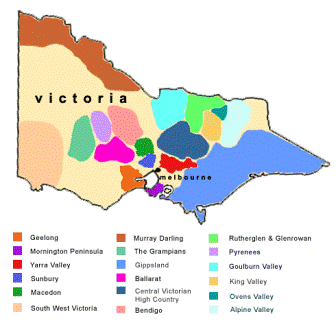
Map of the Victorian Wine Regions

Wine Regions of Victoria Map Dark blue formerly Central Victorian High Country and now divided in Strathbogie Ranges and Upper Goulburn Wine Region (www.wineaustralia.com/australia

The region is very diverse in terms of altitude, climate, temperature, rainfall, and soils. Site selection is of ultimate importance. Rainfall varies from 700 to 1400 mm. Some vineyards even rise to the snowline at 800 m. Many locations are ideally suited for sparkling wine production consisting of Chardonnay and Pinot Noir grapes. Aromatic varieties such as Riesling, Gewuerztraminer and Sauvignon Blanc can be found but also Cabernet Sauvignon, Merlot, Malbec and Shiraz. (www.greatwinecapitals.com/melbourne/mel_reg_centralvictorianhighcountry.html)

The Upper Goulburn is very picturesque and one of the gems of Victoria. It extends from Tallarook in the west to Mansfield, Lake Eildon and further north Lake Nillacootie. Regional centres like Yea, Alexandra and Eildon are located in the region. Mount Buller and its skiing slopes, the lakes, the small rivers and the high planes are a premium destination for national and international tourism.

Mount Buller

Mount Buller with snow cap

Two Hills Vineyard can be found at the most southern edge of the region on the way to Yarra Glen. Today there are about 25 wine labels and more than 30 vineyards in the region. Recently a branding workshop has identified the key characteristics of the region which include:

● high diversity of vineyards and wines
● climate very suitable for premium cool climate grapes and wines
● aromatic whites/sparkling wines and elegant reds
● hand picked and hand crafted grapes/wines
● family owned businesses
● environmentally aware producers
● low environmental footprint
● shared experience between producers and customers
● good infrastructure
● unknown – Victoria’s secret

From these few words it is clear where you have to spend your next holidays: in Central Victoria. See you there (www.visitvictoria.com/wineries).

Two Hills Vineyard

Two Hills Vineyard


Of Droughts and Bushfires

January 12, 2007

Today, I climbed from the heavans and my meetings with the celtic gods (remember Sucellus?) down to earth again. And a hot earth it is. From The Age (www.theage.com.au) I learned about the progress of the bushfires in Victoria. 950.000 ha of forest have already burnt down, which according to The Age is almost as large as Jamaica (it has a bobsled team). Mt Buller where it burns is only about two hours away from our vineyard in Glenburn.

Some years ago I went skiing with my friend, Timo Meyer, Australian of Swabian origin, and his and our children for a day of racing down the hills. Timo is a vintner and a very sought after winemaker at Gembrook Hill Vineyard (www.gembrookhill.com.au). He is famous for his very fine palate. Timo made our second vintage of Sauvignon Blanc which in the end got us the bronze medal at the Singapore Wine Show. He has also his own vineyard at a very steep slope which is called “Bloody Hill”. His wines can be bought at Yarra Valley Dairy (www.yvd.com.au).

The picture below has been taken by Andrew de la Rue and it shows the fire raging near Mt. Bulller village.

buller_smoke_wideweb__470×2930.jpg

We are suffering under the drought for some years already. Because of the higher altitude of our vineyard loaction in Glenburn, we normally receive sufficient rain. Years ago we enlarged the old dam and built a new 13 megalitre storage. This kept us going. It did not rain much this winter (June to August on the southern hemisphere). I have never seen our big dam as low as in July/August 2006. Margit and I, we are of course a bit scared that some fires might break out in the nearby forests. Many of the fires are deliberatly lit by arsonists, others are ignited by lightning. The temperatures are high at the moment and together with the strong northerly winds, they make firefighting dangerous.

It has been a strange year so far. First, many vineyards were hit by two waves of late frost which destroyed in some places all the fruit at the vines. We at Two Hills were lucky. According to Steve Sadlier our friend, who manages our vineyard, we lost about 20% of the Sauvignon Blanc, 60% of the Pinot and about 40-50% of the Merlot. Some vineyards in the neighbourhood lost up to 60-70 % of their fruit, others lost everything. As a consequence the Victorian wine industry is suffering tremendous damages. Demand for fruit is strong. If we had only more of it. The old agricultural law prevails, that the economic value of a bumper harvest is usually lower then the one of a meager year. The frost damage will have lasting effects. Also the 2008 harvest will be lower because of the frost damage last year. Second, comes the drought and the fires. If Kinglake National Park start to burn, we will be in trouble.

Below some pictures of Two Hills in winter 2006. Isn’t the place beautiful?

Winter on Two Hills 1

Two Hills Vineyard

Winter on Two Hills 2

Winter on Two Hills 3

Sauvignon Blanc in winter


From the Old to the New World: My Vineyard in Glenburn, Victoria

January 10, 2007

Today I want to take you to a small place in Central Victoria Glenburn, between Yarra Glen and Yea, about one hour northeast of the capital city of Melbourne. From there we drive about 5 km up north and turn right into Two Hills Road, a gravel road which will lead us to our vineyard.

The vineyard
Our vineyard facing north

It’s all grazing land here surrounded by gum forests of the national park. Most residents are retirees; many are weekenders. The vineyard is located on the right hand side on a 50 acres block (about 21 ha). It consists of about 1 ha Sauvignon Blanc (planted in 1996), 1 ha of Pinot Noir (planted in 2002) and 1.3 ha of Merlot (planted in 1997). The rest of the land is grassland with some small patches of gum trees and a small forest. A small river, Katy’s Creek, builds the boundary on one side.

Second Hill

Two Hills Vineyard towards our second dam

In 2001 we had our first vintage. Our Sauvignon Blanc of 2002 even won us a bronze medal at the Singapore Wine Show.The wines are available in Melbourne at the Old England Hotel in Heidelberg (bottle shop; www.oldenglandhotel.com.au), at the Berry Cafe in Dixons Creek (on the way from Yarra Glen to Yea) and in the Alexandra supermarket chain. In Germany my friend Dr Ulrich Hillejan (Gesellschaft fuer Unternehmensentwicklung mbH, www.s-h-r.de) sells our Merlot to other friends and family. At the moment we have only Merlot 2004 for sale. All the other wines have sold out which is of course good news for the producer and bad news for the consumer. 2006 was our most successful year so far. We had a good harvest (after a complete loss in 2005 due to adverse weather conditions), sold all our grapes, and most of our wines. The 2006 vintage of Merlot is ripening in French and American oak and will be bottled in March 2007.
We are selling most of the fruit to other wineries. Living abroad is not very conducive to wine marketing. Another friend, Steve Sadlier of Vineadvice from Yarra Glen, takes care of the vineyard management. He is our viticulturist. Our wines are made by another friend, Alan Johns, owner and winemaker of Yering Farm Wines (please visit their website at: www.yeringfarm.com.au).

The wine region is called the Upper Goulburn Wine Region Victoria (formerly Central Victorian High Country) and is promoted by various organisations among them the Upper Goulburn Winegrowers Association of which we are also a member (please visit their website: www.uppergoulburnwine.org.au). I took the map from this website. Unfortunately, it’s not up to date (we are not yet listed as members for instance) but it gives some idea of the location.
ugmap2.jpg