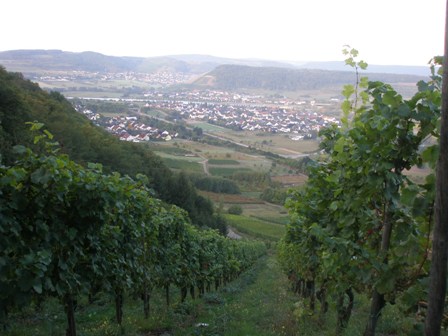
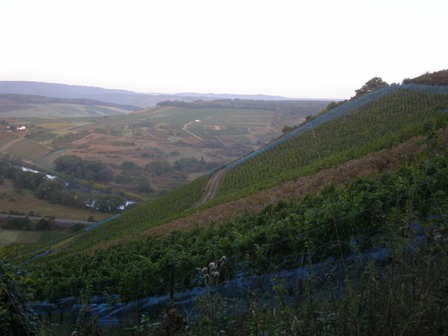
The last sip – a Delatite Riesling

April 18, 2010

Leaving Two Hills Vineyard in Glenburn is always a sad affair. The evening before departure we bid farewell to our old friend Steve and our family, Michael and Helen. On Sunday morning we said good bye to our neighbours, Hillary and Ken. Then we drove to Yarra Glen where we left the car at Gayle’s farm. We had a morning tea, moved the luggage into her car and off we went to Melbourne Airport. Gayle dropped us there and we did the usual stuff.

Fortunately, there was a nice bar called “Plonk”, right next to gate No. 4 from which we were to depart for Bangkok. We went through their wine list and chose a wine from our wine region (the Upper Goulburn Wine Region), a ‘2008 Delatite Riesling’. What a delight this wine was, fresh and fruity with citrus and passion-fruit aromas, a good structure and a long finish. The waiter was particularly charming. Here we said our final good bye. Reminiscing about the past is an old man’s vice, but the memories we took with us are treasures of a very special kind.


Vineyards of Thailand Part 3: PB Valley Khao Yai Winery

February 25, 2010

Wine tastings at PB Valley

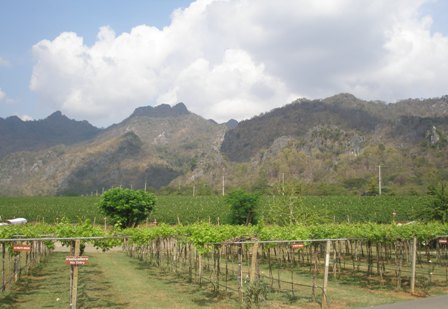
PB Valley is the largest of the Khao Yai vineyards and wineries. It’s total production is about 600,000 bottles a year. It is also the oldest vineyard in the region. It was started in 1989 on a large plot of land. It took a couple of years to identify the most suitable grape varieties for the climate.

PB Valley wines have won a number of international wine awards (mostly at AWC in Vienna). Apart from vineyard and winery, it also has a restaurant, the Great Hornbill with about 200+ seats, and holiday accommodation. I like their reserve Shiraz and Tempranillo wines best.

Unfortunately, we had no time for a winery tour or any organised tasting. We just dashed to the cellar door and bought a couple of bottles. As in other wineries, the product range includes all kinds- of non-wine products from health care, cosmetics to nutrition.

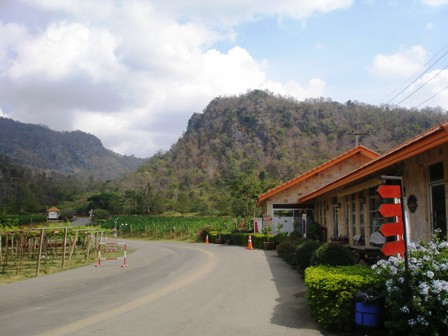
The entrance to the sales room

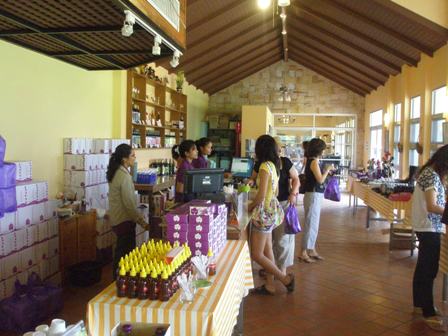
The cellar door

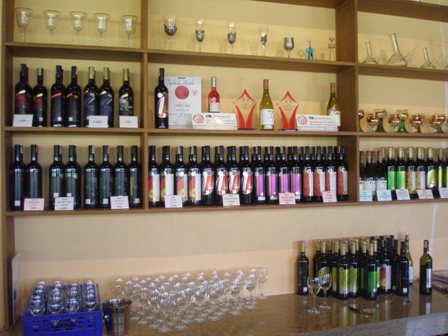
Wide product range

If you visit Bangkok, rent a car with driver for the day and visit the wineries and vineyards of PB Valley and Gran Monte. This gives you a perfect start for the exploration of new latitude wines. The area is beautiful and the national park offers some unique experiences of Thailand.

If you have no time, visit their sales offices in Bangkok and stock up on their wines.


Wine of the day: 2008 Yering Chardonnay

February 18, 2010

After a hot day in the tropics nothing is better than a nice glass of white wine. We selected a ‘2008 Yering Station Chardonnay’ from the Yarra Valley. Yering Station is the oldest vineyard in Victoria. The winery is a must visit if you are touring the Yarra Valley. It’s located just outside Yarra Glen.

Only very recently had this wine arrived in our supermarket in Thonglor, Bangkok. It’s moderately priced for Thai conditions (less than 10 EURO or A$ 15) and a very lovely drink.

Wine on the terrace: 2008 Yering Station Chardonnay

Yering Station has still ‘grape growers with contracts’ and our friend Steve Sadlier is one of them. If we want to drink wine from his grapes, Yering Station is the winery to buy it from. Steve produces excellent cool climate fruit in the Yarra Valley.

We were a bit homesick and needed a reminder that Australia can be very near. Cheers folks


Vineyards of Thailand Part 2: Gran Monte, Asoke Valley, Khao Yai

January 11, 2010

Gran Monte vineyards

I have visited Gran Monte located in the Asoke Valley in the Khai Yai area before. But this time we did not have an appointment with the boss, Mr. Visooth Lohitnavy, and a winery tour was out of the question. We played the innocent tourist, and walked right into the cellar door and tasted the new vintage.

Cellar door to the right, beautiful mountains ahead

The tasting room

2009 was a great year for Gran Monte. The winery won about 20 national and international awards for its “new latitude” wines, and is now firmly established as one of Thailand’s top producers easily matching international standards.

Wines on display in the tasting room

2009 Spring Chenin Blanc

Though Chenin Blanc is usually not “my variety”, I just loved the ‘2009 Spring Chenin Blanc’ which won a silver medal at the AWC Vienna International Wine Challenge 2009. It’s a very fresh wine with a beautiful bouquet, and a clean finish. I liked it much better than the ‘2009 Sole Unwooded Chenin Blanc’. The ‘2009 Sakuma Rose Syrah’ was not for tasting but we bought some bottles nonetheless. Finally, we bought a whole selection from different vintages, varieties and price ranges. More about the food and wine pairings and our experiences with Gran Monte wines will follow soon.

Newspaper reviews about Nikki Lohitnavy

The daughter of Visooth Lohitnavy, the managing director and CEO, is Nikki (or Visootha). She is the first female wine-maker in Thailand. With a degree in oenology from Adelaide, the young vintner is on a mission, and one can feel this when visiting Gran Monte. The 2009 vintage with its excellent whites shows her hand.

Gran Monte has a guest house and restaurant at the winery. The park around the house and the cellar door is very lovely too. When we visited the place was very busy, with many visitors dropping in, most of them Thai. Apart from wine, there are a wide range of local produce including creams and lotions available from the shop.

Gran Monte is definitely worth visiting when going on a winery tour in Thailand, a “must” so to say. There are many other interesting things to visit in the Asoke valley and its surroundings. Khao Yai is just a beautiful region.

Address:
GranMonte in Bangkok
Granmonte Co,Ltd.
17 / 8 Soi Sukhumvit 6, Sukhumvit Road,
Klongtoey, Bangkok 10110
Tel : +66-2-653-1522
e-mail: Marketing@granmonte.com

GranMonte Vineyards and Wines at Asoke Valley, Khao Yai
52 Moo 9 Phayayen, Pakchong,
Nakornrachasima, Thailand
Tel : 081-923-200-7 , 084-904-194-4, 081-900-828-2 , 080-661-755-5
www.granmonte.com


Vineyards of Thailand Part 1: Holiday Park

January 10, 2010

This blog entry if the first of three looking at various vineyards in Thailand. During the Christmas vacation, we went on a winery tour, visiting three Thai vineyards; Holiday Park, Gran Monte and PB Valley, except Holiday Park, all in the Khao Yai area.

Holiday Park, about two hours north of Bangkok, is a complex undertaking, more a holiday home cum entertainment facility than a vineyard cum winery. However, they do produce grapes, as it seems mostly table grapes for direct consumption. When we arrived in the place, vineyard workers were busy “cleaning” the grapes, which was thinning individual bunches of smaller berries so that the remaining ones could grow bigger. The table grapes we saw were very healthy.

Vineyard workers thinning bunches under the trellis system

Table grapes at Holiday Park

Small tractors were converted into small “locomotives” with wagons so that visitors can be driven around the property including a holiday housing park, a lake, an activity centre, the vineyards and a play ground.

The locomotive

The undertaking is obviously targeting domestic tourists and visitors. The staff at the tasting counter did not speak English. But nonetheless there were wines and juices to be tasted. It was my first ever experience with small plastic cups for a tasting.

Plastic cups for wine tasting at Holiday Park

I assume the wine made is just a by-product of the table grape business. The grapes which cannot be used as table grapes and/or are left over are made into wine. The price of the bottle was THB 250 (about 5 EURO or A$ 7.50). We did not buy any wine.

Holiday Park red

If you have small children, Holiday Park is still worth visiting. I suggest you go there early in the morning when it is not too hot. From there on you drive to Khai Yai to visit other wineries or the national park.

I could not find any address for Holiday Park on the internet in English. Sorry folks.


Bodegas Muriel Reserva, Rioja

November 30, 2009

2001 Bodegas Muriel Reserva, Rioja

I do not buy a lot of wine from Spain, main reason being that I do not know enough about Spanish wines. But the other day I made an exception and bout a bottle of ‘2001 Muriel Reserva’ from Rioja, Spain. Made of Tempranillo grapes, this wines is just wonderful, rich and full, lot’s of red forest fruit, silky and smooth the tannins.

As you can see from the picture below, the colour of the wine is already like a brick. Reserva wines by Muriel are aged for a minimum of two years in oak barrels and three years in the bottle. It was a great pleasure to drink this wine. I need to learn more about the wine region of Rioja and its wines. We had the wine with dinner, of course.

The colour of the Rioja

Muriel is located in the heart of the Rioja region in the small town of Elciego, next to the river Mayor, east of the E-804 from Zaragoza to Bilbao. When in 1973 on our final study tour before concluding “Gymnasium” (high school), I passed the area on my way from Burgos to San Sebastian not knowing anything about the famous wine region (not that I would know much more today).

Muriel also makes a white wine, from Viura grapes, the website said. Honestly, I have never heard of the Viura grape, what an ignoramus I am. There is so much to learn out there. Life is just beautiful.


Climate change and grape varieties

November 2, 2009

RieslingSchoden

Riesling grapes in Schoden, Saar, shortly before vintage 2009

Uff, I am reading in todays “Your Daily Wine News” newsletter that some of Australia’s top wine experts think that over the next 20 years climate change will be responsible for the decline of Shiraz and Chardonnay and the rise of varieties such as Vermentino, Arneis, Nebbiolo, Pinot Grigio and Viognier (some call them “alternative varieties”).

This is bad news for me and my own small vineyard. At Two Hills Vineyard we have concentrated on some of the traditional French varieties: Sauvignon Blanc, Pinot Noir, Merlot and Chardonnay (first vintage in 2011 or 2012). Our fruit ripens usually well (if we do not suffer severe frosts) and shows a superior quality. But will that persist under the conditions of climate change?

I still remember vividly how I pulled out the 2 1/2 acres of Cabernet. it was hard work, wrapping a chain around every single vine and lifting the hydraulic of the tractor. I should have left them in, I guess. If temperatures rise in Glenburn, the drought persits, and/or we’ll have less percipitation in the future, Cabernet could have been the ideal variety for our spot. I ripped the vines out because the grapes would not fully ripen. At the moment we have sufficient water, our two dams are overflowing after years of drought but that might change quickly again.

Another issue is age, my age. At 55 I might still have a chance to enjoy some of the coming Chardonnay vintages but replanting would “cost” me many years of waiting. I could contemplate to plant on our second hill where we still have another 5-6 acres of space. Well, let us see what is going to come.

At least there is no politician who tells me what to do and chances are small that an elector such as Clemens Wenzeslaus of Saxonia, who changed the Mosel by instructing vintners to ripp out their red varieties and replant with Riesling, would appear on the Australian scene. However, danger is looming from the anti-alcohol lobby in Canberra which is working day and night to convince law-makers that the purchase of alcoholic beaverages needs to be made more costly for the consumer and profitable for the taxmen.


Rioja in Taiwan

October 22, 2009

Beronia

After teaching a full day I am usually exhausted and somehow empty. the best way to spend the evening is with a glass of wine. Jim and I, we marched into the wine shop just across the ICLPST in Taoyuan and shopped for some wine.

I choose a ‘2006 Tempranillo Beronia Rioja’ from Spain. What a nice wine this was; an “umpf” wine, as we call it in Australia. Dark red in colour, full of wild fruit, plum, and berry flavours, this wine is of a more traditional character, heavy and intense, but with balanced acidity and spicy notes from the oak it is matured in, and good mid-palate weight.

Beronia1

We had no wine glasses but drank it from large, thick tea glasses. That’s the reason why I have no picture to show the beautiful colour of the wine. The ‘2006 Tempranillo Beronia Rioja’ sells for about US $ 13 in the USA, we got it for the equivalent of about US $ 21 in Taoyuan, not bad for such a wine.


Vintage time: Schodener Herrenberg

October 6, 2009

Schoden1

Schodener Herrenberg, in the background the village of Schioden with the Saar

One of my favourite places along the Saar river is Schoden, a small hamlet about 30 minutes southwest of Trier, my hometown. I visit regularly, because my friend Heinz together with some friends has rented the local hunting territory and when I visit Trier, we often go together on the hunt.

Schoden has also some vineyards and wineries. The location (terroir) “Herrenberg” is one of them. The vineyards are quite steep, which is difficult to depict in a photograph as you can see from the comparison of the two pictures above and below. It is realy a steep site, and the best location for producing Saar Riesling wines of superior quality.

Schoden2

Schodener Herrenberg: vineyards from the South

Schoden3

Schodener Herrenberg: the vineyards from below

Schoden4

A promising vintage?

Schoden5

Beautiful Riesling fruit

The fruit on the vines looked very healthy. In a couple of days or weeks, depending on the weather, the pickers will come to harvest. Needless to say that no machinery can be used, all the work will be done by hand. The vineyards workers will have to navigate the steep hills and balance on the slate pebbels which can be tricky when they are wet.

Needless to say that Schodener Herrenberg produces outstanding Riesling wines. Learn more about these Saar wines on my blog soon. Cheers


German wine regions: the Nahe

September 17, 2009

Nahe2

The Nahe wine region has a great significance for me and my family. It was here that I got first into contact with vine cultivation and wine appreciation at a rather tender age.

Why you might ask? Were you not from Trier, Mosel?
Well, my maternal grandfather, Hans Heinrich Schüssler, a native of Reichenberg, a village near Würzburg, used to live in Martinstein. Being from Franconia, another famous German wine region, he was the only wine drinker in the immediate family (my father preferred beer). He used to be the station master in Martinstein (today 322 inhabitants), a hamlet along the left bank of the Nahe river. The village was founded in the middle ages at a ford crossing the Nahe river. In 1340 it got a castle and even market (city) rights.

My brother and I, we used to spend the long summer holidays (and many other holidays) at my grandparents house in Martinstein. My grandfather used to take us on long walks in the forest and villages nearby. During these walks we always found a country inn where we could refresh ourselves, enjoy a drink or a “Brotzeit” (a typical German snack). He would drink a “Schoppen” (0.25 litre glass) of the local Nahe wine. He loved dry white wines. We would have a lemonade.

He was associated with a “hiking brotherhood” (called “Hunsrückhöhenverein”) whose members would walk in large groups on weekends to various destinations. Usually a country inn was the designated object of the hikers. Here the group converged for a hearty meal and some drinks. Shortly after vintage, “Federweisser” (freshly made but still half-fermented wine) was a popular drink.

But boys being boys, we would sip at his glass from time to time. He being deeply involved in conversation with fellow hikers, did not notice. Neither did we. The sweetness of the fresh wine veiled its dangers. To cut a long story short, we had the experience of a first inebriation of our young lives and could hardly walk strait on our long way home.

After my grandfathers retirement he moved out of the train station into a newly built home right in the middle of vineyards at the outskirts of the village towards the east. Vineyards stretched right to the door. Just a short walk up the hill and endless vineyards lay at your footsteps. Occasionally we would help during vintage time (more play than serious helping). But we would often taste fully ripened grapes and enjoy the fruit. I treasure these wonderful memories of my youth at my grandfathers house in Martinstein.

Map Nahe wine region

The Nahe wine region (photo source: wikipedia)

As you can see from the above map, the Nahe wine region stretches from Martinstein to the West along the river eastward, later north towards the estuary at Bingen where it flows into the Rhine river. The largest city in the region is Bad Kreuznach, a small town of about 45,000 inhabitants.

Nahe1

With about 4,200 ha under vines, the Nahe region is one of the smaller wine growing areas in Germany. It is still larger than, for instance the Yarra Valley in Victoria (with about 3,800 ha, about 2% of Australia’s total). The Nahe region is dominated by white grape varieties (about 74% of the total area under vines). The main variety is Riesling (26%) followed by Mueller-Thurgau (14%) and Dornfelder (13%).

Fifty years ago the variety distribution was very different. Silvaner used to be the most planted variety with about 50% of the total area but has ever since been replaced by the Burgundy varieties (Pinot White, Gris and Noir) as well as by Riesling, Dornfelder, Blauer Portugieser and Müller-Thurgau plantings.

The Nahe is divided into seven collective sites (Grosslagen) and 328 individual sites (Einzellagen). Due to its volcanic origins, the soils of the nahe show a great diversity. The wines reflect this. Only in 1971, the German wine law defined the nahe region. before that time, its wines were sold as “Rhine wines”. However, some of the best Riesling wines of germany originate from the Nahe and today Nahe wine can rival the best from Mosel and Rheingau or any other German wine region.
Nahe3

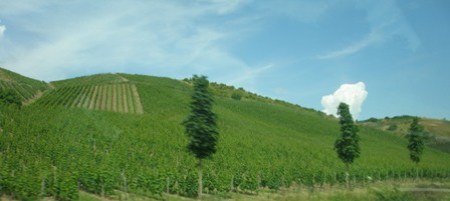
The Nahe can be divided into the upper (west) and lower (north-east) Nahe and the region around Bad Kreuznach. In Martinstein and the neighbouring village of Monzingen (first mentioned in 778) the oldest vineyards of the Upper Nahe are to be found. The soils of the Nahe range from sandstone to quartzite and slate. The region shows a temperate climate and some of the southern slopes enjoy a micro climate comparable to the Mediterranean. Elevations range from 100 to 300 meters altitude.

Nahe4

Who are the top producers of the Nahe wine region?

Well, the name Herrmann Doenhoff comes to mind. He is the leading vintner of the Nahe and his wines are ranked among the top Rieslings in Germany. Herrmann Dönnhoff has about 20 ha under vines and produces about 140,000 bottles a year. His winery is located in Oberhausen/Nahe. The 2007 vintage produced outstanding wines; the 2008 Riesling wines did not quite reach that quality level during recent tastings. But his ‘2008 Niederhäuser Hermannshöhle Riesling Gran Cru’ earned 93 Parker points.

Other top producers are Emrich-Schönleber in Monzingen (about 15 ha under vines, yearly production about 110,000 bottles), Schlossgut Diel (17.5 ha and 120,000 bottles) in Rümmelsheim and Schäfer-Fröhlich (14 ha under vines and 75,000 bottles annually) in Bockenau.

Wines and vintners I like very much are Sascha Montigny in Laubenheim and Weingut Edelberg at Gonratherhof 3 in Weiler just on the other side of Martinstein. The former I like because of the high quality of his red wines, especially the 2006 vintage; the latter produces solid country wines which remind me of my youth in Martinstein and the long hikes with my grandfather. The country inn at Gonratherhof was often our destination when the three of us set out from our little house in the vineyards.