Sticks Pinot Noir and Cowboy food

March 18, 2012

Beautifully coloured Pinot Noir

The last thing I did at Melbourne Airport when we left for Thailand in early January this year, was to buy a bottle of ‘2010 Pinot Noir’ by Sticks Winery.

I knew the bottle would not last long. On a Saturday when we felt like rural folks, we had it with a hearty meal of cowboy food.

Sticks Winery and its vineyards are located just opposite the old homestead of the Sadlier family at the foot of the hill South-west of Yarra Glen, called Christmas Hill. My friend Steve Sadlier had set up most of the vineyards many years ago when the place was still known as Yarra Ridge Winery.

If I remember correctly, my first ever wine tasting in Australia was in the tasting room of this winery. The wines were presented by Meagan, who became Steve’s wife a couple of years later. Sticks was the first vineyard I walked through in Australia. Goodness me that’s now so many years ago, maybe 1991 or 1992.

The 2010 Pinot Noir by Sticks

I was not sure if the wine would go that well with rural tucker. After all Pinot Noir makes a delicate and refined wine, something subtle and gently textured. And Sticks Pinot Noir is exactly that with delicious fruit aromas from wild cherry with a bit of spice, long on the palate with a suppleness hard to imagine. Maybe ill suited to the food we were going to have, I thought.

However that may be, we were in for a dish by Jamie Oliver, one of my favourite chefs of modern cuisine. From his “America” book, we cooked the Mountain Meatballs (page 308).

Mountain Meatballs as interpreted by Margit Adam

These meatballs are spicy. Jamie Oliver made up the recipe, he says in the book. The true Rocky Mountain dish is made of “prairie oysters”, sheep or cattle balls. We followed Jamie more than the wild West tradition.

The melted cheese in the meatball is just wonderful creamy. I also love the slight coffee aromas. This dish is a ripper of bush tucker, as we would call it in Australia. We served it with rice. I could eat it for breakfast, I must say, with bread or potatoes.

Jamie suggests a wine from the Côtes du Rhône, most likely a Grenache, a Shiraz and/or a Mourvèdre. Next time we’ll have these meatballs, I will try that.


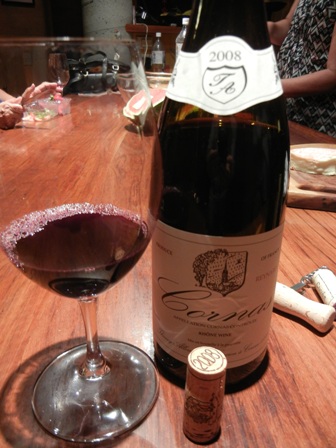
Best Syrah in 2011 – 2008 Cornas by Thierry Allemand, Cornas, Northern Rhone

March 12, 2012

Human memory is anything but perfect. In fact it is one of the most fallible of human organs there is. In hindsight we clear out memories we do not like any more. We add and subtract from it, we construct stories which never happened in the first place; we make sense where there was none before. Our memory seems to possess an independent creativity that bears only a passing resemblance to actual events.

That’s why wine geeks keep tasting notes, isn’t it? But even if we do, aren’t we deceiving ourselves, mixing up things, are influenced by the circumstances, the sympathy we have for the people we tasted the wine with, the location and the situation when we finally write it down as in a blog entry?

We humans like a narrative. We love to connect the dots even if there is little connectivity, no correlation not to speak of causation in the first place.

Please join me while reminiscing about the past year. What was the best Syrah I drank in 2011?

Well, this is not an easy task. 365 days of wine-drinking gone bye, need to be scrutinised. Pages of tasting notes need to be mastered. I’ll make it short for you

Please allow me to take you to my “winner”. It’s a wine by Thierry Allemand from Cornas village, a small wine region in the Northern Rhone, northwest of Valence, the charming small French town at the Rhone river.

I guess you have heard about the vintener and wine-maker Thierry Allemand.

The best piece on the internet about Thierry Allemand, I found on http://www.wineterroir.com. Thierry Allemand is one of my favourite French wine-makers.

Here you can indulge yourself, see the man, learn about his vision, his vineyards and his wines.

The first Cornas by Thierry Allemand which was served to me was by my good friend Timo Mayer at his home in the Yarra Valley. It was the 1996 Syrah Reynard cuvee from Cornas. The wine tasted like burned rubber which is sometimes labelled as a fault. But I liked this funky wine. It was wonderful complex and full in the mouth, with thr right spicyness. One feels like in paradise while the wine slowly winds it way down the throat.

Timo Mayer presented me with the 2008 vintage of this wine (last Christmas while at his house). It is difficult to describe this awasome drop. In comparison with the 1996 vintage, I would call this wine “domesticated”.

It is not wild as the 1996 vintage. It caters to the more mainstream taste, of what Syrah should taste like. I was not disappointed, not at all. However, I prefer the funkyness of the older vintage.

How can I get access to this wine in Bangkok? Does anybody have an idea?


Resfreshing bubbly produced by Di Giorgio Family Wines

March 9, 2012

Di Giorgio sparkling

One of the many refreshing bubblies we tasted during our Christmas holidays in Glenburn, was this bottle of Di Giorgio sparkling, a blend of Pinot Noir and Chardonnay wines. I had bought it in our local supermarket in Yea.

The bottle of sprakling on our kitchen table

Di Giorgio Family Wines is a family business celebrating in March its 10 anniversary. Some of the vineyards are located in Lucindale district of the limestone coast near Coonawarra, South Australia.

Stefano Di Giorgio migrated from Italy to Australia in 1952; with his wife Rita, he has four children. Apart from viticulture, the family holds interest in cattle, sheep, wool production and horticulture.

In 1989 the first vineyards were planted in Lucindale. Today, about 126 ha are under vines, and Cabernet Sauvignon, Merlot, Shirz, Pinot Noir and Chardonnay grapes are produced.

The holdings in Coonawarra covers almost 228 ha under vines. Apart from the varieties above, they also include some Cabernet Franc and Tempranillo.

From 1998 onwards the Di Giorgio’s decided to move from fruit growing to wine-making, and in 2002 they established their own winery. The enterprise is not small. I wish to congratulate them to their anniversary and wish them well for the future.

The sparkling Pinot Noir (85%) Chardonnay (15%) is a very fresh and refreshing wine. I loved the strawberry aromas and the spicyness. It is not completely dry but carries some hints of sweetness. The soft creaminess is lovely and gives it a very “homely” character.


Yarra Valley: TarraWarra Estate and Museum of Art

March 8, 2012

One of the places we always wanted to visit is TarraWarra Estate and Museum of Art, which is one of the attractions in the Yarra Valley. Year after we year, we postponed our visit. We simply ran out of time.

Not so this year, that was at least our resolution for the Christmas holidays 2011-2012. My daughters were very keen that we kept our promise this time, and in the end, we did.

Unfortunately, I have no really good photo of the place. But rest assured, it is a very lovely place indeed. The Tarrawarra Estate and Museum of Art is a must see in the Yarra Valley.

We were lucky that the works of William Delafied Cook, a landscape painter from England, and his paintings of the Australian countryside, were on display. This was a faboulous exhibition and the three of us had a great time.

When we wanted to buy the catalogue, it was out of print but the lovely ladies behind the counter offered to send it to Bangkok. We were stunned. But just two weeks later, the catalogue arrived savely. What a great service.

The view from TarraWarra

The vineyards near the winery

My daughters Lucy and Charlotte

We had no time for a proper wine-tasting because we had to rush for a lunch appointment with our friend Steve Sadlier. Therefore, I just rushed in the cellar door and bought a bottle of ‘2009 TarraWarra Estate Pinot Noir’.

2009, the year of the great Victorian bush fires was a challenging year for win-makers in the region. Lot’s of grapes showed smoke taint, and were not useful for wine production. TarraWarra was no exception. That’s why this Pinot is a blend from different sources in Victoria.

But it turned out to be a good choice. The cherry and dark fruit aromas were very pleasant and so where the fine tannins. I regretted that we did not buy a second bottle which we could have enjoyed at home.

Charlotte with the Pinot Noir bottle

Address:
TarraWarra Estate
311 Healesville-Yarra Glen Road,
Yarra Glen 3777
Tel.: +61-3-5957-3510
Opening hours: Tuesday to Sunday 11 am to 5 pm
www.terrawarra.com.au


My beloved Mosel river – 1868 map of its terroir

March 6, 2012

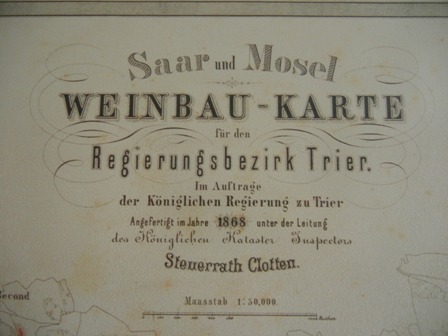
I am very excited. Finally, my historical map of the Mosel river, which I had bought some years ago at Karlsmuehle, a winery cum restaurant at the Ruwer river, was put in a proper frame here in Bangkok. It’s a replica and not an original of course. But I looks very nice on my wall.

Vineyard location and quality map of 1868

The map shows the quality of the terroir in different shades of red. The more intense the red is, the better the quality and the higher the tax category. The Royal Prussian government had produced this map in order to streamline their tax collection.

The newly framed map of the Mosel, Saar and Ruwer

I can already see this map hanging in my house in Australia on our vineyard in Glenburn. I will tell my grand-children where I come from and how much I love my native town, Trier, and the Mosel river.


GranMonte harvest festival 2012

March 4, 2012

GranMonte Vineyards in Khao Yai, Thailand

About two weeks ago, my family was invited by Khun Visooth, the owner of GranMonte Family Estate, to attend this years harvest festival at GranMonte vineyard in Khao Yai, Asoke Valley, Thailand.

The four of us had rented a car and drove up country for a day of fun, food, entertainment and excellent wines.

Rows of vines at GranMonte

The Adam family: Margit, Charlotte, Lucy and me

We were some of the first guests, and used the time to walk around the vineyards and inspect the cellar door. It was a big event, about 120 plus people were expected.

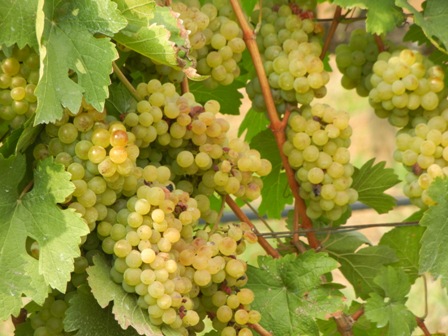
Chenin Blanc grapes

Chenin Blanc ready to be harvested

Syrah grapes

Beautiful bunches of Syrah

I did not take any pictures during the evening meal. We were just to busy enjoying ourselves. And my little camera is not good at night either. The following pictures were taken while we waited for the start of the harvest festival.

The terrace of the restaurant where dinner would be served later

The restaurant

The GranMonte cellar door

The award winning wines of GranMonte

The entrance to the winery

This is where the event started, the entrance to the winery. We had nibblies and various wines, including freshly fermented grape juice, which we call in German “Federweisser”.

Stainless steel tanks

What would wine be without oak.

Selected wines on oak barrel

Khun Visooth and his family thanking the guests

The party was just wonderful. We enjoyed the food and the free flow of wine. The band played nice music even with some songs from my youth.

One highlight of the evening was the release of the ‘2010 Cabernet Sauvignon-Syrah’, the award winning flagship wine of GranMonte. It was poured from 1 1/2 litre bottles. Delicious stuff.

Unfortunately, we had to leave the very same evening at about 10 in order to get back to Bangkok. I had to leave for the airport the next day at 5 h in the morning. The other guests slept in a nearby hotel and could enjoy a second day of play, wine and food.

We made the best of our time. I loved the music and the band as well as the volunteers singing and dancing. We left fully satisfied with a couple of boxes of GranMonte wine in the car.
Thanks Khun Visooth for inviting us.

If you holiday in Thailand you should set a day aside and organise a day trip to Khao Yai. The mountains are beautiful, the trip is pleasant and in the Asoke Valley a few wineries with restaurants are waiting for you; one of them GranMonte.

Address:
GranMonte Vineyard & Wines
52 Moo 9 Phayayen, Pakchong,
Nakornrachasima, Thailand 30320
Tel : +66-81-923-200-7 , +66-84-904-194-4
+66-81-900-828-2 , +66-80-661-755-5
http://www.granmonte.com/


The vineyards of Myanmar II: Lunch at Red Mountain Estate

February 11, 2012

View from the tasting shed: Majectic mountain chain in the back

Red Mountain Estate is located near Inle lake in Shan State. It was the second vineyard in Myanamar I had the chance to visit in January.

I had met its French vintner and wine-maker, Francois Raynal, at the 3rd International Symposium on Tropical Wine in Chiangmai, Thailand in November lasy year. Francois has presented the experience of Red Mountain Estate and the challenges of cultivating and producing “new latitude wines”.

The international wine experts were very positively surprised by the good quality of his wines. Ever since his impressive presentation, I wanted to visit the place. And here I was.

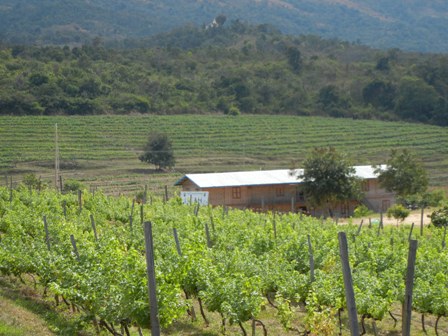
Some of the vineyards at Red Mountain estate

Unfortunately, Francois was not there when we visited the estate. But the staff was very friendly. They took us around the premises and explained the various items. I will show you the modern facilities in another blog entry later. Red Mountain Estate has lots of steel tanks, new oak barrels, a bottling facility and an underground cave for the storage of its wines.

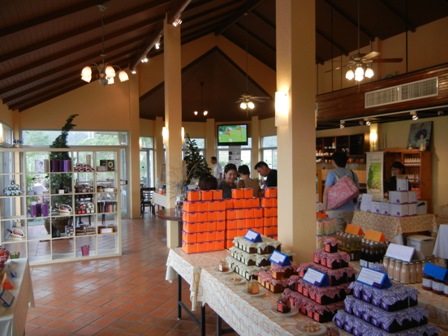
The bottle shop

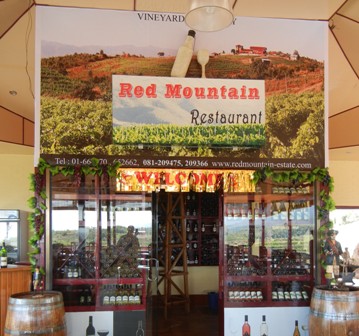
From the “tasting shed”, a roofed veranda open at four side, one has a good view of the vineyards and the surroundings. Red Mountain was set up in 2002, so it is a bit younger than Aythaya. Every year some more vineyards were planted. In 2006 the first wine was produced (about 1000 bottles). Today the annual production is about 120,000 bottles.

The Inle Valley series, a low price vin-de-table

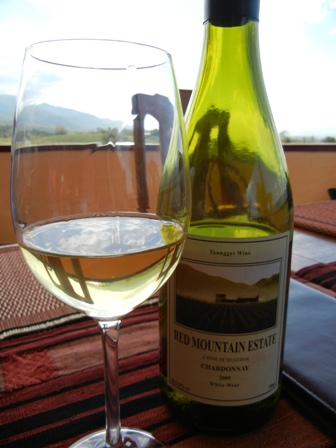
Before lunch, we did a kind of tasting of some of the wines. The Chardonnay, the most expensive one on the list, we had reserved to be sampled with lunch.

We started with the Sauvignon Blanc, then went on to the rose and ended with the reds.

Red Mountain Sauvignon Blanc

The wine we liked best was the SB, fresh and fruity. The only thing I hated was the cheap plastic cork.

The rose

A very drinkable wine, well suited for hot summer days.

The Red Mountain Shiraz-Tempranillo blend

The Shiraz-Tempranillo blend is somehow special. It is a light bodied red with low alcohol and with pleasant fruit flavours and tannins. I guess that it must be difficult to get to the desired style. I consider the wine to be work in progress.

The food was OK. But I did not take pictures of it, so I guess it was not exceptional. There might be some room for improvements here.

Friends who had visited the estate just a couple of months earlier, were pleasantly surprised by the general improvements of the facilities. While we were there quite a few small tourist groups dopped in for a meal and/or a tasting.

Francois had reported about the difficult process of experimentation in a completely new environment and a economy riddled by the international sanctions. Some of the cuttings had to come from Israel, the oak barrels from Hungary, the bottles and corks from China, and so on.

But Red Mountain is a place to watch. The investment undertaken is huge, the staff motivated, the wine-maker committed, and Myanmar is a coming power in South-east Asia. It will take no time to get the tourist flow to come to vineyards and wineries. Myanmar has a lot to offer.

PS: We bought as many bottles of the Sauvignon Blanc as we could carry.

Address:
Red Mountain Estate
Taung Chay Village Group, Nyaungshwe Township,
Southern Shan State, Myanmar.
Tel: +95-081-209366, +95-081-209554
Fax: +95-081-209475
Mobile: +95-09-5174312
www.redmountain-estate.com

Red Mountain Production Co., Ltd
No. 39(A), 7 1/2 miles, Pyay Road,

Mayangone Township, Yangon, Myanmar.
Tel: +95-01-664970, +95-01-652662
Fax: +95-01-652793
Mobile: +95-09-2035632, +95-09-5021843
Email: redmountain.tc@gmail.com
info@redmountain-estate.com
contact@redmountain-estate.com


The vineyards of Myanmar I: Lunch at Aythaya Wines, Taunggy, Myanmar

February 8, 2012

View over the valley from Aythaya Winery

I habe written about the wines from Aythaya Winery near Taunggy, in the Shan State in Myanmar in an earlier blog entry.

Recently, I had the opportunity to visit Shan State and the twon of Taunggy. This gave me also the chance to drop in atAythaya which is located in the foothills of the Blue Mountains, about 5 km on the road leading to Taunggy.

Together with my two colleagues, we went for lunch at the winery cum restaurant. It was a glorious day with sunshine and warm temperatures.

In 1997/1998, Bert Morsbach, a German native, started with this venture and planted the first wine grapes in Myanmar. Though the first attempt was not successful, Morsbach continued his efforts until finally succeeding.

The elevation of the vineyard near Aythaya village is at about 1000 to 1300 m. But there is another vineyard in another location nearby.

The first wines were presented to the public in 2004, and since 2006 another German joined the team at Aythaya Wines: Hans-Eduard Leiendecker, vintner and wine-maker from Bernkastel, Mosel. When we visited, both were not at Aythaya, but the friendly Burmese staff showed us the premises.

Tractor spraying the vines through Bougaivillias and palm trees

We sat on a shaded terrace with a beautiful view over the valley. Some work was done in the vineyards. We also explored some of the surroundings.

A pond with vineyards in the background

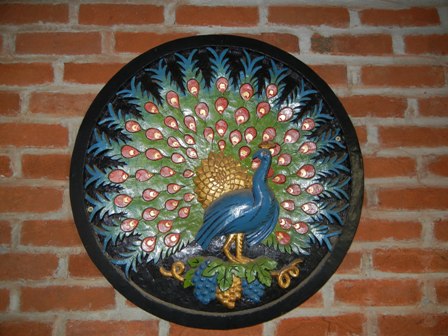
The peakock is the symbol of Aythaya

The Aythaya product range is impressive

I had tasted Aythaya wines before, some of them in Yangon, others had been given to me by colleagues returning from Myanmar. Aythaya’s product range is quite impressive. I like their Sauvignon Blanc (late harvest) best.

Another terrace at the restaurant with vineyard views

The menu is quite simple and straight forward. To my great suprise also “Spaetzle”, a type of South-German dumplings, were on the list. My heart jumped. I had to try them. I was not going to be disappointed. The “Spaetzle” were delicious.

So was the wine, buoyant with tropical fruit flavours, fresh acidity and a pleasant finish.

Suebian “Spaetzele”

The flagship Aythaya wine, I would say

The back label of the Sauvignon Blanc

Beautiful SB in the glass

The Aythaya wine-maker comes from the Mosel river

Of course there is a lot to see in Myanmar. However, in my view nothing beats a visit to a real vineyard where “new latitude wines” are grown and made. The region around Taunggy is very interesting and the nearby Inle lake deserves your visit as well.

The best time to visit is November to February when the nights are cool and the days sunny and warm. Meet you there, one day.

Address:
Aythaya Wines
38G Myitzu Street, Parami Avenue Mayangone T/S,
Yangon, Myanmar.
Tel.: +95-664386, 664756
E-mail::Sales@myanmar-vineyard.com.mm
Website: www.myanmar-vineyard.com

and
Aythaya Vineyard
Aythaya-Taunggyi, Southern Shan States
Myanmar
Tel.: +95-81-24536.


In memoriam: the victims of the 2009 bushfires in Victoria

February 7, 2012

The bush fire season has started again.

This is a good opportunity for reminiscing about the devastating bush fires exactly threes ago which claimed so many lives and caused severe damage to property in Victoria.

Today, services and commemorations will be held in quite a few places.

When you drive through the area where the fires wrecked havoc very little can be seen. After a fire gum trees are reinvigorated and new underground growth is visible everywhere.

I cut quite a few 3 to 5 m tall young trees during the Christmas vacation to make room for other vegetation. We were lucky and did not suffer any serious damage. We put in new boundary fences. Our neighbours have replaced the burned down sheds with new ones.

But not everybody has rebuilt, not everybody has returned. Many rural communities are still in shambles and suffering (Kinglake for instance).

The scars in peoples minds and souls are not visible either. But many are still suffering the terrible personal losses of loved ones.

I salute all of them, the ones who rebuilt and the ones who went elsewhere.


Mosella – home of the best Riesling wines in the world

February 5, 2012

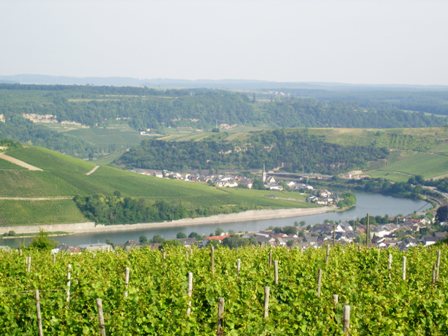
The Mosel valley with the hamlets Riol and Longuich

Maybe because it is Sunday, maybe because that lends itself to some introspection, maybe because I am abstaining from consuming wine for a couple of days, maybe because I have not been to my beloved Mosel for such a long time, maybe…who knows.

Anyway, on this beautiful tropical Sunday in Bangkok and while my Thai vintner friends in Khao Yai, about two-three hours north-east of Bangkok, are busy harvesting their grapes, I am exploring the writings of Decimus Magnus Ausonius (310-393 AD), a Gallic-Roman government official, educator of princes and poet who lived for some years in my home-town Trier.

The Mosel, photo taken from Nittel, the Luxembourg side to the left

Have you heard about Ausonius? No? Well, let me tell you that he was born in Buldigana, which it called Bordeaux today, and where he also died. He had studied rhetoric in Toulouse.

In 365 Valentinian I, emperor of the West-Roman empire, called Ausonius to Trier (yes, my home-town which was the capital of the West-Roman empire for a while) or Augusta Treverorum, as it was called in those days, to educate his eldest son, Gratian, the heir-apparent.

The wine village of Alken, Mosel river and castle

In 371 Ausonius published his impressions (early travel writing) from a trip in 368 which brought him from Mogontiacum (Mainz) through Bingium (Bingen) and Noviomagnus (Neumagen) to Augusta Treverorum (Trier). This work is know as “Mosella” and consists of 483 hexameters describing the land and its people along the road which now carries the name of the poet: Via Ausonius.

The “Mosella” is the only known poem from antiquity describing a single German river: the Mosel. In his poem Ausonius praised the beauty of the river, the lands surrounding it, the fertility of its soils and the industriousness of its people.

The poem has inspired endless other poets, writers and bards until the present times. I like for instance the CD “Mosella” with songs praising the Mosel region by the folk music group “Woltaehr”.
The Mosel river, photo taken from the train near Puenderich

So far so good, you might say, but what about the wine, the famous Riesling you adore so much?

Unfortunately, I did not drink that many Riesling wines from my native Mosel in 2011. I do not know how it happened. I must have explored other wines more often than usual.

However, the ones I tasted where really special and of the highest quality. I fondly remember my visits to Leiwen where I visited Grans-Fassian and St. Urbans Hof in November 2010.

Both wineries produce beautiful Riesling and other wines of the finest quality. Both belong to the association of the top German wine producers (Called VDP). Both win regularly awards. Usually the top wines are in the range of 88 to 96 Parker points, just so that you have a general idea.

Most of the wines I brought with me then, were consumed in 2011, either here in Bangkok or at my mum’s home in Trier. I admit they were the 2009 and 2010 vintages only.

I have written about the two wineries which you can find in earlier blog entries (Grans-Fassian, St. Urbans Hof).

Feel free to explore Riesling wines from the Mosel. It’s worth it.