The top 100 Wineries in Germany

June 14, 2007

Today, I visited the website of the winery Adolf Schick (Jugenheim/Rheinhessen) which I had visited with a group of Indonesian politicians some years ago. The visit and the tasting was a great adventure, because Mr. Schick was so enthusiastic about his wines and his family business with a tradition of winemaking going back to 1590!

Our Indonesian guests were very impressed and so was I. Well, as an Australian boutique vineyard vintner I find a family business going back to 1590 very remarkable. At that time kangaroos were hopping through the forests where today, Two Hills Vineyard is located, I guess.

w_gut.jpg

Weingut Adolf Schick in the heart of Jugenheim

The winery is located in the village of Jugenheim, a very charming place, which I know from own experience. The family does not only produce high quality wines, it also owns the Hotel Weedenhof. The hotel’s restaurant is very good too. We had lunch there. The vineyard consists of 9.8 ha planted with the Burgundy varieties, Chardonnay, Rieling, Kerner, Portugieser and Dornfelder. Needless to mention that the wines won many local and national awards. The wines are very reasonably priced and you will find a wide range of different products including grape juice. All my Indonesian friends all bought some bottles of it.

As in previous years, the Weingut Adolf Schick (www.weingutschickjugenheim.de) was also in 2006 ranked (by the DLG, the German Agricultural Society) among the 100 best wineries in Germany (rank 47). Only 12 wineries from Rheinhessen can be found in the top 100. From my home region, the Mosel, 11 wineries made it into the list (www.wein.de), and only one of them came from Trier (Weingut Deutschherrenhof). I loaded down the list to plan my next excursion to German wineries when I will be visiting again in September. Happy tastings ahead of me, I guess.


Wine Industry in Crisis

May 17, 2007

Today I received information from the Upper Goulburn Wine Growers Association, of whichTwo Hills Vineyard is also a member, about the current problems in the North-East Victorian wine industry. As you all know, the 2007 vintage was volumewise much smaller than earlier vintages. In fact the crushed tonnage was 65% less than average. Because of the adverse conditions (late frosts among them) in 2007, the tonnage projections for the 2008 vintage are about 50% of normal times. This has a far reaching impact on the region, the councils, growers, wineries, consumers, tourists and the people in rural Victoria’s North-East. The livelihood of many producers, wine grape growers as well as wine processors, is threatened.

The Victorian Wine Industry Association has come up with a hands-on training program for those affected. This modular program looks at four main areas:

1. Vineyard Management
2. Business Sustainability
3. Market Development
4. Winery Tourism

For a boutique vineyard such as Two Hills all of these are very important. I am particularly interested in the possibility of future wine grape sales online. As an absentee owner, I appreciate more information about potential sales, demand and prices. Of course this year we had no problem in selling our fruit. Just that we did not have enough of them, and that’s made 2007 a bad year so far, the volume was just no there. It was good news for the receiving wineries, they got first class fruit from Two Hills. The online sales mechanism is most likely to be housed atwww.winesofvictoria.com.au

I also expect that I will have good use for the planned benchmarking guide for small wine businesses and the standardised Gross Margin Calculator. Though we are already exporting some wine, I hope to benefit from the country specific export market guide kit. If anybody of my readers knows any reliable importer, for instance in Germany but also elsewhere, please let me know. Our volumes at Two Hills Vineyard are small. Our single site vineyard does not allow blending with other fruit, which makes the special character of our products. Moreover, ‘exciting to drink a wine every year, for instance Merlot, from the same location and it always tastes different: one tastes the specific year, its climate, the soil….

I am an unlikely beneficiary of the training itself. Have I told you that we have booked our flights to Australia and that we will be in Glenburn from 11 July till 15 August? Come and visit us and have a glass of Two Hills wine.

picture-384web.jpg

Lunching together with family and friends


Old Friends and Good Wine

April 6, 2007

According to Plato “only philosophers have what it takes to venture outside of the cave into the sunlight”. And what do they do there (apart from eating as we know from my last blog entry)?

They drink good wine of course!

When our friend Alan Wall came over from Canberra they other day, he brought with him, as usual, some bottles of good wine. Alan is one of these people who has forgotten more about wine then many of us will ever learn. He has a fine collection of about 3,000 bottles which are stored in his insulated garage.

We started with a single vineyard wine, a Mount Pleasant 2000 Lovedale, Hunter Valley Semillion. The bottle was decorated with five trophies of gold and top gold medal signs. What a wine this was. It displayed honeyed toast and hay aromas but it also showed some lemon and grapefruit character as many young wines do. It could have easily be cellared for much longer but when old friends meet, good wine has to flow. Of course we had food with it, a delicious seafood pasta.

The Hunter Valley, one of the oldest wine regions in Australia, is famous for its Semillions and its Shiraz. Whoever plans to visit Sydney should also include into their program a trip to the Hunter Valley just a 2 hours drive north of cosmopolitan Sydney.

The main dish was grilled beef (on my Weber) and with it we drank a Coonawarra Rymill Shiraz of 1996, a very well aged and harmonious wine of great depth and with a long finish. What a delight this was with it’s spicy peppery character and the blackcurrant flavours.

After the desert we continued with a wine from Sonoma County, a Chateau St. Jean Merlot of 2004 which displayed all the good Merlot charactereristics which we are looking for, deep cherry and plum aromas, with good texture, some weight in the mid-pallate and a long finish.

Of course the company was what really counted. Drinking wine we discussed about electoral systems, political party and democracy development and the future of the young Indonesian democracy. Life is just too short to drink bad wine.

sa500267forbloga.jpg

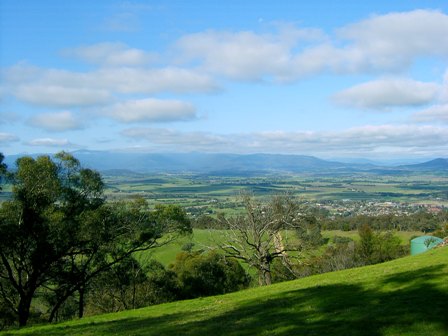
The Yarra Valley in Victoria


The Treverer

February 4, 2007

The first time the river Mosel is mentioned in a written document is the account of Gajus Julius Caesar in his De Bello Gallico, IV in 55 B.C. where he describes his battle and the subsequent victory over two German tribes, the Usipeter and Tencterer. Around the same time we also learn about the original settlers in the Mosel river valley and around Trier, the Celtic Treverer.

“The Treverer are cleverer” sounds a line in a popular song of a local rock music group called “Leiendecker Bloas”. But not only that. The Treverer were feared by the Roman invaders as well.

Treviros vites censeo. Audio, “capitales” esse; mallem, auro, argento aeri essent.

This is what Marcus Tullius Cicero wrote to a friend during Caesar’s war against the Treverer in about 55 B.C. In a free translation that reads as “better avoid the Treverer; they go for your throat. I wish those guys would rather work as silver and gold smiths”. The Romans in fact had some troubles in controlling the Celtic population of the Mosel valley. In 69/70 A.D. the Treverer revolted against the imperialists from Rome but were defeated again. The Roman general Petilius Cerealis did not lose his composure in battle despite the fact that his cavalry was already wiped out, his camp fortification destroyed and the walls overrun by the fierce Celtic fighters from the Mosel.

But over the decades that followed the Celtic swineherds were transformed into vintners and the people thanked the god of wine – Sucellus – for this. The Treverer were known to be hungry for fame, quarrelsome and rowdy. They were also known to be big drinkers, more so than even the Germans. The many drinking competitions they held are ample proof of their favourite pastime. The ones who could not drink were despised as weaklings. That people could call themselves lucky if they got away alive from those fierce drinking competitions, was a common notion. That’s how it was: The good old days. These times have long gone and modern man does of course some drinking here and there but we are all more or less domesticated in some way or another. We go to work 5 days a week. We do sports in our free time, watch TV, send sms and e-mail, write blogs and so on.

Joseph Roth in “The Radetzky March” describes the changes at the turn of the 19th to the 20th century but his description can certainly also be applied to earlier times and ages.

Everything that grew took long to grow
and everything that ended took a long time to be forgotten.
Everything that existed left behind traces of itself
and people then lived by their memories,
just as we nowadays live by our capacity to forget,
quickly and comprehensively.

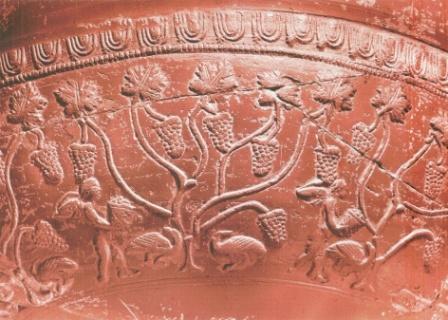
Schale

Terra Sigillata bowl found in Trier (Karl-Josef Gilles: Bacchus and Sucellus, Briedel 1999)

Vinum vires is what the Romans said, wine gives power! My suggestion for the day: open a bottle of your favourite wine and enjoy the Sunday.

Bene tibi sit “Wohl bekomms” or To your health, salute, cincin and so on

————————
Reading tip: Edgar Christoffel: “Mosel und Wein – Stimmen aus zwei Jahrtausenden”, Trier 2003