Old friends, wine from the Mosel and other culinary delights

September 16, 2007

What a weekend this was. After my delightful tour along the Mosel River I finally reached my destination Trier, the 2,000 years old Roman town which I also call home. Saturday I should meet Thomas Weber, an old school friend from high school times at Hindenburg Gymnasium. It was about 33 years ago that we met last time. We were brought back together by another school friend, Juergen Olk who lives in Eitelsbach near Trier. Juergen told Thomas about our vineyard in Australia and through the shared love for wine we should be reunited. Thomas is a wine aficionado. He has written two wonderful books (wine as a gift) about wine (www.wein-als-geschenk.de). He had promised to organise a wine tasting for me (more about the tasting in my next entry). We met at the Porta Nigra, a Roman city gate and landmark of Trier. He introduced me to Birgit and the three of us had a cappuccino and later a “Viez” (a local variety of an apple and pear cider, very sour normally). It was a lively reunification and Thomas proposed to have dinner together at his parents place.

And dinner we had, the five of us. It was a culinary tour through many varieties of bread, cheese and olives. The wines were all from the Mosel region. We started with a dry 2005 Riesling from Staatliche Weinbaudomaene Trier, Rotliegender Schiefer (vines planted on red coloured slate), 12 Vol%. Nice and fruity wine, with typical Mosel Riesling character, citrus aromas, crisp and minerally. Then we moved to an off-dry wine from the Saar River, a 2002 Ayler Kupp, Riesling Auslese produced by Weingut Weber, Margarethenhof. The wine has only 8.5 Vol% alcohol; I guess 15 g/l sugar, a wine of great elegance and balance. From here we moved to a kind of new cult wine. The young vintner Andreas J. Adam (not related to my family) who took over some neglected vineyards from his grandfather, has recently become a new star in wine circles along the Mosel. We tasted a 2006 Dhroner Hofberg Riesling, a dry wine of great finesse. This locations is one of the best along the Mosel but was somehow forgotten until recently. The Weingut (winery) Andreas Adam is a boutique vineyard with about 1 ha under vines and a production of about 1500 bottles a year located in the small town of Neumagen. The German wine critics are full of praise for the young vintner and his excellent Riesling wines. German web entries give some idea about the character of the wines. Interesting is also the winerys own webpage which has the following web address: www.aj-adam.com.

aylerkuppfromschoden.jpg

Ayler Kupp in the background, Schoden in the foreground seen from the hights

To an Australian vintner wine prices for these excellent Mosel wines are a shocker. The “Weinbaudomaene” price list shows the dry Riesling (Staatliche Weinbaudomaene Trier, Avelsbacher Hammerstein, 2005 Riesling Kabinet, dry, 11 Vol%) for 3.20 € (!) per 0.75 l bottles. Other Rieslings do not cost more than 5.50 € which corresponds to 5 until 8 A$ cellar door prices. What heaven on earth the Mosel is for wine consumers. Even the Andreas Adam Riesling is available for about 12 € only. In Jakarta the minimum one has to pay for a reasonable Australian Riesling is about 10 €/bottle and these wines are hardly equivalent to the simplest of the Mosel Rieslings. In order to compete with those wines, we Australian vintners have to dig deep and improve wine quality and our cost structures considerably.

The shock of my life should soon follow when we tasted some Mosel reds. Yes, there are more and more red wines from the Mosel to be found, unbelievable. Over the last couple of years the acreage for Pinot Noir and Dornfelder is increasing continuously, reaching almost 10% of the total acreage under vines. We started with a Pinot Noir from Mehring, producer Alfons Sebastiani. Great drop displaying all the varietal characters of a good and earthy Pinot Noir. I remembered the many vineyards in the flats from my trip along the Mosel the other day but did not expect such beautiful wines. The Dornfelder we drank after the Pinot was not to my taste. I was also not impressed by the Acolon, a kind of “hybrid” variety (cross between Helfenstein x Heroldsrebe – Blauer Lemberger and Dornfelder) which produces deep red wines of a rather “tarty” character. But the Pinot was wonderful and so the evening ended with delight. Thanks to the hosts, the Weber family for their great hospitality and the good company.

Furthermore, Thomas informed me that the Mosel used to be a prime producer of red wines (I did not know this and can you believe this!) until the times of Kurfuerst (elector) Clemens Wenzeslaus of Saxonia (1739-1812) who became archbishop of Trier in 1768. Wenzeslaus issued on 30 October 1787 a new ordinance for the improvement of wine quality in his dominion along the Mosel River. The “bad” grape varieties, mainly reds and high acidity whites were to be replaced by “good” varieties, mainly Riesling vines. This ordinance was rigorously enforced by his administration and it was the kiss of death for most red varieties along the Mosel for many decades to come. The recent revival of red wine production is therefore not something completely new but rather a reminiscent of older days. I will have to try more of the Mosel Pinot Noir to see how they compare to Pinot Noirs from the Yarra Valley and the Upper Goulburn Wine Region (www.uppergoulburnwine.org.au) and of course my own.

On Sunday we had our usual lunch at the “Landgasthof Kopp” in Hentern (www.landgasthofkopp.com) near the Saar where we enjoyed good German country style food and local wines. Dinner was scheduled to be had at a gourmet restaurant in Trier called “Bagatelle” in “Zur Lauben”, a famous location in Trier next to the Mosel River with a beautiful view of the river and the red sandstone cliffs at the opposite side. Learn more about this in my next entry.
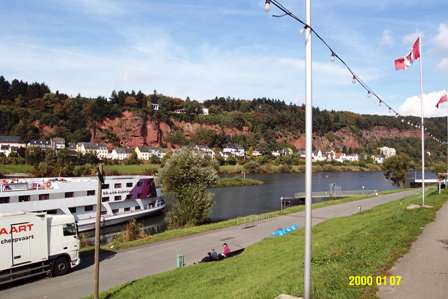
trier-4web.jpg

The red sandstone cliff “Weisshaus” from the “Zur Lauben” side of the Mosel River


At Yering Farm

September 7, 2007

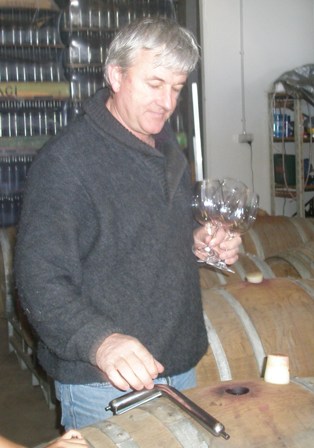
As in previous years, our 2006 Merlot was made by Alan Johns, owner and winemaker of Yering Farm Wines. We were there to do some tastings before bottling started. From 18 old-French oak-barrique barrels we took samples of the young wine. It showed all the varietal character of Merlot, had a deep red colour, a bouquet of ripe red forest fruit, good structure and a long finish. We were very satisfied with the quality of the new drop from Two Hills Vineyard. The wine from the barrels was pumped into a steel tank, blended and then filtered. It is in bottles now and we will release it in December.

faesser1.jpg

2006 Two Hills Merlot in old oak

alan2.jpg

Alan getting ready for the Merlot tasting

adamtastersweb.jpg

The Adam family tasting crew

Yering Farm Wines is a great place to visit in the Yarra Valley. I love the rustic tasting shed. It has a great atmosphere, not the rather sleek and sterile type foften preferred by urbanites, but one which reminds any visitor that grapes are grown on a real farm, in a real vineyard, in earth and soil and have not fallen fully pressed into bottles out of nowhere. Alan Johns Yering Farm series wines are delicious and brilliant for easy drinking especially in warm summer. For advanced drinkers, he has various award-winning wines at hand, for instance Yering Farm Chardonnay (see the various awards at http://www.yeringfarm.com.au). In 2007 the late frost wiped out all of Alan’s fruit. If you are in the Yarra Valley don’t forget to drive by for a tasting.

yeringfarm-web.jpg

Yering Farm Vineyard


Vineyard profile: The Mayer Vineyard

September 6, 2007

The “Mayer Vineyard” is located in the Yarra Valley, about halfway between Healesville and Yarra Junction on a steep slope overlooking the surrounding valley. The vineyard belongs to the Mayer family, Timo and his wife Rhonda. They and their three children (Rivar, Ruby and Ivy) live in a beautiful, rammed earth house on the top of the hill.

mayerfamily.jpg

The Mayer and the Adam families (Rivar missing from the picture)

Timo is the winemaker cum viticulturist at Gembrook Hill, a well-known boutique vineyard at the far southern and cooler end of the Yarra Valley. He is famous for his fine palate and a much sought-after wine consultant.

His own vineyard covers about 6 acres (VSP trellising, cane pruned, row spacing 2.5 m, vine spacing 1.5 and 0.75 m) and his wine label is called “Bloody Hill” which is also “written” or should I better say “slashed” (by a tractor slasher) into the remaining paddock in between the two vineyard blocks. Timo produces a “Bloody Hill” Chardonnay, a Pinot Noir and a “Big Betty” Shriaz. The wines can be obtained from various retail outlets (for instance the Wine Hub at the Yarra Valley Dairy or the Winehouse at Southbank in Melbourne) and by mail order. Timo makes also a very delicious Rosé. The total yearly production is about 12 tonnes of fruit which is ‘transformed’ into about 700 cases of wine.

mayervineyard.jpg

One part of Bloody Hill, the Mayer Vineyard

We were lucky to have had Timo make our 2002 award winning Sauvignon Blanc. However, we have more in common than a love for wine. Timo is also of German origin. He is the son of a farmer from the beautiful lands of the Suebians (Schwaben), home to a German tribe in the South and he cherishes many old local traditions. During a recent birthday celebration we were involved in a breathtaking collective “move the table” ritual, nothing spiritual of course but rather a rustic rural drinking game (with all the glasses and the crockery standing on it), where we physically lifted the table to above our heads chanting merryily, entirely in the Suebian language. All this went very well in the Australian setting of multiculturalism.

My suggestion: Check out the wines now and fill your wine cellar to capacity before they become a cult wine and very, very expensive.


Hanging Rock Winery

September 4, 2007

hangingrock.jpg

During our recent holiday in Australia we once strayed from our home turf. We went west towards Bendigo. On our way back from a visit in Castlemaine, we came through the Macedon Ranges wine region where we had never been before. This was a perfect opportunity to get to know some of the wines there. I had always dreamt of visiting the famous Hanging Rock Winery (www.hangingrock.com.au) whose webpage I had visited before. Visiting ‘virtually’ is one thing, but nothing beats the real thing. So we pulled up for a tasting. The winery is situated near the small settlement of Woodend. From the cellar door one has a wonderful view of the famous Hanging Rock, a major tourist attraction of the region.

hangingrock3.jpg

The Hanging Rock seen from Hanging Rock Winery

It was a grisly day and we were cold when we entered the cosy tasting room. Andrew showed us some of the outstanding wines produced at the Jim Jim Vineyard . The Macedon Ranges is a cool climate region, producing some of the finest sparklings in Australia. We also tasted wines made from grapes from the Heathcote area, another well known wine region of Victoria. In sharp contrast to the Macedon Ranges, Heathcote is hot and therefore ideal for red varieties such as Shiraz.

We talked about all kinds of things; among others the challenges of the Asian, especially the Chinese, wine markets. We had a great time and bought a few wines, from the Rock range, the premium range (yellow label) and the super premium range (black label). Some days later, together with friends, we decided to sample the 2003 Heathcote Cambrian Rise (which won a gold medal at the 2007 Korea Wine show). It is indeed a very impressive wine.

From a brochure called milestones, I learned many interesting facts about the winery and its owner, John Ellis, and his family and friends. 2007 is a special year for the Ellis family and Hanging Rock. It marks the 25th anniversary of the winery and the 40th year of John Ellis in the wine industry. There are more causes for jubilation among them the 21st vintage at Jim Jim Vineyard and the 20th for the Heathcote Shiraz. In 2007 John Ellis was also elected the Chairman of the Small Winemakers Committee of the Winemakers federation of Australia.

hangingrock2.jpg

Lucy, Charlotte and Margit with a case of treasures from Hanging Rock

We did not try the sparkling (we were in red wine mood, I reckon) but the Rock Macedon Cuvée XI and the Macedon LD Cuvée VI were rated by James Halliday’s 2007 Wine Companion at the top of his “Best of the best” rankings. Congratulations. The winery is certainly worth a visit. Its not far from Melbourne. Have a great time there and say hello to Andrew.


Vineyard profile: Nenagh Park

August 28, 2007

The most important person to our small vineyard was and is Steve Sadlier from Yarra Glen who convinced us many years ago to plant the first grapes on Two Hills Road in Glenburn. Ever since, he has been our viticulturist consultant. But Steve Sadlier has not only a consultancy business, called “vineadvice”, but also a vineyard of his own. Its name is Nenagh Park. He choose the name in commemoration of his great-grandfather, also called Stephen Sadlier, who came from Ireland to Australia in the mid 19th century from the town of Nenagh in the county of Tipperary.

steve2.jpg

Steve Sadlier

The Sadlier family moved to Yarra Glen more than 100 years ago. The original homestead burned down in the bushfire of 1939. Steve and his family of six (wife Meagan and the children Bronte, Lou-Allan, Millicet and Heidi) live in the little house which was erected as replacement for the lost homestead. Of the original family land, Steve farms about 60 acres of which 21.5 acres are under vines. The vines are between 10 and 17 years old. Before 1997 Steve was the chief viticulturist at Yarra Ridge which is just across the road from his own vineyard and the Sadlier property.

The Yarra Valley is one of the most famous wine regions in Victoria. Outstanding cool climate wines are made here, especially Chardonnay and Pinot Noir. In the last couple of years late frosts destroyed most of Steve’s fruit. In 2002 only two tonnes of fruit were harvested from 21 acres; in 2006 the harvested volume was 32 tonnes which compares to a normal year of 75 tonnes. Severe frosts usually do not only have a negative impact on the fruit in the year the frost occurs but also the subsequent year. Usually, volumes are down until the vines recovered.

steves-chardy2.jpg

The Chardonnay block

Steve grows Chardonnay (about 9 acres), Pinot Noir (7.5 acres), and to a lesser extent Merlot (0.75 acres), Cabernet (2.5 acres) and Sauvignon Blanc (1.3 acres). Some of his fruit is contracted on a long term basis by one of the oldest wineries in the Yarra Valley, Yering Station. Steve sells mainly the fruit but in some years produces up to 250 cases of his own wine, usually made by Alan Johns of Yering Farm who makes also our wines. He sells his own wine as “clean skins” but plans are underway to develop a label and for the more distant future the vision is to develop the old house into a cellar door-cum-bed and breakfast.


Single-vineyard wines

August 26, 2007

According to an article in The Age (18.08. titled “The singles scene”), Steve Flamsteed, the winemaker of Giant Steps in Healesville in the Yarra Valley allegedly said that “the future is in single-vineyard wines”. In fact one of his own single-vineyard wines, a 2005 Sexton Chardonnay, only recently won a gold medal at the Royal Melbourne Wine Show. And his second single-vineyard wine, a 2005 Terraford Chardonnay, won a silver medal at the same event.

It is easy to be a supporter of single-vineyard wines when you have only a single vineyard, like me (Two Hills Vineyard has only one site). However, where I come from, the Mosel River valley, single vineyard wines are very common, rather the rule than the exception. It comes as no suprise to me that if you have selected the perfect site and planted the right grape variety, your fruit and with it your wine must be exceptionally good. The proliferation of the industry and also the expansion to second grade locations must have a negative effect on quality, which will show somewhere.

Well, the vintners at the Mosel had about 2000 years to select the right sites and the right varieties. We in Australia are not as fortunate as far as the time frame is concerned. But our entrepreneurial spirit, our love for quality and the beauty of the land allow for exceptional finds and with it for exceptional wines. Its great to contribute to this, especially if you are only a miniscule vintner with a very small and rather new vineyard in the Upper Goulburn Wine Region. Let’s move it.


Vineyard news – Two Hills in winter

August 21, 2007

thwinter07.jpg

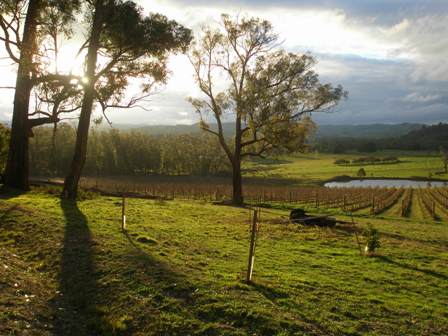
Victorian winter and Two Hills Vineyard

I would like to bring you up to date on some recent developments. The dry season seams to be over in our neck of the wood. When we arrived at Two Hills Vineyard our small dam was full and the larger “irrigation” dam was slowly collecting runoff water from the surrounding hills. However, when I was digging out some blackberry roots I quickly discovered that the ground was still rather dry. Only about the first 5 cm of soil showed some moisture but below there were hardly any to find; not quite dry as a bone but still too dry. We will need much more rain in order to refill the ground.

unproonedwines.jpg

The un-pruned vines

Another exciting news is, that we are extending our vineyard. We are in the process of planting 1 ½ acres of Chardonnay (clone P 58). The posts are almost in. Peter Thwaites could not finish the job because it was too boggy. The spacing is 3 meter between the rows and 6 meter between the panels. Pro panel we will plant 4 vines (1.5 m per vine). We have 20 new rows of different length but about 1200 vines should find a new home at Two Hills Vineyard. We have to be patient though. Experience suggests that we will have to wait another four to six years before we can drink the first drop from this site.

postschardonnay.jpg

neblock.jpg

The new Chardonnay block in the making


Sauvignon Blanc

July 10, 2007

My morning newspaper, the International Herald Tribune, carried the other day an article summarising the tasting of 25 Sauvignon Blanc wines from New Zealand. Sauvignon Blanc is one of my most favourite white wines. The results were interesting. Only about 10 of the 25 wines found the approval of the tasting panel (it was a New York Times event of the dining section). For the judges, the tasting was a disappointment. They were looking for the bold, pungent refreshing SB but found that too many wines were dull, too sweet or simply wishy-washy or as Eric Asimov put it “commercially inoffensive”. My favourite SB from New Zealand, Cloudy Bay came up third (behind “Villa Maria” in number one position), described as “quieter than the top wines” but still “bold, zesty and delicious”. In my bottle shop in Jakarta it retailed for 40 US$ the bottle last week. Gone are the days when I had to pay only 18 US$ for this most delicious white.

Mr. Asimov is of the opinion that many producers have decided to push quantity at the expense of quality and that they are over cropping (too high yields per acre). I learned something else from the article: that in New Zealand wine producers are allowed to add sugar or acid to make up for “green” (not fully ripened) grapes, as we say. In Australia, we are not allowed to engage in this technique or should I say “manipulation”. Next time in the bottle shop it will be much easier for me to walk away from the dear SB from Marlborough and turn to some cool climate Sauvignon Blanc of Australian provenance. I might be enticed to make some Two Hills Sauvignon Blanc again in 2008. Kinloch Wines (www.kinlochwines.com.au) Sauvignon Blanc of 2006 is sold out, as I learn from their website. Guess who provided some of the fruit for this most delicious wine from the Upper Goulburn River (www.uppergoulburnwine.org.au)?


Merlot Night

July 2, 2007

Looking at the calendar, we were alarmed that quasi “half of the year is already over”. Time flies, it seems. What have we been doing? How could it go so fast? Consequently, we spontaneously decided to celebrate this event with a wine tasting on the last evening inJune.

Merlot was our choice of the day. Our wine cellar had only two brands left:

● a 2003 Hungerford Hill, Orange Merlot from the Hunter Valley and

● a 2004 Two Hills Merlot from the Upper Goulburn Wine Region.

The Hunter Valley (www.hunterweb.com.au) is one of the oldest wine regions in Australia. Its flagship wines are Semillion and Shiraz but it has also pockets of cool climate sites. The Upper Goulburn Wine Region (www.uppergoulburnwine.org.au) is a significant cool climate grape growing area in Victoria with quite remarkable diversity of varieties and wine styles.

We had the two wines after dinner with a most delicious cheese, a Brie “au lait entier”, processed according to traditional methods by “Paysan Breton” and fresh baguette.

Both wines come from cool climate regions. Hungerford Hills Merlot belongs to the regional series of the brand (www.hungerfordhill.com.au). It is produced in Orange in New South Wales, a rather new location on the Australian wine map (established in 1983). Formerly it was know as the Central Highlands centred on the slopes of Mount Canobolas which is an important fruit producing area (apples, pears, cherries). The first commercially planted vineyards were established in the 1980s. The location of some of the vineyards for this regional wine is above 600 m altitude.

The 2003 vintage is under cork whereas the Orange Merlot 2004 is already under metal capsules. Both are available at duty free bottle shops in Jakarta, retailing for about 23 to 26 US$ per bottle. The internet order form of the winery shows 28 A$ per bottle for the Merlot (22.40 A$ for wine-club members). Whereas the 2003 bottle does not show wine awards stickers, the 2004 shows a gold medal and other distinctions at the 2006 Sydney International Wine Competition. The winemaker is Philip John.

As you probably know, Two Hills Vineyard also produces cool climate wines. The Geographical Indication (GI) for the Upper Goulburn Wine Region was only recently identified (formerly also called Central Victorian High Country) but grapes have been grown there since more then 30 years. The vineyard is a single site on a slight northerly slope. The 2004 vintage is under a DIAM cork closure. The wine is made by Alan Johns, the owner-winemaker cum viticulturist of Yering Farm Wines in the Yarra Valley (www.yeringfarm.com.au). Retail price at the Old England Hotel (www.oldenglandhotel.com.au) in Heidelberg, Melbourne should be around 15-17 A$/bottle. It can also be obtained at the upcoming Upper Goulburn Wine and Food Expo (Saturday, 11th August, in Alexandra Town Hall).

picture-076webmerlot.jpg

Tasting notes
Both wines show excellent dark crimson red colours. The nose of the Hungerford Merlot shows complex aromas of wild berry fruit with a slight nose of liquorice and nutty French oak. The wine is a blend from different vineyards in Orange. It is medium bodied, has a soft finish and displays balanced tannins.

All wines at Two Hills Vineyards are hand crafted. The grapes for Two Hills Merlot are coming from a single site, the vines are hand pruned and the grapes are hand harvested. The ‘2004 Two Hills Merlot’ also displays ripe wild berry fruit but not the liquorice and nuts flavours. The wine is very subtle, elegant with great finesse. It is medium bodied, dry, with good acidity, and a long finish. Its tannins are firm and give the wine a fine balance.

Hungerford Hill, Orange Merlot 2003
14% alcohol, matured in 60% new and 40% old French oak for about 15 months

Two Hills Merlot 2004
13.5 % alcohol, matured in 90% old and 10% new French oak for about 18 months


Boutique Vineyards

June 27, 2007

Where Two Hills Vineyard is located, among the beautiful rolling hills between Yarra Glen and Yea at the Southern edge of what is commonly known as the Upper Goulburn Wine Region (www.uppergoulburnwine.org.au), there are many more small and very small vineyards and wineries out there.

Definitions of what a boutique vineyard and/or winery are vary. Some think the total tonnage for the wine label should be below a certain limit (for instance a maximum of 250 tonnes crushed per year). Others see the limitation of yields as crucial (for instance less than 3-4 tonnes per acre). Specialised organisations of producers and wine merchants support the Boutique vineyard sector (for instance www.boutiquewineries.com.au) and cater to their needs. The size differential is usually compensated by outstanding product quality. Hand crafted, artisan wines from Boutique vineyards and wineries can certainly compete with mass-produced, industrial products.

thv-03-valley2web.jpg

Two Hills Vineyard in Glenburn

What they all have in common is the limitation of overall quantity for the sake of quality.This is exactly what we at Two Hills are attempting to do. Less is more for us. Our philosophy is that only excellence is worth being produced. This is also our economic niche which hopefully allows us to survive in this very competitive market. Fortunately, wine drinkers always want to try something new, they want to explore new opportunities, find new challenges. We attempt to serve this urge. And since every year’s grapes are different also the wines we make out of these grapes are different. We only use high quality fruit. In order to get to the 3 tonnes yield per acre we have to drop a lot of fruit in order to ripen the remaining one to the highest standard. Steve Sadlier of Vineadvice, our viticulturist, makes sure that the standards are high and consistently maintained.

Another aspect of Two Hills Vineyard is that it is a single site (in German: Lagenwein). Therefore the “terroir” matters to us more than to others. Our wines are made in the vineyard. There is no blending going on. What we get at harvest time, is what we process. We do not buy grapes from other locations. This is why we devote all our times and effort to the production of clean and healthy, top quality fruit. The wines we produce are witness to this philosophy. Alan Johns, our winemaker at Yering Farm (www.yeringfarm.com.au), has the passion and devotion to producing top wines. The Merlot 2006 which we are going to release soon will prove this. Unfortunately we have only a couple of thousand bottles of this treasure.