Welcome 2008 – The very first day

January 1, 2008

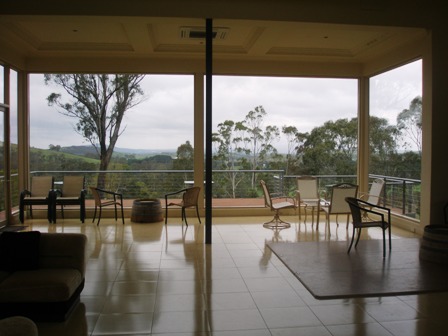
Happy New Year to all of you. I am having breakfast with my daughters Lucy and Charlotte. We are sitting at a large table in Giant Steps Winery (www.innocentbystander.com.au) in the middle of Healesville and are enjoying this very first morning of the New Year. It is busy here, families eating out and meeting friends, waitresses running from table to table, beautiful guitar music in the background. People are recovering from last nights new years eve celebrations. A large Christmas tree occupies the middle of the restaurant.

Giant Steps Winery (I will write more about this winery later in a separate blog entry) provides for its guests wireless internet connections which is fantastic and this is why I can write this very first blog entry of 2008. We had a wonderful time in Australia so far. It started with the wedding of Michael and Helen on 16 December, a very merry and happy occasion which sat the tone of the rest of our holidays on the vineyard in Glenburn.

pc160314w.jpg

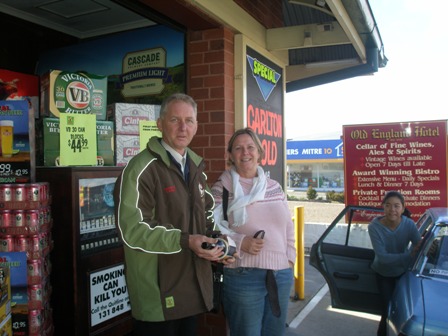
At the wedding (I hold a bottle of Bitburger Beer!, my “home” beer from Germany)

We celebrated Christmas in the vineyard with family, my brother-in-law Michael and his new wife Helen, and our friends Florian and Nelly from Jakarta. It was peaceful and very homely, intimate. The weather was splendid and we enjoyed the nature and scenery of Two Hills and its surroundings.

Needless to say we met droves of our friends and had a lot of visitors ever since, hopping from one meal to the next, gobbling up huge amounts of delicious food and drinking gallons of wine from our own vineyard and wines from wineries of the Upper Goulburn and the Yarra Valley.

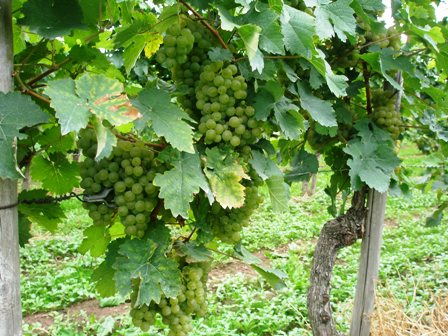
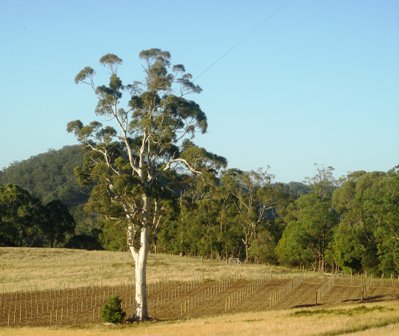
All is fine at Two Hills Vineyard. The grapes look very good. Despite a freak hail storm on 22 December, which fortunately did not do much damage, the 2008 crop shows great promise. The next vintage could be the best ever. Another good news is that all the grapes are already sold to a keen wine maker who knows the outstanding quality of our grapes. We might even enter a long term arrangement and deliver fruit to this winery on a continuous basis. This is bad news for our own wine-making. The good news is that we still have a couple of thousand bottles of the 2006 Merlot vintage in our hands which we have not released as yet. The few bottles we tasted show all the good qualities of our earlier vintages. You do not have to worry though, we will bring this wine to the market soon.
imported-photos-00216w.jpg

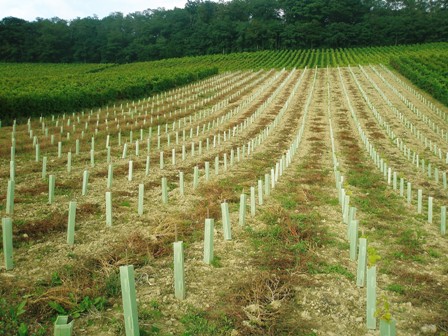
The newly planted Chardonnay block

I hope your new year started as good as mine. I will be busy with vineyard work in the coming few days before returning to Jakarta. See ya later mate.


Wine and vineyards in Trier-Olewig

November 19, 2007

pa020110w.jpg

The wine village of Olewig near the city centre of Trier

Olewig is one of four villages within the city boundaries of Trier were vines are grown till today (the others are St. Matthias-Feyen, Krüenz and Pallien) since Roman times. Vines, wine production and wine trade were basic features of city life, its culture and its economy. Many famous poets eulegized the beauty of the town (among them Goethe of course). In the drinking song of Carmina Burana of the 13th century one verse praises the city of Trier and its comforts, the dedication of its citizens to “the vines and the wines” and the culture of enjoying the fruits of the vintners labour.

One of my many walks around the town brought me to Olewig, a village nestled between two steep hills in the South-East of the town. Early in the morning I sat out from the banks of the Mosel river, from my parental home in “Britannia” (Britannien), as our neighbourhood is called. Its the area where the old city harbour had been, roughly between the two cranes to unload barges moored on the river.

pa020090w.jpg

The view of the city from Petrisberg (left: Roman Basilica, Cathedral, and in the background the red sandstone cliffs)

I climbed the gentle slopes of the Petrisberg and turned South where the wine appreciation path (Weinlehrpfad) starts. This walk leads the wine interested rambler along ruins of Roman tombs through vine gardens and vineyards to the village of Olewig. I did not enter the village but instead walked in a long circle through the vineyards and returned to the Petrisberg where one has a wonderful view of the old city. It was vintage time and crews of grape pickers were busy harvesting.

pa020083w.jpg

The start of the path/walk: Between Sucellus (left) and Bacchus (right), the Celtic and Roman gods of wine respectively

The poster says that the wine appreciation path is about 1500 m long. It leads through the open fields of the Trier wine district and ends in Olewig. Along the way large posters are displayed educating and informing the wanderer of the various historical, cultural and technical aspects related to the vineyards and the production of grapes. One of the signs gives the total area under vines as 373 ha. The number of full-time vintners is about 100 family farms. Main grapes grown are Riesling (86 %), Rivaner (8 %), Pinot Blanc (4 %) and Pinot Noir (2 %).

pa020088w.jpg

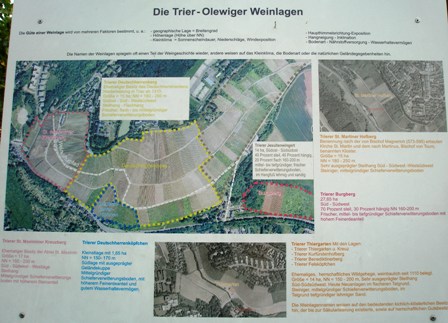
The map of the Olewig “Terroir”

The main locations of Trier-Olewig are

– St. Maximiner Kreuzberg
– Deutschherrenberg
– Deutschherrenköpfchen
– Burgberg
– Jesuitenwingert
– Thiergarten unterm Kreuz
– Thiergarten Felsenkoepfchen
– Benediktinerberg
– Kurfürstenhofberg
– St. Martiner Hofberg

pa020102w.jpg

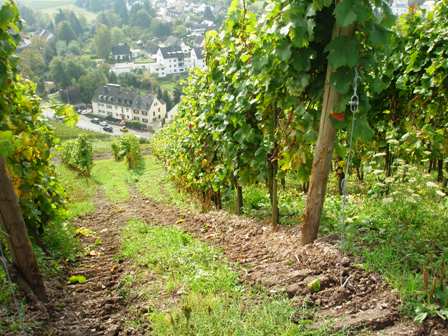
The slopes are steep, only caterpillar tractors are able to scale them (in the background Olewig)


DAGERNOVA: wine co-operative at the Ahr

November 18, 2007

I have already written about my visits to the Ahr wine region. Vine cultivation has a long tradition in the Ahr valley going back to about 770 AD.

d1000176dagernova4.jpg

The above sign reads as follows: “Happy humans and good wine should always be united together”. I found it on the wall of the cellar door of the DAGERNOVA Wine Co-operative in Dernau, Ahr valley. DAGERNOVA is the latin name of Dernau, a quaint little village in the Ahr valley and the seat of the co-operative.

One of the interesting phenomena in the German wine economy is the ‘wine co-operative’, usually the association of grape and wine producers to jointly make and sell their wines or some of their produce.

Co-operatives are very common in German agriculture and have a long and winding history as an institution. Today some of the most powerful and efficient wine producers in the wine sector are of this type. The economic advantages of co-operatives are obvious: the larger scale of purchases of inputs and the sale of produce allows a much better bargaining position in the market. One of the few downsides might be that top individual producers might find higher prices for their top wines outside the co-operative umbrella but cannot dispose of their minor qualities without it. This conflict of interest might severely damage the prospects of co-operatives’ business success.

Therefore true support and a certain discipline on the part of the members of the co-operative is necessary to make it successful. Competing strategic goals are to be avoided, instead synergies need to be developed. Professional wine making and marketing are a precondition for the making of high quality wines, wines which can also enter into the premium and high price segments of the market.

d1000172dagernova2.jpg

The cellar door of DAGERNOVA in Dernau

An excellent example for this segment of the German wine industry is ‘DAGERNOVA Wine Manufactory’, a co-operative of the Ahr vintners. On its webpage the co-operatives (www.ahrwinzer-eg.de and www.dagernova.de) motto is cited. It reads “tradition without dust”; and in fact the co-operative has a long tradition but is modern in nature. Its was founded in 1970 when two of the local vinters associations merged and created this new entity. In the years following many more vintners and their associations joined. From 1993 onwards the co-operative was operating under “Ahr Winzer eG” which translates into ‘Ahr Vintners registered co-operative’. Today the members of the co-operative cultivate about 170 ha of vineyards. Needless to say that the co-operative won many awards and medals for its wines. In 2006 for instance the German magazine ‘Weinwelt’ (wine world) awarded DAGERNOVA ‘the best Riesling producer of the Ahr’ title. Gault Millau awarded ‘one bunch’ (eine Traube).

When we visited the co-operatives cellar door it was buzzing with customers. Every sunny autumn weekend is seen by many in the surrounding towns of the Rhineland and the Ruhr as an excellent opportunity to take a long Sunday walk along the Ahr river and to visit wineries and cellar doors. Although Ahr wines are more pricy than wines from many other regions, the Ahr has successfully succeeded by justifying this by rigorous emphasis on quality.

d1000173dagernova3.jpg

The Ahr valley is German red wine territory. Here a bottle of Regent, a “new” red variety.

Needless to say we tasted quite a few bottles of excellent red wines of the base (up to 7 €/bottle) and primium segements (up to 9.5 €/bottle). What they call ‘cult wines’ starts at 11.85 €/bottle. I acquired a “2006 Pinot Noir Spätlese” which I gave to my friend Ulrich Hillejan and where I anxiously await the “tasting results”.

ahrtastingcrew.jpg

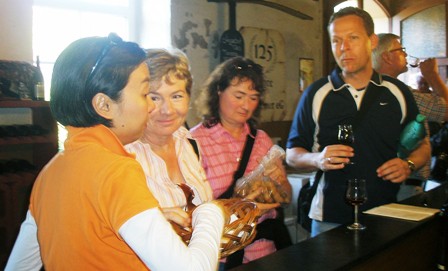
Joyce, Ulla, Claudia and Rainer, DAGERNOVA cellat door


The Blöser winery

November 11, 2007

d1000307bloeser6.jpg

The Bloeser vineyard and the “wine walk” (a vineyard and wine appreciation path) at the Suelzenberg

When I wrote about the ‘Weingut Suelz’ wine bar some time ago, I also referred to the Bloeser family (www.weingutbloeser.de) and its vineyards at the Suelzenberg (the most northerly vineyard along the Rhine) in Oberdollendorf, near Koenigswinter along the Rhine river. Winemaking is an old tradition in the Bloeser family (since 1696!). Today the family cultivates 7.2 ha of vineyards.

The main varieties are Riesling and Mueller-Thurgau, furthermore Portugieser, Dornfelder, Scheurebe, Kerner, Optima, Traminer, Pinot Noir and Regent are grown. The cellar door and the tasting shed (an old barn) are worth visiting. Tastings are to be held for groups of 15 and more persons but you can also visit the cellar door and taste some wines there.

The Bloeser webpage shows some very interesting pictures of the historic buildings in the vicinity of the winery and the picturesque village of Oberdollendorf.

Prices start from 3.3 EURO/0.75 l. bottle. Reds are a bit dearer (6.3 EURO for Dornfelder, Regent and Pinot Noir). Riesling Auslese and Beerenauslese cost between 9.0 and 15.5 EURO per bottle.

d1000308bloeser5.jpg

A new planting at the Suelzenberg

d1000344bloeser3.jpg

Two generations of Bloeser vintners in the vineyard

Address:

Weingut Bloeser
Bachstrasse 112
53639 Koenigswinter-Oberdollendorf
Tel.: (+49) 02223-3322 and 3634
info@weingutbloeser.de
http://www.weingutbloeser.de


And the winner is ? – 2007 Canberra International Riesling Challenge

November 4, 2007

whitegrapes1.jpg

You might remember that I wrote about the 2007 Canberra International Riesling Challenge? The 8th Challenge has seen a new record of 486 entries (wines) from 249 wineries and six countries. What I have not done yet is to also inform you about the outcome of the event. This is the more enjoyable since the overall winner comes from a German winery which I visted recently in Würzburg, Franconia. The newly added category trophy of ‘Best in the World’ was won by “Weingut Juliusspital Iphofer Julius-Echter-Berger Riesling Beerenauslese 2006”.

As last year the ‘Challenge Winner’ came from Australia. The 2006 winner was a “Tim Adams 2006 Riesling” and the 2007 award was won by “Orlando Wines St. Helga Eden Valley Riesling 2002”.

The history of the event is a success story of new world wine, in this case Riesling wine, promotion. Under www.rieslingchallenge.com you can find the full story and the long list of entries and winners. Although I cannot do justice to all the many award winners from the different countries, I would like to selectively take out and refer to some of the participating wineries and their wines.

It came as no surprise that the German Riesling winner of the ‘Best in the World’ came from Franconia, one of the wine regions famous for its ‘Bocksbeutel’, wine filled in ellipsoid shaped bottles. Franconia (area under wines in 2007: 6072 ha) had a ripper of a vintage in 2006, ranked by the German wine magazine ‘Weinwelt’ as 4 to 5 star quality, the best since 1997.

Because of the cool August of 2006, the wines show high acidity which together with the excellent extraction values provides a high storage potential. The growing period, however, ended after a beautifully warm (almost hot) September, in a very wet October (50 to 140 liter precipitation) and for many vintners this meant a run against the clock to avoid the fruit rotting on the vines.

Weingut Juliusspital is one of the top German wineries. Horst Kolesch, the head of the winery (which is one of the three big wineries in Wuerzburg), can be very happy with the outcome of the event. Apart from winning the main trophy, his wines did very well in the competition and won various other medals. Another of the top Franconian wine producers, Horst Sauer Winery, won among others a gold medal in the ‘current vintage 2006 sweet category’ for his “2006 Eschendorfer Lump Riesling TBA” and a bronze medal for “2006 Eschendorfer Lump Riesling trocken”.

From the vicinity of my hometown Trier, the ‘Bischoefliche Weingueter’ won a silver medal for their “2006 Kaseler Nies’chen Spaetlese” (sweet category), a famous terroir from the Ruwer river. The “2006 Scharzhofberg Spaetlese” won a bronze medal in the ‘current vintage dry category’. The location of the vineyard is the prime terroir for Riesling wines in Wiltingen, a small village at the Saar river. From the Mosel vineyards of the Bischoefliche Weingueter the “2006 Dhroner Hofberg Spaetlese” won a bronze medal in the ‘semi-dry category’.

Let me turn to some of the Australian wineries. From the Yarra Valley the Long Gully Winery (the owners are of German origin)won a gold medal for their “2007 Long Gully Estate Riesling” (current vintage dry category).

From our own region, the Upper Goulburn Wine Region, only Delatite Winery (www.delatitewinery.com.au) had (three) entries. The “2006 Barwite Riesling” and the “2005 Delatite Riesling” won bronze medals each. The “2006 Delatite Riesling” won a silver medal. These awards are a great success and a further addition to the many national and international awards Riesling wines from Delatite have won recently.

The 2007 Judges were:
– Louisa Rose (Chairman of Judges), Chief Winemaker, Yalumba
– John Belsham, Foxes Island, Marlborough, New Zealand
– Ken Gargett, Wine Writer, Queensland
– Alexander Kohnen, Director of the German Wine School
– David O’Leary, Director/Winemaker, O’Leary Walker Wines
– Sally Harper, The Bathers Pavillion/Sommerlier, Sydney

PS: It was interesting to learn that Sevenhill Cellars from Southern Australia won a bronze medal for their “2007 Sevenhill Riesling” and a gold medal in the ‘museum class 2004 and prior vintages’ category for their “2001 Sevenhill Riesling”. My friend Neville Rowe has recently taken up the general managers position at this winery which is the oldest in the Clare Valley.


Excursion along the Rhine: Weingut Sülz in Oberdollendorf

October 12, 2007

Carpe diem, ‘enjoy the day’ was the motto my wife suggested I should adhere to, while away from home for the two-month long stay in Germany. I try to follow this advice and make the best out of the separation from my family. Recently I visited a place of my youth, so to speak, from my student times at Bonn University. We used to visit a wine garden-paradise called “Weingut Sülz” (Sülz Estate) in Oberdollendorf near the Seven Peak Mountains (in German, Siebengebirge) on the south side of the Rhine river near Königswinter.

d1000352drachenf1.JPG

The Dragon Rock Mountains seen from the Rhine river

The cultivation of grapes and the production of wine have a long tradition here, dating back to the 10th century. In the 14th century ‘Gut Sülz’ (the Sülz Estate) belonged to the nearby monastry of Heisterbach. A country inn was established in 1656. The estate changed hands a few times. Today Weingut Sülz is neither a vineyard nor a winery, but a lovely country inn with a large open-space garden for its many visitors.

d1000318suelz8.JPG

Sülzenberg vineyards

The location is splendid, featuring a beautiful view of the surrounding vineyards. The inn is to be found at the foot of the Sülzenberg, a vineyard location in the form of a theatre at the edge of the Seven Peak Mountains, south of Bonn. The vineyards might be the most northerly ones along the Rhine. Since land consolidation in 1973 and 1979 all vineyards in the theatre have been cultivated by the Blöser family (more about them in a separate later blog entry).

d1000306suelz7.JPG

The Sülz Country Inn

Since 1999 Andreas Lelke has been running the Weinhaus Weingut Sülz (www.weinhaus-gutsuelz.de). His list consists of more than 500 wines and has received multiple awards. His white wine list is dominated by Riesling wines. In 2000 the Riesling Society awarded Andreas Lelke its Riesling award. The German Wine Institute ranked his wine list as “very good” and the Wine Guide Gault Milau awarded its “best wine list” in 2007 to the country inn. It goes without saying that delicious food is served with the wines at Weingut Sülz.

d1000296suelz1.JPG

“What did I drink?” you might ask. Well, during my first visit I sat outside on the terrace and felt like drinking what the hill behind the inn (the Sülzenberg) had to offer. I had a choice between a Sülzenberg Riesling and a Sülzenberg Blue Portugese (Blauer Portugieser in German). I choose the latter. ‘Blue Portugese’ is an old vine variety grown mainly along the Danube river and in South-Eastern Europe. The variety has many different names in the various places it is grown. However, it has nothing to do with Portugal. I cannot recollect ever having drunk the variety before, so the tasting was a ‘maiden affair’. The picture below shows me with a glass of this dark red, but light and fruity wine in my hand. I took the picture myself, which might explain the strange posture.

d1000300suelz2.JPG


The next big thing: German Pinot Noir

October 10, 2007

d1000110pinot.JPG

Pinot Noir grape

It seems that I’ve been drinking the right stuff: “Blauer Spätburgunder” as the Germans call it, Pinot Noir is all the vogue in “the German lands”. Traditionally, Germany has always been considered a white wine producer. The recent rediscovery of Riesling and the boom in worldwide Riesling demand supports this view.

Now it seems domestic attention has shifted to the colour red. In particular the Pinot Noir wines show a tremendous rise in quality and consumer demand. Wine experts in Germany praise the progress made and estimate that an increase in demand for German Pinot Noir is going to follow the Riesling boom.

But red varieties are no strangers to Germany, as I have pointed out in one of my recent blog entries (“Old friends, wine from the Mosel and other culinary delights”, 16. September 2007). Where would German red wines be if politicians had not meddled in the vintners’ affairs in the 18th century, as elector Clemens Wenzeslaus of Saxonia did along the Mosel?

d1000133pinot2.JPG

Vintage time for Pinot Noir 2007

My recent explorations of German wines made from the Pinot Noir grape can only confirm the wine writers’ opinions, though they mainly point to the wine regions of Ahr, Baden, Rheingau and Rheinhessen and seem to forget the next big thing, Pinot Noir from the Mosel.

I argue that the quality of Mosel Pinot Noir wines is as good as wines from the other regions and you will get a good drop at much less expense. The Ahr, pioneering Pinot Noir grapes for many decades, has always been considered a high-price red wine region. However, you do not have to spend €12 to 20 per bottle.

My favourite Mosel Pinot Noir wine producer, the winery of Alfons Sebastiani in Mehring offers a beautiful Pinot Noir for €5,40 the 0.75 litres bottle.

Another great Pinot Noir producer on the Mosel is Weingut Markus Molitor in Wehlen. I tasted his 2004 Molitor Spätburgunder at the Weinhaus in Trier (opposite the Karl Marx Haus in Brückenstrasse 7); it is very drinkable.

Less affordable are the Molitor 2004 Pinot Noir wines from the locations Graacher Himmelreich and Brauneberger Klostergarten (€35 to 49 /075 l bottle). These prices are an indicator for the general trend; Mosel Pinot Noir wines seem to be becoming the new cult wines. Wine producers and consumers will benefit from it.

As for the average wine drinker like myself, I do not worry about high prices as long as there are plenty of new wines to find, explore, and taste. My recommendation is to try some German Pinot Noir wines.


Sutherland Estate

September 24, 2007

A place we like to visit when in Victoria is Sutherland Estate, a vineyard in the Yarra Valley, Victorias oldest wine region (with about 3.600 ha of vineyards and a production of about 19.000 tonnes of grapes) on the way to Yea and the Upper Goulburn Wine Region. Sutherland Estate is a family owned boutique vinyard on a beautifully located property with bushland and hills where herds of kangaroos graze peacefully. The views from the cellar door/tasting room are stunning. We love the modern architecture and the setting. There are four vineyard blocks with a total of about 10 acres under vines, mainly Chardonnay, Pinot Noir, Shiraz and cabernet Sauvignon. New planting include Tempranillo and Gewuerztraminer. The first Tempranillo was released only recently; however, I had no opportunity as yet to taste the new wine. I particularly like their 2002 Shiraz but also the fresh Chardonnay and the Rose which make great drinking in summer.

The photos below show my family enjoying the tasting while in Australia in July/August this year. If you visit Victoria next spring or summer, I recommend you check out this wonderful place (www.sutherlandestate.com.au).

The Two Hills “tasting crew” visiting Sutherland Estate

Sutherland Estate wines

The breathtaking views from the Cellar Door


Where to buy Two Hills wines?

September 19, 2007

Today I will introduce you to some of the retail outlets where you can buy Two Hills wines. There is first and foremost is The Old England Hotel in Heidelberg, Melbourne, where all our wines have been sold for many years(www.oldenglandhotel.com.au). The Old England Hotel has won many national awards for best hotel in Australia and best bottle shop, among others. If you are in Melbourne, please drop in. The place is definitely worth a visit.

oeh-stewart.jpg

Stewart of the Old England Hotel and Margit while delivering wines

oeh-winesweb.jpg

The bottle shop of the Old England Hotel in Heidelberg, Melbourne

Then there is the Delatite Hotel in Mansfield where you have been able to buy our reds since last August. Mansfield is about three hours drive north of Melbourne near the snow fields of Mount Buller. It’s a very charming country town and a major hub to reach various tourist destinations in Victoria.

delatite-mansfieldweb.jpg

The Delatite Hotel in Mansfield

In the Mansfield-Alexandra region you can also purchase our wines in the local Foodworks supermarkets chain which has outlets all over the place. Near Healesville and Yarra Glen, you can also buy our wines at the Yarra Valley Wine Hub (www.yarravalleywinehub.com.au). This beautiful location shares the premises with the Yarra Valley Dairy , which means that you can combine your wine selection with your cheese and dairy product purchases. Check it out.

winehub2.jpg

The Wine Hub at Yarra Valley Dairy near Yarra Glen and Healesville

And if you should happen to be in Germany you can get Two Hills wines from Dr. Ulrich Hillejan in Ramsdorf near Muenster (e-mail to: Ulrich.hillejan@s-h-r.de).


What a degustative experience: Wine tasting in Trier

September 18, 2007

I had the great fortune to spend the most amazing culinary weekend in my hometown Trier. It was organised by my friend Thomas Weber and held at a restaurant called Bagatelle (www.bagatelle-trier.de) in a place called “Zur Lauben” in Trier.

thomas1.jpg

Thomas while giving us the introduction to the degustation

There were 10 of us, Thomas and Birgit, Peter and Baerbel, Rainer and Brigitte, Uli and Hiltrud, Ulrich and myself (another Rainer). Most of us did not know each other prior to the tasting. See some of the tasters in the picture below. The glasses were not empty for long.

thewinetasters.jpg

The meal consisted of three courses: an entree, a seafood platter, a venison main course and a desert. Needless to say that the food was very delicious indeed.

seafoodplatter.jpg

The seafood platter

Thomas had selected all the wines. He provided us with information about the wine producers and he had translated all the tasting notes into German (I am not translating them back, please visit the webpages of the wine producers for tasting notes). We tasted 9 Sauvignon Blanc and 6 Merlot wines.

The ‘9’ Sauvignon Blanc wines were the following:

– 2004 “Monmousseau”, Sancerre, AC-Loire (France)

– 2006 “Nehrener Roemerberg”, Weingut Theisen, Nehren, Mosel (Germany)

– 2005 “Lands End”, Hidden Valley Wines, Elim Vineyards, Cap Agulhas (South Africa)

– 2002 Two Hills Vineyard, Sauvignon Blanc, Upper Goulburn River, Victoria (Australia)

– 2003 Clairault Estate, Margaret River (Western Australia)

– 2006 Clowdy Bay, Marlborough (New Zealand)

– 2003 Johner Estate, Marlborough (New Zealand)

– 2005 Rodney Strong Estate “Charlotte’s Home”, Sonoma County, California (USA)

– the ninth wine was what is called in blind tastings a “pirate”, i.e. a wine which is not a Sauvignon Blanc.

The ‘6’ Merlot wines were:

– 2004 Bimbadgen Estate, Hunter Valley, New South Wales (Australia)

– 2004 Two Hills Vineyard Merlot, Upper Goulburn River, Victoria (Australia)

– 2005 Merlot, Auslese Weingut Guenther Steinmetz, Brauneberg, Mosel (Germany)

– 2001 Domaine Font-Mars, Languedoc (France)

– 2004 Marques de Casa, Concha Peumo Valley (Chile)

In addition and as in the white pannel there was as sixth wine also a “pirate” among the reds.

Tasting wines without restraint is a most wonderful thing. All of the participants were wine lovers with some considerable experience. The self-introduction showed that most of them were staunch Mosel wine afficionados (some with preference for off-dry Mosel wines) with some of them with likings for Spanish red wines. But generally new world wines were seen as somehow to be not very desirable as far as their taste buds were concerned. Well, we were to be taken all around the world with this blind tasting with considerable effects as I can witness.

I only became aware that two of my own wines were part of the tasting when the paper sheets with the information on producers and the tasting notes were distributed. I was of course scared not to be able to identify my own wines and Thomas teased me with the remark, that most producers do not recognize their own wines in blind tastings that he had attended. Well, these were challenging prospects. Without bragging about how many wines I correctly identfied during the evening, I would like to point out here that I did in fact identify the two Two Hills Wines which came as a relief.

We congregated at 17 h in the afternoon and parted company at about midnight. Needless to say that we had a jolly good time. We had to match the tasting notes with the wines and to make it not to difficult, we worked with a pannel of three wines at the time. The results were given after each pannel. Therefore, the odds were not ‘too big a stew to chew’. Tasting notes are indeed an interesting lead to wine but some of us felt more at ease with their own feelings and taste buds. Needless to say that after the completion of the tasting wine drinking did not stop. The dessert called for a dessert wine. Thomas selected from the restaurant wine list (Bagatelle has a very good wine list indeed). Unfortunately, I am not sure what we drank because my tasting notes became rather confused the longer the evening lasted. Moreover, we did not restrain ourselves to one bottle only but had several instead. One of them might have been a 1997 Maximiner Gruenhaeuser Riesling Auslese from Ruwer. Thomas is of the opinion that the first ‘sweet wine’ was a 2006 Drohner Hofberg from A.J. Adam.

Saying good bye was not an easy thing after these marvellous hours together discussing and enjoying wine and food. Ulrich and I walked back home to the Irminenfreihof (located in a part of town next to the old river harbour called Britannia) where my mothers house is located in an elevated spirit.

ulrichh.jpg

My friend Ulrich in a jolly good mood

PS 1: I love certain aspects of gobalisation and modern technology: while writing this down I am listening to wonderful music from Mozart broadcasted by the ABC Australian classic radio via the internet and of course I am enjoying a glass of 2004 Two Hills Merlot.

PS 2: Ulrich is our non-profit importer of Two Hills wines to Germany.

Address:
BAGATELLE restaurant and bistro
Zurlaubener Ufer 78
54292 Trier
Te.: 0651-29722
http://www.bagatelle-trier.de