Grape grower of the year in McLaren Vale

October 3, 2008

The Daily Wine News, an e-newsletter from the Australian Wine Industry Portal of Winetitles, carried the other day a summary of the McLaren Vale Annual Wine Industry Awards. One of the award winners (in the category ‘Grape grower of the Year Award’) was a vintner names Joch Bosworth of Edgehill Vineyards.

I went straight on to google the man and found a very interesting website (www.edgehill-vineyards.com.au). Joch’s wine label – the Battle of Bosworth -is named after a famous battle in England in 1485. The Bosworth family has grown grapes in the McLaren Vale region since the 1840’s. The Edgehill vineyard is located in Willunga, and was established by Peter and Anthea Bosworth, the parents of Joch, in the early 1970’s.

Needless to say that Edgehill Vineyard was converted to organic viticultural practices (in 1995) and today is a certified A-grade organic farm (certified by ACO www.australianorganic.com.au). It has some 50 acres under vines, planted to Shiraz (some more than 20 years old), Cabernet Sauvignon, Chardonnay, Viognier, Sauvignon Blanc and Mourvèdre.

What I find remarkable too is the fact that the rows between the vines are left to a “vicious” weed, the Soursob, the picture of it featuring on the wine label. The Soursob produces a very pretty yellow flower. The life cycle of the Soursob complements the cycle of the grape vines in so far as it dies off in spring and flowers and uses water in winter when the vines are dormant. Would love to know wht his neighbours say to that system.

I present you a video which is posted on Joch’s website. I do this for two reasons:

1. It is interesting to watch and informative
2. It shows the relaxed atmosphere and vine growers culture of my adopted home Australia which I treasure so much.

Enjoy watching it.

I have visited the McLaren Vale wine region only once and enjoyed the triop tremendously, but next time I will look out for Edgehill Vineyards in Willunga.

Address:
Battle of Bosworth Wines
PO Box 11 McLaren Vale
South Australia 5171
(Ganney Road, Willunga, SA)
Tel.: +61-885562441
http://www.edgehill-vineyards.com.au


I am crazy for vineyard pictures….

September 14, 2008

I love to look at vineyard pictures and do not grow tired of looking at them. I do not know where this comes from. It has certainly also to do with our own vineyard, for sure. When I am in Glenburn I walk my vineyard every day, from left to right, from right to left, from top to bottom and the other way, in the evenings and mornings, even late at night (actually I have to admit that after a rather joyful night, I drove around the vineyard in my old Mazda car, listening to loud music, windows wide open).

Two Hills Vineyard in Glenburn, Victoria, picture taken from the east by Nelly A. Kemur-Witt, December 2007

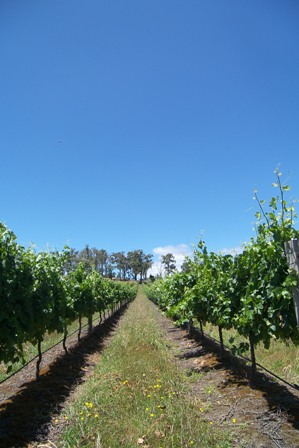
In the picture above you can see my treasure: Two Hills Vineyard in Glenburn, Victoria. First comes Merlot, then Pinot Noir, then Sauvignon Blanc, and to the left you can see the posts for the Chardonnay block, all in all 4 ha under vines.

Two Pinot Noir rows (photo by Nelly A. Kemur-Witt)

Pinot Noir fruit (photo by Nelly A. Kemur-Witt)

On some of the wine and vintner blogs and web pages which I regularly visit, there are stunning pictures of vines, vineyards, grapes, and nature in general. I would like to introduce to you a small selection of only three blogs you should visit and browse through their photo collections (and of course also their stories).

I start with the blog of Iris and her Weingut Lisson in southern France. The Winery (Weingut) has also a web page (www.olargus.info) in three languages including English, but I usually visit Iris’s personal blog where she tells interesting stories (in words and pictures). The language is German. She also bloggs in French. I love the slide shows and the photo albums.

The second blog is from Germany posted by the owners of the Weingut Steffens-Kess in Reil, Mosel. Also in this case there is a proper website for the winery (www.steffens-kess.de), and a blog called “Bildergeschichten aus dem Weingut Steffens-Kess” (in English: Stories in pictures from the Steffens-Kess Estate). Again, great pictures around vineyards and vines are to be found.

The third blog with great photos comes from California, USA. It is the Tablas Creek Vineyard blog. The blog won the American Wine Blog Awards in the winery category in 2008. Since Tablas Creek specialises in Rhone varieties you can find wonderful photos of Mourvedre, Roussanne and Grenache among others.

All three blogs have more than nice vineyard photos. They are delightful to read and contain heaps of useful information about the wine industry, the ecology and the every-day-life of people who’s hearts are buried deep in their respective vineyards and wineries.

If you got nothing to do right now, click a bit around and discover exciting new worlds.


Wine tasting at Van Volxem Estate in Wiltingen, Saar

September 8, 2008

In April this year, my friend Heinz and I, we had visited the Van Volxem Winery (www.vanvolxem.de) in Wiltingen, Saar for the first time. Unfortunately, all wines were sold out then. Dominik Völk, the wine maker, served us a delicious coffee instead and we were invited to visit again in the month of July when part of the new vintage would be released.

Steep slopes for maximum exposure to the sun at the Saar

And that’s what we did. This time I brought my whole family (mother, wife, children). Our appointment was at 14 h in the afternoon on a rainy summers day. Ms. Niewodniczanski, the wife of the owner Roman Niewodniczanski, served us six newly released wines, all of which were excellent representatives of the Saar region. Van Volxem calls these wines ‘classic dry wines’, though residual sugar in Van Volxem Riesling wines may go up to 9 g./l.. For Franconian vintners, for instance, 7.5 g./l. is the agreed maximum. Van Volxem, however, believes that the higher residual sugar content contributes to the overall harmony of its wines. The only exception to the dry wines we tasted was a semi-dry ‘2007 Rotschiefer Riesling Kabinett’.

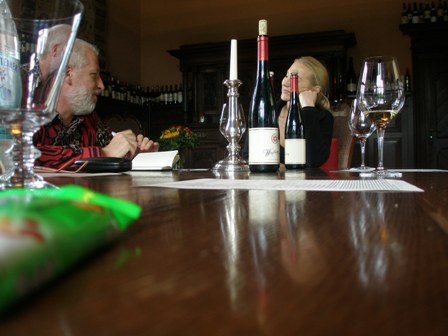
Contemplating about Riesling wines with Ms. Niewodniczanski

Five of the six were Riesling wines, one was a Pinot Blanc. The following list shows the six wines:

– ‘2007 Weissburgunder’ (Pinot Blanc), 9.90 Euro/0.75 l
– ‘2007 Schiefer Riesling’ (“slate” Riesling), 8.60 Euro/0.75 l
– ‘2007 Saar Riesling’, 9.80 Euro/0.75 l
– ‘2007 Wiltinger Braunefels Riesling’ (a single location/vineyard wine), 12.50 Euro/0.75 l
– ‘2007 Alte Reben Riesling’ (from old vines), 13.80 Euro/0.75 l
– ‘2007 Rotschiefer Riesling Kabinett (red slate), semi-dry, 9.90 Euro/0.75 l

We liked all of them but some more than others. Heinz bought some bottles of Saar Riesling and the semi-dry Rotschieder Riesling Kabinett. Apart from Saar Riesling I bought some bottles of ‘Alte Reben’ (old vines).

The Van Volxem tasting room is a wonderful place, with old wooden furniture and beautiful old maps on the walls.

The estate will release the Grand Cru wines later this summer. We were to early to taste them.

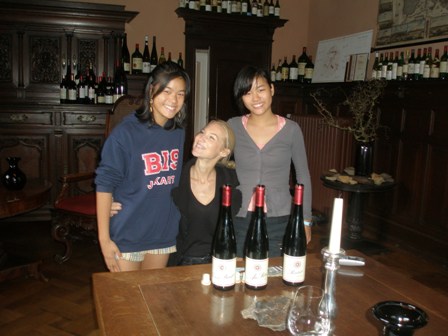
Farewell, but we will come back (my daughters Lucy and Charlotte with the vintner’s wife).

If you are interested in German Riesling, you have to visit the Saar region. Wiltingen is a must, so is Van Volxem Estate. Have fun tasting the best German Riesling has to offer.

Address:
Van Volxem Estate
Dehenstr. 2
54459 Wiltingen, Saar
Te.: +49-6501-16510
e-mail: vanvolxem@t-online.de
www.vanvolxem.de


D’Arenberg

August 29, 2008

The ‘2001 The Coppermine Road Cabernet Sauvignon’ from d’Arenberg winery in McLaren Vale, South Australia should be the last bottle of wine we drank with a proper meal, sitting on our Indian garden furniture on the back terrace overlooking our lush tropical garden. The next day, all should be packed away. Interestingly, the food was also Indian. After all, we came from India to Indonesia in 1998, ironically everything seemed to revert back.

The ‘2001 The Coppermine Road Cabernet Sauvignon’ from d’Arenberg

In January 2005 we had visited d’Arenberg winery with our friend Sylvan Elhay from Adelaide. The photo above was taken in the car park. We tasted some wines in the tasting room (of which I have no picture) and enjoyed, apart from the wines, the beautiful valley view, depicted in the photo below.

The ‘2001 The Coppermine Road Cabernet Sauvignon’ has a beautiful dark, almost blue/black) red colour (almost like blood). The wine has won many gold medals in various wine shows, for instance the 2003 Pacific Rim International Wine Competition, the Perth Royal Wine Show and the Sydney International Wine Competition. The latter awarded d’Arenberg also the title of “most successful winery” in 2003 and the San Francisco International Wine Competition followed with the “Winery of the Year” award the same year. So “gold” was all over the bottle. It retailed for about US$ 40 in the Fatmawati duty free shop in Jakarta and I had reserved the bottle for a special occasion.

The vineyard where the grapes for this wine are grown has a long and interesting history (www.darenberg.com.au). D’Arenberg’s new website design includes an introductory video worth watching. Among others the winemaker, Chester Osborn, fourth generation of the founder family, explains the philosophy of their wine-making style.

The Coppermine Road wines belong to the category “icon wines”. The grapes come from a Cabernet Sauvignon clone which is almost extinct. The wines show an intense flavour of blackcurrant, cassis, some chocolate notes. The wine critic Robert Parker suggest a cellaring of 5 to 7 years. So, the 2001 vintage we drank was just perfect. Ang guess what? According to the website and the label on the bottle, even traditional foot-treading is used prior to modern pressing techniques. Not many wines enjoy such treatment these days. The wine had an excellent balance of oak and tannins and we thoroughly enjoyed it with a meal of “left-over” Indian dishes. It was a wine for a special occasion, and a special occasion it was.


Its pruning time in the vineyard

July 1, 2008

Winter in Victoria is usually a very nice time, not too cold but has many days with beautiful blue sky and sunshine. It always reminds me of an Irish summer.

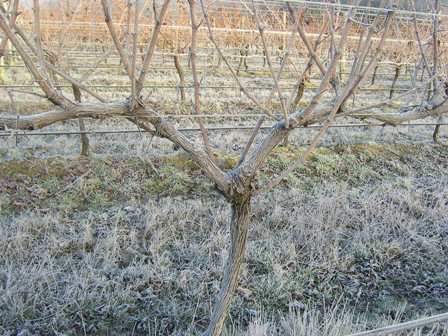
In the vineyard we are busy pruning , of course. The vines below are awaiting the pruners.

Our professional association, the Upper Goulburn Winegrowers Association advertised recently a pruning course (www.uppergoulburnwine.org.au).

This reminded me of the virtual-pruning tool of the German University of Hohenheim near Stuttgart. From time to time I play with it to somehow make up for not being in the vineyard this time of the year. Its in German, but I am sure you will master it. Its strait forward.

Wachsen = grow
Schere = secateurs
Biegen = bend
Neu = new
Zeit = season
Fruehling = spring
Sommer = summer
Herbst = autumn
Winter = winter

Check out the link below and prune your heart out. Have fun.

https://www.uni-hohenheim.de/lehre370/weinbau/java/index.htm


Yering Farm Wines

June 13, 2008

Enough of Europe and Indonesia, today I will take you to my future home country, Australia. This might be a sign of homesickness. Usually during the months of June-July-August we go back to our farm and spend splendid winter days in Glenburn, work a bit in the vineyard, plant trees, watch the kangaroos, have friends and family over for lunches on the grass (it’s not a lawn) and visit neighboring wineries and pubs.

As you probably know from earlier blog entries, the owner-winemaker of Yering Farm Wines (www.yeringfarm.com.au), Alan Johns, is also the person making our Merlot wines. In his huge shed thousands of bottles of Two Hills Wines wait to be consumed and in a dozen or so barrels our 2008 Merlot is doing what young wines do.

Yering Farm is beautifully located. When you turn off the Maroondah highway (also known as Whitehorse Road taking the name from White Horse Hotel in Box Hill) in Coldstream on the way to Yarra Glen, you will find it on the right hand side long before you see the town. The cellar door is an old hay shed with a very rustique character and great views of the Yarra Valley. Since I have posted pictures with these beautiful views before, I present today photos from the inside of the cellar door.

yeringfarm-2.jpg

The cellar door and tasting room

yeringfarm1.jpg

Many medals on the wall

yeringfarm-3.jpg

yeringfarm-4.jpg

Alan introducing his wines to a group of wine tourists

My hot tip of the day: when you are in the neighborhood visiting Yering Farm should be on your to do list. Have a good time there and say hello to Alan.


Wining and dining at Two Hills Vineyard

May 13, 2008

Since a long time I wanted to show you again some more pictures from our vineyard. Two Hills Vineyard in Glenburn, Victoria, is such a marvelous place. Maybe I am getting homesick. Normally we visit in July/August but this year we are planning to go to Germany, Spain and Portugal.

Our vineyard from the East (first Merlot, than Pinot Noir)

winingthv2.jpg

The table set on the grass

With visiting friends….

diningthv3.jpg

….and more visiting friends.

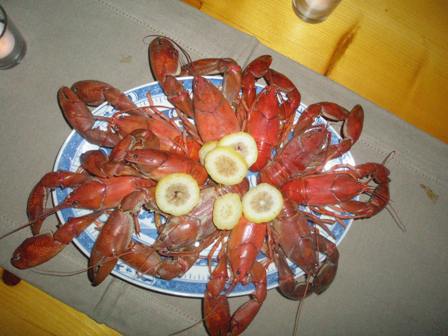
Delicacies from our dams: yabbies, an Australian kind of crayfish


Row spacing and trellis systems in Germany

May 10, 2008

While traveling in Germany last year, I took quite a few photos of vineyards and the way vines were grown there. While visiting the Ahr, Rhine, Mosel and Saar I notices that row spacing and trellising could showed a wide variety of different spaces and systems.

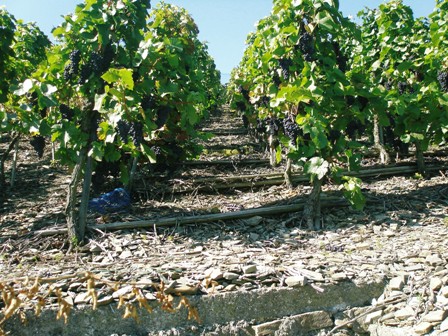
This slope on the Ahr shows “planting with the slope” and planting “parallel to the slope”, and also the width between rows shows variations.

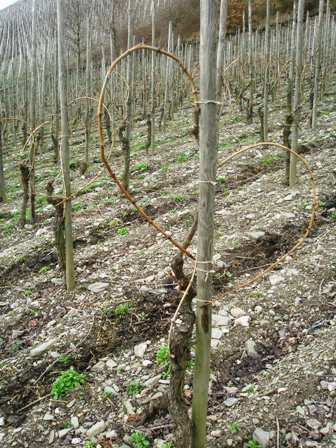
Here (photo above from the Ahr) sticks have been put between the individual vines in order to make it easier to move in the vineyards and to prevent stones and earth to be washed down the rows. Every vine has its own individual post and no wires are required. One finds this system also along the Mosel and the Saar.

Individual vines and the post after pruning (Saar)

After pruning, two canes are bound to the post on the individual post system. I wonder if spur pruning can be applied to it too?

Usually movable fruit wires, as we have them in Australia (VSP = vertical shoot positioning), are not a feature of these trellis systems. This is not surprising. On the steep slopes of the Mosel, Ahr and Rhine rivers moving fruit wires would be suicidal.

In my own vineyard in Glenburn, we use a simple VSP-trellis system. The move of the fruit wires is usually not a difficult job, especially along the gentle slopes as we have them. However, when the rows are long, the wire gets heavier and heavier the longer the day lasts.

Three fixed wires on vines in Olewig, Trier/Mosel

One finds also more and more metal posts, here also with three wires (Olewig)

In some of the locations, even if they are steep, caterpillar tractors are used to work the land. These tractors are small but still need narrow rows between the vines in order to operate.

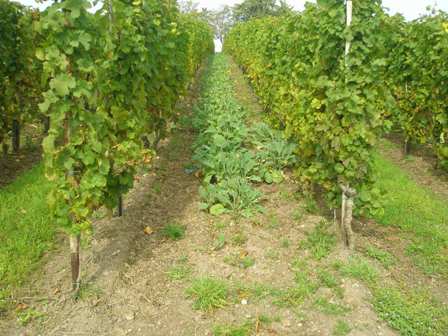
Below, two rows have been planted close to each other (and no vehicle can work between them), but the next rows a planted at a wider distance so that the caterpillar tractor can be used.

Even cabbage is grown between the rows (Olewig/Trier, Mosel)

In my blog entry titled “Along the Mosel River”, of September 12th, 2007 I showed some of the elevators used on steep slopes to carry material up and down the vineyard. Have a look and check it out; it’s an interesting system, one can observe on many steep vineyard slopes on the Mosel.


Chain of Ponds, Adelaide Hills, Australia

April 26, 2008

I found another treasure in our local duty free shop a Chain of Ponds ‘1999 Grave’s Gate Shiraz’, from McLaren Vale in South Australia. The homepage of Chain of Ponds (www.chainofponds.com.au), located in the Adelaide Hills, claims that they are “Australia’s “most highly awarded boutique vineyard”. After studying the page I have the feeling that for my taste, they are already much too big to qualify for such a label, but I am easy on that.

Of course their origins (in 1985) were small but they have grown over the years in a sizable business.
I just managed to get the bottle in the last year of the drinking time frame: best drinking 2003 to 2008, it says somewhere.

The wine background is given as follows:

Frost at the commencement of the 1999 growing season wiped out Chain of Ponds estate plantings of Shiraz, hence the sourcing of fruit from McLaren Vale for this wine.

In 2001 James Halliday gave a rating of 90 out of 100 point. The wine comes from the River Series, sold for A$ 18 per bottle. I payed US $ 18.20 for it, which seems to be quite reasonable. The wine could be described as follows:

<“Deep, bright red-purple; clean, fresh juicy/berry fruit on the bouquet is followed by luscious and sweet berry fruit on the palate. Neither the oak, nor the extract, nor the alcohol (13.5°) have been overdone”.

The winemaker is Neville Falkenberg. The 1999 wine must have been made by his predecessor since Neville has been with Chain of Ponds for only the last five years. The Adelaide Hills is a premier cool climate region of South Australia, only about a 20 minutes drive from the capital Adelaide. I love Adelaide not just because my wife originates from there, and recommend it for any visit to Australia. It’s a must, seriously.

Apart from this series, Chains of Ponds has a Premium Range segment. It also produces wines from Kangaroo Island grapes. Its Italian Varietals come from the Adelaide Hills (Nebbiolo, Sangiovese and Pinot Grigio). The low cost segment is called Novello Range (A$ 14/bottle). I have not been to the place but the homepage shows beautiful pictures. Another place to check out.


Miranda – Sam Miranda

April 20, 2008

After posting my recent blog entry on “Cool Climate Wines” I had second thoughts as regards the accuracy of my assessment. I thought about the label issues, than visited the Sam Miranda website again (www.sammiranda.com.au).

There I learned that Sam Miranda had sold the family business (Miranda Wines) to McGuigan Simeon in October 2003. And then things fell into place. Of course the bottle I had bought must have come from McGuigan Simeon (www.mswl.com.au). When I visited their website today I found the Miranda brand and learned that they also source fruit from the King Valley.

So the bottle of Miranda I had the other day came from McGuigan Simeon and not from Sam Miranda of King Valley.

However, I can maintain my general assessment.

1. Wines from the cool climate King Valley Wine Region are excellent and worth trying.

2. The “High Country” Cabernet Sauvignon from Miranda (McGuigan Simeon) was a good buy.

and

3. I will visit the Sam Miranda cellar door next time we are in Glenburn. That’s for sure.