The Christmas Market in Trier

December 15, 2008

weihtrier0

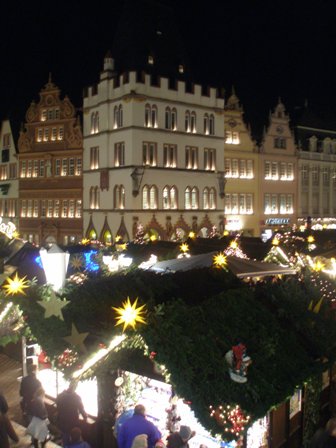
The main market square – Hauptmarkt in Trier

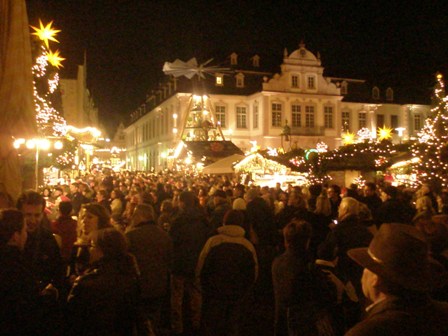
I had only about 24 hours for a family visit in Trier, my beloved home town. This is not much time and I needed to buy urgently some supplies. I was in a hurry which is not good when you end up in a Christmas market. Gee it was crowded. I had not expected so many people. After all the media lamented the economic crisis, the downturn, the loss of jobs and income in short a dark and insecure future. Nothing of that could be felt at the Christmas market in Trier. It was packed with people. I was pushed through the masses. One could hear many languages, French, English, Dutch, Luxembourgian and various German dialects.

weihtrier1

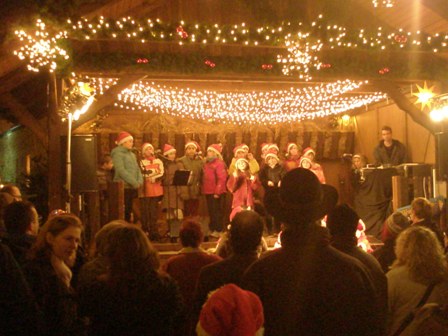
Children sing Christmas carols

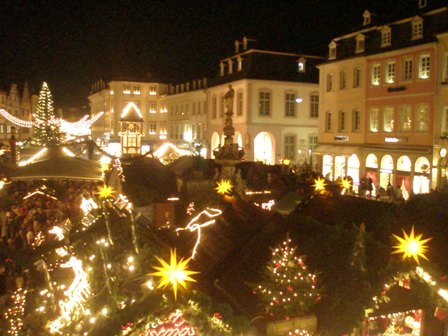
We have learned from other economic crises that people try to forget the dire circumstances by celebrating even more and more intensely than in “normal’ times. Well, that must have been the case in Trier as well. Everywhere people were drinking mulled wine which is good against the cold but also beer and “normal” wines were on offer. It was a cheerful mood; joyous and happy faces wherever I looked. The pictures above and below give you an idea.

weih-trier2

Main market square towards Porta Nigra

weih-trier3

Steipe – the old town hall

weih-trier4

The St. Peter fountain

St. Peter must have been happy too with all these many cheerful Christmas shoppers. After a bath in the crowd I sought refuge in a quiet place and escaped to one of my favourite watering wholes, the wine bar Kesselstatt. I ordered a ‘2007 Kaseler Nies’chen Riesling’ from the Ruwer river, a tributary of the Mosel and listened to the conversations of my neighbours.

It’s good to be home and Christmas is an auspicious time. I let myself be taken in and my mind flowed through the narrow lanes and back streets of the old Roman town. I could smell the smells of my youth and saw faces of people long gone. I dreamt myself away for a while before strolling home. It’s s pity that 24 hours have only 1440 minutes.


Scottish Delight: St. Andrews Ball 2008, Bangkok

December 13, 2008

Our first social function here in Bangkok was the attendance of the St. Andrews ball in the Amari Watergate Hotel on Saturday 22th November. Wherever we live in Asia, we join the Scottish St. Andrews and the Irish St. Patrick’s Society. The Bangkok St. Andrews Society was established in 1890 by a small group of expatriate Scots to celebrate among others Scottish culture.

A special reunion awaited us in Bangkok, a reunion we were ardently looking forward to. Our good old friend Rab Thomas whom we met many years ago in Jakarta has settled down in Thailand. It was a tremendous pleasure to meet him again. The ball was the right occasion for this reunion.

rab-and-basha-web

Rab Thomas and his partner Basha

pipers2

One of the Pipe bands

It was a lovely evening. About 280 people sat around large tables with delicious food. Entertained by pipe bands, dance performances and so on, we made new friends. At our table there were quite a few Thailand veterans. To listen to their stories was very informative and entertaining, especially for newcomers to Bangkok like us.

pipers1

A traditional Haggis dish entree

pipers3

The main course

pipers4

Also Scotsmen have a sweet tooth

pipers5

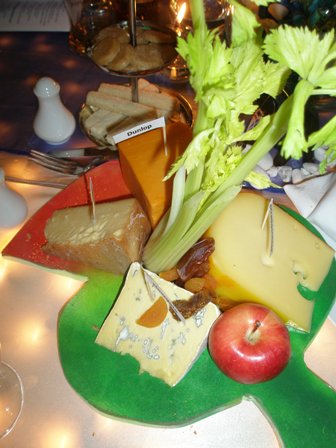
The surprise of the evening: Scottish cheeses

Have you ever heard about Scottish cheeses? Do the names ‘Loch Arthur’, ‘Howgate’, ‘Dunlope’ or ‘Strathkinnes’ ring a bell? Well, then you should rush to get to know them; there is not only whisky in Scotland (by the way “Famous Grouse” was served in lavish quantities). Scottish cheeses are the world’s best kept secret, I would say. Each of them was wonderful and deserved a special mention.

On www.taste-of-scotland.com the above cheeses are describes as follows:

Loch Arthur: traditional farmhouse organic cheddar from Loch Arthur near Dumfries.

Howgate: Established artisan farmhouse cheesemaker, originally from Howgate near Edinburgh, now in Dundee, pioneered the making in Scotland of continental cheeses including Howgate Brie, Camembert and Pentland. Other cheeses include St Andrews, Bishop Kennedy, Strathkinness and Howgate Highland Cream Cheese.

Dunlop: resembles Scottish cheddar with soft texture. Mostly creamery-made in blocks on Arran and Islay but also traditionally in Ayrshire (Burns), near Dumfries and at Perth (Gowrie).

Strathkinness: award winning Scottish version of Gruyere, nearly 50 gallons of milk goes into a cheese! Matured 6-12 months. Limited availability.

These four cheeses are only a select few; there are many more to explore. Please visit the above webpage for more information including sources where you can oder them.

PS 1: Needless to say that the evening ended in wonderful harmony. We went home utterly satisfied. We will definetely come back next year.

PS 2: Wines were also served of course but it was a mass produced wine not worth mentioning.


Fine Dining in Beijing: Grand Mansion Chinese Restaurant 大宅门中式餐饮会所 Da Zhai Men 大宅门

December 12, 2008

Recently friends in Beijing invited me to a fancy place for dinner. Da Zhai Men – 大宅门, or as it is called in English “Grand Mansion Business Club” (Chinese style) or 大宅门中式餐饮会所, that’s what the brochure says.

The place is a kind of replica of a Ming and/or Ching dynasty style eating place. The decoration is amazing. Though housed in a modern, glass walled, high rise building, the internal architecture makes you feel having entered a distant, forgotten but very exotic world, a world you otherwise see only in historical epic movies or kung fu films.

The entrance is styled as a gate to a compound, a kind of “se he yuan”, or four wing traditional house. I felt like “abducted” into a forgotten world. The restaurant staff is clad in outfits which might also come from the good old times of imperial China, very colourful costumes. I cannot judge their authenticity but I liked the combination of fur, colour, patterns and ornaments. The ambience of the place makes you forget the grim reality of a cold November evening in the capital city of the fastest growing economy in the world.

We had booked a separate room at the second or third floor. We went around one corner after the other until we were led into a cosy little room decorated in the same style with some modern elements. For instance the pictures were framed in modern golden coloured frames depicting modern scenes. The furniture was wooden, wooden were also all the screens and panels, a window simulation was hung with a long brown cloth. The crockery on the table was equally colourful but was not for use.

grandmansion1

The menu consisted of a big, equally colourful book with excellent quality photos of the various dishes on offer; captions were in Chinese and English. The photos were interspersed with explanatory texts and pictures of various motives, reproductions of old material on ingredients and the history of the dishes.

The mansion offers “aristocratic” cuisine whatever that might mean, in contrast to royal or simple peoples cuisine. Instead of a regional denomination, the mansion praises itself for creating “modern Chinese fusion” dishes which attempt to blend various traditional and modern influences into new harmonies. To say it from the outset, the food was excellent.

grandmansion2

The soup

grandmansion3

A fish dish

For my wine drinking friends, the fact that we did not have wine with our meal might come as a disappointment. So I have no clue what the wine list looks like. Instead, we drank some of the finest tea China has to offer, a dark coloured tea from Hangzhou called ‘West Lake Dragon Well tea’.

The event did not lend itself to picture taking. I dared to take only a few but in order to not create too much disturbances I quickly put away the camera. But rest assured the food was exquisite. The Mansion is a dining experience of the noble kind indeed.

Address:
Grand Mansion Business Club
Wanquanzhuang, Haidian District
Wanliuxingui Mansion, No. 28
Beijing
Tel.: +86-1058720188 or 89
Fax: +86-010-58720133
海淀区万泉庄28号万柳东路万柳新贵大厦
Daily 11am-2pm, 5pm-9.30pm


And the poet says…..

October 28, 2008

Recently, my friend Jim Riddell gave me copy of a collection of poems by Khalil Gibran (1883-1931) in a Chinese-English version. To my shame I must admit that I had never before heard about the poet Khalil Gibran.

Khalil Gibran (Source of the photo: http://en.wikipedia.org/wiki/Khalil_Gibran)

From the internet (wikipedia) I learned that he is the third best-selling poet in history after William Shakespeare and Laozi. Khalil Gibran was born in present day Lebanon. He was a Lebanese-American artist, poet, and writer who had migrated to the USA in 1895. This is where he also died (in New York City) at the tender age of 48 only.

I selected the following excerpts from a poem on eating and drinking for you:

“And in the autumn,
when you gather the grapes of your vineyards for the wine press,
say in your heart.
I too am a vineyard,
and my fruit shall be gathered for the wine press,
and like new wine I shall be kept in eternal vessels.

And in winter,
when you draw the wine,
let there be in your heart a song for each cup;
and let there be in the song a remembrance for the autumn days,
and for the vineyard,
and for the wine press.”

A good day to all of you.


Dorfprozelten – at the fringes of the Franconian wine region

October 13, 2008

The first part of our family reunion last July brought us to the village where my mother grew up: Dorfprozelten, a small hamlet at the banks of the Main river in Lower Franconia as the region is called. The village is situated between the small towns of Miltenberg and Wertheim.

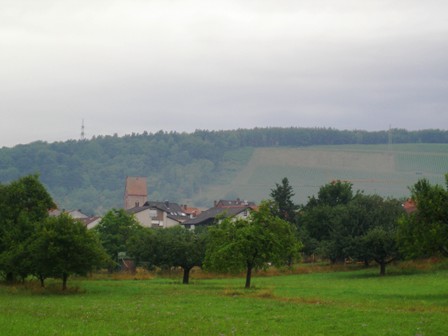
Dorfprozelten in the morning (photo taken from the meadows at the river banks). In the back one can see the location ‘Predigtstuhl’ where vines are cultivated.

I spent most of my childhood summer vacations in Dorfprozelten, lodged at my maternal great-grandmothers house in the middle of the village. Since my family could hardly afford to go on holidays as we do today, we spent our time with relatives and explored the beautiful surroundings between Spessart and Odenwald, two hilly, forested regions sanwiching the Main river.

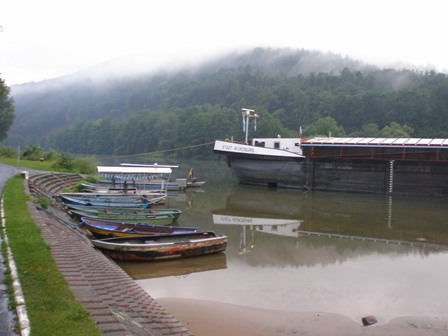
Many of the village inhabitants were fishermen; many others were barge owners transporting goods from port to port in the inland river and canal systems which link many German lands with its neighbours. My uncle owned and operated a 1,000 tonne ship (river barge) together with two of his sons. My father often joined them during his holidays as a kind of occasional sailor.

In July this year, we arrived on a Friday two days before the fishermen would celebrate their annual local fishing festival. We should miss it all together since we stayed only for one day and one night. But on a rainy Saturday morning walk, I took the picture of this poster stuck to a tree near the river.
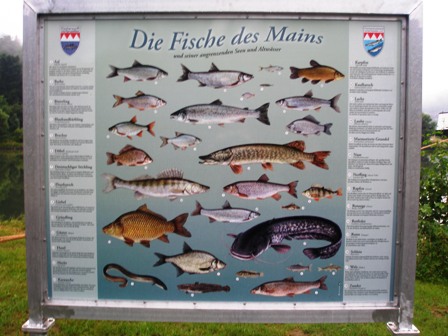
The billboard introduced the various fish varieties which call the river Main their home. Their numbers are on the increase ever since river pollution was reduced by the introduction of waste water treatment plants in the 1970s and 1980.

When on holidays we swam in the river as little kids until it was forbidden because of the rising pollution. My father used to swim out into the stream to greet barges, at times go on board and jump back into the rapid river waters. He was a very good swimmer. Today, swimming is again allowed because of the improved water quality.

The wine produced in Dorfprozelten does not come from “premier cru” terroir but rather belongs to the “Landwein” category (table wine or ‘vin de pays’). Among others Bacchus vines are cultivated. I am personally not a lover of Bacchus grapes and wines, but I drink “local” as much as I can.
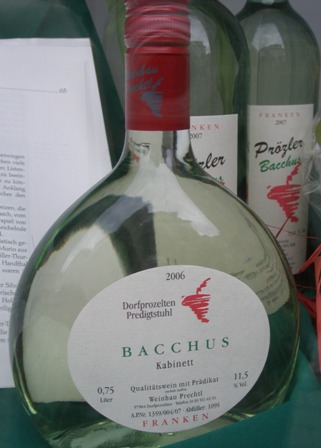
Franconian wines are often filled in traditional bottles, called “Bocksbeutel” with a rounded, big belly shape. Sylvaner is the dominant grape variety, much liked by the locals and of outstanding quality only in this part of Germany. Apart from Riesling, Sylvaner is my most preferred variety of the German white wines.
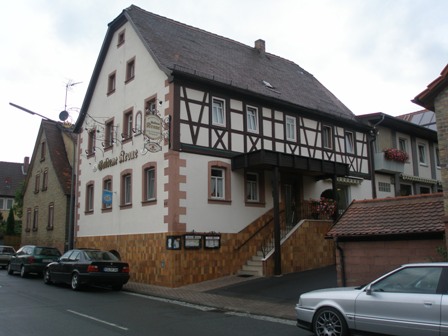
We stayed in a typical country inn, named “Gasthaus Krone”.

Country inns in Germany offer home style cooking and local German cuisine which is not easy to find these days. Most Germans eat home style dishes at home and when they go out, they are looking for some more exotic cuisines. Moreover, these days many Germans try to avoid the restaurant business because of the long working hours. Therefore, today many country inns are operated by non-Germans offering everything from Turkish, Chinese, Thai, Italian Greek and other foods. But not so in Dorfprozelten.

The rooms were furnished in a typical Southern German country style. They were clean and spacious. Ideal for two families with children. The breakfast was a delight, offering many local cheeses, eggs cold cuts, sausages, and other meats.

The menu was a typical ‘country inn’s menu with a lot of local dishes. I loved the richly decorated hard cover in thick leather.
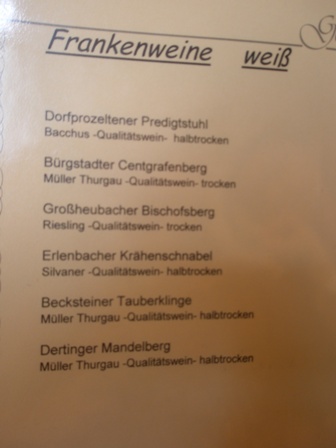
The wine list, here the section with local white wines only, was dominated by local wines from Franconia. Unfortunately, we could not taste them all. I guess we have to come back for some more sampling.

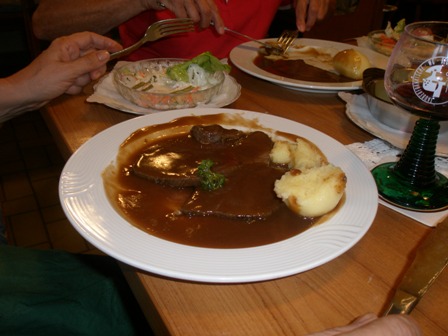
Sauerbraten with Knoedel, a hearty German country meal.

If you plan to visit Lower Franconia, I recommend you stay in this village of my ancestors for a night or two. It’s worth it, I promise.
Portugal – Quinta de Gatão

October 10, 2008

This summer we spent a wonderful week on Quinta de Gatão (www.quintagatao.com), near Penafiel, about 40 km east of Porto. “Quinta” is either translated as “Farm/Vineyard/Winery” or “Manor house”.

Quinta de Gatão is owned and managed by Mr. Jorge Coelho da Silva, a very lovely man who’s day job is being a professor at a teachers college in Porto. The property has been with the family since four generations. Five peasant families used to live and work there. Today, the vineyards are only cultivated every other year to produce vinho verde., a bottle of which waited for us in the fridge. In the mornings, fresh bread is delivred and you can find it hanging on the door. What a treat! The horse stable and the riding school were the main attractions for our daughters. The old folks were equally attracted by the vineyard feature.

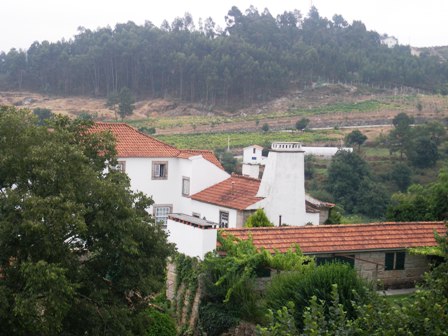
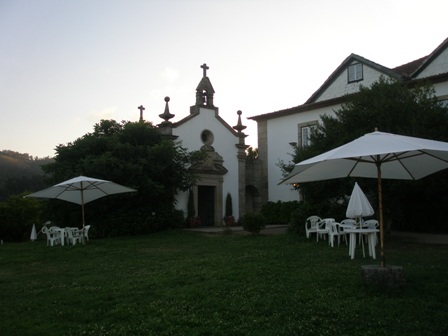
The Quinta de Gatão consists of a manor house with a chapel surrounded by various farm buildings. Some of these were converted into cottage type accommodation. We had rented one of them. Because of its elevation one has a magnificent view of the area which is quite densely populated. In comparison to the rural Australia we are used to around Glenburn, the housing sprawl in Penafiel is a bit too much. However, it does not seem fair to compare quasi empty rural Australia to the vicinity of a bustling port city such as Porto.

The Manor house from the backside

The entrance to our cottage

We loved our cottage. With its rustic rural charm it put a spell on all of us. The walls consisted of big granite stone blocks. It has a fire place in the kitchen, a bathroom and a bedroom with a loft (just as our home in Australia).

This is the place where we prepared delicious country meals

The vines are providing shade, originally to produce vegetables and other crops underneath.

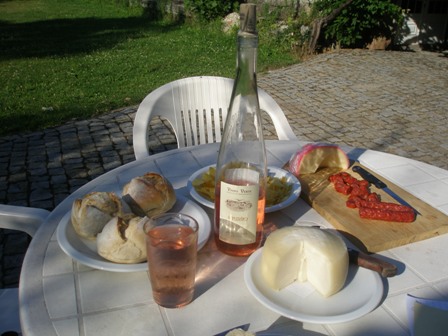
A typical snack in the afternoon consisted of Vinho Verde (here ni rose), country cheese, some sausages, olives and bread.

An Australian vintner in a Portugeuse vineyard

The swimming pool with a great view of the surroundings

Apart from the riding stable and the riding arena, Quinta de Gatão has other facilities to offer its visitors. Among them is the beautiful swimming pool, a tennis court, and a large field to play all kinds of ball games; indoor entertainment such as kicker etc. and billyard is also available. One can have long walks in the vineyards and the surrounding forests.

The entrance to the chapel

We had a great time there and I can only highly recommend the place. Actually, we plan to return next year and spend some more time in this region. We had juts not sufficient time to explore the region. There is so much to see. The Douro is close by. Porto less an an hour away. But it is the hospitality of Mr. da Silva and his family which will draw us back. There are no words to describe the welcome we received on Quinta de Gatão.

Address:
Quinta de Gatão


The Pearl of the Orient

September 27, 2008

No, I am not writing about wine this time. But you might ask ‘What is the pearl of the orient’ if not a wine? Well, read this.

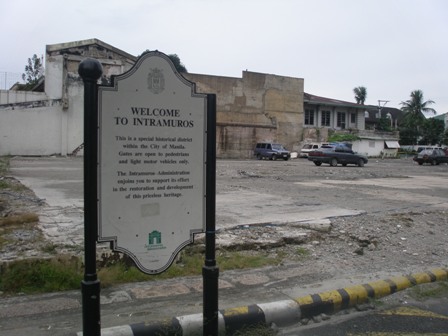
“Intramuros” (freely translated as ‘within the walls’) is the title of the walk through old Manila City which I joined last Sunday. It should turn out to be the most amazing city tour I ever participated in in my life.
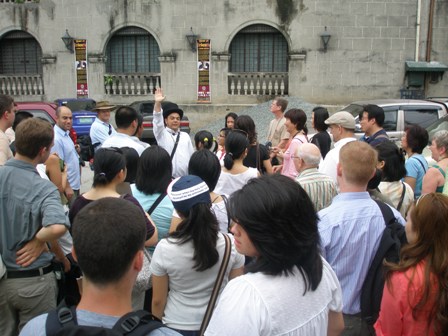
Carlos Celdran, the man who guided us through old Manila (www.celdrantours.blogspot.com), is the most interesting tour guide I have met. Before writing this I visited his blog and recommend you to logging on to it. There are many reviews about the Intramuros walk as well. So google the man it will reward you with more information than I can give. Walk this way please.

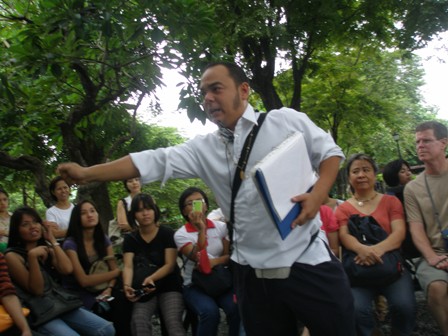
About 60 people had showed up at the entrance of Fort Santiago to learn more about the history of “The pearl of the Orient” as Manila was called. The normal number is around 25 to 30 people. The showing of that Sunday was just overwhelming. Half of the eager tourists wanting to learn about the history of Manila were Filipinos or better Filipinas, because most of them were female.
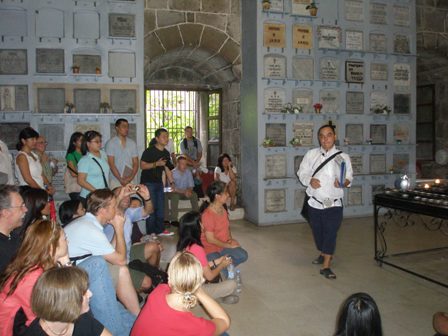
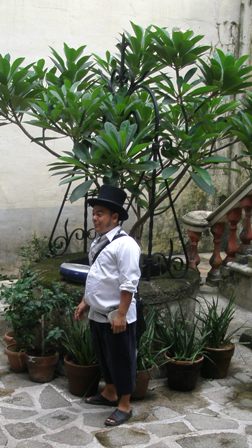
Carlos arrived in a black Spanish hat, had a microphone around his neck and a folder in his hands. He invited all the Filipinos to help him with the tour and subsequently involved them in all kinds of questions and answer games.

But starting we did with a joint singing of the Philippine national anthem followed by an explanation of the meaning of various words in the local language (Tagalog). “Nila” from Ma-nila for instance standing for a kind of flowering mangrove which was to be found in the area.

Above you see the entry with the wooden relief of Fort Santiago. The Spanish had taken the city from their Muslim rulers by force which is shown somehow on the relief (I forgot who the slayer is). At that time the city was made entirely of bamboo because no other building material was available.

I cannot repeat here all what was explained to us. Anyway the history of Manila can be read about on the internet and in books. But while following Carlos on our walk, we learned about history, religion, culture, people, the Spanish and the Americans and others who left their traces in this place. We got a glimpse of Jose Rizal, the national hero of the Philippines, generals and politicians crucial for Manila and the Philippines. Walk this way please.

But if you are around, join the tour of Carlos. That’s better than reading and you might have a chance to remember much more because of the vivid, energetic and illustrative style of Carlos. He uses songs, photos, mimic, some acting, all in all great showmanship. And its educational as well; entertaining too I should add.

Here is the group in front of the museum next to St. Augustin church, the only one remaining of the original seven churches in the perimeter of Intramuros. The main entrance of the church is guarded by four Chinese lions. We lit candles in the church which entitled us (novices to churches in the Philippines) to three wishes. Walk this way please.

The painting in the museum depicted the landing of the Spanish among other scenes from colonial times.

In the crypt, we learned about the Japanese occupation, the slaughtering of Manila citizens and the bombing by the Americans that finally destroyed the historic centre.

Carlos is among others promoting the better maintenance, preservation and even the reconstruction of Intramuros as it is part of the core of Philippine civilization.

Carlos in his outfit.

The end of the three hour tour consisted of an explanation of Filipino cuisine. It inspired me so much that I should buy a Philippine cooking book a couple of days later. At the end of the “show”, and I mean the very entertaining city walk, Carlos made us all taste “halo-halo” (meaning mix-mix), the traditional iced dessert Filipinos are so fond of. He finally recommended a traditional restaurant to us and sold us some of his maps.

The good-byes were warm, we all left mesmerized. I guess nobody was dissatisfied and nobody minded the price (850 Pesos, half-price for students). I must conclude that Carlos changed my perception of Manila and the Philippines quite a bit. I have less prejudices now and I am very appreciative of the island nation. I will visit again and I might go on to another walk with Carlos Celdran.
Walk this way please.

How to contact:
The Blog and Tour Schedule of Carlos Celdran.
A man who is trying to change the way you look at Manila – one step at a time.
Telephone: (02)4844945
Text/Cell:(0920)9092021 or
Email: celdrantours@hotmail.com


Wine Promotion the Portuguese Way

August 16, 2008

During our recent holiday in Portugal, we visited the Palácio da Bolsa, the splendid Stock Exchange Palace, in the city of Porto (Oporto). It is the most visited attraction in this historic city of Northern Portugal (more than 200.000 visitors per year). It was used as the first stock exchange in Portugal, among others the results of intensive international trade especially in port and other wines.

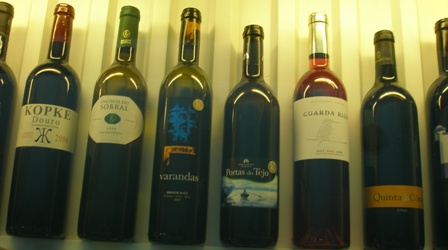
Today, it is mainly a museum. The stock exchange has long moved to the capital city of Lisbon. The palace used to house the headquarters of the merchants guild. A modern “guild”, however, is still displaying its products there: Vini Portugal, the Portuguese Wine Trade Association, a mulit-stakeholder trade association to promote and support Portuguese wines at home and abroad (www.viniportugal.pt) maintains a small showroom in the basement.

Some of the wines on display

Having a wine tasting and display room in the Palácio da Bolsa is a great asset and a clever public relations strategy given that so many people from all over the world visit the historic building. The guided tour includes an invitation to the free wine tasting in the Vini Portugal showroom. Wine enthusiasts such as us, had no choice but to pay it a visit and check out the place.

Margit in the showroom

Two wines were open for tasting both from the Douro wine region, a ‘2006 Costa do Pombal’, a white blend (‘cuveé’ sounds much better than ‘blend’ which has a slightly negative connotation; even better is the word ‘composition’ which somehow stresses the artistic qualities of the wine maker) of Rabigato, Gouveio, Vions(h)inho and Arinto (that is what the lady wrote down for me) and a ‘2003 Borges Reserva’ (14.5 % vol./alc.) blend of Touriga Nacional, Tinta Roriz, and Touriga Franca. I liked both wines, though they remained a mystery to me. I need to taste more Portuguese wines to develop my palate. Portugal has more than 200 autochthone vine varieties, maybe the largest in the world. Many of them have not been explored outside Portugal and they might be a tremendous potential for future development.


Berlin – Auerbachs Bookshop

June 26, 2008

Auerbachs Bookshop from the outside

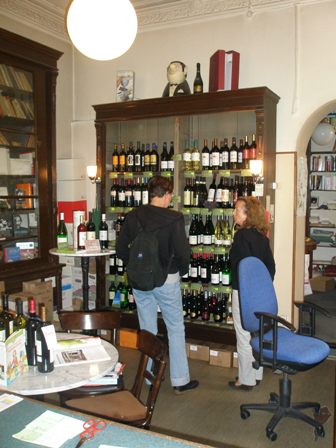
A very good friend of mine made me aware of this little marvel of a bookshop. Its owner, Gabriele Seeboden, is a very friendly and helpful person. But the shop does not only offer books, also a rather interesting selection of fine wines is on offer, all from small, family-owned vineyards and wineries. Gabriele’s passion is book and wines, that’s for sure. The clients love her for the excellence of the service; they also love the flair of the bookshop.

Gabriele Seeboden with a customer in front of the wine rack

This year the bookshop celebrates its 125 anniversary. It was opened by Richard Auerbach in 1882. Gabriele Seeboden is the third successor of Mr. Auerbach. It is not easy these days for such small ventures to economically survive. This was one of the reasons to add a product which goes well with books and reading. Wine is the natural choice, I would say. Wine tasting are also organised at the bookshop from time to time. Give it a go and visit when in Berlin. You will not find such combination anywhere else.

Address:
Auerbachs Buchhandlung
Albrechtstr. 10
12165 Berlin
(near Rathaus Steglitz underground station)
Te.: +49-30-7913125


Book review – The Vintner’s Luck

May 28, 2008

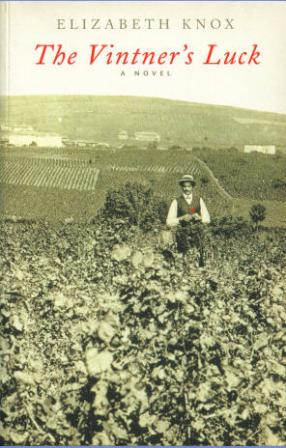
The other day I was going through our little library at home and came across a book which I loved reading a couple of years ago. Elisabeth Knox’s “The Vintners Luck” published in 1998.

The novel is set around a vintner, his family life and his vineyard. Imagine Burgundy in 1808, the bulk of the Napoleonic years still to come when a young vintner meets for the first time an angel in his father’s vineyard.

The angel accompanies Sobran Jodeau, the Burgundian vintner, all his life until he dies in 1863. Every vintage has a special name. For instance in 1808 Sobran meets the angel for the first time and the vinatge is called “vin bourru”, meaning “new wine” and the year before he passes away (1862) is called “vin de dieux”, wine of gods or sweet botrytised wine, whereas the last year is titled “vinifie” which is “made into wine”. And thats the end of a long, exiting, complicated, at time treacherous, but overall joyful life full of various vintages, some with disastrous consequences, others producing the best Burgundian wine ever.

I will not tell you more, you need to find out yourself. What I like in this book that all comes to an end, as in real life but at the same time everything is like in a dream and the border of reality and dreamland is sometimes overlapping with exhilarating results.

The cover of “The Vintener’s Luck” by Elisabeth Knox