Restaurant review: Capital M, Beijing

October 22, 2011

City gate and Tian an men square seen from Capital M, Beijing

When in Beijing I try to visit at least two places, both my favourite destinations: Red Gate Gallery run by my old friend Brian Wallace and Capital M is a wonderful eatery located right next to the South gate of Tian an men square with a splendid terrace with a great view,. The former I visit to immerse my senses in modern Chinese art, the latter to indulge in good food and enjoy fine wines.

Both places you should visit if in Beijing.

Part of the terrace at Capital M
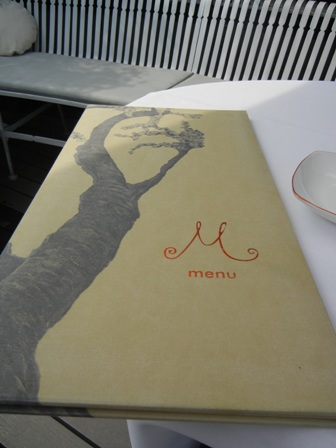
The menu

A picture of parts of the wine list

I was with a dear friend of mine, and we were ready for lunch after a walk around Tian an men square. We made our way to Capital M. One has a great view from the terrace. It was a sunny autumn day, just the right temperature to sit on the terrace and have lunch.

I did not feel “meaty” and ordered some greens as a starter and a seafood pasta as a main. Needless to say, the food was most delicious. Awesome, especially after days of “only” Chinese food (I do not complain, Beijing has wonderful eateries with great Chinese food), I am craving for something else.

Salad and veggies

Seafood pasta

I was delighted to find a ‘2010 Sauvignan Blanc’ by Shaw and Smith from the Adelaide Hills in South Australia.

2010 Sauvignon Blanc by Shaw and Smith

Shaw and Smith are one of the best producers of Sauvignon Blanc in Australia. The wine is bone dry. Aromas of grapefruit and lime came to my nose with some floral notes as well. It is crisp and clean. This medium bodied wine has a great balance, good acidity and a long finish.

And after lunch, a coffee

We had a very enjoyable lunch at Capital M. The service was, as always, perfect. This is value for money and if you happen to be in Beijing just check it out yourself.

Address:
Capital M
3/F, No.2 Qianmen Pedestrian Street
(just south of Tian’anmen Square)
Beijing 100051 China
中国北京市前门步行街2号3层
邮编 100051
Tel (86 -10) 6702-2727
Fax (86-10) 6702-3737


Riesling from the Nahe – 2008 Monzinger Halenberg by Emrich-Schönleber

October 21, 2011

I love to eat fish. Red snapper is a good one. That one can prepare it with mushrooms was new to me. Alas there is Marcella Hazan and her cookery book which are always an inspiration.

Dinner in the making

Mushrooms on the fish

Unfortunately, I messed up the pictures of the food on the plate. I do not know how it happened. At times I am just too stupid to handle my new camera, it seems. Sorry folks, you have to be content with the two pictures above. I assure you that the fish was delicious. We served it with a bean salad in onions but had also some peeled tomatoes as a salad. We did not need carbohydrates.

A delicious fish, I usually enjoy with a good wine, not always white, sometimes red, but tonight it was white. From my last visit to Germany I had brought a bottle of my favourite winery in the Nahe valley, Weingut (winery) Emrich-Schönleber in Monzingen, a small village next to where my grandfather used to live (Martinstein) and where I spent almost all my school holidays.

The winery Emrich-Schönleber is one of the best wineries in the Nahe region and in Germany. It is famous for its dry and off-dry Riesling wines, mainly from the locations Halenberg and Fruehlingsplaetzchen. I usually visit them coming straight from the airport during my annual sommer break or home leave as it is called.

It is hard for a German Riesling lover who resides in Bangkok to find good Riesling wines. I am spoiled in this, I know.

But look at this colour? Golden, pure, with a fragrance of delicious grape fruit and citrus flavours. It has some residual sugar, so it’s not bone dry but the wine is creamy and dense, round and full, with good structure and a wonderful long finish.

It stays on the palate. If you ask me, it could stay there for ages. I was in paradise for the duration of the meal and woke up to the hard reality: no more Riesling from Emrich-Schönleber in my wine fridge.

Sigh, life can be hard.

2008 Monzinger Halenberg R by Emrich-Schönleber

Address:
Weingut Emrich-Schönleber
Soonwaldstraße 10a
D-55569 Monzingen
Tel.: +49-67 51-27 33
Fax: +49-67 51-48 64
www.emrich-schoenleber.de


Wine village Kasel, Ruwer – Mosel Riesling at its best

October 7, 2011

This is the coat of arms of Kasel, a small village located at ther Ruwer river not far from my beloved Trier. The Ruwer river is one of the tributaries to the Mosel.

Originally our wine region was called ‘Mosel-Saar-Ruwer’ which named the two smaller rivers explicitely.

Grape vines all over the place

The slopes around Kasel are planted with grape vines

The Pauliner Landgasthof is part of Weingut von Nell

Von Nell Estate – Weingut von Nell

The newly refurbished Pauliner Hof is part of the Weingut von Nell.

We wanted to check it out and dropped in for lunch on a beautiful late summer’s day. The sky was blue and the Ruwer valley showed its most beautiful side.

I must say that I love this country inn right in the middle of Kasel, the lovely wine village.

During our high school days my brother Wolfgang and his friends used to help in vintage time and picked grapes at the steep slopes in the vineyards of the Von Nell Estate.

The interior of the inn is light and bright. The air well is covered by a glass roof and the subdivisions with rod iron and sheets of textiles give it a warm feeling. The big olive tree right in the middle of the restaurant gives the place a mediterranean flair. The service was excellent.

We had pork nuckle and a delicious mushroom dish, great German country food in my view.

Pork knuckel

The mushroom stew

My old folks

A shot of the wine list

I had an estate grown Riesling of course. The ‘2010 Kaseler Dominkanerberg Hochgewaechs’ was a very nice and fresh house wine, something for easy drinking and enjoyment with hearty country food. I just wish I would have access to it here in Bangkok (sight). Well, one cannot have it all.

The Ruwer valley is a true jewel, you should go there and check it out.

Address:
Pauliner Hof
Bahnhofstraße 41
54317 Kasel
Tel +49-651-9679090
Fax +49-651-96790916
www.restaurant-paulinerhof.de


The program is out – 3. International Symposium on Tropical Wine

August 24, 2011

I have already announced and informed you about the 3rd International Symposium on Tropical Wine to be held from 12. to 18. November in Chiang Mai, Thailand.

Now the first draft program is out. Gosh there are so many interesting sessions, international and national speakers, and exciting field trips on offer that I might not know where to go. I cannot attend all for them.

Have a look and check it out.

By the way, you should register, I have already done it.


Gurame and Gruener Veltliner

July 4, 2011

After extensive travel to Vietnam, Thailand, the Philippines, and then to Germany I am finally back home in Bangkok. For too long I had no time for my blog. As a consequence my stats have come down. The prospects for the next two months are not any better. That’s somehow frustrating because I worked so hard to get all these people to look at my stories about food and wine.

But such is life.

Today was a family day (as you all know it is also celebrated in the USA as the day of the declaration of independence). We had family lunch and later family dinner. I would like to share with you what we had for lunch (we had a delicious pasta for dinner by the way with a blend of Primitivo and Merlot from Southern Italy).

Back to our lunch.

We had “gurame”, a fresh water fish from Indonesia. The fish is marinated in “Bumbu”, a paste freshly made of root spices and herbs with pestle and mortar.

The Gurame in the pan

..and on the plate with rice and asparagus in coconut sauce

The recipe for the “bumbu” you can find in Sri Owen’s cookery book of 2008 titled “Indonesian Food”. The “bumbu” (paste) is made as follows:

– 6 candle nuts (we used makademia nuts), chopped
– 5 shallots, chopped
– 4 garlic gloves, chopped
– 4 red chillies, deseeded and chopped
– 2 tsp chopped fresh root ginger
– 1 tsp chopped galangal
– 1 tsp ground tumeric
– 4 tbsp tamarind water
– 4 tbsp coconut milk
– 1 tsp salt

And here you go with the mortar and “pestle” away.

How about the wine for this meal?

During my stop-over at Vienna Airport I was looking around for some Austrian wine. I bought a bottle of Gruener Veltliner which seemed to be just right for this feats.

I bought a ‘2010 Gruener Veltliner Edition Chremisa’ by Winzer Krems@Sandgrube 13, Lower Austria. The wine has 13.5% alcohol and feels almost like a sparkling wine with all the bubbles it releases after being poured into the glass.

This wine won a gold medal at MUNDUSvini 2010 and was declared ‘best dry white wine of Europe’, not bad I think. I had to pay 6.50 EURO only for this treasure. The high acidity (7.1 g/l) complemented the food in an ideal way.

Edition Chremisa 2010 Gruener Veltliner by Winzer Krems

Back label

The wine in the glass is full of bubbles

As dessert we had a piece of home made orange cake. That prompted me to open another one of my wine treasures. Some time ago my friend Felix had given me a bottle of ‘2007 Kracher Auslese Muscat Ottonel’ by Weinlaubenhof Kracher, Burgenland, Austria.

The orange cake

This dessert wine is just wonderful. The grape variety produces a stunning sweetness in the wine, a full aroma of honey and peach. I could not imagine a better way to end this family meal.

2007 Kracher Muscat Ottonel

Try this wine if you can, it’s worth it.


Restaurant review: Rogacki in Berlin Charlottenburg

June 30, 2011

A place I love to get lost in is “Rogacki” in Berlin-Charlottenburg. Rogacki is a kind of gourmet super market cum wine shop and eatery where you can order all kinds of delicacies, all freshly made for you. The only drawback: you have to devour it standing up.

However, the standing at tables and the counter is a very sociable undertaking. Almost immediately one gets into contact with the neigbhours and before you can count to three one is immersed in a discussion with a complete stranger.

That’s just wonderful because otherwise it is not so easy to get into a conversation with a stranger in Germany.

Rogacki offers all kinds of foods: fresh vegetables, processes meats, meats, cheese, bread, wine and all kind of complementary goods. I could spend days just studying their wares.

I ordered the above dish. The Germans call is “Crevetten Spiess”, it’s grilled prawns with some veggies. When I asked for a glass of wine, guess what wine was on offer, a Riesling from my beloved Mosel.

The ‘2010 “Gutsriesling” Reichsgraf von Kesselstatt’ is simple but solid wine for easy drinking. Rogacki serves it exactly for that purpose and I was happy to reconect to my home at the Moel river here in Berlin only about 70-80 kilometers from the Polish border.

How I miss my native Mosel valley.

PS: When I visited Rogacki last year, I was asked by the staff not to take photos. It was forbidden. Therefore I decided not to write about Rogacki and its most delicious food. This time no such rule was imposed on me.

The place is a “must see” if you are in Berlin and want to experience the flair of the city and “real food”.

Address:
Rogacki
Wilmersdorfer Straße 145
10585 Berlin-Charlottenburg, Germany
Tel.: +49-30 343825-0
Open Mon-Sat 9am-6pm
Subway: Bismarckstraße
www.rogacki.de


上朋 Japanese Restaurant in Taoyuan, Taiwan

June 12, 2011

Tucked away in a side street 上朋 Japanese restaurant has a great façade

Since quite some time I wanted to post this little story of two old friends going on a stroll to celebrate life at a Japanese restaurant.

上朋 (Shang peng) Japanese restaurant, not far from the International Centre for Land Policy Studies and Training in Taoyuan where we were teaching, was our choice.

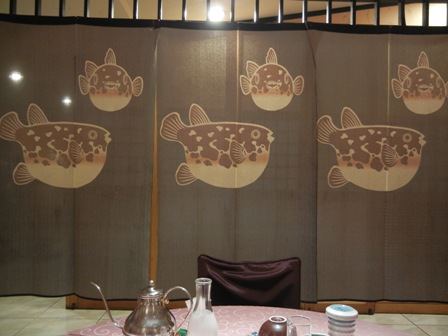
上朋 restaurant curtain

The diners

We ordered Sake. Jim preferred the cold one which came in a carafe with a whole in it in which ice cubes were placed to keep the Sake cold. Fancy stuff. I choose the warm Sake which was a delightful drink.

The cooled down Sake

Simple and easy: warm Sake

We booth choose one of set-menu type meals, also for the sake of convenience. As it turned out we should not be disappointed. The cold dishes set before was were very tasty. More appetizers should follow.

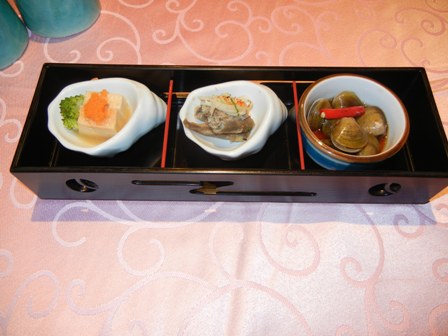
上朋 cold dishes

More cold appetizers were to follow

Japanese food is art

Also the fish is tastefully presented

The Sushi platter was divine

Then came the ingredients for the soup

The soup was boiled on a table stove. The liquid was not held in a clay pot but in parched paper. Then
we dropped the ingredients above into the broth and let it cook for a while.

Isn’t the soup beautiful?

A sauce was presented to dip the fish and vegetables in

A selection of fruit ended our meal

This was a wonderful meal in a very peaceful atmosphere. The service at 上朋 is excellent. The food is reasobaly priced, and as customer you have the feeling that you are king. I highly recommend the place.


Easter Sunday: Lunch at Bacco, Bangkok

April 26, 2011

No better place to go for a Sunday Easter family lunch than Ristorante Bacco, our favourite Italian restaurant in Thonglor, our old neighbourhood. We like real food with rustic charm and not the designer stuff, small bits of food looking like works of art on big plates.

Below you can see what we ate. First are the three antipasti we selected. Delicious.

Melanzane alla parmigiana

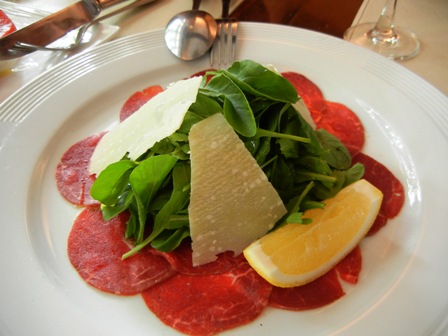
Carpaccio

Insalata caprese

All three antipasti on my plate

Our family consists of “traditionalists”. Three of us ordered gnocchi, the other main dish was tagliatelle with mushrooms in a creamy sauce.

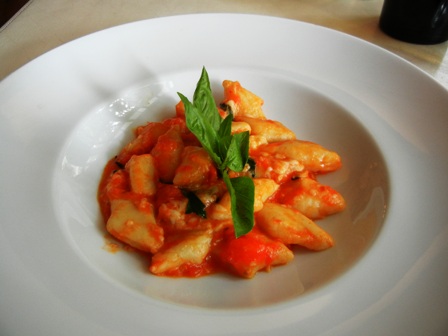
Gnocchi

Tagliatelli delicata

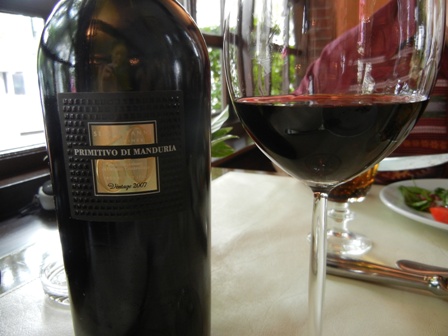
How about the wine, you might ask. I love to order a simple ‘Primitivo’ (called “Zinfandel” in the USA) from Apulia. This time I selected a pricier wine than normal, a Primitivo made from 60 year old vines.

It turned out to be an excellent choice. The ‘2007 Primitivo di Manduria DOC’ by Feudi di San Marzano is a big wine (with 14.5% alcohol). The intense fruit aromas, plums mainly but also with earthy and spicy notes, had me forget that I was in the tropics.

Manduria is a town of about 30,000 inhabitant, about 30 km east of Taranto and about 14 km north from the Apulian coast. The place has a very warm climate.

The wine is made from 100% Primitivo grapes. One can sense that the vines are old, very old (sixty years, is what the label says). The bottles are also very heavy and old fashioned. I liked it, not wasting any thought about the carbon footprint.

2007 Primitivo di Manduria DOC

The back label of the Primitivo by Feudi di San Marzano

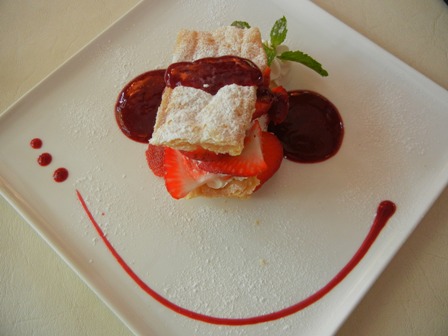
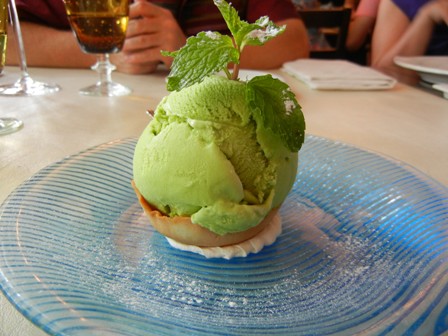
And after all this delicious food came the sweets or dolce as they are called in Italian.

Strawberries and cream

Pistaccio ice cream

Tirramisu

This was a very memorable Easter Sunday lunch. We had a great time with yummy food and delicious wine at Bacco. I will remember the wine and order it again.

If you need something special, and you do not want any more Thai food, have a break and eat Italian at Bacco. You will not regret it.

Address:
Bacco Osteria da Sergio
Sukhumvit Soi 53, Bangkok,
Thailand
Tel.: +66-2-662-4538
http://bacco-bkk.com


Sunday roast – lemon chicken

April 4, 2011

Chicken is not my favourite meat. Therefore, I have really high quality standards when a chicken dish is brought before me.

Well, in comes the classic cookery book “Sunday Roast – the complete guide to cooking and carving” by Clarissa Dickson Wright and Johnny Scott.

Their suggestion for a lemon chicken on page 100 is just a treat.

It is a traditional Greek recipe and you need the following ingredients (4 serves):

– 1.3 kg whole chicken
– 4 tbsp extra virgin olive oil
– salt and freshly grounded black pepper
– 1 large onion, finely sliced
– 3 carrots sliced
– 1 celery stick
– 6 sprigs of basils
– 2 lemons
– 300 ml of hot water

And what do you do with all this?

Well, heat the olive oil in a casserole and brown the seasoned chicken. Cook the onion slightly until it is transparent. Then add all the vegetables and the basil for a few minutes. Put the chicken back into the casserole atop the vegetables and pour the juice of the two lemons over the chicken. Cut the rind of the lemon in small stripes and sprinkle it over the chicken. Then you add the water and cook for about one hour.

And ‘simsalabim’, magic is done: serve.

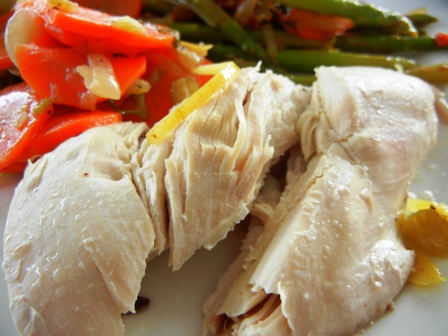
Doesn’t it look great: Lemon chicken the Greek way

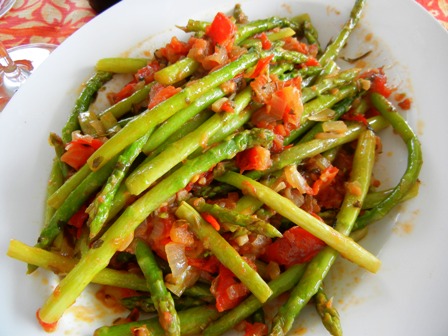
The asparagus with tomatoes

We had some boiled baby potatoes with it and a side dish of fresh asparagus with tomatoes. All in all super delicious. I could not believe it. The meat was not dried out at all, it was moist and very tender. Chicken can be very tasty. It just needs to be prepared the right way.

A great dish and a great Sunday lunch

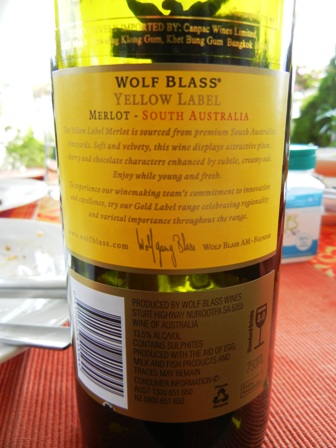
Unfortunately, we did not have a Greek wine (no retsina or a nice red from the Greek islands). Therefore a bottle of ‘2009 Yellow Label Merlot’ by Wolf Blass, South Australia had to do the trick.

Beautiful colour

This Merlot is an industrial wine, well made, something for every day. I did not have anything else at hand, and did not want to plunder my already diminished treasures.

The front label of the Wolf Blass Merlot

I just love a straight Merlot. The Yellow Label Merlot is medium bodied with all the characteristics of the grape variety.

It matched the chicken very well, because it was not overpowering and not as fruity as for instance our own Merlot is (lots of cherry in the 2004 vintage).

13.5% alcohol

PS: I love this old fashioned book by Clarissa Dickson Wright and Johnny Scott.


East meets West – 龙徽

March 26, 2011

Finally, we managed to have a dinner in our new home like in the good old days in Thonglor. All four of us sat on the terrace and enjoyed a family meal together.

The pasta (zucchini) below was just delicious.

I went through my wine fridge but could only produce a bottle of ‘2008 Cabernet Sauvignon’ by Beijing Dragon Seal Winery, China. It was given to me by the hotel manager during my last trip to Beijing.

A bottle of Dragon Seal red wine was one of our first wines when we moved to China in 1990. The winery has quite some history which goes back to 1910 and some French friars in Beijing who started to grow grapes and make wine. Ever since French viticulturists and oenologists have been associated with the brand. The modern Dragon Seal Winery was founded in 1987. Various white and red wines are produced today.

The grapes are grown in Huailai County (怀来县) in Hebei Province about 150 kilometers northwest of Beijing which has a semi-arid climate. The precipitation in this part of China is very low (below 400 mm per year). Mean temperatures range from -7.4 Celsius in January to about 24.4 Celsius in July. Humidity in August-September is between 60 and 70% only.

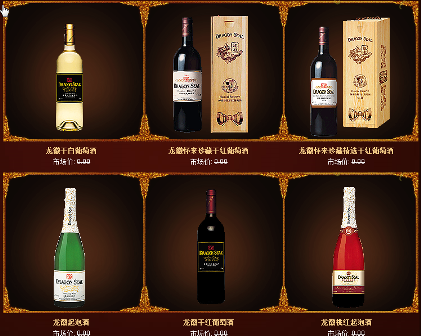
Product range – screen-shot from the Dragon Seal website

The flagship wines of Dragon Seal Winery are it’s Huailai Reserve, a blend of Cabernet Sauvignon (50%) and Syrah (50%) which is matured for a year in French and American oak and it’s Cru de Huailai, a 100% Syrah made from grapes grown in Donghuayuan (东花园镇).

Does this not sound very exotic in your ears?

Well, the 2008 Cabernet Sauvignon is a solid but overall ordinary wine (‘Landweinkatagoerie’). The enclosure consisted of a plastic “cork” (uuh). I was immediately suspicious. 2008 vintage (!), but was the bottle sealed properly?

Yes it was. The wine has only 12% alcohol. The colour was a beautiful dark red. But the taste was OK. It is a rather light wine with pleasant red fruit aromas. We did not regret opening the bottle, and it also matched the pasta somehow. I must try the two flagship wines mentioned above. They won medals at international wine shows. That’s my resolution from this wonderful family meal in Ekamai.