What we were drinking: South Australia

March 23, 2007

David, the son of our mutual friend John, from Sydney brought two wonderful bottles of wine over the other day. We had them with a beautiful meal for Saturday lunch. With the spicy clam pasta we enjoyed a bottle of 2006 Sauvignon Blanc from Shaw and Smith from the Adelaide Hills (www.shawandsmith.com), a cool climate region in South Australia where my wife comes from. Grapes where planted there as early as 1839 and today there are about 60 wine labels with over 3,000 ha of vineyards planted. This young Sauvignon Blanc is a wine to my taste: fruity (with passionfruit and guava flavours), grassy-herbaceous, flinty and well rounded with a long finish. The wine is unwooded and James Halliday gave it 94 points. Very enjoyable in a tropical climate such as Jakarta.

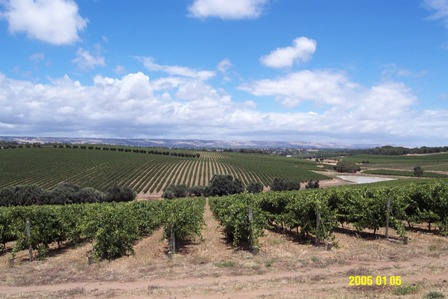
McLaren vale1

McLaren Vale with vineyards, sea view in the distance

The second bottle we drank with the main dish, a vegetable stew, came from Mitolo Wines (www.mitolowines.com.au), a family owned winery situated in the most southern tip of the McLaren Vale region. I will write more about McLaren Vale in one of the next entries, because we visited the region in 2005 and had a wonderful time visiting some of its vineyards. We drank a 2004 Jester Shriaz. The wine had a deep purple colour. The nose showed intense blackberry, plum and chocolate aromas of rich black fruit. The wine has a good structure, is well rounded and has a long finish. Of course it should have been cellared for 4-5 more years but we could not wait. Both wines made our day which we spent sitting on the terrace and discussing the pleasures of life in general and life in Indonesia in particular. Come and visit us one day.

McLaren Vale 2

Vineyard view in McLaren Vale


A most marvelous fish dish

March 4, 2007

I have been away for a while. Let me tell you about a very memorable dinner I had with my friends Joyce and Rainer and a couple of other friends in Bangkok the other day. It started as a kind of late Chinese New Year celebration. We jointly tossed a special Singapore salad with the most astonishing ingredients of which I cannot give you a run down. Eating this dish together brings you luck of course. We had it as a kind of entree.

The main dish, however, is what I would like to introduce to you today:

Baked Sea bass with Basil-Feta Crust

This is a most amazing creation. I always thought that fish and cheese do not go well together. Wrong. They can build a terrific partnership and create an explosion of your senses in your mouth. The recipe goes as follows (4 serves):

Crust ingredients
– 3 garlic gloves
– feta cheese (one block)
– bread crumbs
– basil leaves
– black pepper, salt
– 4 table spoons of best extra virgin olive oil

Fish
– 4 pieces of Sea bass fillet, but any other “white” fish will do

How to do it
– Grind peeled garlic cloves and basil leaves together into a coarse consistency, mix the olive
oil into it
– put ground basil mixture into mixing bowl together with bread crumbs and Feta cheese. Mix
well together. Add pepper and two more tablespoons of olive oil.
– was sea bass fillet and sprinkle with pepper and salt. Place on oven-proof dish.
– put basil-feta mixture on fish covering the surface.
– bake for 30 minutes in 180 c oven
– serve with vegetables as desired.

We drank a Sicilian white wine with the fish. I would have loved to have a Two Hills Sauvignon Blanc instead; the wine we had at Rainer and Joyce’s wedding some years ago for instance. Of course also a Sauvignon Blanc from another cool climate wine region would do. But Sauvignon Blanc definately be my preferred choice with this dish.


2004 Two Hills Merlot and its DIAM cork

February 20, 2007

Many of our customers might have wondered why we changed from a natural cork as used for the 2001 vintage to one which looks like a compound, glued together closure. Well, let me share with you some of the information which brought us to this change.

Wine industry experts estimated that each year about 200 million bottles of wine worldwide are having a moldy smell coming from defective cork contaminated with Trichloroanisole (TCA). The financial losses to the industry are enormous. If one assumes than on average about 9% of the bottles are contaminated, then any method able to reduce these losses is highly welcome especially by small producers or boutique vineyards such as Two Hills. A French closure company, Sabaté of Oeneo, has developed a new closure, the DIAM cork, which guarantees a 100% cork taint free closure of wine bottles. These corks also offer near perfect seals and no random cork oxidation or leaks.

How is the DIAM cork made?
The procedure is similar to the technique used to produce decaffeinated coffee. The cork is reduced to cork flour, and then washed with carbon dioxide where the TCA is removed. After that the flour is reconstituted and held together by the same polymer that contact lenses are made from. Independent research, for instance by the Australian Wine Research Institute (AWRI; www.awri.com.au), has confirmed that DIAM corks are exceptional in preserving freshness by avoiding oxidation. In 2004 Oeneo Closures has won an international award, the Gold Medal Trophy of Vinitech in Bordeaux, for technical innovation.

We at Two Hills Vineyard had basically three options: (1). buy more expensive conventional cork, (2) put the wine under screw caps and (3) experiment with DIAM cork. I could not bring myself to put red wine under a screw cap. I might be called a romantic by I enjoy opening a bottle with a traditional opener. For white wines, I hold a different view. I am willing to sacrifice the same romantic notion for a guaranteed cork free taste of the wine. I am not so sure about Riesling though, especially those Riesling wines which benefit from aging. In such a case I would be willing to invest in more expensive conventional corks, I guess. This is of course not logical but rather arbitrary, I know. Alas we do not have Riesling grapes at Two Hills so that I do not have to make this decision. But for aromatic wines such as Sauvignon Blanc of which I am especially fond off, I readily accept the screw cap.

In the end we decided to give DIAM a chance. I hope that our customers will be satisfied with this explanation and continue to enjoy the exceptional quality of our wines. For those of you who want to know more about closures, please visit www.winestate.com.au or put DIAM in your search engine.

2004 Two Hills Merlot

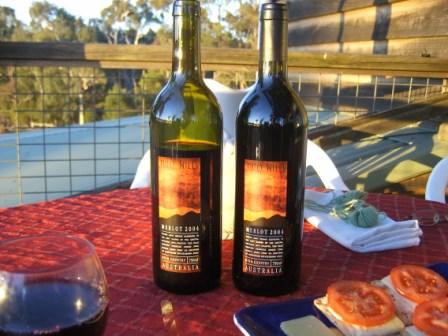
2004 Two Hills Merlot bottles shortly before consumption on our terrace in Glenburn


Two Hills Merlot

February 11, 2007

It was the perfect day for a Merlot. Actually any day is good for Merlot but in the tropics one has to be careful with alcohol of any kind. Nevertheless, we had to do some tasting today. 2001 was our first Merlot vintage. Nobody wanted to buy the fruit. This is why I decided to make all of it into wine. Alan Johns of Yering Farm (www.yeringfarm.com.au) did this for us.

All our wines are hand crafted. They come from a single site vineyard, Two Hills Vineyard in Glenburn, and are hand picked. The fruit was fermented in traditional open fermenters and aged in old French barriques to preserve the Merlot’s elegance and finesse. At 12.8 % alcohol it is not too “heavy”. It is medium bodied, dry with a good acidity and a long finish. Its subtle flavours of ripe forest fruit and its firm tannins give the wine a fine balance.

The Merlot Block

Two Hills Vineyard – Merlot Block, single site (3 1/2/ acres)

We do not have many bottles left of the 2001 vintage here in Jakarta, and in fact not many are left on our vineyard either. It has matured in the bottle and some of our friends like it better then the lighter more elegant 2004 vintage. 2001 was a warm year with a golden autumn to ripen the fruit in perfect conditions. Timo Mayer, our friend and winemaker at Gembrook Hill (www.gembrookhill.com.au), described it as an “umpf” wine, rich and heavy whereas the 2004 Merlot vintage is elegant with great finesse. Anyhow, we enjoyed the drop today far from the place where it was grown. It reduces the homesickness we feel from time to time.

If you want a bottle or two please call in the bottle shop of the Old England Hotel in Heidelberg/Melbourne (www.oldenglandhotel.com.au) and ask for Two Hills Merlot. If you are in Germany please contact Dr. Ulrich Hillejan (ulrich.hillejan@s-h-r.de). Zum Wohl. Salute.

Product Range THW

2001 and 2002 Sauvignon Blanc and 2001 Merlot vintages of Two Hills Vineyard


Sunday Lunch with Riesling from the Saar River

January 29, 2007

What a wonderful weekend this was. It goes without saying that I had “to weber” some of our food; to be precise it was my task to barbecue Sunday’s lunch. As our house guest David is vegetarian it meant that I had a lot of “veggies” (as Australians commonly call vegetables) to prepare. But we had also fresh fish, a Pomfret as it is commonly known. There are two varieties, the white and the black pomfret. The Indonesians call the former “Bawal Putih”. White pomfret has an excellent flavour and is commonly used for a dish called Ikan Asam Manis (sweat & sour fish); needless to say that it is very delicious either steamed or grilled.

The White Pomfret

The White Pomfret (from Kaarin Wall “A Jakarta Market”, page 53)

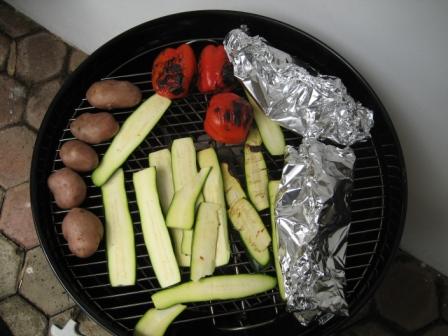
First, I grilled the vegetables: potatoes (after they were boiled), onions, capsicum, green peppers, and zucchini. The fish was marinated with black olives and capers and wrapped in aluminum foil to keep it moist. I put it on for only about 20 minutes. The food was delicious and we had the right wine to go with it.

misha2-097w.jpg

My Weber with the vegetables

We drank one of my last two bottles of Van Volxem Saar Riesling 2003. This wine estate is located in Wiltingen (www.wiltingen.de), a village about 20 km south of Trier at the Saar River, a cool climate region belonging to the Mosel-Saar-Ruwer area. The lower Saar is a very small winegrowing region but has some of the best Grand-Cru locations for Riesling (for instance Schwarzhofberg) on which its reputation is based.

misha2-111w.jpg

The 2003 Van Volxem Riesling

Van Volxem is the oldest estate in the Saar. Formerly a monastery, the estate belonged to the Van Volxem family for four generations. In 1999 it was purchased by Roman Niewodniczanski of the beer brewing Bitburger family. Based on old tax records, many excellent and sometimes forgotten vineyard sites were newly acquired when the estate was expanded. Most of the more than 20 ha are planted with Riesling vines. The first vintage was bottled in 2000 and ever since elegant wines with excellent ratings were produced under a system that avoids the German “Praedikat system”. Unfortunately, the estate’s internet presentation is still under construction. Therefore, we have to wait a while longer until you can visit www.vanvolxem.de.

sa500041w.JPG

A typical Saar vineyard

The soils of the Saar are based on blue-black slates and very stony. The vineyards are located at steep southerly slopes. The key for the Van Volxem Estate’s success are late harvests and low yields, environmental friendly practices (no pesticides) and low input cultivation techniques (no chemical fertilizers), relying in the cellar on natural yeasts fermentations and maturation in oak barrels. The 2003 dry Riesling blend has 12% alcohol. It was the first vintage producing dryer wines. 2003 was a ripper year as regards the weather and this might explain the higher than usual alcohol content of the 2003 vintage. Some of the wines are produced from more than 100 years old vines. The 2003 Riesling is medium bodied, had a buttery aroma and displayed some sweetness. It showed some mineral characteristics, had a fruity nose and a long finish. It is terrible that I have only one more bottle left of this excellent vintage (www.riesling.de). Wines do not age well in the tropics, even if you keep them properly refrigerated. There is always the odd power failure which destroys your well thought through cellaring program.

The drinking of Saar wine reminds me of my youth when my father and his friends used to go hunting in Schoden, a village further upriver. Often groups of hunters would descend on the Saar villages after successful campaigns and dine in one of the old rural inns (Gasthoefe). When at home with my mother in Trier, we often set out for long walks in the forests covering the hills above the Saar. From there one has a magnificent view of the lovely countryside.

From Schoden

Vineyards in a distance

sa500039w.JPG

The Saar Valley, the village of Biebelhausen in front on the left side of the Saar, behind the terroir “Ayler Kupp”, and to the left further back the famous village of Ayl.


Sunday Lunch the Mosel Way

January 22, 2007

The weekend came and went like a storm, exhausted I am sitting on my desk at Monday lunchtime and contemplate about the good times gone by. As always, we had great food on Sunday. My wife Margit prepared a “Wehlener Specksalat”, which translates into English as “Wehlener potato salad”. With it we had a wonderful fresh water trout. The wine we enjoyed with the food was a Riesling of course, a 2003 Kaseler Riesling from the Reichsgraf von Kesselstatt Estate.

The settlement of Wehlen/Mosel is part of the district of Bernkastel-Kues, a small but famous town in the Mosel valley, about 50 km downriver from Trier. Wehlen has one of the best vineyard sites among the Middle Mosel producing outstanding Riesling wines. The world renowned site is called “Wehlener Sonnenuhr” (Wehlener sundial). The vines are cultivated on steep slopes (50%) on an altitude between 110 and 190 meters above sea level. The soils are very stony and are classified as Devonian slate soils. The wines produced are elegant and deep, full-bodied and fruity.

Wehlen goes back to Roman times when Celts established this village. The settlement has a tradition of more than 1100 years of vineyard cultivation and wine production. In a historical document of 874 the Arch Bishop of Trier requires the vintners of Wehlen to deliver 10% of their produce to the local church. Only the vineyards allocated to local monks were excluded from this tax. Unfortunately, the website of Wehlen is only in German but you might still visit and enjoy the impressive pictures (www.wehlen.de).

Back to the food. The “Cookbook of the Mosel” (Author Gisela Allkemper, published by Wolfgang Hoelker) was given to my wife many years ago as a Christmas present by my mother. And ever since, Margit has referred to it and experimented with its recipes. Wehlener Specksalat has become our favourite potato salad. Here is how you prepare it:

Wehlener Specksalat

Ingredients: 1 kg of potatos, 2 table spoons of oil, 5 ts of vinager, 2 onions, salt, pepper, a pinch of sugar, 75-100 grams of smoked streaked bacon

Peel the potatoes and cook them, still warm, cut them into cubes and mix them with the dressing; cut the beacon also into cubes, fry it in a pan and add it with the fat to the salad; keep the salad warm, mix it from time to time. Serve it with backed or fried fish, and/or sausages or other fried meats.

We drank one of my last bottles of ‘2003 Kaseler Riesling’, Reichsgraf von Kesselstatt – The Riesling Estate (www.kesselstatt.com). Kasel is a small village at the Ruwer River, some 10km from Trier on the right hand side. When we were at high school my brother Wolfgang used to earn some pocket money by working for family vineyards during harvesting season. That’s hard work because the slopes are steep, the weather often wet and unfriendly. He reported about the great hospitality of the vintners and the fun he had with the co-workers of the labour crews employed for picking during vintage time. I never got to it and regret this now at the tender age of 52. Another lost opportunity.
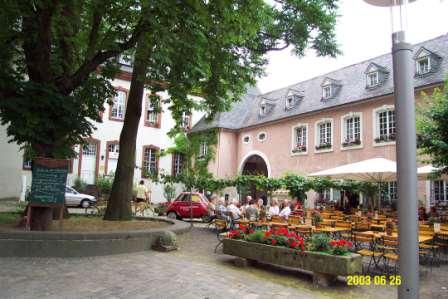
Wine Pub and Garden of Reichsgraf von Kesselstatt in Trier

The Wine Bar and Garden of Reichsgraf von Kesselstatt in Trier

Reichsgraf von Kesselstatt maintains a beautiful website (www.kesselstatt.com) in three languages; German, English and Chinese. The latter made me very happy. Having lived in China and Chinese speaking cultures for more than eight years, it is always a pleasure to see Chinese characters. I guess that many of the Chinese tourists visiting Trier, the birth place of Karl Marx, also belong to the customers of the estate. Let us hope that many visitors from the Far East become lovers of wine from the Mosel river and its many vineyards, wineries and wine estates. Kesselstatt, by the way, owns also a vineyard in Wehlen (according to the website 0.3 ha) in the location “Sonnenuhr”.
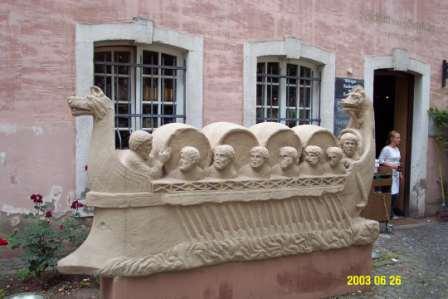
“Neumagener Wineship” replica in front of the Kesselstatt wine bar

The “Neumagener Wineship”, replica in front of the Kesselstatt Wine Bar.

Similar to the “village-system” of Burgundy, Kesselstatt produces regional wines. The fruit for this Riesling is sourced from around Kasel. Kesselstatt itself owns two holdings there (top locations Nies’chen 4.4. ha on a 60% slope and Kehrnagel 1.8 ha on the valleys finest sites). Some of the vineyards belonged to the St Irminen monastery. By the way, I grew up at Irminenfreihof 5 in Trier (the neighbourhood was locally also knows as Brittany), next to the monastery located in the middle of the city of Trier.

The Wine: 2003 Kaseler Riesling dry
This full-bodied fine Riesling shows all the characteristics of the typical Mosel Rieslings. It’s very minerally (because of the slate soil) and fruity, depicting pineapple, peach, apple and lemongrass characteristics. It’s is also well balanced, dry with a lingering finish. The alcohol level is rather high for a Mosel Riesling (12.5%). But 2003 was a most astonishing year. Throughout the year temperatures were higher then normal; the year was also much drier. Because of these favourable conditions growth was exuberant. When temperatures hit the 40° Celsius in August sunburns were widespread. The grapes ripened quickly and picking started much earlier along the Mosel river and its tributaries then in most years. The fruit picked was usually healthy and showed aromas which were not depicted in other years. Unfortunately, I have only another two or three bottles left of this treasure. I will reserve it for special occasions with more Wehlener potato salad and fresh trout.

Barbecueing – The Australian Pastime

January 19, 2007

My wife gave me as Christmas present the Mercedes Benz of the grills. a Weber. The Weber, a Canadian product, is the most sophisticated among a wide range of grills (www.weber.com). I have already one with gas but now the round, shiny Weber is decorating my backyard. It was easy to assemble the thing, even for a man with two left hands like me.

In Australia, the mother country of my wife, grilling is a men’s affair, no work for women. I am a lousy cook, I admit this. When we are back on the vineyard usually my brother in law, Michael, (or any other Australian male nearby) is doing the grilling, but in Jakarta there is no Michael. Now I ran out of excuses, and the Weber is there calling for me.

The second impediment for me becoming a master griller is that I do not appreciate meat very much. Not that I am a vegetarian, no, I am rather a selective meat consumer. There are days I cannot swallow the flesh of animals and stick to green stuff exclusively. The biggest challange for me is to find out when the meat “is done”.

I knew long before Christmas Day that I would get a Weber. The packaging gave it away. It was just to bulky under the Christmas tree. So mentally I was somehow prepared for it. I also knew that Margit had bought a Turkey to be prepared for Christmas lunch. And Tukey it was, my first grilled masterpiece.

The photo below depicts me doing my job as an Australian man. Sorry for the outfit (no Akubra; www.akubra.com.au; another icon of Australian identity), but it’s hot in the tropics. The Turkey tasted wonderful. I am sorry for the winedrinkers. When I stand next to a grill I can only drink beer. A case of Tooheys Red, the favourite hops drink of my brother in law, was consumed in the battle with the grill and later with the meal I drank the last supply of my Bitburger Beer from my hometown. Margit drank sparkling and the girls had water.

Adam and the Weber