“Greek dinner” at the vineyard

January 6, 2009

greek-dinner

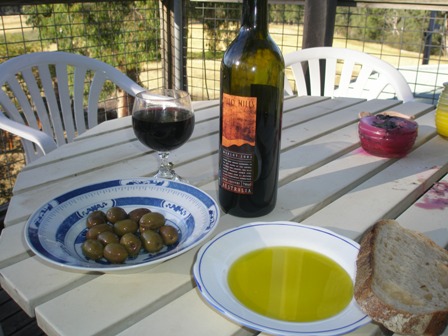
Australian olives and olive oil and Two Hills Merlot, what a treat !

From the outset, I apologize to all Greek people, Greece and Greek culture and so on. I did not in the least want to offend anybody or humiliate the great Greek culture.

What you see in this picture is of course not a Greek dinner, but just a modest dish of olives, Australian olives to be precise. They are coming from an olive groove in Tallarook. Juergen grew them and Michael cured them, and needless to say: they are delicious.

I am of course not known for being a (great) cook or a cook at all. Moreover, I am alone in the vineyard at Glenburn. However, before another session of fruit wire lifting in the evening, I made myself this little dish. The olive oil is also local coming from ‘down the road’. The bread comes from Giant Steps in Healesville and can match any rural bread from Europe.

I am almost done with the wire lifting, only the Pinot Noir is left. Hurrah!!!!

The evenings here are magic. You have to come and see for yourself one day.


Geoff Achison at the Yarra Glen Grand Hotel

January 5, 2009

I will have to jump a bit regarding the time line. There is so much to write about. Some of it happened in 2008 but I still want so let you know. The live music with Geoff Achison took place on December 18th I think.

geoff1

Fortunately, it did not rain. We had been unloading containers the whole day and furniture and other stuff was all over the place. It was hard work and we were very much looking forward to the evening.

It was just my second evening in Australia. It should become a memorable event. Michael, my brother-in-law, had booked a table for a dinner with a music performance by Geoff Achison, a famous blues guitar player, at the Grand Hotel in Yarra Glen.

geoff2

The girls had a bottle of ‘2005 Yering Station Cabernet Sauvignon’, a very nice wine from the oldest vineyard in Victoria (founded in 1838 ) which is just around the corner from Yarra Glen.

geoff3

When I went to the bar, I discovered that they had a German beer on tap and could not resist (I was also the driver) to order a Beck’s. The food was solid and we enjoyed the atmosphere.

The Grand was packed with people, young and old to listen to the “legend”: Geoff Achison. He did not disappoint us.

Geoff had to give a few encores before the crowd allowed him to take a rest. Before departing I bought two of his CD’s and had a nice chat with him.

Michael had introduced me to his music years ago but so far there was no opportunity to see him live. His voice, is the voice of a black man and his virtuosity on the guitar is just amazing. Check out his webpage: www.geoffachison.com but Geoff is also on facebook and has a fan website. I love his music, especially the old blues pieces.

This pleasurable evening should be an auspicious start to my holidays in Australia, I thought. Thank you Geoff and cheers folks to four eventful weeks in the country.


The best pasta – a farewell lunch

December 3, 2008

best-pasta

My farewell meal before leaving my Bangkok home was “pasta”. Since there was not much time between the decision to get on the plane and the packing of suitcases, it needed to be a fast one: ‘spaghetti alio e olio’ with some ‘peperoncini’ was the choice. A delicious meal on our terrace, very civilized, a moment of reflection and introspection before the outer world was allowed to swallow me again.

best-pasta2

The drink of choice was our new “house wine”, a ‘2007, The Bushman’s Gully Chardonnay’, a simple but straight forward white, mass produced wine which sells at about 8 EURO/bottle which is not exactly cheap and much too expensive for a “house wine” for every day consumption. But we are in Thailand and not in some wine drinkers heaven.


Karl Marx and Chinese Grape Wine

November 28, 2008

To state it from the outset, Karl Marx never ever tasted Chinese grape wine in his lifetime. However, Karl Marx, the most famous son of my home town Trier, used to own for some time some of the better vineyards properties along the Ruwer river, a tributary of my beloved Mosel river.

The Marx family vineyard was found in the location “Viertelsberg” a medium quality terroir near the castle ‘Gruenhaus’. In 1857 the family sold its vineyards in Mertesdorf. Karl not only invested in vineyards and the wine industry but he also loved to drink Mosel wine. I frankly do not understand how Marx could survive those many years in London where good Mosel wines were certainly hard to come by in the latter half of the 19th century.

Marx would have enjoyed the samples of “College Wine” produced by the Chinese Agricultural University (CAU) oenology department. The wine is produced for purely non-commercial reasons. The bottles were presented to me by an old friend. We enjoyed it over a meal which marked our reunion. The wine went very well with the Chinese food on offer. Later at home in Bangkok we would have it with an Italian pasta. But in this case I felt that some depth and ‘strength’ was lacking.

collegewine2

The grapes for this wine come from Changli in Hebei province and were supplied to the oenology department by the well known Huaxia Winery. When I lived in Beijing in the early 1990s, it was marketed as Great Wall wine.

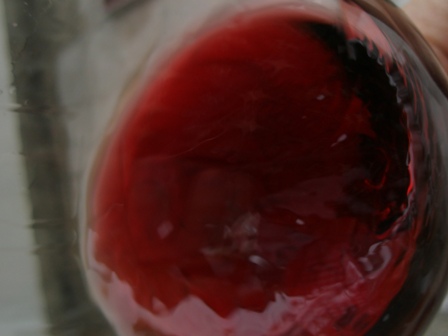
swirling-college-wine

Swirling in the glass – what a beautiful ruby-red colour

The wine displays the typical varietal character of a Cabernet Sauvignon but is medium to lights bodied. At 12% alcohol it’s a bit “thin”/”light” for my taste. In comparison, it went well with Chinese but not Italian food.

collegewine3

A somehow classic design

Afterthought
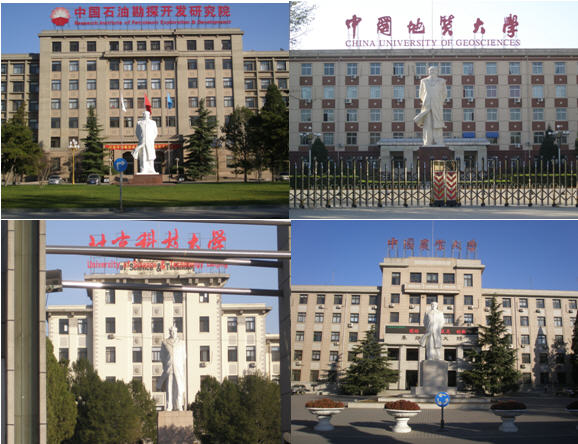
PS: Despite the fact that the CAU is a modern university, at the entrance to its eastern campus, one of the few statues of Mao Zedong graces the gate. When I lived in Beijing in the early 1990s, my friend David McGrath (al marhum), chased the remaining Mao statues still standing in the capital city. He took photos of all of them. If I remember correctly David identified 8 statues. Around ‘Xue Yuan’ road where I stayed, I found 4 of these 8 in no time. All were to be found at the entrances of universities or other academic institutions.

the-4-maos

The four Mao statues

F.l.t.r. and up to down: Research Institute of Petroleum Exploration and Development, China University of Geosciences, University of Science and technology, China Agricultural University.


Restaurant Review: La Vaca Veronica – fine dining in Madrid

November 2, 2008

Madrid is a wonderful place to visit. We were very lucky and had a great time in the capital city of Spain. We used the four days we had to the utmost to explore the amazing town. Foremost, we wanted to visit the museums such as the Prado and the Reina Sofia (we did not make it to the Thyssen museum). But it’s not just art and culture. The people of Madrid are amazingly friendly. It just blows you away. It started with the guy picking us up from the airport. He did not speak a word of English, and he also did not know where to bring us to. Alas, the modern world has mobile phones on hand (what did we do before we had them?). He made a call to the apartment renting agency and the rest was smooth driving. We communicated with hands and gestures, also the Spanish phrasebook helped somehow. It was a marvellous start of our four nights in Madrid.

Needless to say, we also explored the restaurant scene. First we checked out some of the many (many many many) tapas bars. On our last evening, however, we decided to have a different type of dinner. On our endless walks we had passed La Vaca Veronica before. After some appetisers in a famous Sherry bar, we leisurely strolled towards the narrow lane where La Vaca Veronica is located.

The restaurant opened only at 21h which we did not know. We were surrounded by other, patiently waiting, guests outside. My daughters passed the time by jumping from the roadside pillars barring cars from parking on the side walk. But luck was on our side. We got a table without a reservation. The restaurant owner was around and helped us along.

The dining room

What did we order? Well, mainly Italian type cuisine as you can see from the pictures below. We somehow all lounged for a pasta. The food was delicious. The colourful interior contributes to a very friendly atmosphere. We enjoyed it thoroughly and had a jolly good time. After all, it was our last evening after some very busy and eventful days.

If I am not mistaken, we ordered the house wine. I lost my tasting notes, sorry folks. But there is so much good wine in Spain that you cannot go wrong.

The landlady behind her desk.

Here is our recommendation: 5 stars out of five.

The decisions was democratically derived at. We go with the principle: one person, one vote. If you can, visit Madrid, and if you are hungry go to La Vaca Veronica for a meal, it’s worth it.

La Vaca Veronica
Restaurante
Abrimos los Domingos
Moratin, 38
28014 Madrid
Te.: 914297827
http://www.lavacaveronica.es


Restaurants in Jakarta – Anatolia

September 24, 2008

It was our last Saturday night in Jakarta. Everything must come to an end. After 10 years, leaving was not an easy thing. A quiet “last supper” with our friends Liz and Walter was our preferred choice. They invited us to Anatolia, a Turkish restaurant in South Jakarta.

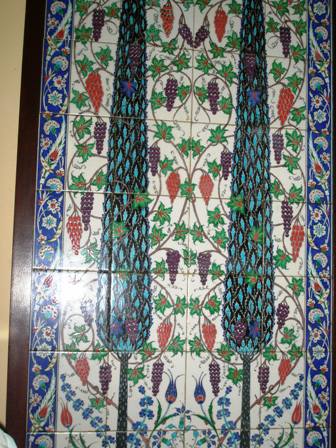
Beautiful tiles depicting among others “grapes”.

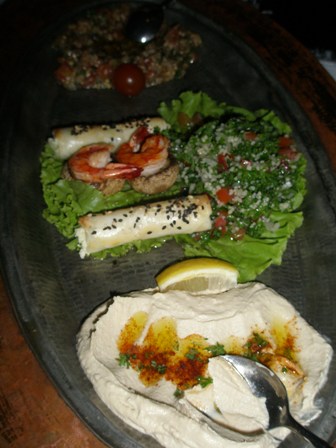
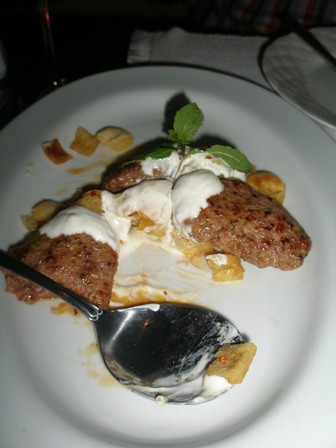
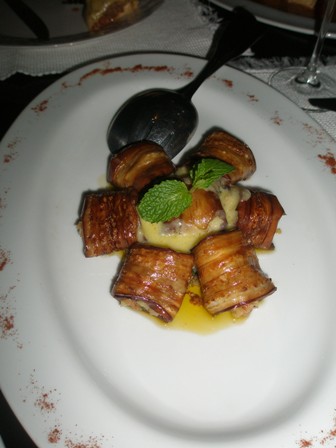
I am a lover of Turkish food and so it came as no surprise that we just loved the various dishes which were put in front of us. Good food, good company, good conversations, fun and good wine, that should become the recipe of the evening. And look at some of the food!

Various starter platters.

Unfortunately, I forgot most of the names of the different dishes. The atmosphere in the restaurant was lively. We were entertained by a dancer and modern music from the Middle East.

What did we drink? As so often before, I was given the task of selecting the wine. I could have chosen some Australian reds but could not resist to order something new, something I had never heard of: a Turkish wine. Have you ever heard about Yakut (not not the thin Japanese milk-yoghurt drink, which is written with an l before the t)?

‘Yakut Kavaklidere’ was written on the bottle. Fortunately the back label was in Turkish. I just could not resist ordering the bottle and some more were to follow. The wine was dark red in colour. We were all surprised by its round taste, an intense fruit flavour, a bit of plum and cherries. But it was unlike other wines. I could not identify the grape variety. We all agreed that the wine matched the food very well. Existing prejudices about Turkish wines were quickly transformed into admiration. Despite the fact that this wine was simple (and not expensive) and not at all sophisticated, we just loved it. Thanks Liz and Walter for the wonderful evening.

Are you living in Jakarta and having no plans for Friday night as yet? The choice is clear. Have a meal at Anatolia.

Address


The Gourmet Garage, Jakarta III – Jolly Farewell

September 15, 2008

It was another farewell but one of those were time seems to have stopped. We enjoyed the moment, the pleasure of being together for a memorable meal and we did not think much about parting or not living in the same city again. Any future starts in the present moment, and we were sure we would have lots of it. We were not doubting that we would meet again, as friends do.

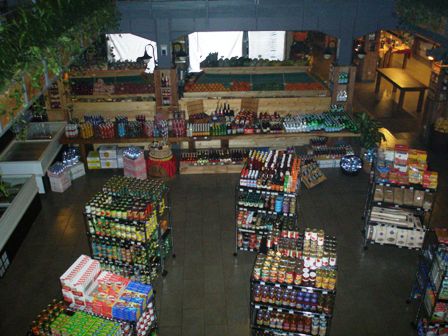
Well, were did we go? And who is “we” in the first place? To answer the first question, we met at the Gourmet Garage in Kemang, Jakarta, a very fashionable place. It was also easy to reach for all of us.

The inside of the Gourmet Garage in Jakarta with various shops on the ground floor and the restaurants upstairs.

The answer to the second question is, there were the five of us: Flo (Florian) and Nelly, Jasmin, Margit and me.

Margit, Florian, Nelly and Jasmin

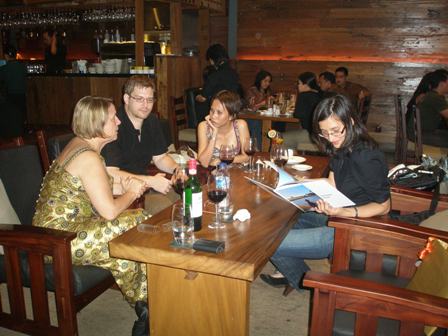
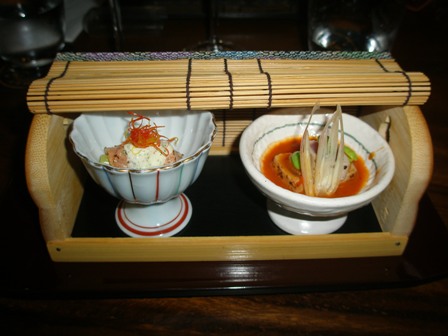
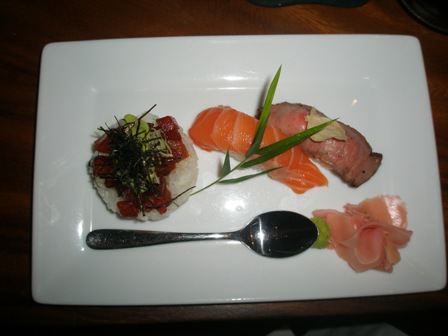
The three had invited us to spend our last Friday night in Jakarta among friends. They talked us into ordering the four-course Japanese meal. Depending on the day, the chef changes the composition of the dishes of the four courses. Surprise, surprise but since we like adventures, we were eager to wait for things to come. Flo and Nelly ordered other dishes from the Japanese menu. There are two more menus to choose from at Gourmet Garage, a Western menu and an Indonesian menu.

Flo started with an oyster.

The starters for the four-course menu were beautifully decorated.

So were other dishes from the menu.

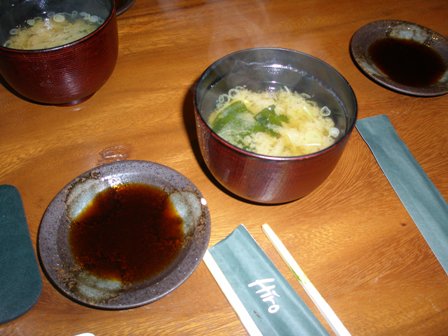
This soup was just delicious.

The miso soup came with the four-course meal.

This was part of Nelly’s dish.

And Flo had a similarly decorated meat dish.

This is one of the desserts we had.

In short, the food was delicious. According to some expat Japanese, Gourmet Garage offers the best Japanese food in town.

You might like to know what wine we drank. Nothing special, I can tell you. Well, we opted for a simple, red wine from Australia. With ‘Penfolds Rawson’s Retreat Shiraz-Cabernet’ you cannot go wrong if you need a wine for every day which is easy to understand and to drink. Gourmet Garage prices these wines very reasonably. The choice was a compromise, of course, but I did not fancy the whites from the wine list. A Mosel or Saar Riesling would have been my preferred choice.

But we had a great time and that was what mattered most. Farewell gifts changed hands (I do not reveal what they were) and at about midnight we parted company as on many other occasions before. See you guys in Bangkok, or on our farm in Glenburn. As you know, you are always welcome; ‘sampai jumpah’ as we say in Indonesia.


Vinho Verde – Portuguese delight

September 11, 2008

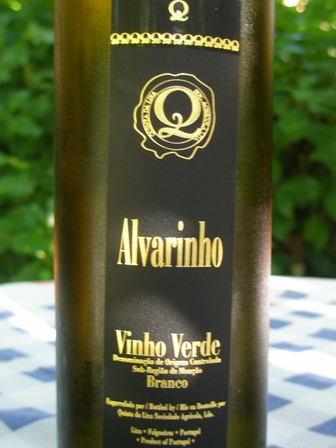
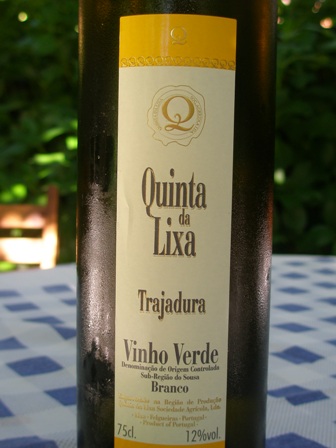
Vinho Verde wines are unique among the blended white wines of Portugal (and the world) attempting to harmonize delicate aromas and flavours. The name, Vinho Verde, is somehow misleading. Vinho Verde wines are not made of “unripe” grapes as some people say, but are rather “young” wines in contrast to “aged” wines. There are red and white Vinho Verde wines available. The red ones are often a challenge to our culturally determined palates. During my recent trip to Porto, Portugal I had ample opportunity to taste and explore the wines of Northern Portugal. Among them the famous Vinho Verde wines of the Minho wine region.

It is not easy to find a “pure”, varietal wine in the Minho wine region of Portugal. Traditionally Vinho Verde is a blend consisting of several grape varieties (www.vinhoverde.pt) such as Alvarinho, Arinto, Azal, Avesso, Trajadura and Loureiro.

However, with a bit of luck I found some bottles in the café next to the cathedral in Amarante, a small town at the (Rio) Tamega river, about 50 km east of Porto. The wines came from Quinta da Lixa (www.quintadelixa.pt), a well known producer located in the village of Vila da Lixa about 20 minutes northwest of Amarante.

From left to right: 2007 Quinta da Lixa Loureiro, Alvarinho and Trajadura

The tasting notes for the three wines you can find on the websites which I mentioned above. Average production for the three varieties at Quinta da Lixa is bout 7 tons per hectare. The wines are low in alcohol (10 to 11.5%) and show an acidity of about 6.5 g/l.

The Trajadura grape has, in contrast to Alvarinho and Loureiro, a rather plush character and is less acidic than the other two varieties. It is often used to soften the blended Vinho Verde wines.

The Loureiro grape provides the fragrant character of the blended Vinho Verde wines. The single varietal wine of Quinta da Lixa which I tasted was slightly “sparkling” and very aromatic (more aromatic than the other two single varietal wines of Quinta da Lixa). All three wines showed citrus, lime and green apple aromas. They were very fresh and clean, served at the right temperature they are wonderful summer wines. Earlier vintages of Quinta da Lixa Loureiro and Trajadura received 89 and 90 points by some tasters. I loved them as single varietals as well as in the blended incarnation.


Wine tasting at Van Volxem Estate in Wiltingen, Saar

September 8, 2008

In April this year, my friend Heinz and I, we had visited the Van Volxem Winery (www.vanvolxem.de) in Wiltingen, Saar for the first time. Unfortunately, all wines were sold out then. Dominik Völk, the wine maker, served us a delicious coffee instead and we were invited to visit again in the month of July when part of the new vintage would be released.

Steep slopes for maximum exposure to the sun at the Saar

And that’s what we did. This time I brought my whole family (mother, wife, children). Our appointment was at 14 h in the afternoon on a rainy summers day. Ms. Niewodniczanski, the wife of the owner Roman Niewodniczanski, served us six newly released wines, all of which were excellent representatives of the Saar region. Van Volxem calls these wines ‘classic dry wines’, though residual sugar in Van Volxem Riesling wines may go up to 9 g./l.. For Franconian vintners, for instance, 7.5 g./l. is the agreed maximum. Van Volxem, however, believes that the higher residual sugar content contributes to the overall harmony of its wines. The only exception to the dry wines we tasted was a semi-dry ‘2007 Rotschiefer Riesling Kabinett’.

Contemplating about Riesling wines with Ms. Niewodniczanski

Five of the six were Riesling wines, one was a Pinot Blanc. The following list shows the six wines:

– ‘2007 Weissburgunder’ (Pinot Blanc), 9.90 Euro/0.75 l
– ‘2007 Schiefer Riesling’ (“slate” Riesling), 8.60 Euro/0.75 l
– ‘2007 Saar Riesling’, 9.80 Euro/0.75 l
– ‘2007 Wiltinger Braunefels Riesling’ (a single location/vineyard wine), 12.50 Euro/0.75 l
– ‘2007 Alte Reben Riesling’ (from old vines), 13.80 Euro/0.75 l
– ‘2007 Rotschiefer Riesling Kabinett (red slate), semi-dry, 9.90 Euro/0.75 l

We liked all of them but some more than others. Heinz bought some bottles of Saar Riesling and the semi-dry Rotschieder Riesling Kabinett. Apart from Saar Riesling I bought some bottles of ‘Alte Reben’ (old vines).

The Van Volxem tasting room is a wonderful place, with old wooden furniture and beautiful old maps on the walls.

The estate will release the Grand Cru wines later this summer. We were to early to taste them.

Farewell, but we will come back (my daughters Lucy and Charlotte with the vintner’s wife).

If you are interested in German Riesling, you have to visit the Saar region. Wiltingen is a must, so is Van Volxem Estate. Have fun tasting the best German Riesling has to offer.

Address:
Van Volxem Estate
Dehenstr. 2
54459 Wiltingen, Saar
Te.: +49-6501-16510
e-mail: vanvolxem@t-online.de
www.vanvolxem.de


Germany’s Best Riesling Wines 2007

August 30, 2008

Riesling vineyards in Olewig, Trier

The wine magazine – Weinwelt (Aug./Sept. edition) – I picked up at Frankfurt Airport when leaving Germany in August carried an article on the best Riesling wines in 2007.

About 1.500 wines were entered into this tasting and the overall winner (with 93 points) was

● Weingut Geheimer Rat Dr. von Bassermann-Jordan, Pfalz wine region with a
‘2007 Auf der Mauer Riesling QbA, dry’

Among the top seven wines were 4 from Pfalz, one from Austria, one from Rheinhessen and one from Franconia. For someone like me, a native of the Mosel, it is devastating that no wine from my home region was among the best seven.

Another Riesling competition in Bingen/Rhein in July had a record entry of almost 2,000 wines (1,937 to be exact) from 754 producers from almost all wine producing regions in Germany and from Austria, Canada, Australia, Luxembourg, France, USA, and New Zealand. Most of the non-European Riesling wines came (surprise), of course, from Australia.

The show is conducted every two years and 160 judges of an international jury assesses wines according to the international wine bureau (OIV) standards. The full report of this tasting can be found on www.riesling.de under the rubric “best of Riesling 2008”. In the category “dry Riesling wines”, the winner came from the Rheingau wine region:

● Weingut W.J. Schaefer in Hochheim for the
‘2007 Hochheimer Kirchenstueck Spaetlese’.

Number 2 came from the Mosel:

● Weingut Frank Brohl, Puenderich for the
‘2007 Puendericher Nonnengarten Spaetlese’

and from Pfalz,

● Weingut Emil Zimmermann in Wachenheim for the
‘2007 Wachenheimer Koenigswingert Spaetlese’.

In the “semi-dry Riesling category” wines from Rheinhessen, Mosel and Nahe could be found among the three top wines. However, the “sweet wine category” was dominated by Mosel wines.

There will be many more shows and wine tastings in the coming months. In July this year, when we tasted the 2007 vintage at Van Volxem Winery (Wiltingen, Saar), the “grand cru” wines were not yet presented because their release was scheduled for fall.

Given the fact that most wineries have not yet officially released their “gand cru” or, as the Germans say, “grosse Gewaechse”-wines, we will witness great quality Riesling wines of the 2007 vintage hitting the market later this year. That’s what I call wonderful prospects for us wine lovers.

My favorite Riesling from the Saar

PS: From October 14-18, 2008 the 2008 Canberra International Riesling Challenge will be conducted. For the first time in the history of the event, the number of entries has surpassed 500 wines (506 total entries), with a record number from Germany (99 entries). Let us see what the outcome may be.