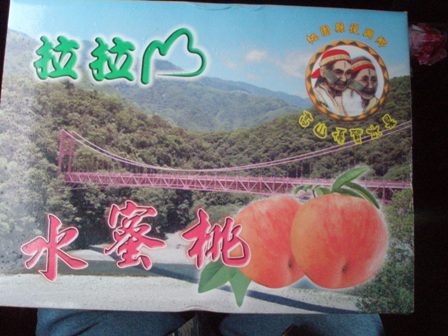
The Peach Farmer of La La Mountain

June 16, 2010

Peaches of La La Mountain

We were heading to Fuxing district on La La mountain, near Daxi county just about a three hours drive from Taoyuan. We all met at the shrine to the memory of former president Jiang Jie-she (Chiang Kaicheck) in Daxi. There was also a fruit and vegetable market and this is were Mr. Chen Long-gui has a stall to sell his peaches. His daughter Ajoan was already waiting for us and off we went.
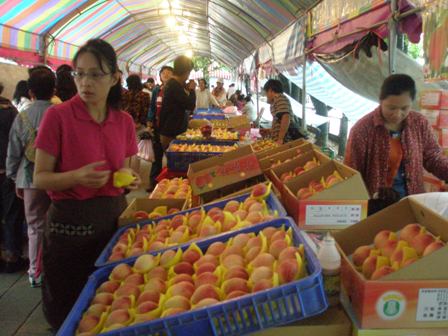
Fruit stalls near the shrine in Daxi

Prof. Jim Riddell, Prof. Yen Ai-ching and me

The winding road lead us up into the La La mountains, a region inhabited since “time immemorial” by the aboriginal tribe of the Atayal. After about two hours we reached the small hamlet where Mr. Chen Long-gui and his family resided. we met at a small local restaurant were we had a delicious lunch. We were a large group, as you can see from the photo below.
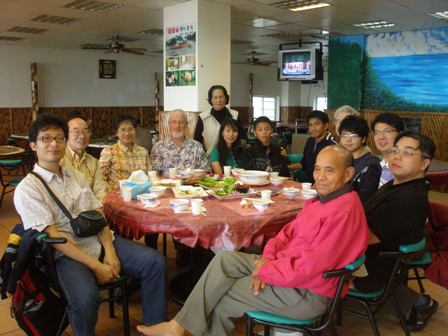
Mr Chen, the peach farmer (in red shirt), and our group

After we had our fill and the stomachs were satisfied, we headed for the home of the Chen family. Mr. Chen is Mr. Peach, because he was the first to introduce the cultivation of peach trees to this area. Today he has about 300 trees planted on the hillsides at about 2000 m above sea level.

Harvested peaches

Packing of the fruit for sale

Prof. Yen and farmer Chen and his wife and the appreciation for outstanding performance

We had tee in the Chen family home where we also discussed land, agricultural, economic and cultural issues in a very relaxed atmosphere. because of the heavy rain, we could not go out and see the fruit orchard and the trees. We tasted some of the fruit of the early harvest. As you can see, all work is done by hand. Apart from the peach trees Mr. Chen is growing vegetables for home consumption and sale. he is also a minister of the local church. In parting we wished him plentiful harvests and good prices for his crop. We have to come back. I was told that there are breathtaking views to enjoy from Mr. Chen’s home and his village. But the weather of the La La mountains had no mercy with us that day.


The ring in – a new fruit grower?

June 14, 2010

Photo of the day: at Mr. Chen’s peach farm on Lala Mountain, Taiwan


La Domenica – A Tuscan feast with Tuscan wine

June 13, 2010

Jamie Oliver’s Italy

It was high time for some beautiful Italian food after my culinary peregrinations in Taiwan, especially since I am in the process of packing my suitcase again. I will be in Vietnam for the next two weeks and explore some of the foods in Hanoi and Saigon.

I am a lover of pasta, any pasta. Based on a recipe from the Jamie Oliver Italy book, we set out on a “fusilli con rague”. Imagine a sauce thick with the flavours of beef rosemary and tomatoes simmering on the kitchen stove for hours.

Our favorite Prosecco so that the waiting was bearable

The table waiting for the pasta

Voila: the pasta

It was delicious, just what I needed, earthy and robust, rooted in the peasant traditions of Italy.

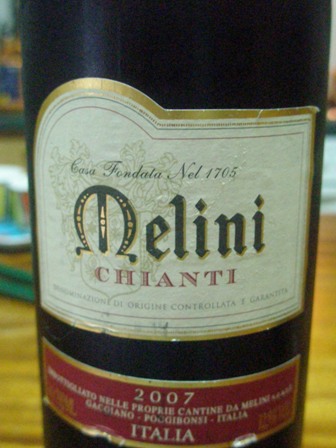
What about the wine? I bought a bottle of Italian wine from my favourite wine shop in Taoyuan just across from the International Center for Land Policy Studies and Training (ICLPST). Nothing special, but decent. It was a bottle of ‘2007 Chianti D.O.C.G.’ by Melini, one of the best wine makers of Tuscany.

In wine reviews it gets three, sometimes four, out of five stars. It has about 13.5 % alcohol and costs between US$ 8 to 12. This young Chianti is a solid wine for every day, with good fruit flavours, medium bodied with a long finish. It went very well with the pasta.

PS: The good news is that in July we will be in Rome and Florence with ample opportunity to taste many Tuscan wines.


Taiwanese delicacies: Yu Tou Guo (芋 頭 粿)

June 12, 2010

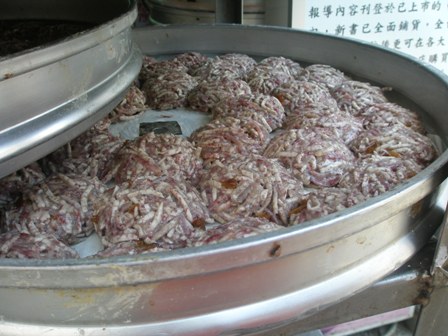
“Yu Tou Guo” 芋 頭 粿 on display in Lugang, Tainwan

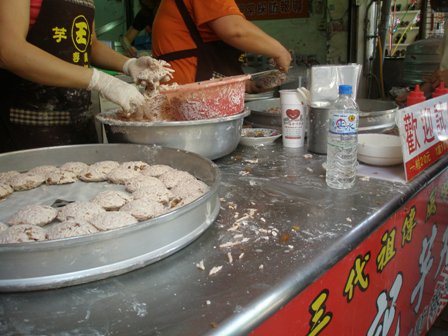
How “Yu Tou Guo” 芋 頭 粿 is made on the street

While walking the streets of Lugang the other day, I observed women making a strange dish. I took some photos and asked my friend Chimei the next day what it was. “Yu Tou Guo” (芋 頭 粿) was the result. Well, what is it, you might ask.

It seems Yu Tou Guo (芋 頭 粿) is made from taro, a tropical root vegetable. It is a kind of steamed taro cake, stuffed with some filling. I saw the women doing it, but did not ask because this stall was very busy. I will have to find out what the filling is made of. I did not dare buying one since it looked raw and not ready for consumption. All the buyers took it away, nobody ate from it on the spot. I will have to find out more and give it a try next time.

PS: My Chinese dictionary gave me another combination for “Taro” in the simplified character form. But since I was in Taiwan, where the “full” Chinese characters are used, I guess that what Chimei scribbled on a piece of paper for me was correct.


Delicacies from Lugang 鹿港, Taiwan

June 10, 2010

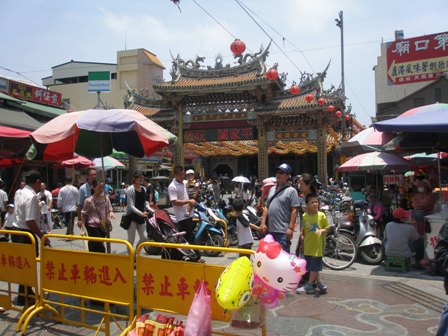
Matsu Tempel in Lugang 鹿港, Taiwan

The Matsu Tempel and it’s surroundings in Lugang 鹿港 are very crowed places. People from near and far visit the historic center of this harbour city in central Taiwan. Lugang has lot’s of interesting things to offer, among them some Taiwanese food specialties which you should not miss.

These you can enjoy in one of the many street eateries like the one below just opposite the entrance to the magnificent temple.

A typical street eatery

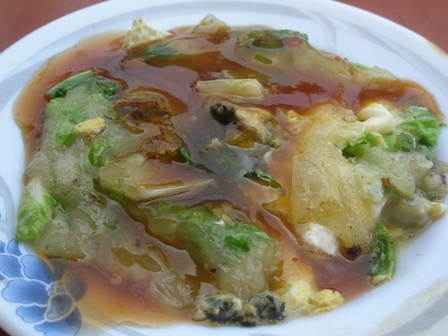
One such delicacy of Lugang is called “e-a zen” in Taiwanese, a kind of omelet made of eggs and oysters, with starch from sweet potatoes. Lettuce is also added. Finally a sauce is added whose composition is usually a trade secret. Every family has it’s own recipe but the liquid consists, among others, of soja and miso sauce, sweat chili and other ingredients.

The photo shows how “e-a zen” is prepared

“e-a zen” ready to be eaten

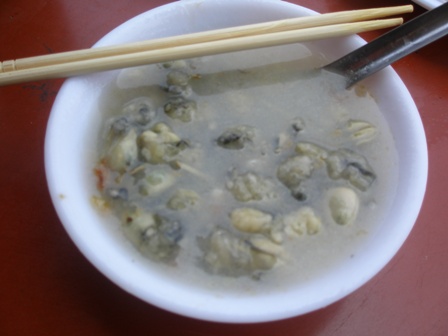
Oyster soup with ginger

My friend Jim after the oyster feast

We had also oyster soup with the “e-a zen”, the oyster omelet. If you do not like oysters this is not a meal for you. But if you do, the two dishes are “heaven on a stick”. What a wonderful explosive experience for your taste buds. Incredible. Delicious. A must if you travel in central Taiwan.

We enjoyed the open air atmosphere where we shared a table with a Taiwanese couple. The son of the owner, very business like at the tender age of 10, waited on us, brought us chairs and the necessary eating implements. He also managed brilliantly our messy ordering in improvised Mandarin.

We washed the food down with a cold Taiwan beer. The place and the food were a great choice. Go and do it yourself.

Taiwan Beer


Food heaven at Bangles in Taoyuan

June 7, 2010

A Hamburger and a Kronenbourg beer

After all this very delicious Chinese food here in Taiwan, my taste buds needed a break, so my friend Jim and I, we decided to go out to an eatery called Bangles, a hamburger restaurant in Taoyuan with waiters in cowboy costumes, and have a “decadent” Hamburger or something like it. This was very nice indeed. The service in Bangle is very friendly, the atmoshere pleasant, the food tasty and the beer is very decent.


Delicious streetfood in 鹿港 (Lugang), Taiwan

June 6, 2010

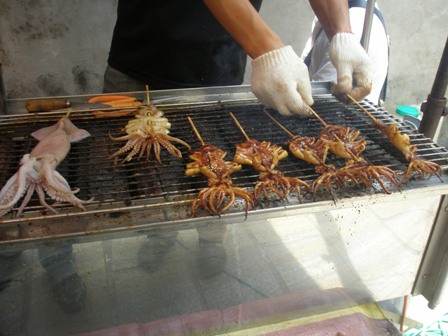
I had the chance to visit the former port city of 鹿港 (Lugang) near Changsha and Taichung on Taiwan. We were lucky that it did not rain. The sun was shining and the sky was blue. The historic centre attracts a lot of visitors. The main attraction of the town is it’s temple dedicated to the Taoist goddess of the sea, “Matsu”. All kinds of good are for sale including delicious traditional snacks. The squid below was one of them.

Squid on the street barbecue

Small and large specimen for the hungry passers by

Needless to say, we had a great day. Tomorrow. I’ll show you more of this scenic spot in the middle of this splendid island.


Winery Review: Vereinigte Hospitien, Trier, Mosel

June 2, 2010

vereinigtehospitien1

The St Jacob of United Hospices wine label

I grew up just next to the convent of St. Irminen at Irminenfreihof No. 5 in Trier, Mosel. The convent belongs to Vereinigte Hopitien, a foundation which also ownes a well known winery with the same name. Their English name is “United Hopices Wine Cellars“. The patron saint of United Hospices is St Jacob, an image of which is also used on the wineries labels.

As a kid I played in the cellars and warehouses of the convent. I also remember them sending their vats and barrels for controlling purposes to the Eichamt, the local Weights and Measures Office, which my father was heading. We played around the barrels and I vividly remember the smell emitted by the oak and the moist wood.

vereinigtehospitien3

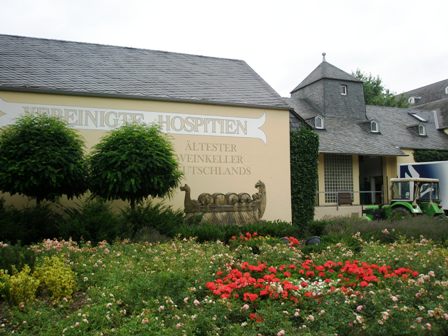
The winery

United Hospices owns vineyards along the Mosel (locations: Piesporter Goldtroepfchen and Triere Augenscheiner) and the Saar (locations in Wiltingen, for instance Hoelle, Scharzhofberg and Kupp, Kanzem and Serrig). Most of the vineyard originally belonged to monastries and convents. Today about 25 ha are under vines, 90% of which are planted with Riesling grapes (my favourite grape variety), the rest consists of Pinot Gris, Blanc and Noir.

As many of the wineries in Trier, also United Hospices has a large traditional wine cellar (some parts of it dating from the 3. century) which you should have a look at. Wine tasting in ths historic atmoshere are unforgettable events. United Hospices top wines are the dry and sweet (Trockenbeerenauslese) Scharzhofberger Riesling wines from the Saar some of which sell for up to 100 Euro/bottle. The ordinary Riesling wines cost about 6.20 Euro/1 l. bottle.

I hope you are going to visit Trier this summer and drop in for a wine tasting. Cheers

vereinigtehospitien4

The main hospice building along the Mosel

vereinigtehospitien2

Church St Irminen

Address:
Vereinigte Hospitien
Krahnenufer 19
54290 Trier
Tel.: +49-651/945-1210 o. 0651/945-1211
Fax: +49-651/945-2060
Opening hours: Mo. – Thu. 08-12:30 and 13:30 to 17h; Friday closing at 16h, Saturday 10-14h