Melbourne’s water supply

September 10, 2009

When I read in the Age that Melbourne is planning to take 10 billion litres (which covers the city consumption for about 10 days only) from the Thompson River to make up for the shortfall which cannot be covered from the Yarra River, I was not impressed. The Labour government is desperate.

The interview of Tim Holding, the Victorian Water Minister, which Plug the Pipe has on its website is revealing. The North-South pipeline is completed ahead of schedule but there is no water. The conclusion I draw from it is, the Minister should change jobs before it is too late. The state’s water policy is a mess.

The cartoon below (from Plug the Pipe) summarises the situation. Whereever Melbourne turns to these days for water: there is none. There is hope though: elections are around the corner (2010).

Cartoon N-S Pipelineweb


From the sidelines: Judging the wine judges II

September 9, 2009

The day I received the results from the 2009 Decanter World Wine Awards, I also received an e-mail from Karl Storchmann from the American Association of Wine Economists announcing the newest publication of the Journal of Wine Economics (Vol 4, No 1).

The lead article in this issue of the journal is about the wine judges and their reliability in judging wines. This was the perfect contrast reading to the long list of award winners from Decanter. Again Robert T. Hodgson has summarized some more research about the topic in question.

The title of the article is “An Analysis of the Concordance among 13 U.S. Wine Competitions”. Hodgson followed over 4,000 wines entered in these competitions of which 2,440 wines were entered in more than three competitions. 47% of these wines received gold medals in one show but 84% of these same wines received no medals at all in the subsequent shows. These results indicate that winning a Gold medal is greatly influenced by chance alone. Or to put it another way: Wines which were deemed of an extraordinary quality by some wine judges were assessed as very ordinary by others.

In come the Decanter World Wine Awards 2009 results. What does the study say about these awards. Nothing, of course. My skepticism about wine shows, however, is rather stronger then before.

One may ask the question are the Hodgson findings about wine shows in the U.S. applicable to shows such as Decanter? Can we safely conclude that some of the Decanter award winners would be seen as ordinary by other wine judges at other shows, and that some of non-winners could easily win a Gold somewhere else. Or could the Decanter wine judges replicate the tasting with the exact identical findings? Or what would their “margin of error” or inconsistency be?

What Hodgson’s study also tells us is, that wine judges are just human beings who are inconsistent and unpredictable. But we might rightly assume that they are trying to do the right thing but fail in this from time to time. The judges at the wine competitions surveyed, though, seem to have a shared idea about the wines they do not like and therefore win no awards at all. That’s at least something.

A few wine blogs have taken up the issue as well. Alder Yarrow for instance writes on Vinography about the AAWE paper and calls for a stop of the proliferating state wine shows. He admits, however, that the shows surveyed where, and I quote, “essentially the largest and most prestigious wine competitions in America”.

What does this tell us wine consumers? Well, wine quality and medals won at wine shows are not “orthogonal”, the presence of one doesn’t imply the presence of the other. Therefore, trust your own taste and buy what you like, possibly after tasting and let the wine shows be wine shows.

How about the vintner? Well, it is very nice for any wine producer to be recognized for outstanding quality and performance. So it is nice to win a medal at a wine show or getting a five star winery rating from James Halliday for instance. But it is not the end if this is not coming along. Most important is that ordinary people like to drink and buy your wine; the rest takes care of itself.

papa290131

Cheers folks, trust your own judgment and taste as many wines as you can.


A night at the opera

September 8, 2009

I would would love to talk to Giuseppe Verdi.

He talked to me last night through his masterpiece, La Traviata, which was the opening act of Bangkok’s 11th International Festival of Dance and Music.

It was performed by Ekaterinburg Opera and Ballet Theatre, Russia. Playing Violetta Valery was soprano Natalia Starkova, a gold medallist at the International Bellini Vocalists’ Competition. Alfredo was played by Dymtry Kuzmin, a soloist with the National Opera of Ukraine. The conductor was Mikhail Granovsky from Bolshoi Theatre, Moscow.

To say it from the outset: this was a fantastic performance. Of course the end of La Traviata is tragic but the joyous parts are equally beautiful. All the singers were just great and they harmonised so well.

For me as a vintner, the so called “Drinking Song” (well its’ actually about the beauty of love) is just wonderful.
Here are the lyrics:

Alfredo
Libiamo ne’ lieti calici,
che la bellezza infiora;
E la fuggevol ora
S’inebrii a voluttà.

Libiam ne’ dolci frementi
che suscita l’amore,
poichè quell’ occhio al core
omnipotente va.
Libiamo, amore, amor fra i calici
più caldi baci avrà.

Tutti
Ah! libiam, amor fra’ calici
più caldi baci avrà.

Violetta
Tra voi sapò dividere
Il tempo mio giocondo;
Tutto è follia nel mondo
Ciò che non è piacer.
Godiam, fugace e rapido
E il gaudio dell’amore;
E un fior che nasce e muore,
Nè più si può goder.
Godiam!
C’invita un fervido
Accento lusinghier.

Tutti
Ah! Godiamo!
La tazza e il cantico
La notte abbella e il riso,
In questo paradiso
ne scopra il nuovo dì.

Violetta
La vita è nel tripudio.

Alfredo
Quando non s’ami ancora..

Violetta
Nol dite a chi ‘ignora.

Alfredo
E il mio destin così.

Tutti
Ah! sì godiamo..
La tazza e il cantico
La notte abbella e il riso;
Godiamo, in questo paradiso
Ne sopra il nuovo dì.

I could not find Natalia and Dymtry on youtube singing this song. That’s the bad news. The good news is you can go and see her performing live.

But I will not let you go without the song: here it is. There are many versions of this song on the internet. By chance I selected this one.
Salute Giuseppe


2008 Aspen Estate Semillion Sauvignon Blanc

September 6, 2009

Wine prices in Bangkok are somehow comparable to what we call in German “pharmacy prices”, meaning a price for a slightly overpriced product; the reason for the price being that if you buy such an “ordinary product” in a pharmacy you pay top notch prices as for a “luxury” good.

AspenSSB080

Every time I go shopping in our supermarket around the corner in Thonglor, I have this “pharmacy” experience when buying wine. Take my latest buy, a ‘2008 Aspen Estate Semillion Sauvignon Blanc’, a simple mass-produced, industrial wine which is shipped to any place in Australia for about A$ 5.40 per bottle plus a A$ 0.90 surcharge for shipping. This wine costs a whopping A$ 17.30 (about 10 Euro) in my supermarket. With such prices one tends to consume only medicinal dosages of fermented grape juice.

AspenSSB081

Mind you, because of the great wine glut in Australia, companies are flogging their wines for much lower prices than in the past. Therefore, wine prices in my supermarket have come down a little. We also have more choices at the lowest price point (350 to 500 Bath/bottle). Even a Yering Station white you can have for 650 to 800 Bath which is not bad. It is just the taxes which kill us here in Thailand.

I know already your suggestion: why on earth are you not turning your back on Thailand and moving into vintners heaven? Well, eventually I will, be patient mate.


“To die for”: Argentinian wine

September 5, 2009

Last night we went out for a drink with friends. “To die for” was our aim, a fashionable hang-out place with the mildly decadent décor of sofa beds (divans) in the back yard in Thonglor, Bangkok. I chose a bottle of red from Argentina, a ‘2004 Trumpeter Reserve’ by Rutini Wines.

Rutini

What a pleasant surprise this wine was. Full-bodied, succulent with a good finish. Great drop from the new world. The wine is a blend of Tempranillo and Malbec to equal parts and the rest (about 30%) is Cabernet Sauvignon, a well rounded affair. 35 Euro in a restaurant in Bangkok is an OK price, I think.

We relaxed on the divan and watched the young fashionable Thais socializing. What a great end to a busy working week. Cheers folks


The other Mosel: The wines of Luxembourg

September 2, 2009

Lux0

Luxembourg vineyards along the Mosel seen from the German side in Wellen

Having grown up in Trier, Mosel the Grand Duchy of Luxembourg is no stranger. As a teenager we used to drive to Luxembourg City to enjoy its night-life visiting the famous discotheque “Blow up” and thereby expose ourselves in a kind of pan-European experience, populating the dance floor amid dancers from Belgium, Holland, France, Germany and Luxembourg.
Lux1

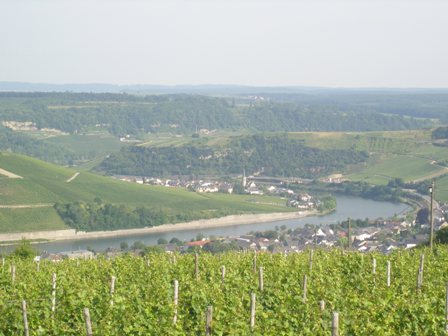
Mosel river with Nittel in the foreground (German side) and Machtum (Luxembourg side)

The above photo shows the Mosel valley, in the foreground the wine village of Nittel on the German side, and in the background the Luxembourg village of Machtum/Miechtem along the “Route du Vin”, the road which leads the visitor through the picturesque vineyards and wine villages of Luxembourg. I took these photos during my last visit to Trier at the end of June when I cruised along the river visiting both Grevenmacher and Nittel.

One of the best kept secrets as regards European wines are the fine wines of Luxembourg. Total production is about 12.4 million litres of which more than half is exported (mostly to Belgium and Germany). The total area under vines is about 1300 ha only which is about a third of the Yarra Valley. Luxembourg is a kind of artisan wine producer, where the winery sector is dominated by small family-enterprises, whereas large, corporate-wine industrialists shine through their almost complete absence. Of the odd 430 grape producers only about 60 have their own wineries. Most vignerons are members of a wine co-operatives at the village level.

Luxembourg is mainly a producer of dry, varietal white and sparkling wines (about 15% of total production). This is a stark contrast to the German side of the Mosel which has a strong tradition in semi-dry and sweet wine production.

Of the 15 approved wine varieties, Müller-Thurgau (Rivaner) accounts for about 29% of the area under vines followed by the Burgundy varietals (together almost 40%). Auxerrois (14%), Pinot Blanc (12%) and Pinot Gris (13%). Riesling covers only about 13% of the area in Luxembourg whereas it is the dominant grape variety on the German side of the Mosel. Luxembourg also has about 10% of the area under Elbling, the oldest wine variety in middle Europe, characterized by its high acidity which makes it ideal for the production of sparkling wines. Chardonnay and Gewürztraminer are other white varieties grown. Pinot Noir (about 7% of the area) is the most common red variety of Luxembourg.
Lux2

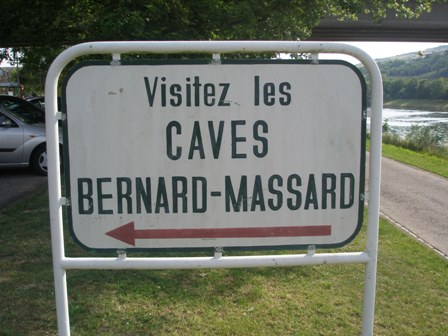
Parent house of Bernard Massard in Grevenmacher

On of the largest producers of still wines and crémants (bubbly/sparkling for my Australian readers) is Bernard Massard. Bernard Massard is also well known in Trier where the company has a large office and wine cellars in the middle of the town centre (Jakobstrasse), but Bernard Massard owns and operates vineyards also along the Loire river in France. The parent house of the company is located in Grevenmacher. More than 30,000 visitors come to see the extensive wine cellars

Lux3

Bernard Massard owns two vineyards along the Mosel: Domaine ‘Thill’ in Schengen (12 ha under vines) and Domaine ‘Clos des Rochers’ in Grevenmacher and Wormeldange (18 ha) with a combined production of about 120,000 bottles (or 10,000 cases) per year. Through the sparkling production in Trier about 3 million bottles of crémants and other sparling wines are sold. The French vineyards (Caves Monmousseau at Montrichard and La Petite Cave at Ronchamp) along the Loire river produce mainly crémants (Crémants de Loire and Touraine sparkling wines) and a variety of local wines.

Lux4

Domaine ‘Clos des Rochers’ in Grevenmacher

Lux5

Vineyards near Mertert/Wasserbillig

The bulk of Luxembourg’s family vineyards and wineries is much smaller than Bernard Massard. Because of the long tradition of viticulture in the villages and hamlets along the Mosel, many vintners come from families who have a strong family tradition in grape growing and wine making. Many families are related through intermarriage and therefore many wineries have combined family names most of which you will have never heard of.

Representing these strong traditions I would like to mention only three smaller wineries. I apologise to all the others; I know many of you deserve a full portrait.

Caves René Bentz, Wellenstein (5.2 ha)
The vineyards are located in Wellenstein, Remich, Wintringen and Bech-Kleinmacher. Main variety is Müller- Thurgau, however the most important varieties are Riesling, Pinot Gris, Pinot Blanc and Auxerrois. The Riesling wines of the Gottesgôf selection are worth trying, and so is the 2007 Pinot Gris Côteau Wellenstein.

Domaine Viticole Charles Decker, Remerschen (4 ha)
Charles Decker has a clear vision of his wines. He is one of the few who cultivates Muscat Ottonel grapes and experiments with German new varietals such as Siegerrebe, an aromatic grape. He specialises in sweet wines. Try his Muscat Ottonel wines but also the Chardonnay and the Pinot Gris are commendable.

Caves Kayl-Noesen Nic et fils, Remerschen (6 ha)
This is a very young undertaking, with the winery established only about 5 years ago. Before that the family produced grapes and sold the fruit to other wineries. The young vintner who studied oenology in Germany, manages the estate with his father. The classic varieties of Luxembourg are the wines you should try. Their Auxerrois, Pinot Blanc and Pinot Gris are ideal wines consumed with fine cuisine.

Lux6

The mouth of the Sauer river at Wasserbilligerbrück meeting the Mosel

It is worth visiting Luxembourg and its vineyards and wineries. Stop at any nice café or wine bar and try the local Elbling or go for the more elaborate cool climate Auxerrois, Pinot and Riesling wines.

Information about Luxembourg and its wines:

I found the following book very useful (in German): “Weine und Crémants aus Luxemburg”, Einkaufsführer 2009, Meininger Verlag (www.meininger.de), Neustadt, Weinstrasse.

A very informative article about Luxembourg can be found on http://www.wine-pages.com/features/luxembourg-wine.htm
.

But also the Wikipedia write-up gives the newcomer a very good overview.

The fourth source of useful information comes from http://www.vins-cremants.lu/en/winegrowers/alphabetical_listing.html