What we were drinking: South Australia

March 23, 2007

David, the son of our mutual friend John, from Sydney brought two wonderful bottles of wine over the other day. We had them with a beautiful meal for Saturday lunch. With the spicy clam pasta we enjoyed a bottle of 2006 Sauvignon Blanc from Shaw and Smith from the Adelaide Hills (www.shawandsmith.com), a cool climate region in South Australia where my wife comes from. Grapes where planted there as early as 1839 and today there are about 60 wine labels with over 3,000 ha of vineyards planted. This young Sauvignon Blanc is a wine to my taste: fruity (with passionfruit and guava flavours), grassy-herbaceous, flinty and well rounded with a long finish. The wine is unwooded and James Halliday gave it 94 points. Very enjoyable in a tropical climate such as Jakarta.

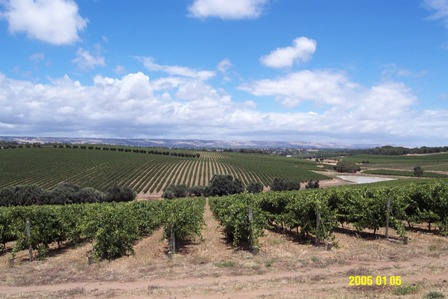
McLaren vale1

McLaren Vale with vineyards, sea view in the distance

The second bottle we drank with the main dish, a vegetable stew, came from Mitolo Wines (www.mitolowines.com.au), a family owned winery situated in the most southern tip of the McLaren Vale region. I will write more about McLaren Vale in one of the next entries, because we visited the region in 2005 and had a wonderful time visiting some of its vineyards. We drank a 2004 Jester Shriaz. The wine had a deep purple colour. The nose showed intense blackberry, plum and chocolate aromas of rich black fruit. The wine has a good structure, is well rounded and has a long finish. Of course it should have been cellared for 4-5 more years but we could not wait. Both wines made our day which we spent sitting on the terrace and discussing the pleasures of life in general and life in Indonesia in particular. Come and visit us one day.

McLaren Vale 2

Vineyard view in McLaren Vale


A most marvelous fish dish

March 4, 2007

I have been away for a while. Let me tell you about a very memorable dinner I had with my friends Joyce and Rainer and a couple of other friends in Bangkok the other day. It started as a kind of late Chinese New Year celebration. We jointly tossed a special Singapore salad with the most astonishing ingredients of which I cannot give you a run down. Eating this dish together brings you luck of course. We had it as a kind of entree.

The main dish, however, is what I would like to introduce to you today:

Baked Sea bass with Basil-Feta Crust

This is a most amazing creation. I always thought that fish and cheese do not go well together. Wrong. They can build a terrific partnership and create an explosion of your senses in your mouth. The recipe goes as follows (4 serves):

Crust ingredients
– 3 garlic gloves
– feta cheese (one block)
– bread crumbs
– basil leaves
– black pepper, salt
– 4 table spoons of best extra virgin olive oil

Fish
– 4 pieces of Sea bass fillet, but any other “white” fish will do

How to do it
– Grind peeled garlic cloves and basil leaves together into a coarse consistency, mix the olive
oil into it
– put ground basil mixture into mixing bowl together with bread crumbs and Feta cheese. Mix
well together. Add pepper and two more tablespoons of olive oil.
– was sea bass fillet and sprinkle with pepper and salt. Place on oven-proof dish.
– put basil-feta mixture on fish covering the surface.
– bake for 30 minutes in 180 c oven
– serve with vegetables as desired.

We drank a Sicilian white wine with the fish. I would have loved to have a Two Hills Sauvignon Blanc instead; the wine we had at Rainer and Joyce’s wedding some years ago for instance. Of course also a Sauvignon Blanc from another cool climate wine region would do. But Sauvignon Blanc definately be my preferred choice with this dish.


Burns Supper – Java St. Andrews Society

February 10, 2007

I will write more about Celts and Celtic traditions today. Friends of ours got flooded out and could not attend this year’s Robert Burns (1759 – 1796) Supper and the related celebrations of the Java St. Andrews Society (www.javastandrewsociety.com). They kindly passed the ticket on to us and we were welcomed as replacements by the Scots. Thanks again Liz and Walter for your generosity.

Burns Supper 2007

We sat at the “Holy Willie’s Prayer” table together with four Americans. Most men at the supper were in kilts and every time I see this, I want to buy a traditional Bavarian outfit (with leather trousers and so on) which would at least come a bit closer to this formidable dress for the Scottish men. We used to be members of the society many years ago but when our Scots friends at the time had left Jakarta we did not renew our membership. We had also attended quite a few Burns Suppers so that we knew what we were in for. A very memorable one was the first ever held on Chinese soil in Beijing in 1992.

Robert Burns is the beloved poet and lyricist of the Scots (the national poet). He is regarded as a pioneer of the Romantic movement and his poems and writings became a source of inspiration to the founders of both liberalism and socialism. Burns loved women and drink. Statues of Robert Burns can also be found in Australia (Sydney, Canberra and Adelaide). The celebration of his birthday (25th January) follows a fixed ritual.

The program in Jakarta looked as follows:

● The Selkirk Grace (by Sandy Duncan)

● Address to the Haggis (by Chieftain Scott Thompson)

● The Loyal Toast (by Tony McEwan)

● Songs of Burns (by Barbara and Alastair Speirs)

● The Immortal Memory (Robert Burns Live by Chris Tait)

● The Land we Live in and Absent Friends (by Ross Scholes)

● The Land we Hail From (by Brian Scott)

● To the Lassies (by Tony Milne)

● Holy Willie’s Prayer (by Jim Tait)

● The Reply from the Lassies (by Alex Faulds)

● Poems of Burns (Robert Burns Live by Christ Tait)

As customary at this occasion, the haggis (filled sheep’s stomach) is served. It is brought into the hall accompanied by pipe music and usually a guard of honour sometimes holding bottles of whiskey crossed in front of their chests like swords. The pipers were the Edinburgh Chevaliers flown in for the occasion and they entertained us very well. The speeches were well presented too. In addition a Robert Burns look alike (Chris Tait) gave quite a performance. For non-Scots it is at times difficult to follow but its great fun. I always enjoy listening to these old almost forgotten Celtic languages.

The dinner consisted of green pea soup followed by the customary haggis with neeps and tatties. As the main course, we had angus steak pie with new Ayrshire Potatoes, baby carrots and Iona parsley. The desert, McEwan’s Apple Tart and ice cream, we spiced with the whisky which was generously deposited on each table. This year it consisted of bottles of Johnny Walker (12 years old).

The Scots do not grow vines as we all know. We drank a 2004 Timber Ridge Shiraz, a wine from Western Australia. It showed a very lively, fruity character of black fruit, raspberry mainly. My palate detected cherries but I might have gotten it all wrong. The wine was clean and well balanced and surprised us. I had never heard of the vineyard. The next day I searched it on the internet. Unfortunately, the website of the Timber Ridge Vineyard is not yet operational. There is a vineyard of the same name in the USA but I could not find out more about the Western Australian venture, except tasting notes for the 2004 vintage.

For the Whiskey

The Whisky “Taster”


Australia Day

January 26, 2007

Today is the National Day of Australia (1788) and our family and friends down under are celebrating. For us in Jakarta it is just a normal working day. Like every morning at 6h I woke up my girls to get ready for breakfast and ultimately school. I enjoy waking them very much because it gives me the chance to hear their first words of the day. And because I frequently work late at night, I often do not see them again in the evening, the mornings are a chance not to be missed.

I followed over the last couple of days the controversy about the flag ban for concertgoers of the Big Day Out music concert in Sydney. The fact that the ban caused such a storm among the public including politicians and scholars, I found interesting.

As a German I personally have still severe emotional reservations about national emblems such as national flags and national anthems which is not surprising for people from my generation born after the war. While travelling as a young man I would always answer questions about my origin with “European” and only later admit to my German nationality. However, I was very happy to see during last year’s soccer world cup that many Germans have developed a more normal relationship with their national flag and were proud to display it at the games. The only national flag I possess is the one of my host country Indonesia which we fly on 17 August, the Indonesian National Day, celebrating the freedom Indonesians gained on that day in 1945.

My children also like to sing the Australian National Anthem. They sang it every Monday morning at the Dixons Creek Primary School which they attended during extended holidays over a couple of years every June/July. I like to join in when they sing the anthem. In fact I would rather sing other national anthems than the German one, for instance the French one (La Marseillaise) or even the American one (The Star Spangled Banner). Startled by these thoughts I did some research on the internet to find out more about national anthems. Many of them are a celebration of freedom which for me as a modern-classical liberal is worth being celebrated. In the Australian case, the second line says “for we are young and free” and in the German case the anthem opens with “Unity and right and freedom”.

Many of them originate from the mid 19th century when feudal overlords were defeated and modern nations were born. It often took some time until a specific song was accepted as the national anthem. It took the Australians until 1984 when on 19 April “Advance Australia Fair” was declared the national anthem (www.dfat.gov.au) though it was composed in the 19th century and fist performed in 1878 in Sydney. The composer was a Scott, Peter Dodds McCormick. Extensive opinion surveys were conducted before it was adopted. The “Deutschlandlied” (Song of the Germans) was officially played for the first time in 1890 and only adopted as a national anthem on 11 August 1922 by the first president Friedrich Ebert. It does not praise or even mention war or victory which might explain why it was retained after the Second World War.(http://German.about.com)

I knew that the German National Anthem was composed by Franz Joseph Haydn and that the text came from August Heinrich Hoffmann von Fallersleben (das Deutschlandlied). I also knew that the third stanza was selected after the Second World War as the official anthem and that the first one was dropped. What I did not know was that in about 1840 when it was written the introductory line, which I always found so repulsive, “Germany, Germany more then all, more then all in the world”, had of course a very different meaning. At that time Germany did not exist, we had only a large number of German monarchies and some republican free cities. Instead the song was an appeal to all Germans to finally unite. I only identified it with the Nazi’s quest for German superiority.

Today I feel a little bit wiser. I might even be on my way to a more natural relationship with the German emblems of nationhood such as the flag and the anthem. I might become maybe a bit like my children who can sing away to their heart’s content “Advance Australia Fair”. For me the wine drinker the second stanza of the Song of the Germans is of interest. Unfortunately, this stanza was never very popular. It reads as follows:

German women, German loyalty
German wine and German song,
Shall retain in the world,
Their old lovely ring
To inspire us to noble deeds
Our whole life long.
German women, German loyalty,
German wine and German song.

The stanza depicts to some extent the lighter, more joyous and life embracing character of the German people. Von Fallersleben had intended the text to be used as a simple drinking song. And of wine drinking songs we can never have enough.
Happy Australia Day


Barbecueing – The Australian Pastime

January 19, 2007

My wife gave me as Christmas present the Mercedes Benz of the grills. a Weber. The Weber, a Canadian product, is the most sophisticated among a wide range of grills (www.weber.com). I have already one with gas but now the round, shiny Weber is decorating my backyard. It was easy to assemble the thing, even for a man with two left hands like me.

In Australia, the mother country of my wife, grilling is a men’s affair, no work for women. I am a lousy cook, I admit this. When we are back on the vineyard usually my brother in law, Michael, (or any other Australian male nearby) is doing the grilling, but in Jakarta there is no Michael. Now I ran out of excuses, and the Weber is there calling for me.

The second impediment for me becoming a master griller is that I do not appreciate meat very much. Not that I am a vegetarian, no, I am rather a selective meat consumer. There are days I cannot swallow the flesh of animals and stick to green stuff exclusively. The biggest challange for me is to find out when the meat “is done”.

I knew long before Christmas Day that I would get a Weber. The packaging gave it away. It was just to bulky under the Christmas tree. So mentally I was somehow prepared for it. I also knew that Margit had bought a Turkey to be prepared for Christmas lunch. And Tukey it was, my first grilled masterpiece.

The photo below depicts me doing my job as an Australian man. Sorry for the outfit (no Akubra; www.akubra.com.au; another icon of Australian identity), but it’s hot in the tropics. The Turkey tasted wonderful. I am sorry for the winedrinkers. When I stand next to a grill I can only drink beer. A case of Tooheys Red, the favourite hops drink of my brother in law, was consumed in the battle with the grill and later with the meal I drank the last supply of my Bitburger Beer from my hometown. Margit drank sparkling and the girls had water.

Adam and the Weber


From the Old to the New World: My Vineyard in Glenburn, Victoria

January 10, 2007

Today I want to take you to a small place in Central Victoria Glenburn, between Yarra Glen and Yea, about one hour northeast of the capital city of Melbourne. From there we drive about 5 km up north and turn right into Two Hills Road, a gravel road which will lead us to our vineyard.

The vineyard
Our vineyard facing north

It’s all grazing land here surrounded by gum forests of the national park. Most residents are retirees; many are weekenders. The vineyard is located on the right hand side on a 50 acres block (about 21 ha). It consists of about 1 ha Sauvignon Blanc (planted in 1996), 1 ha of Pinot Noir (planted in 2002) and 1.3 ha of Merlot (planted in 1997). The rest of the land is grassland with some small patches of gum trees and a small forest. A small river, Katy’s Creek, builds the boundary on one side.

Second Hill

Two Hills Vineyard towards our second dam

In 2001 we had our first vintage. Our Sauvignon Blanc of 2002 even won us a bronze medal at the Singapore Wine Show.The wines are available in Melbourne at the Old England Hotel in Heidelberg (bottle shop; www.oldenglandhotel.com.au), at the Berry Cafe in Dixons Creek (on the way from Yarra Glen to Yea) and in the Alexandra supermarket chain. In Germany my friend Dr Ulrich Hillejan (Gesellschaft fuer Unternehmensentwicklung mbH, www.s-h-r.de) sells our Merlot to other friends and family. At the moment we have only Merlot 2004 for sale. All the other wines have sold out which is of course good news for the producer and bad news for the consumer. 2006 was our most successful year so far. We had a good harvest (after a complete loss in 2005 due to adverse weather conditions), sold all our grapes, and most of our wines. The 2006 vintage of Merlot is ripening in French and American oak and will be bottled in March 2007.
We are selling most of the fruit to other wineries. Living abroad is not very conducive to wine marketing. Another friend, Steve Sadlier of Vineadvice from Yarra Glen, takes care of the vineyard management. He is our viticulturist. Our wines are made by another friend, Alan Johns, owner and winemaker of Yering Farm Wines (please visit their website at: www.yeringfarm.com.au).

The wine region is called the Upper Goulburn Wine Region Victoria (formerly Central Victorian High Country) and is promoted by various organisations among them the Upper Goulburn Winegrowers Association of which we are also a member (please visit their website: www.uppergoulburnwine.org.au). I took the map from this website. Unfortunately, it’s not up to date (we are not yet listed as members for instance) but it gives some idea of the location.
ugmap2.jpg


Why this blog?

January 9, 2007

Mosel river in Trier

The Mosel river in Trier from “Zur Lauben” side

Finally, my blog is up and running. Thanks to the help of Ms. Vera Jasini Putri from my office, I beat the deadline which I had sat myself earlier. This is my personal blog far away from my professional work. Therefore, it will not deal with liberal democracy and issues related to change management but it will be about wine, my favourite drink, and culture.

Wine and culture are at the heart of many civilisations. They were the determinants of where I come from, the lovely town of Trier in the Mosel river valley with its more than 2000 years of culture of vineyards and wine making. I grew up in this corner of Germany, rich in historical monuments, abound in stories about times gone by, and it’s small town culture at the most western edge of the Federal Republic of Germany.

Wine and culture are also at the centre of the lives of a select few pioneers in the Central Victorian High Country at the Upper Goulburn River in the new world in Australia where the wine industry has become an important engine of growth and rural prosperity during the last couple of decades. It is here where 10 years ago my wife Margit and I established a small vineyard: Two Hills Vineyard in Glenburn, Victoria. And it is here where I will retire someday in the hopefully not too distant future.

Following the example of Banjo Paterson’s famous poem “The man from snowy river“, a ballad praising the resiliance of the rural folk in the High Country of Victoria, I have chosen the title of this blog.

In my home town Trier the Mosel river is the dominating force and feature of the city and the region. Another one are the very steep slopes of the benches where even before Roman times “vitis vinifera” the ordinary grape producing vines were cultivated by the indigenous celtic settlers of the Treverer tribe. Today the town which claims to be Germany’s oldest city is a major tourist destination. Please visit it if not in person at least on the net (www.trier.de).