Wiltingen Saar – the best of Riesling wines in Germany

March 31, 2008

The little village of Wiltingen, Saar , about 9 km southwest of Trier, is one of the most famous “terroirs” for Saar Wine. It has about 1400 inhabitants and is the heart of Riesling production. The area under vines is 160 ha only and rather small one might say but these vineyards produce excellent wines.

The location (terroir) ‘Scharzhofberg’, for instance, produces outstanding Rieslings which are world renown and regularly win international awards as best wines.

Wiltingen is home to many famous wineries. I cannot name them all. There is for instance the “Riesling pope” Egon Müller who has his family business there, so has Roman Niewodniczanski’s winery Van Volxem, and many others.

wiltingen2.jpg

Wiltingen at the Saar river in March, photo taken from the Schoden side

wiltingenschild.jpg

Wiltingen is a jewel also for tourism

It was a rainy day when we visited Wiltingen. However, we wanted to pay a visit to Van Volxem and maybe purchase a couple of bottles of the finest Saar Riesling. Well, we met the winemaker, a very friendly young man from Franconia, as I could identify from his accent, and he invited us in, mentioning in passing that if we came to buy wines, we would have to come again, because they sold out completely. Nonetheless, he made us sit down, served us a very good cup of coffee and told us the story of the Van Volxem wines.

Spring is a busy time in the vineyards. We were told that Van Volxem has about 30 ha under vines and that they are in the process of planting another 6 ha in prime locations, usually on very steep slopes along the Saar river.

Also Ms. Niewodniczanski showed up and took her time fro a friendly chat; she urged us to come again later in the year when they new vintage would be released. She promised she would show us around, not only to the cellars but also the vineyards could be part of our visiting program. We left our addresses and promised to come again. Who could resist such friendliness, a treatment so warm, only expected to be extended to family members.

vanvolxem.jpg

Van Volxem, entry to the cellar door

vanvolxem2.jpg

In the historic tasting room

Postscript: A couple of days later, I sat in the Weinhaus, one of my favorite wine bars in Trier, and witnessed the sale and hand over of two 6-bottle boxes of Van Volxem Riesling wines to customers.

Well, I thought, I cannot complain since I still have some bottles in my “cellar” in Jakarta, and the next vintage will certainly make a wonderful buy.

Address
Weingut Van Volxem
Roman Niewodniczanski
Dehnstrasse 2
54459 Wiltingen, Saar
Ph.: +49-6501-16510
e-mail: vanvolxem@t-online.de

The estate is member of the VDP (Verband deutscher Praedikats- und Qualitaetsweingueter), the association of German prime wine estates (www.vdp.de). Today the Association has 200 members and covers about 3% of the German viticultural area.


Easter Sunday Lunch

March 23, 2008

Easter calls for some special celebrations. Because we were at home, the four of us for the first time since a long time, we needed something yummy.

We had a red snapper left in the fridge and decided to prepare it in the style of Guadeloupe and Martinique. The recipe we got from Mark Bittman, “Fish – The complete guide to buying and cooking”, Hungry Minds Co, New York 1994, and it goes as follows:

– 4 firm-fleshed steaks from a large red snapper, scaled, gutted (head on or off as you like it best)
– 2 cups of water
– 1/2 cup fresh lime juice
– salt
– 1/4 cup olive oil
– 1 cup chopped shallots, scallions (both green and white parts)
– 1 tablespoon minced garlic
– 1 hot pepper, deveined, seeds and chopped
– 1 1/2 cups chopped fresh tomatoes,
– 1 bay leave
– 1/4 cup chopped fresh parsley
– 1/2 table spoon minced fresh thyme
– freshly ground black pepper
– lime wedges

You marinate the fish in the water, lime juice and 1 table spoon of salt (make sure the fish is completely covered) for about 30 minutes (drain, refrigerate if the weather is too warm, as it is here in tropical Jakarta).

Heat the oil and cook the shallots, about two thirds of the garlic and the chopped red pepper until soft, then add the tomatoes and herbs, season with salt and pepper and cook for about 5 minutes. Drain the fish and add the above together with some of the marinade, add some more garlic and simmer over low heat for about 10 minutes. Spoon the marinade over the fish and serve with rice and the lemon wedges.

Voilá, that’s what it may look like.

fisheaster.jpg

Court Boullion, red snapper

Needless to say, the red snapper was delicious. We had rice and some steamed vegetables with it. Since we ran out of white wine (how terrible in a vintner’s family), we opened instead a bottle of Pinot Noir. It came from South Baden (Kaiserstuhl), a ‘2005 Ihringer Winklerberg Spätburgunder’, dry wine, 13.5 % alcohol, produced by the Ihringer Winegrowers Co-operative (www.winzergenossenschaft-ihringen.de).

It was a typical Pinot Noir as far as the colour was concerned. It was fresh, fruity and showed well balanced tannins and acids. The aromas were dominated by forest berries. But despite this it complemented the hot chili taste of the red snapper very well.

The bottle was given to me by Birgit Lamm, the director of our International Academy for Leadership in Gummersbach, Germany after I facilitated a training recently. It did not last long. But wine in the tropics needs to be consumed rather earlier than later. Thanks again for this nice gift. I’ll come back for more soon.

jhringer.jpg

2005 Ihringer Winklerberg Spätburgunder (Pinot Noir)

After the meal we had espresso and cognac together with some thin chocolates. I smoked a Juan Clemente cigar (made in Santiago, Dominican Republic) which was excellent. I had acquired them during my recent trip to my hometown Trier, Germany, from Wolsdorff Tobacco where I usually stock up on cigars.


Habel Wine Culture

March 20, 2008

The other day in Berlin a shower drove me into the next available shelter and fortunately it was a wine bar: ‘Habel Weinkultur’, where I always wanted to visit (www.wein-habel.de).

habel1.jpg

The place is huge with various rooms and bars. It is also a place with tradition. Habel attempts to revive the old tradition of Prussia’s wine tasting. Originally it was located at Unter den Linden 30 were it was opened in 1779!

habel2.jpg

The elegant dining and tasting rooms of Habel Weinkultur

habel3.jpg

I was the only customer at 15:00 h in the afternoon but I was lucky again, they served customers.

The wine list was beautiful, however, a single person can only drink wine ‘glass wise’ and not by the bottle. I have to come again, I thought, with a friend to sample some of these wines. The food menu looked also very inviting. A good place to visit in Berlin.

I settled for a Riesling of course, this time I choose a Riesling from the Rheingau, one of the best German wine regions, a ‘2005 Riesling Schloss Vollrads’ (4.70 €/0.2 ltr.), a dry wine with a lush bouquet of apples (not a citrus bomb), fruity, well balanced acids, fresh with a nice finish.

habel5.jpg

When I studied the wine list I found that it contained many wines from Germany, France, Italy, Austria, Spain, Chile, Argentina and South Africa but only one single wine from Australia (a Penfolds BIN 2 Shiraz Mourvédre).

Of course with a wine from Penfolds you cannot go wrong but apart from the corporates there are zillions of excellent wines from small wineries and vineyards which would deserve to be sampled by the German wine lovers.

Address:
Habel Weinkultur
Luisenstrasse 19
10117 Berlin
Ph.: +49-30-28098484


German Vineyards in March

March 18, 2008

March is a great time of the year in the Northern hemisphere. Nature is ready to go, buds are almost bursting, waiting for the right temperature, the hours of sunshine which make the difference, warm the soil and the plants. As every year another miracle is in the making.

The vineyards are neatly pruned and ready to go shortly before the new growing season begins. The following pictures from the Saar Wine Region might give you an idea.

vineyardin-march.jpg

The colour scheme is still dominated by greys and dark winter colours but here and there we can see greenish spots, and soon spring will have driven winter away.

The slopes are steep and every vine has its own post. This one is very well tended, not a single stem or blade of grass can be detected.

pruned3.jpg

The pruning is of a special kind too. In Australia we hardly see this kind of binding the canes.

pruned1.jpg

It is not easy to spread organic manure in the vineyards at these steep slopes.

menure1.jpg

A metal sledge is used to bring the manure to the vines.

pruned2.jpg

Apart from the well tended vineyards (as above in Ockfen, Saar) we also find here and there a neglected one or one in a rather ‘chaotic stage’ but they are the exception rather than the rule.

chaoticvineyard.jpg

The neglected vine garden


Trivento – Wine from Argentina

February 9, 2008

You might remember that the other day in Kuala Lumpur I could not taste the wine on the menu, a ‘2005 Trivento Golden Reserve Malbec’ of the Maredo Restaurant because it was sold out.

Guess what? I found the brand in Vin +, a small wine shop in Kemang, Jakarta. I bought one bottle only to try it out.

trivento-malbec.jpg

The Trivento 2005 Golden Reserve Malbec

You might wonder about the results?

Today I went again and bought a whole case of it. It is a most delicious wine and retails for about 235,000 Indonesian Rupiah which is equivalent to about 17 € or 28 A$.

It is a deep, red, ruby wine with a wonderful nose displaying aromas of mint, cherries and chocolate. The wine was matured in new French oak for a year and was aged for another year in the bottle before its release. Its a pity that Malbec has this short, dry finish but the aromas compensate you for that. However, for non-Malbec lovers there are Syrah and Cabernet Sauvignon wines on offer as well.

Moreover, I also bought from the Trivento product range a ‘2006 Reserve Chardonnay’, a ‘2006 Tribu Torrontes’ and a ‘2005 Reserve Malbec’. More about these wines later.

Trivento Bodegas Y Vinedos (www.banfivintners.com) was founded in 1996 and is located in Mendoza, Argentina. Most of its vineyards are to be found on high altitude in the best zones of Mendoza (up to 1100 meters above sea level). Trivento Vineyards possess a modern winery with a capaity of about 27 million litres of wine. It has all the modern equipment used nowadays to make wine. The winery is surrounded by about 10 ha of vineyards.

Tomas Larrain holding a degree in agricultural economics from the Catholic University of Chile is the general manager and Federico Galdeano, a native of Mendoza with extensive experience in the Napa Valley/California and Tuscany/Italy, is the wine maker.

By the way I now found out that the rumour – that the Argentineans drink their best wines themselves and export only the rest – is false. They do export some of their good wines!


Christmas in the vineyard

January 11, 2008

We had a wonderful Christmas eve dinner in the vineyard. Michael, my brother in law and his wife Helen stayed over night and as customary in Australia we opened our presents in the morning of the 25th.

x-mas-eve.jpg

It’s present time

Later that day Florian and Nelly, our friends from Jakarta holidaying in Victoria, joined us and we had ‘lunch in the vineyard’ or rather on the lawn in front of our dwelling with magnificient views of the Glenburn hills. We ate turkey of course and drank lashings of Two Hills wines. It was a sunny but rather chilly day and our guests from Asia needed jackets.

floa-dn-nelly.jpg

Nelly, Flo and Margit

chirstmas-on-the-lawn.jpg

Christmas lunch on the lawn

It felt so good to be back home among family and friends. We did not mind the low temperatures but enjoyed the clean air, the quiet, nature and the splendid surroundings. What a lovely Christmas this was.


German wine regions: Franconia- a visit to Würzburg

November 16, 2007

Together with my mother and my brother Wolfgang, we visited the hometown of my maternal grandfather for a family reunion. The small village of Reichenberg, near the city of Würzburg was our destination. My mothers father, Hans Heinrich Schüssler, was the one who introduced me to wine and wine drinking. When I was about 16 years old he took me to the Juliusspital (one of the three big wineries in the city and winner of this years ‘Riesling of the World’ Challenge in Canberra) in Würzburg where I had my first ‘official’ glas of Franconian wine.

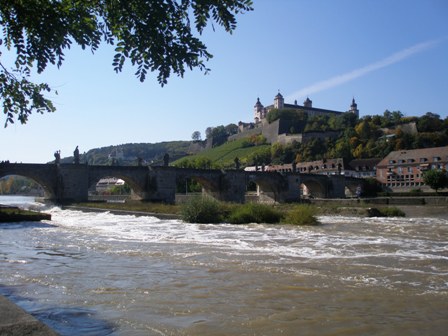
Würzburg is another ancient city where the Catholic church and its archbishops reigned. Needless to say that vineyards and wine production are an old and beloved feature of the local culture and the economy influencing its specific social habits and customs. The castle of Würzburg is one of the main features. On its slopes vines are grown as well.
p9300039w.jpg

The castle in Würzburg, with the historic bridge and the vineyards on the castle slopes

Franconia is the name of the wine region. It currently has about 6,000 ha under vines. The proportion of red varieties is low (19 %). Main varieties are white grape varieties such as Müller-Thurgau (32 %), Silvaner (21 %) and Bacchus (12 %). But, as along the Mosel river, red varieties are on the increase. ‘Franken’ (Franconia) produces some excellent Pinot Noir wines as well. Nowhere in Germany does Silvaner produce such stunning wines as in Franconia.

The shape of the local wine bottles ‘Franconian style’ is very special too. It’s called “Bocksbeutel” in German and usually reserved for higher quality Franconian wines.

p9300012boxbeutel.jpg

The “Bocksbeutel” bottle, trademark of Franconia

The above bottle from “Staatlicher Hofkeller”, the second of the three big wineries in Würzburg (the third one is “Bürgerspital”), was the first I drank with a glas enclosure in my life. It was a “2005 Hammelburg Trautlestal, Silvaner Kabinett, dry” which displayed all the characteristics of an excellent Franconian Silvaner wine. For newcomers to Franconian wine I can highly recommend this drop.

The next day after the family reunion, we visited Würzburg and had lunch at ‘Juliusspital’ (www.juliusspital.de). ‘Juliusspital’ does not only own vineyards, a winery, a historic cellar door and restaurants but also a hospital, a retirement home, an academy, a conference centre and other facilities. “Spital” also means ‘hospital’.

Juliusspital Foundation was founded in 1576 by the prince bishop Julius Echter of Mespelbrunn (a wonderful little castle in the Spessart, a beautiful region full of forests nearby). Today Juliusspital is a modern service company providing mainly health care and related services to the public but traditionally is also involved in agriculture, forestry and wine making. the Juliusspital Wine Estate is as old as the hospice.

The Franconian wine region covered in the 16th century more than 40,000 ha of vineyards and was the largest coherent wine-growing area in Europe. The decline of Franconian viticulture started with the ‘thirty Years” War which destroyed most of the vineyards in Upper and Central Franconia. After a short revival in the 18th century a second decline reduced the region to about 10,000 ha and the thrid decline was accompanied by peronospera and phyloxera outbreaks at the end of the 19th and the beginning of the 20th century. After World War II only about 2,300 ha under vines remained. Today, about 7,000 vintners cultivate the 6,000 ha under vines which produce roughly 50 million bottles and an annual turnover of about 200 million EUROs.

The soils in Franconia consist either of soils based on red sandstone, shell limestone and what the Germans call ‘Keuper’ (clay rocks), all emerging during different geological epochs some going back more than 200 million years.

Today Juliusspital Wine Estate cultivates about 168 ha of vineyards and produces more than 85,000 cases of wine. The composition of its vine varieties is about 35 % Silvaner, 22 % Riesling, 20 % Müller-Thurgau and 5 % Pinot Noir. the rest (18 %) includes Pinot Gris, Pinot Blanc, Baccus, Scheurebe, Traminer, Muskateller, and Rieslaner (a regional variety). the average yield is given with 60 hl/ha. the top locations (terroir) are ‘Würzbuger Stein’, ‘Iphoefer Julius-Echter-Berg’, ‘Randersackerer Pfülben’ and ‘Eschendorfer Lump’.

At the recently held 2007 Canberra International Riesling Challenge, the Juliusspital Wine Estate won the overall award for best Riesling of the World with its “2006 Julius-Echter-Berger Beerenauslese”. By the way, the webpage of Juliusspital shows this wine with a price tag of 47.60 EURO only.

According to the October-November issue of ‘Weinwelt’ (World of wine), a German wine magazine, the top producers in Franconia are:

♦♦♦♦ (four stars)
– Fürstlich Castellisches Domaenenamt, Castell
– Rudolf Fürst, Bürgstadt
– Horst Sauer, Eschendorf

Horst Sauer also participated in the 2007 Canberra International Riesling Challenge and won a gold medal in the ‘current vintage 2006 sweet category’ for his “2006 Eschendorfer Lump Riesling TBA” and a bronze medal for “2006 Eschendorfer Lump Riesling dry”.

♦♦♦ (three stars)
– Juliusspital, Würzburg
– Fürst Löwenstein, Kreuzwertheim
– Hans Wirsching, Iphofen
– Brennfleck, Sulzfeld (significantly improved in 2006 and newly listed with three stars)
– Hofmann, Röttingen (as above)

♦♦ (two stars)
– Walter Erhard, Volkach (improved in 2006 and newly listed as two stars)
– Rudolf Max, Retzstadt (as above)
– Max Müller I, Volkach (as above)
– Trockene Schmitts, Randersacker (as above)
– Graf Schoenborn, Volkach (as above)

♦ (one star for discoveries of the year)
– Burrlein, Mainstockheim
– Felshof. Sommershausen
– Gebr. Geiger Jun., Thüngersheim
– Max Merkert, Eibelstadt
– Reiss, Würzburg
– Markus Schneider, Volkach

Unfortunately, I have only one bottle of Bocksbeutel left in my wine fridge. Empty bottles I have in abundance (for instance “2002 Würzburger Stein, Silvaner, Kabinett, dry” of Staatlicher Hofkeller which won a gold medal, “2003 Baccus, dry” of Schloss Castell and “2003 Würzburger Stein Sivaner, dry” of Juliusspital). The bottle to be enjoyed soon is a “2005 Kitzinger Hofrat, Silvaner, dry” of Bernhard Völker. What a pity that Franconian wines are not available in my local duty free shop in Jakarta.

The red wine “pope” of Franconia is Paul Fürst (Winery Rudolp Fürst in Bürgstadt. He won “German vintner of the year” award in 2003 and “best vintner of Franconia” in 2004. His webpage is very interesting too (www.weingut-rudolf-fuerst.de).
At the wine webpage www.finewinepress.com you will find an interesting interview with Paul Fürst in English. His “2003 Spätburgunder” (Pinot Noir) is a well acclaimed and award winning wine. I will introduce you to the winery at another time.

While in Würzburg we lunched at Juliusspital Restaurant which is what Germans call “gut bürgerliche Küche”, which I freely translate as “good quality, local food” (robust and harty in nature but also with delicate and fragrant elements). We drank from the open wine list (we had to drive home). My brother had a “2006 Juliusspital Schwarzriesling (Pinot meunier), dry” and I drank a “2006 Würzburger Abtsleite, Silvaner, Kabinett, dry”, both solid wines. It was unfortunate that we could not participate in any tasting since we had to get home the same day.

The design of the restaurant, by the way, is typical for historic German country inns. When I visited the restrooms I found to my great suprise wonderful cartoons on tiles. I had to take pictures, one of which you see below.

p9300049kar.jpg

The texts freely translates as “Guess darling whom I am holding in my arm”.

Unfortunately, I do not have good photos of the family reunion. Needless to say that the three of us were overwhelmed by the hospitaly extende to us. Tables were bending under the food and wine on offer. We were talking and talking. It was so exciting that I forgot to take “intelligent” pictures with the result that I have some good ones of some of the participants but not of others. This is the reason why I will not show any of them because it would be unfair vis-a-vis the people whom I did not catch in a good enough pose. Since I have planned to take my wife and children there when we visit Germany next year, I promise to be more careful and present you with some good shots in the future.

The address of the restaurant cum wine bar is

Weinstuben Juliusspital
Familie Frank & Edith Kulinna
Juliuspromenade 19
97070 Würzburg
Tel.: 0931-54080
http://www.juliusspital.de


The next big thing: German Pinot Noir

October 10, 2007

d1000110pinot.JPG

Pinot Noir grape

It seems that I’ve been drinking the right stuff: “Blauer Spätburgunder” as the Germans call it, Pinot Noir is all the vogue in “the German lands”. Traditionally, Germany has always been considered a white wine producer. The recent rediscovery of Riesling and the boom in worldwide Riesling demand supports this view.

Now it seems domestic attention has shifted to the colour red. In particular the Pinot Noir wines show a tremendous rise in quality and consumer demand. Wine experts in Germany praise the progress made and estimate that an increase in demand for German Pinot Noir is going to follow the Riesling boom.

But red varieties are no strangers to Germany, as I have pointed out in one of my recent blog entries (“Old friends, wine from the Mosel and other culinary delights”, 16. September 2007). Where would German red wines be if politicians had not meddled in the vintners’ affairs in the 18th century, as elector Clemens Wenzeslaus of Saxonia did along the Mosel?

d1000133pinot2.JPG

Vintage time for Pinot Noir 2007

My recent explorations of German wines made from the Pinot Noir grape can only confirm the wine writers’ opinions, though they mainly point to the wine regions of Ahr, Baden, Rheingau and Rheinhessen and seem to forget the next big thing, Pinot Noir from the Mosel.

I argue that the quality of Mosel Pinot Noir wines is as good as wines from the other regions and you will get a good drop at much less expense. The Ahr, pioneering Pinot Noir grapes for many decades, has always been considered a high-price red wine region. However, you do not have to spend €12 to 20 per bottle.

My favourite Mosel Pinot Noir wine producer, the winery of Alfons Sebastiani in Mehring offers a beautiful Pinot Noir for €5,40 the 0.75 litres bottle.

Another great Pinot Noir producer on the Mosel is Weingut Markus Molitor in Wehlen. I tasted his 2004 Molitor Spätburgunder at the Weinhaus in Trier (opposite the Karl Marx Haus in Brückenstrasse 7); it is very drinkable.

Less affordable are the Molitor 2004 Pinot Noir wines from the locations Graacher Himmelreich and Brauneberger Klostergarten (€35 to 49 /075 l bottle). These prices are an indicator for the general trend; Mosel Pinot Noir wines seem to be becoming the new cult wines. Wine producers and consumers will benefit from it.

As for the average wine drinker like myself, I do not worry about high prices as long as there are plenty of new wines to find, explore, and taste. My recommendation is to try some German Pinot Noir wines.


Sauvignon Blanc

July 10, 2007

My morning newspaper, the International Herald Tribune, carried the other day an article summarising the tasting of 25 Sauvignon Blanc wines from New Zealand. Sauvignon Blanc is one of my most favourite white wines. The results were interesting. Only about 10 of the 25 wines found the approval of the tasting panel (it was a New York Times event of the dining section). For the judges, the tasting was a disappointment. They were looking for the bold, pungent refreshing SB but found that too many wines were dull, too sweet or simply wishy-washy or as Eric Asimov put it “commercially inoffensive”. My favourite SB from New Zealand, Cloudy Bay came up third (behind “Villa Maria” in number one position), described as “quieter than the top wines” but still “bold, zesty and delicious”. In my bottle shop in Jakarta it retailed for 40 US$ the bottle last week. Gone are the days when I had to pay only 18 US$ for this most delicious white.

Mr. Asimov is of the opinion that many producers have decided to push quantity at the expense of quality and that they are over cropping (too high yields per acre). I learned something else from the article: that in New Zealand wine producers are allowed to add sugar or acid to make up for “green” (not fully ripened) grapes, as we say. In Australia, we are not allowed to engage in this technique or should I say “manipulation”. Next time in the bottle shop it will be much easier for me to walk away from the dear SB from Marlborough and turn to some cool climate Sauvignon Blanc of Australian provenance. I might be enticed to make some Two Hills Sauvignon Blanc again in 2008. Kinloch Wines (www.kinlochwines.com.au) Sauvignon Blanc of 2006 is sold out, as I learn from their website. Guess who provided some of the fruit for this most delicious wine from the Upper Goulburn River (www.uppergoulburnwine.org.au)?


Grape production in China: Turfan – Oasis in the far West

June 7, 2007

Today I want to take my readers on a long trip to the Far East. China is our destination. That wine is produced in China, is “no news”. When we were living in Beijing in the early 1990s, we were very pleased to find Qingdao Huaguan Chardonnay, Great Wall and the Dragonseal reds. Today, shops in the big cities are well stoked with wines from all over the world. Wine consumption is increasing. The internet is full of news and analysis about Chinese wines and wines in China (www.wines-info.com). I found on the net a lovely 200 pages book manuscript of the late Pieter Eijkloff with the title: “Wine in China – Its history and contemporary development”. There is so much to read about wines in China, incredible.

In 2005 my wife Margit and I, visited the most Western part of China and we stayed a couple of days in Turfan. The main motive was sightseeing and to get to know this part of China which we had never visited before despite the fact that we resided almost six years there. Turfan is a very fertile oasis in the middle of the dessert along the Silk Road. it is located in a depression about 30 m below sea level and the Turfan basin extend to about 50,000 sqkm.

A mosque in Turfan

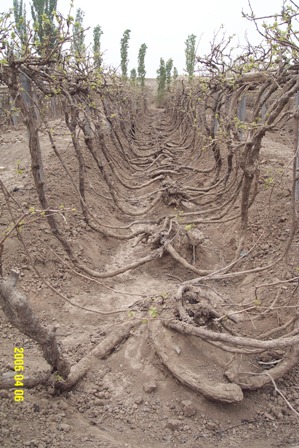
The pictures below give you an idea under what condition grapes are produced in this region with an extreme climate, very short, but hot summers (up to + 40 Celsius) and very long and ice cold winters (up to -20 Celsius). There is only minimal precipitation, on average about 20 mm per year. When we were there it “rained”. That’s what the local guide told us, otherwise we would not have notices. It was just a bit humid.

A typical vineyard near Turfan in spring

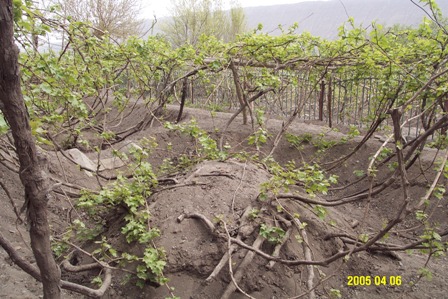
During the winter months the canes are buried in the ground to keep them alive. In spring they dug out and “hung” over various kinds of racks. Because wood is so scarce, we find all kinds of material where the vines are hung up. According to our guide there are many hundreds of different varieties. Unfortunately, our guide was not a grape expert.

Vines in the two-row system

Vines in the one-row system

However, we visited a family and could buy some of their produce. Traditionally they produce raisin not wine. Most Uigurs are Muslim therefore they do not drink alcohol. The grapes are dried in open barns.

A drying barn

Margit buying raisin in the market

In the local supermarkets of Turfan we could get a good overview on what wines were on offer. The sales prices drive tears into the eyes of an Australian primary producer. My vintners heart almost broke. What a pittance of a price for the producer will be left when all the costs of the agents are deducted!

The vines are irrigated with an age old irrigations system, called the Karez system. The water from the surrounding mountains, mostly from melting snow, is brought to Turfan through a sophisticated system of wells and deep channels dug by hand and lined with sheep skins. Thousands of kilometres of underground water channels can be found. From this precious resource mostly vegetables and fruit are grown.

Vines coming from a “central point and hung in squares”

Most meals we had included of some kind of mutton dish. We enjoyed the rustique but delicious cuisine of the Uigurs. After many beers and some “schnaps”, we also tried some of the reds. I do not remember the brands but we loved the drop. Traditional dances were presented and in one location the local invited us to dance to their music to which we joyful obliged. It was a very memorable visit to this most Western part of China and its friendly people in the bubbling markets. Needless to say that I brought back some of the traditional head gear and an lute like instrument.