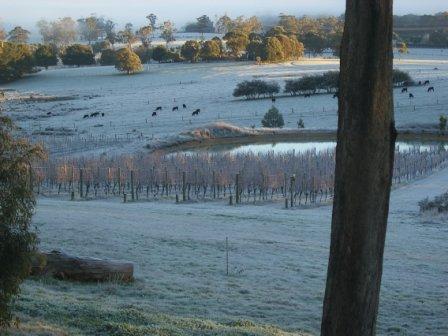
Row spacing and trellis systems in Germany

May 10, 2008

While traveling in Germany last year, I took quite a few photos of vineyards and the way vines were grown there. While visiting the Ahr, Rhine, Mosel and Saar I notices that row spacing and trellising could showed a wide variety of different spaces and systems.

This slope on the Ahr shows “planting with the slope” and planting “parallel to the slope”, and also the width between rows shows variations.
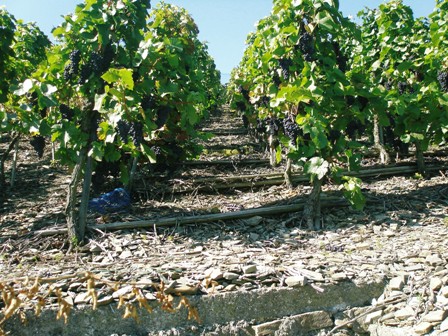
Here (photo above from the Ahr) sticks have been put between the individual vines in order to make it easier to move in the vineyards and to prevent stones and earth to be washed down the rows. Every vine has its own individual post and no wires are required. One finds this system also along the Mosel and the Saar.
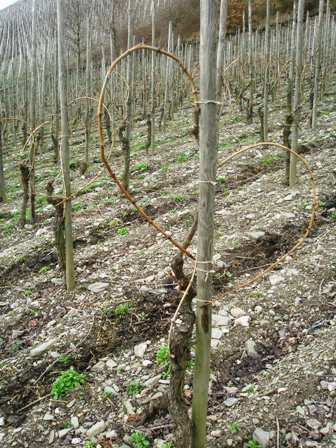
Individual vines and the post after pruning (Saar)

After pruning, two canes are bound to the post on the individual post system. I wonder if spur pruning can be applied to it too?

Usually movable fruit wires, as we have them in Australia (VSP = vertical shoot positioning), are not a feature of these trellis systems. This is not surprising. On the steep slopes of the Mosel, Ahr and Rhine rivers moving fruit wires would be suicidal.

In my own vineyard in Glenburn, we use a simple VSP-trellis system. The move of the fruit wires is usually not a difficult job, especially along the gentle slopes as we have them. However, when the rows are long, the wire gets heavier and heavier the longer the day lasts.

Three fixed wires on vines in Olewig, Trier/Mosel

One finds also more and more metal posts, here also with three wires (Olewig)

In some of the locations, even if they are steep, caterpillar tractors are used to work the land. These tractors are small but still need narrow rows between the vines in order to operate.

Below, two rows have been planted close to each other (and no vehicle can work between them), but the next rows a planted at a wider distance so that the caterpillar tractor can be used.

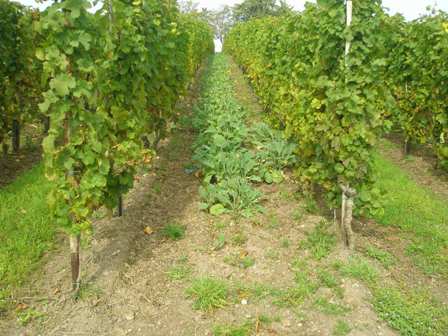
Even cabbage is grown between the rows (Olewig/Trier, Mosel)

In my blog entry titled “Along the Mosel River”, of September 12th, 2007 I showed some of the elevators used on steep slopes to carry material up and down the vineyard. Have a look and check it out; it’s an interesting system, one can observe on many steep vineyard slopes on the Mosel.


Vintage Celebration 2008 – Upper Goulburn Wine Region

May 9, 2008

I missed this year’s vintage celebration of our wine growers association – the Upper Goulburn Wine Region (www.uppergoulburnwine.org). The last weekend of April saw wine ethusiasts, vintners, and other local folks descend on the picturesque rural town of mansfield at the foot of Mount Buller where soon the ski and other winter tourists are going to converge for joyful days in the snow.

For the time being it’s still autumn, all grapes have been harvested and the juices of young wines are working hard to become as excellent a wine as in this part of the world we are able to produce. Thanks to our clean natural sorroundings, the hills and northerly slopes, the terroir and our cool climate, the Upper Goulburn Wine region produces outstanding wines.

This year the vintage celebration weekend (25-27th April) consisted of three major events.

1. Cocktails on the Deck on High – an evening reception at this new venue – normally offering Thai cuisine as well as tapas, with a stylish piano bar and an “oriental room” (whatever that means) – in the High Country with cocktail canapes and the best of Upper Goulburn wines matching these delicious finger foods. The guests were entertained by a string duo from Melbourne named “Take Two”.

2. A Day on High – starting at 11 am until 5 pm and covering the main street of mansfield where regional food, wines and other produce are displayed and cwhere all kinds of culinary delights can be tasted. You just purchase a glass for A$ 5 and off you go to taste the new releases of the regions superior wines. This time the entertainment consisted of “Derek Guille and his Ugly Uncles”, a performance band in blues, folk and jazz (more than the usual country stuff of Country and Western).

3. Long Lunch – the lunch took place in the gardens at Highton Manor , a restaurant in a 1896 historic country house right in town. The lunch does not come cheap but with Mount Buller as a backdrop, the selected four course meal prepared by local chefs and served with the best wines from our region, was a true delight.

The 2008 vintage has been very erratic in Australia. In many places, South Australia for instance, it started very early (one month earlier than normal) with many varieties ripening in unpredictable and abnormal order. Various heat waves partially destroyed the crops, gain an example from South Australia where about 100.000 tonnes of grapes were left on the vines. Wineries had to cope with a mass arrival of fruit concentrated in a very short time band.

But in other regions, Gisborn or McLaren Vale for instance, 2008 produced a great vintage. I have not heard too much from neighbours and other members of our association.

We at Two Hills Vineyard had a good year. We did not overcrop, kept yields low for a maximum of flavour and intensity. Our fruit enjoyed great demand. Finally word has spread around that our fruit is of excellent quality and as a consequence we have more interested buyers than we can satisfy.

A small portion of our Merlot fruit will be made into wine, as always at Yering Farm, by Alan Johns and we are looking forward to another excellent Two Hills Merlot wine.


Country Inns in Germany – Klostermühle, Ockfen, Saar

May 5, 2008

When I am visiting my hometown Trier I always try to arrange an outing to the Saar, my most favourite tributary of the Mosel (the other one I love very much, is the river Ruwer).

One day in March my mother, my friend Heinz and I, we went for lunch in the countryside. It was March. Spring was waiting in the wings, but could not get through as yet. However, it was a beautiful day. We choose the Klostermühle in Ockfen, Saar, as our destination, a winery cum hotel and restaurant (www.bockstein.de).

Winery-Hotel-Restaurat Klostermühle in Ockfen, Saar

Pork tenderloin with Spaetzle, a German type of noodle dumplings

The food was delicious, typical country inn style, rustique, big portions, in short: value for money type of food. I had one of their Rieslings with my food. Ockfener Bockstein is the name of the most famous location (terroir) in this neck of the wood. It was a very typical Saar Riesling, low in alcohol but zippy and fruity, with complex acids, a good structure and a long and intense finish.

After lunch we drove though the vineyards of Ockfen. On our way to Schoden where Heinz together with some friends is renting a hunting ground, we passed by the “Bockstein” which you can see in the picture below (where the tree line on the hill in the background is ending).

Ockfener Bockstein, one of the most famous “terroirs” of the Saar

The Saar is a very picturesque wine region and tourist destination in southwestern Germany and certainly worth a visit. Do it regularly as I do. The Riesling wines are among the best of Germany.

Address
Weingut – Hotel – Restaurant Klostermühle
Fam. Minn
54441 Ockfen, Saar
+49-6581-9293-0


Chain of Ponds, Adelaide Hills, Australia

April 26, 2008

I found another treasure in our local duty free shop a Chain of Ponds ‘1999 Grave’s Gate Shiraz’, from McLaren Vale in South Australia. The homepage of Chain of Ponds (www.chainofponds.com.au), located in the Adelaide Hills, claims that they are “Australia’s “most highly awarded boutique vineyard”. After studying the page I have the feeling that for my taste, they are already much too big to qualify for such a label, but I am easy on that.

Of course their origins (in 1985) were small but they have grown over the years in a sizable business.
I just managed to get the bottle in the last year of the drinking time frame: best drinking 2003 to 2008, it says somewhere.

The wine background is given as follows:

Frost at the commencement of the 1999 growing season wiped out Chain of Ponds estate plantings of Shiraz, hence the sourcing of fruit from McLaren Vale for this wine.

In 2001 James Halliday gave a rating of 90 out of 100 point. The wine comes from the River Series, sold for A$ 18 per bottle. I payed US $ 18.20 for it, which seems to be quite reasonable. The wine could be described as follows:

<“Deep, bright red-purple; clean, fresh juicy/berry fruit on the bouquet is followed by luscious and sweet berry fruit on the palate. Neither the oak, nor the extract, nor the alcohol (13.5°) have been overdone”.

The winemaker is Neville Falkenberg. The 1999 wine must have been made by his predecessor since Neville has been with Chain of Ponds for only the last five years. The Adelaide Hills is a premier cool climate region of South Australia, only about a 20 minutes drive from the capital Adelaide. I love Adelaide not just because my wife originates from there, and recommend it for any visit to Australia. It’s a must, seriously.

Apart from this series, Chains of Ponds has a Premium Range segment. It also produces wines from Kangaroo Island grapes. Its Italian Varietals come from the Adelaide Hills (Nebbiolo, Sangiovese and Pinot Grigio). The low cost segment is called Novello Range (A$ 14/bottle). I have not been to the place but the homepage shows beautiful pictures. Another place to check out.


Miranda – Sam Miranda

April 20, 2008

After posting my recent blog entry on “Cool Climate Wines” I had second thoughts as regards the accuracy of my assessment. I thought about the label issues, than visited the Sam Miranda website again (www.sammiranda.com.au).

There I learned that Sam Miranda had sold the family business (Miranda Wines) to McGuigan Simeon in October 2003. And then things fell into place. Of course the bottle I had bought must have come from McGuigan Simeon (www.mswl.com.au). When I visited their website today I found the Miranda brand and learned that they also source fruit from the King Valley.

So the bottle of Miranda I had the other day came from McGuigan Simeon and not from Sam Miranda of King Valley.

However, I can maintain my general assessment.

1. Wines from the cool climate King Valley Wine Region are excellent and worth trying.

2. The “High Country” Cabernet Sauvignon from Miranda (McGuigan Simeon) was a good buy.

and

3. I will visit the Sam Miranda cellar door next time we are in Glenburn. That’s for sure.


Homecoming – Trier, Mosel

April 8, 2008

Vineyards in Trier

Vineyards on left side of the Mosel near Trier

I listened to Keith Urban’s “Once in a lifetime” on my i-pod when riding into Trier on the train from Koblenz. It was the first day of April.

“But you’ve never been this loved (mm hmm)”, says the forth line of the first stanza and it seemed to summarise my feelings.

I was very happy to have reached the place where I grew up.

Spring greeted me and the sun bathed the hills surrounding the old Roman city. What a perfect day, I thought; how lucky I was. And it turned out later that it should be the only ‘spring day’ during my short visit. Snow and ice should clebrate a comeback a couple of days later.

Behind me lay a wonderful train trip through the charming settlements and small towns of the Mosel river valley: Winningen, Kobern-Gondorf, Alken, Moselkern, Treis-Karden, Cochem (a long tunnel ride depriving me of any view of my beloved Mosel), Ediger-Eller (crossing the river into yet another tunnel) and into Bullay. More tunnels were to follow and we crossed into the Eifel hills leaving the river behind us. The next vineyards would re-emerge in Schweich, near Trier.

It was a glorious morning ride on the train. The Mosel river valley showed its best side and the train trip from Winningen to Bullay is the most enjoyable part. I was listening to music from Sting “Songs from the labyrinth”, a collection of songs from the 16th century. What perfect music for such an historic ride along the shores of the Mosel river.

I followed it up by listening to Alan Stivel and his Celtic Music collection and in my inner eye I could see the original settlers of the area, the Celtic Treverer working the valley and the steep vineyard slopes. This was the perfect music for a homecoming. Here and there castles and ruins thereof greeted us from the hilltops.

Spring had just arrived. Fruit trees were in flowers, apples, pears and cherries in white or a soft pinkish white, peach trees in dark pink. Nature is ready to rock; just a few more warm days and everything will be covered in soft green colours. The willow trees pushed already their sprouts. All other trees, the birches, beech and oak trees on the hills were bare.

The train went along the river through meadows and paddocks, fields and forests. Thousands of years the Mosel flowed through this landscape. River barges made their way down or uphill through the brownish water. White swans working on their nests. The sun blinded me while riding along in the train. Who would have know that these hills would mean so much to me one day?

The vineyards were well tended, immaculate, only some belated vintners were busy binding the canes to the wires or the stakes; soon the buds of the leaves would burst.

Only the dirty train windows prevented me from taking pictures.

At my mothers house a delicious lunch would wait for me (and some Two Hills Merlot of course). Homecoming, it was the second time for 2008, that I had the opportunity to come back to the town I was born in. What a joy.

Noodles and Two Hills Merlot


German Vineyards in March

March 18, 2008

March is a great time of the year in the Northern hemisphere. Nature is ready to go, buds are almost bursting, waiting for the right temperature, the hours of sunshine which make the difference, warm the soil and the plants. As every year another miracle is in the making.

The vineyards are neatly pruned and ready to go shortly before the new growing season begins. The following pictures from the Saar Wine Region might give you an idea.

vineyardin-march.jpg

The colour scheme is still dominated by greys and dark winter colours but here and there we can see greenish spots, and soon spring will have driven winter away.

The slopes are steep and every vine has its own post. This one is very well tended, not a single stem or blade of grass can be detected.

pruned3.jpg

The pruning is of a special kind too. In Australia we hardly see this kind of binding the canes.

pruned1.jpg

It is not easy to spread organic manure in the vineyards at these steep slopes.

menure1.jpg

A metal sledge is used to bring the manure to the vines.

pruned2.jpg

Apart from the well tended vineyards (as above in Ockfen, Saar) we also find here and there a neglected one or one in a rather ‘chaotic stage’ but they are the exception rather than the rule.

chaoticvineyard.jpg

The neglected vine garden


Of Droughts and Bushfires

January 12, 2007

Today, I climbed from the heavans and my meetings with the celtic gods (remember Sucellus?) down to earth again. And a hot earth it is. From The Age (www.theage.com.au) I learned about the progress of the bushfires in Victoria. 950.000 ha of forest have already burnt down, which according to The Age is almost as large as Jamaica (it has a bobsled team). Mt Buller where it burns is only about two hours away from our vineyard in Glenburn.

Some years ago I went skiing with my friend, Timo Meyer, Australian of Swabian origin, and his and our children for a day of racing down the hills. Timo is a vintner and a very sought after winemaker at Gembrook Hill Vineyard (www.gembrookhill.com.au). He is famous for his very fine palate. Timo made our second vintage of Sauvignon Blanc which in the end got us the bronze medal at the Singapore Wine Show. He has also his own vineyard at a very steep slope which is called “Bloody Hill”. His wines can be bought at Yarra Valley Dairy (www.yvd.com.au).

The picture below has been taken by Andrew de la Rue and it shows the fire raging near Mt. Bulller village.

buller_smoke_wideweb__470×2930.jpg

We are suffering under the drought for some years already. Because of the higher altitude of our vineyard loaction in Glenburn, we normally receive sufficient rain. Years ago we enlarged the old dam and built a new 13 megalitre storage. This kept us going. It did not rain much this winter (June to August on the southern hemisphere). I have never seen our big dam as low as in July/August 2006. Margit and I, we are of course a bit scared that some fires might break out in the nearby forests. Many of the fires are deliberatly lit by arsonists, others are ignited by lightning. The temperatures are high at the moment and together with the strong northerly winds, they make firefighting dangerous.

It has been a strange year so far. First, many vineyards were hit by two waves of late frost which destroyed in some places all the fruit at the vines. We at Two Hills were lucky. According to Steve Sadlier our friend, who manages our vineyard, we lost about 20% of the Sauvignon Blanc, 60% of the Pinot and about 40-50% of the Merlot. Some vineyards in the neighbourhood lost up to 60-70 % of their fruit, others lost everything. As a consequence the Victorian wine industry is suffering tremendous damages. Demand for fruit is strong. If we had only more of it. The old agricultural law prevails, that the economic value of a bumper harvest is usually lower then the one of a meager year. The frost damage will have lasting effects. Also the 2008 harvest will be lower because of the frost damage last year. Second, comes the drought and the fires. If Kinglake National Park start to burn, we will be in trouble.

Below some pictures of Two Hills in winter 2006. Isn’t the place beautiful?

Winter on Two Hills 1

Two Hills Vineyard

Winter on Two Hills 2

Winter on Two Hills 3

Sauvignon Blanc in winter