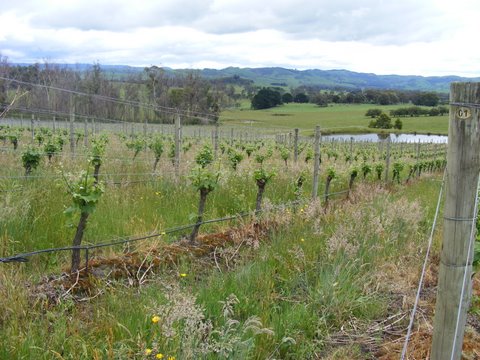
Vineyard work at Two Hills

January 20, 2011

Un-attended vines

A mothballed vineyard is not a pretty sight, especially not after downy mildew had gone through it. It was so humid this spring that mildew was a real problem and we missed to treat the outbreak in good time. Luckily it was only downy and not powdery mildew. The difference is shown in the next picture.

The two mildews (with a spelling mistake)

Source: http://en.wikipedia.org/wiki/File:Downy_and_Powdery_mildew_on_grape_leaf.JPG

Mothballed vineyards react forcefully to being chopped off at the top. If no spurs or canes are left there, the vines respond to the brutal treatement with increased and vigorous growth of side shoots all over the place. These need to be removed.

So what did I do during my holidays on the farm?

I was “desucking”, as it is called colloquially. Every morning from about seven to nine I walked through the Sauvignon Blanc and the Merlot blocks of our vineyard and brushed the suckers (side shoots) off.

The work is easy. It is ritualistic and has an almost religious quality. You bend down in front of the vine (and show your respect) while breaking out all the shoots except the ones on the top.

After my work of “de-sucking”

The fruit of hard labour: clean vines everywhere

Unfortunately, I could not finish the two other blocks, the Pinot Noir and the Chardonnay. Next time I will be smarter and take longer holidays.


Summer time, summer wine: Mayer Vineyard Rosé

January 14, 2011

If you see the pictures of the Queensland and New South Wales floods, it is hard to believe that we in Victoria had perfect weather conditions and enjoyed two beautiful weeks of a mild, but enjoyable summer over the Christmas break.

It is also hard to imagine that the area affected by the floods covers the size of France and Germany combined. The tragic loss of many lives makes me sad. The individual stories are heartbreaking. It is to be hoped that further losses and damage can be avoided in the future.

But Summer calls for summer wines, Rosé being one of them. Timo Mayer, winemaker and owner of the Mayer Vineyard in the Yarra Valley produces just one such wine. His ‘2010 Bloody Hill Rosé’ made in the traditional way out of Pinot Noir grapes, is a just wonderful; it is delicate, complex and refined.

I also love its colour. I wish we had more bottles of it but so is life.

Summer lunch with Timo Mayer Rosé

2010 Bloody Hill Rosé

We enjoyed the wine with an Italian main course consisting of gnocchi with a side salad.

Address
The Mayer Vineyard
Timo Mayer, Miller Road,
Healesville, Victoria
Tel.:+61-3-5967 3779
e-mail: timomayer@bigpond.com.au
http://www.timomayer.com.au


Red snapper with Sevenhill Inigo Riesling

January 5, 2011

What a beautiful red snapper

My friend Brett Travis had given us the above red snapper before leaving on a fishing trip to Samoa. This was a wonderful opportunity for another wonderful lunch at our vineyard. We prepared the fish for a six persons meal.

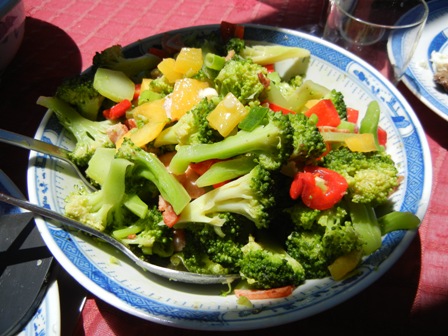
Yummy veggies

It was a beautiful summers day. The fish was “crying” for a white wine too. We took the opportunity to open one of the recently acquired bottles from Sevenhill Cellars in the Clare Valley in South Australia where our mate Neville Rowe is the general manager.

The ‘2009 Inigo Riesling’ is a typical Clare Valley wine. It is young and fresh and lively. Of course I prefer German Riesling wines, and it is my view that Australian Riesling cannot reach that ultimate Riesling level which I love so much.

Sevenhill Cellars is the oldest wineries in the Clare Valley. It was founded by Jesuits in 1851 to produce sacramental wines. We enjoyed the “sacrament” with the delicious fish, and thank all our benefactors. Cheers mate.

2009 Inigo Riesling by Sevenhill, Clare Valley


Top Australian Riesling wines

December 21, 2010

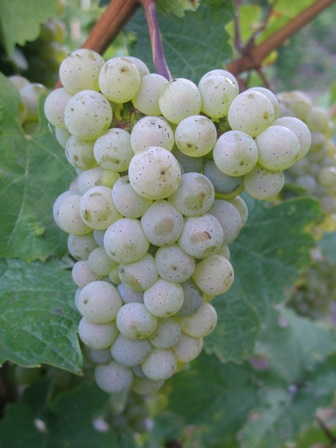
Riesling grape

I admit that as a German Riesling aficionado I have my problems with Australian Riesling wines. I try them again and again but, and to my great chagrin, I have not found what I am looking for.

Australian Riesling wines from the Adelaide Hills, the Clare Valley, the Eden Valley, Tasmania, Canberra District and from Great Southern in Western Australia enjoy a good reputation.

Also our own wine region, the Upper Goulburn Wine Region, produces some beautiful Riesling wines.

The September/October issue of the Australian and New Zealand Wine Industry Journal summarised the tasting of 26 Australian Riesling wines. All of them were under crew caps! Impossible in my native Germany.

Only one of them came from Victoria (Paradigm Hill 2009 Riesling from the Mornington Peninsula). The price range was from A$ 22 to A$ 45 (16.75 to 34.2 EURO). The four top rates wines were:

– 2010 Jacob’s Creek “Steingarten” Riesling (it is German for “stone garden”), a tank sample, Barossa Valley, South Australia

– 2009 “The Florita” Riesling by Jim Barry Wines, Clare Valley, South Australia

– 2009 Premium Riesling by Helm Wines, Canberra District, New South Wales

– 2009 Riesling by Plantagenet Wines, Mount Barker, Western Australia

The magazine carried also a photo of the vineyard where the Jacob’s Creek “Steingarten” Riesling is produced. It reminded me of my home region along the Mosel and Saar river. Here every vine has a single “stick” and is “wrapped” around it with no wire between the posts, nothing.

The “Steingarten” vineyard is entirely worked by hand because of it’s steepness. Also this reminds me of the Mosel with its ultra-steep slopes. The stones are of red colour, though, whereas the Mosel has blue and grey slate.

And believe me these Australian wine producers are not modest. At the recent International Riesling Challenge in Canberra they gave the top wine the title: Best Riesling in the World. Can you imagine. Modesty used to be a virtue which must have jumped out of the window down under.

The trophy was given to a ‘2005 Pauletts Aged Release Polish Hill Riesling’ from Polish Hill in the Clare valley, South Australia by Paulett Wines.

I cannot even try this wine because it is sold out. My search continues. I keep you posted.


Dr Mayer Riesling – fine wine from the Remstal, Germany

December 1, 2010

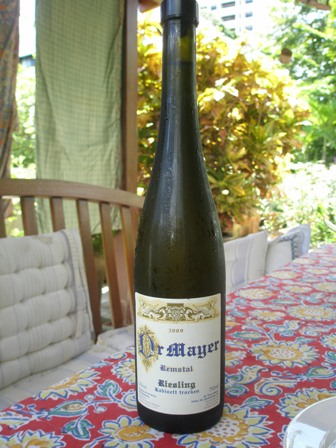
‘2009 Dr. Mayer Riesling’, Remstal, Wuerttemberg, Germany

We were lucky that Timo Mayer, vintner and wine-maker of the Mayer Vineyard in the Yarra Valley, Victoria, carried with him a bottle of the ‘2009 Dr. Mayer Riesling’ with him when he dropped by recently here in Bangkok.

Timo came back from a wine making and wine selling visit to Germany where he had also made his ‘2009 Dr. Mayer Riesling’ from fruit sourced from his native Remstal (to be precise from a village called Grossheppach) in Wuerttemberg.

The dry Riesling has 12.5% alcohol

The wine is under a glass enclosure which gives it a very elegant appearance. It’s a beautiful dry Riesling, elegant and fruity with a good structure and a long and intensive finish, in short a treasure of a wine.

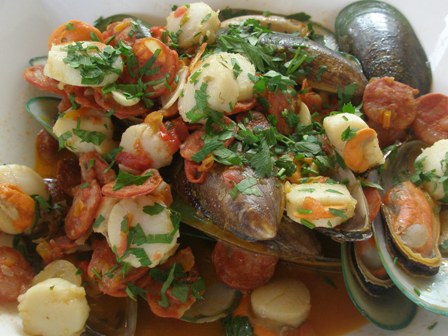
Mussels and clams with chorizo sausage

We saved the bottle for a special occasion, and surprise, surprise, the occasion should arrive very, very soon: a beautiful tropical Saturday afternoon lent itself for a delicious meal consisting of mussels, clams with chorizo sausages. This is a yummy dish and ideal light lunch.

The bad news is, one cannot buy this wine in Germany, the motherland of Riesling wines.

The good news is one can buy it from Timo Mayer in the Yarra Valley and the outlets carrying his wines in Victoria.

Timo got only about a pallet, so you have to be quick. Better rush.


Two Hills Vineyard in November

November 16, 2010

The mothballed Sauvignon Blanc block

Today, my brother in law, Michael, send me some photos from our vineyard. The above one depicts our 2 1/2 acres of Sauvignon Blanc which have been mothballed for the coming season. It look a bit wild. I will slash the grass in a few weeks.

Michael also met a snake in the grass. Is it a black or a tiger snake? Anyway, they are all poisenous.

Thanks Michael for the great photos.


Wild pig from Schoden, Saar

September 15, 2010

I am afraid some of you might not like this post and the pictures which I present today. But meat comes from animals and they have to die so that we can enjoy the meals we make from it. Wild pigs are a real pest in Germany theses days, and very difficult to hunt and kill. My friend Heinz shot the little boar in Schoden, Saar.

My mother prepared a wonderful Sunday lunch with the best parts of the meat. We enjoyed it together with a bottle of our Merlot (2004 Two Hills Merlot), and I tell you that was just heaven on a stick, as we say in Australia.

Wild piglet hide

The carcass

…from a different side.

The butchered boar meat

…and in the pan

…and finally on the plate

How tender is this?

My favorite Australian Merlot


“Rain rain rain rain beautiful rain”

September 4, 2010

This is how a song line from South Africa goes. Paul Simon and Ladysmith Black Mambazo made it famous in my circles. Now the drought in Victoria seems to have come to an end (after 13 years or so). It rains and rains in northern and central Victoria.

Of cause rain brings also destruction, landslides at Mount Buller for instance, flash floods, rivers rising, people had to be evacuated, in short chaos across the state of Victoria. In some places they had 150 millimetres.

But our dams at Two Hills Vineyard are full now. That’s the good news. I have not seen our big dam as full as now. ‘Brownies landing” is floating for the first time in years.

Dam at Two Hills Vineyard


Four Sisters 2006 Merlot

June 27, 2010

Four Sisters 2006 Merlot in an unorthodox glass

I am always drawn to Merlot which is not very surprising for a Merlot producer. I try to extend my experience here in order to better appreciate my own wines. Our own Two Hills Merlot is often like biting into ripe cherries. Some of our vintages were “umpf” wines with lots of alcohol, tannins and bite, others were elegant and subtle.

When I had the chance of buy a Merlot at Bacchus Corner in Saigon I could not say no. A ‘2006 Four Sisters Merlot’ seemed just the right stuff. Four Sisters Winery is a joint venture between Trevor Mast of Mount Langi Ghiran, and Alistair Purbrick of Chateau Tahbilk.

2006 Four Sisters Merlot

I selected the bottle mainly because of the label (and the price 380,000 Dong). In Australia the wine retails for about A$ 12 to 15. I found the silhouettes of the “Four Sisters” interesting.

What I did not like from the outset was, that the back label told me that the grapes for this wine (of course only the best were selected) were sourced from all over Australia. What a blend, I thought and blended it is also with some other red varieties (which the label does not say).

The back label

The wine is medium bodied. It’s colour is a ruby red and the alcohol content is big (with 14% vol.). Plum was the dominant fruit I tasted, and there was lots of it. I did not like the finish which was rough somehow. One should have the wine with food, I think, just straight is less desirable.

Afterthought: try to drink it from a proper wine glass. The hotel did not leave me a choice, there was no wine glass in my room.


Wine of the day: The Wanderer, Yarra Valley

May 16, 2010

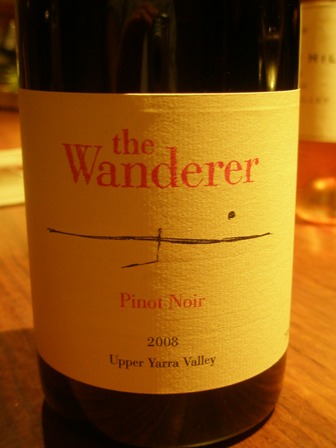
2008 Pinot Noir The Wanderer, Yarra Valley

My wine tip of the day is the Pinot Noir made by wine maker Andrew Marks of Gembrook Hills in the Yarra Valley. The wine is very light in colour with 13% alcohol and has a lot of cherries on the nose. It has some oak and is made from grapes grown from a single vineyard near Tarrawarra in the Yarra Valley.

I know that you have to be in Australia to get hold of this wine. But never mind, visiting Victoria is a bonus anyway. Have a nice Sunday, wherever you are.