Roman Villa Urbana in Longuich, Mosel

August 27, 2012

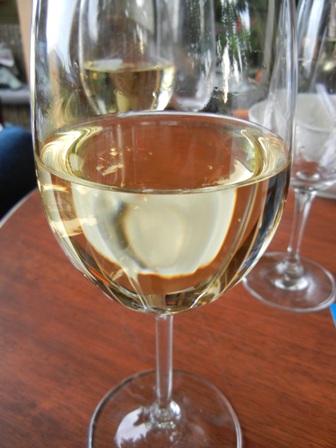
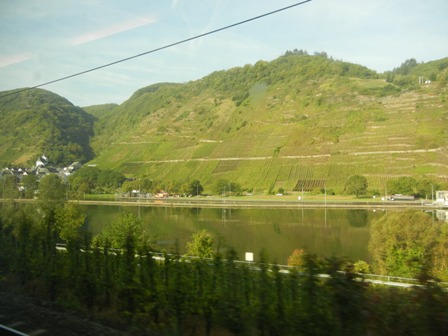
Vineyards near Longuich – Opposite the steep slopes of the Mosel

The cultivation of grapes along the Mosel river and its tributaries Saar and Ruwer is more than 2,000 years old. For the Romans wine was an important commodity. All along the Mosel river one can find traces of the Roman wine industry, among them wine presses and fermentation tanks, vineyard implements, residues of grapes, statues of gods and godesses etc.

Among the treasures are the ruins and foundations of many Roman rural villas. One of them can be found in Longuich-Kirsch, just a few kilometers downstream from my hometown Trier. Various types of these villas can be distinguished. Some of them contain large mosaics as the villa in Nennig.

The villa in Longuich is a “villa urbana”, the seat of a retired high official. It is very large (110 x 28 meters). It was built in the 2nd century after Christ and includes an extensive Roman bath consisting of a Caldarium (hot bath), Tepidarium (warm bath), Sudatorium (sauna), Frigidarium (cold bath) and Praefurnium (fire and heating system).

The foundations of the villa were accidentally discovered during land consolidation and reconstruction work in 1984. Next to the villa some agricultural buildings we found as well.

The villa urbana was restored and is today open to the public. Various billboards inform the casual visitor about various aspects of roman life including the two thousand years of grape and wine production.

Imagine that so long ago people were working in vineyards and wineries in the very same places where also todays wine is produced. Amazing. The work was even harder than today, I guess.

The production techniques of the Romans are well researched. The billbords explain todays challenges and how they were mastered recently. I loved the way ancient history was linked to contemporary modern life. I highly recommend visiting these villas. The view over the valley and its vineyards is another great experience.

Fortunately, the vineyards in the vicinity of the villa are still productive, and many wineries and vintners are happy to welcome visitors and introduce them to their excellent Riesling wines.


Mosel Riesling: Versuchungen (temptations)

August 21, 2012

What a beautiful Riesling: Versuchungen = temptations

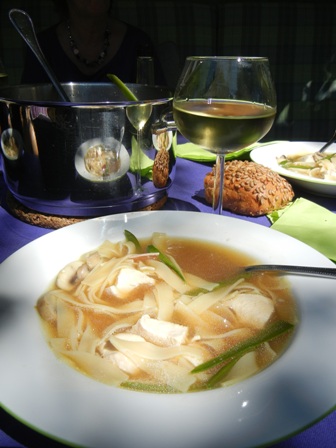
The wine is made by Andreas Bender, a contrarian of the German wine scene, of Weingut Bender. It is a semi-dry Riesling, usually not a wine style I very much like. But it perfectly machted the spicy Asian soup we had it with. Lovely buquet, fine acidity and a sweetness which was round and compassionate, like a kiss.

The wine is named in allusion to two quotes by Oscar Wilde, who must have said that “I can resist everything, except temptation” and “The only way to get rid of a temptation is to yield to it”.

I yielded to it as well. It was modestly priced at Euro 7.50 when I bought it at Weinsinnig, one of my preferred wine barS in My home town Trier.

Versuchungen and the spicy Asian soup

I have not made up my mind about this wine. I need to taste some of the dry wines Andreas Bender produces before I can come to a conclusion. But for the many off-dry wine lovers, this wine is a true temptation.


“Weinsinnig” – wine bar in Trier

August 4, 2012

One of my favourite wine bars in my home town Trier is “Weinsinnig”, located right in the center of town.

The name of the bar is a kind of word play on “Wahnsinnig” (in English “mad” or “crazy”), and composed of two parts, a nomen, “Wahn” or “mania” (in English) and an adjective “sinnig” which can be translated as “plausible”, “make sense”, “evident”, “sensible” or “witted”. In the combination with “Wein”/”wine” it becomes something new, a compound with a new meaning which could be translated as “in the mood to enjoy wine”, “wine is sensible” or “crazy for wine”.

Weinsinnig is also a kind of cellar door for wineries from the Mosel. Moreover, it offers selected culinary delights, for instance “Flammkuchen”, a tarte flambe. And last but not least, Weinsinnig offers various activities related to wine and the people making it.

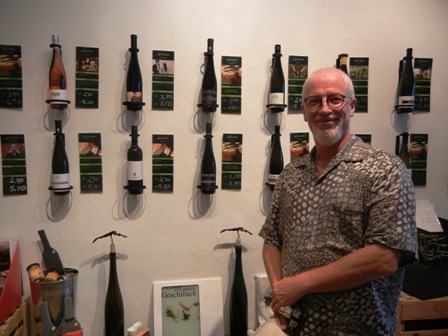
In front of the ‘walk along wine list’

It was a rainy summer’s evening when we visited and therefore we sat inside. Weinsinnig offers also a couple of chairs and tables outside. One sits on the pavement on a narrow street. Fortunately, warm blankets are on offer.

My choice: a dry Riesling from the Ruwer

I love their selection of local wines, many of them produced by young and innovative vintners. I chose a ‘2011 Maximin Gruenhaeuser dry Riesling’ by one of the top producers from the Ruwer valley, von Schubert’sche Gutsverwaltung. I also bought some more of this wine and will only say that this is a Riesling to die for.

2011 Maximin Gruenhaeuser dry Riesling

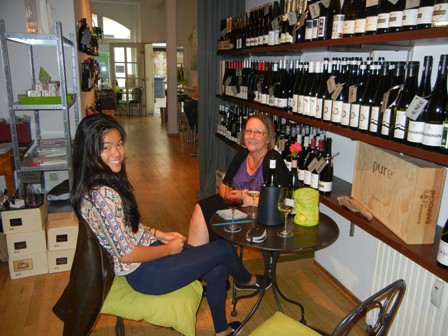
Inside

By the way TripAdvisor rated it 4 of 5 on 16 Jun 2012 and ranked Weinsinnig as 69 out of 182 restaurants in Trier. In my view Weinsinnig belongs to the “must visit” category in Trier. Check it out.

Address:
Weinsinnig
Palaststraße 12
54290 Trier, Germany
Tel.: +49-651 9790156


The art of blogging and wine from Caves Alianca Dao, Portugal

July 11, 2012

No blog entry for two weeks, goodness me. Why I am so busy? It seems this is a terible time. No time for my blog. Moroever, I am going on an extended trip to my hometown Trier, Germany (this time on vacation), where I have very ittle access to the internet. Therefore the prospects are grim. Please bear with me. I plan to continue my blog despite the odds.

Today I have a last entry before the blog-free seasons starts. The good news is that I will be visiting the Mosel and its tributaries. This also means that I will probably visit some wineries and taste some delicious wines. I should come back to Bangkok with many more stories to tell and share.

A beautiful dark red colour

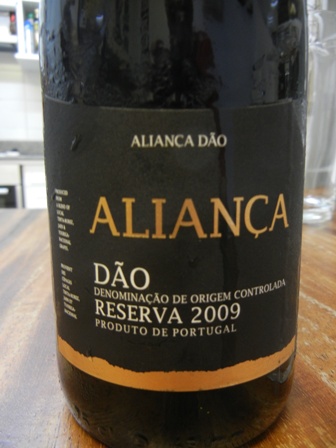
Last night, we had with our meal a beautiful red. It was a ‘2009 Caves Alianca Dao Reserva’, a blend of various Portuguese grape varieties (the label says: Tinta Roriz, Alfrocheiro, Jaén, Touriga Nacional).

The Dao wine region is consistently producing outstanding wines. Ever since our holiday along the Douro river, I am a big fan of Portuguese wines.

Caves Alianca Dao Reserva

With 14% alcohol this wine is big and mighty. It is also very smooth with lots of forest fruit. There is some hint of vanilla (from the oak). The wine has a good mid-pallet weight and a long finish.

The back label of the Alianca Dao

In Europe the wine retails for about 7 Pounds.

We had this beautiful and delectable wine with very spicy green beans and a beef fillet. Woh, that meal was super delicious and the wine was just a perfect match. I wish we had more of it. Well.

Soon we will be at the shores of the Mosel river and ive into the tasting of Riesling. What a consolation.


My beloved Mosel river – 1868 map of its terroir

March 6, 2012

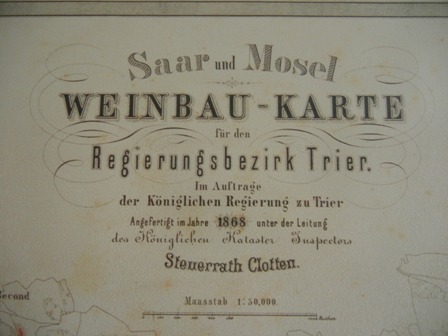
I am very excited. Finally, my historical map of the Mosel river, which I had bought some years ago at Karlsmuehle, a winery cum restaurant at the Ruwer river, was put in a proper frame here in Bangkok. It’s a replica and not an original of course. But I looks very nice on my wall.

Vineyard location and quality map of 1868

The map shows the quality of the terroir in different shades of red. The more intense the red is, the better the quality and the higher the tax category. The Royal Prussian government had produced this map in order to streamline their tax collection.

The newly framed map of the Mosel, Saar and Ruwer

I can already see this map hanging in my house in Australia on our vineyard in Glenburn. I will tell my grand-children where I come from and how much I love my native town, Trier, and the Mosel river.


Mosella – home of the best Riesling wines in the world

February 5, 2012

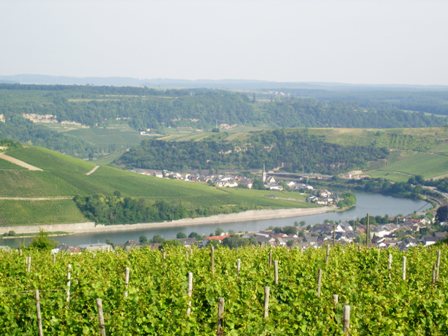
The Mosel valley with the hamlets Riol and Longuich

Maybe because it is Sunday, maybe because that lends itself to some introspection, maybe because I am abstaining from consuming wine for a couple of days, maybe because I have not been to my beloved Mosel for such a long time, maybe…who knows.

Anyway, on this beautiful tropical Sunday in Bangkok and while my Thai vintner friends in Khao Yai, about two-three hours north-east of Bangkok, are busy harvesting their grapes, I am exploring the writings of Decimus Magnus Ausonius (310-393 AD), a Gallic-Roman government official, educator of princes and poet who lived for some years in my home-town Trier.

The Mosel, photo taken from Nittel, the Luxembourg side to the left

Have you heard about Ausonius? No? Well, let me tell you that he was born in Buldigana, which it called Bordeaux today, and where he also died. He had studied rhetoric in Toulouse.

In 365 Valentinian I, emperor of the West-Roman empire, called Ausonius to Trier (yes, my home-town which was the capital of the West-Roman empire for a while) or Augusta Treverorum, as it was called in those days, to educate his eldest son, Gratian, the heir-apparent.

The wine village of Alken, Mosel river and castle

In 371 Ausonius published his impressions (early travel writing) from a trip in 368 which brought him from Mogontiacum (Mainz) through Bingium (Bingen) and Noviomagnus (Neumagen) to Augusta Treverorum (Trier). This work is know as “Mosella” and consists of 483 hexameters describing the land and its people along the road which now carries the name of the poet: Via Ausonius.

The “Mosella” is the only known poem from antiquity describing a single German river: the Mosel. In his poem Ausonius praised the beauty of the river, the lands surrounding it, the fertility of its soils and the industriousness of its people.

The poem has inspired endless other poets, writers and bards until the present times. I like for instance the CD “Mosella” with songs praising the Mosel region by the folk music group “Woltaehr”.

The Mosel river, photo taken from the train near Puenderich

So far so good, you might say, but what about the wine, the famous Riesling you adore so much?

Unfortunately, I did not drink that many Riesling wines from my native Mosel in 2011. I do not know how it happened. I must have explored other wines more often than usual.

However, the ones I tasted where really special and of the highest quality. I fondly remember my visits to Leiwen where I visited Grans-Fassian and St. Urbans Hof in November 2010.

Both wineries produce beautiful Riesling and other wines of the finest quality. Both belong to the association of the top German wine producers (Called VDP). Both win regularly awards. Usually the top wines are in the range of 88 to 96 Parker points, just so that you have a general idea.

Most of the wines I brought with me then, were consumed in 2011, either here in Bangkok or at my mum’s home in Trier. I admit they were the 2009 and 2010 vintages only.

I have written about the two wineries which you can find in earlier blog entries (Grans-Fassian, St. Urbans Hof).

Feel free to explore Riesling wines from the Mosel. It’s worth it.


Winery review: Punt Road Wines – Yarra Valley, Victoria

February 4, 2012

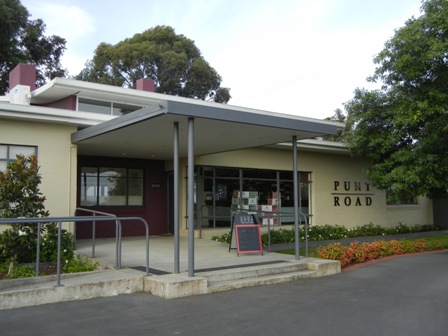
Punt Road cellar door entry

We were on St Hubert’s Road on our way to Healesville when we passed Punt Road Winery and decided on the spot to drop in. Our main motivation was to buy some of the famous pear cider for Michael, my brother-in-law.

The back entrance to the tasting room

In all the many years we have come to the Yarra Valley, we had never made it to this well known winery. The estate with about 75 ha under vines (two vineyards, one planted in 1987 and the other in 2001) is owned and operated by the Napoleone family.

The senior wine-maker is Kate Goodman, one of the so called “young guns” of the Australian wine industry and much sought after judge for wine competitions.

The Punt Road vineyards are planted with the white varieties Sauvignon Blanc, Pinot Gris, Chardonnay and Viognier and the reds Pinot Noir, Merlot, Shiraz, Cabernet Sauvignon, Petit Verdot and Cabernet Franc.

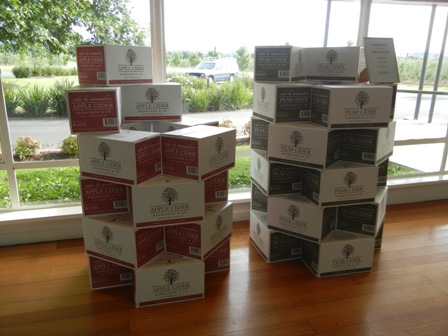
The cider stacks

From the outside we already spotted the boxes with the Napoleone Co. apple and pear cider piled up in a neat stack.

My heart jumped. Here it was, the golden liquid which stirs up so much emotions, and is considered one of the best ciders in the valley. Quality has its price, so a box of the stuff does not come cheap.

Having been raised in Trier at the Mosel river, I am very familiar with cider, which is called “Viez” in the local dialect. “Viez” is a mixture of fermented apples and pear juice coming from a very small kind of apples/pears (they are in-edible and very very sour/acidic).

The trees are grown along the rural roads. All the peasant in the region used to make their own cider, as a very refreshing drink for home consumption.

The garden

The premises are very lovely with wide open spaces, tables and chairs, picnic facilities and an area prepared for boule playing (pétanque).

The back porch

We had not time for a proper tasting. The man behind the counter was not very welcoming either. So we decided to try some of their bubbly and the Pinot Gris which we (my wife Margit and I) both liked.

I am not a fan of Pinot Gris but this one was just the right stuff for a hot summers day. We bought a bottle of each. Later we also tasted the Pinot Noir, but the 2010 vintage did not catch our fancy.

The two bottles we acquired at Punt Road Winery

Golden liquid: Punt Road Pinot Gris

I guess we will have to come back for a proper tasting. Punt Road is a good place to visit in the Yarra Valley.

Address:
Punt Road Wines
10 St Huberts Road – Coldstream
Victoria, Australia 3770
Tel.: +61 3 9739 0666
Fax: + 61 3 9739 0633
wine@puntroadwines.com.au
www.puntroadwines.com.au


Wine bar Kesselstatt, Trier – Mosel

October 28, 2011

The main market place in Trier

My favourite wine bar: Kesselstatt

The view from the Kesselstatt garden

Pinot Noir from the Mosel

If you visit my home town Trier, please explore the wine bars in this beautiful old Roman town. Kesselstatt should be among them. Apart from the Mosel Riesling wines, you should also try the Pinot Noirs. The Mosel produces some of the finest Pinot Noir wines in Germany.


Wine village Kasel, Ruwer – Mosel Riesling at its best

October 7, 2011

This is the coat of arms of Kasel, a small village located at ther Ruwer river not far from my beloved Trier. The Ruwer river is one of the tributaries to the Mosel.

Originally our wine region was called ‘Mosel-Saar-Ruwer’ which named the two smaller rivers explicitely.

Grape vines all over the place

The slopes around Kasel are planted with grape vines

The Pauliner Landgasthof is part of Weingut von Nell

Von Nell Estate – Weingut von Nell

The newly refurbished Pauliner Hof is part of the Weingut von Nell.

We wanted to check it out and dropped in for lunch on a beautiful late summer’s day. The sky was blue and the Ruwer valley showed its most beautiful side.

I must say that I love this country inn right in the middle of Kasel, the lovely wine village.

During our high school days my brother Wolfgang and his friends used to help in vintage time and picked grapes at the steep slopes in the vineyards of the Von Nell Estate.

The interior of the inn is light and bright. The air well is covered by a glass roof and the subdivisions with rod iron and sheets of textiles give it a warm feeling. The big olive tree right in the middle of the restaurant gives the place a mediterranean flair. The service was excellent.

We had pork nuckle and a delicious mushroom dish, great German country food in my view.

Pork knuckel

The mushroom stew

My old folks

A shot of the wine list

I had an estate grown Riesling of course. The ‘2010 Kaseler Dominkanerberg Hochgewaechs’ was a very nice and fresh house wine, something for easy drinking and enjoyment with hearty country food. I just wish I would have access to it here in Bangkok (sight). Well, one cannot have it all.

The Ruwer valley is a true jewel, you should go there and check it out.

Address:
Pauliner Hof
Bahnhofstraße 41
54317 Kasel
Tel +49-651-9679090
Fax +49-651-96790916
www.restaurant-paulinerhof.de


Along the Mosel river – impressions from a train ride

October 6, 2011

Taking pictures from a train usuallay did not work for me in the past. However, the other day when I visited the Mosel river and my home town Trier, I tried it again with my new digital camera.

The outcome is not too bad, I think. And this is why I want to share it with you here on my blog. Unfortunately, I did not catch famous terroir, single vineyard locations and/or famous wine villages and towns, just some no-name impressions.

In any case, this is maybe the best view one can get of the Mosel: exploring the region on a train.

I suggest to any tourist and casual visitor to this part of Germany to take the train from Koblenz to Trier and enjoy from the regional express train the sometimes spectacular views of the Mosel valley and its vineyards.

You can feel the speed of the train – above the ‘Autobahn’ bridge at Winningen

Most ‘grand cru’ locations are to be found on the steep slopes (right) but there are also flat parts with vineyards (left)

Train station in Bullay with the view of two Mosel bridges

Vineyards on steep slopes

An autumn feeling

Blue slate on the roofs of the houses along the Mosel

The river bed, train tracks, and a country raod, all three have to find a space in the narrow Mosel river valley. That the vineyards are located on the steep slopes is not an accident. This is where the slate underground reflects the sunlight and keeps the vines warm for the optimal ripening of mainly Riesling grapes. The steep slopes are hard work for the vintners.

I love the Mosel. I find it extremely relaxing to sit on the train and watch the landscape along the winding valley.

Alternatively one can also visit the Mosel by pushbike or car. Every way of transport, every way of movement will bring new insights and offer other aspects of this magificent river landscape.