Autumn views – wild berries ripening

October 7, 2009

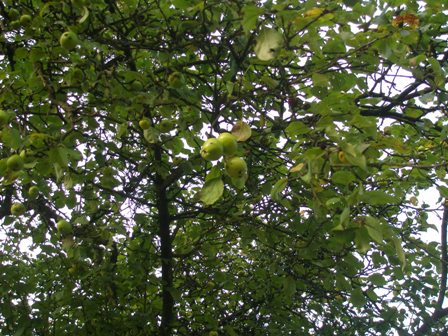
Autumn is an exciting time in Europe not just for grape growers but also for other nature lovers. In the forests and along the many paths, rural roads, and highways various types of berries and other fruit can be spotted. The photos below are from Schoden, Saar. I took them last week.

Autumn1

Rose hip

Autumn2

Wild apple

Autumn3

Hawthorn

Autumn4

Sloes


Vintage time: Schodener Herrenberg

October 6, 2009

Schoden1

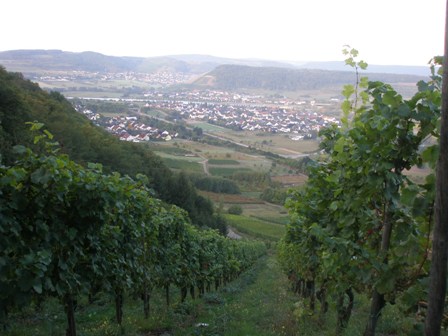
Schodener Herrenberg, in the background the village of Schioden with the Saar

One of my favourite places along the Saar river is Schoden, a small hamlet about 30 minutes southwest of Trier, my hometown. I visit regularly, because my friend Heinz together with some friends has rented the local hunting territory and when I visit Trier, we often go together on the hunt.

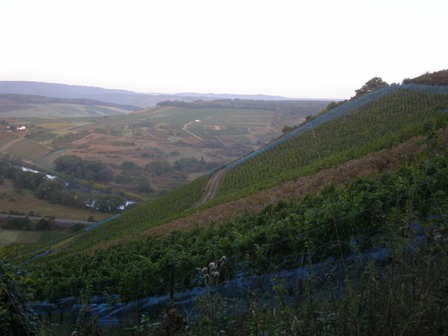
Schoden has also some vineyards and wineries. The location (terroir) “Herrenberg” is one of them. The vineyards are quite steep, which is difficult to depict in a photograph as you can see from the comparison of the two pictures above and below. It is realy a steep site, and the best location for producing Saar Riesling wines of superior quality.

Schoden2

Schodener Herrenberg: vineyards from the South

Schoden3

Schodener Herrenberg: the vineyards from below

Schoden4

A promising vintage?

Schoden5

Beautiful Riesling fruit

The fruit on the vines looked very healthy. In a couple of days or weeks, depending on the weather, the pickers will come to harvest. Needless to say that no machinery can be used, all the work will be done by hand. The vineyards workers will have to navigate the steep hills and balance on the slate pebbels which can be tricky when they are wet.

Needless to say that Schodener Herrenberg produces outstanding Riesling wines. Learn more about these Saar wines on my blog soon. Cheers


Also the foxes like sweet grapes

October 4, 2009

Fuchs00

Ripe Riesling grapes, Herrenberg in Schoden/Saar

Right now it is vintage time in Germany and along the Mosel and the Saar one can admire ripening grapes. What a beautiful picture.

The weather was warm and dry when I accompanied my friend Heinz on a morning hunt in Schoden, Saar. We sat on a raised hide from about 5:30 until 8 in the morning. We watched two red deer does with their young ones making their way through the meadow. Later we went through the hunting territory and checked out a couple of places.

Fuchs1

I found the above turd of a red fox. Obviously the beast loves what humans love: the juicy fresh and sweet grapes. Also other wild animals love to nibble from the vines, especially red deer and wild pigs. They can be a quite a nuisance.

Autumn is just such a beautiful time in Germany. I will share more with you soon. Watch my blog entries.


German wines: delight in red and white

July 4, 2009

Traveling in Germany I had the opportunity to taste some marvelous wines with some of my friends. Two of these I would like to briefly present to you, one red, one white wine, one from the Pfalz and one from my native land, the Mosel or to be precise the Saar.

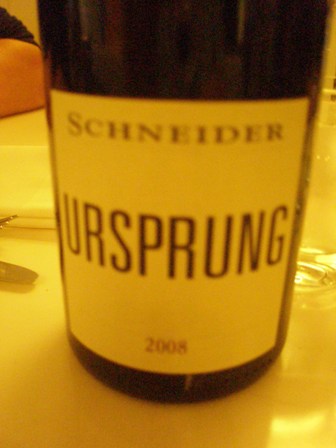
Over a dinner at “Schneeweiss”, a fashionable restaurant in the eastern part of Berlin offering “cuisine from the Alp mountain lands”, we had a bottle of ‘2008 Schneider Ursprung’, a cuveé made of Cabernet Sauvignon, Merlot and Portugieser by Markus Schneider.

Markus Schneider is one of the young but accomplished vintners who earned the highest praise from wine critics and experts from the wine and hospitality industry. This cuveé is made from grapes grown on a rather warm location at the “Feuerberg”, a terroir known for its capacity of heat retention by the local gravel stones which allows the grapes to fully ripen.

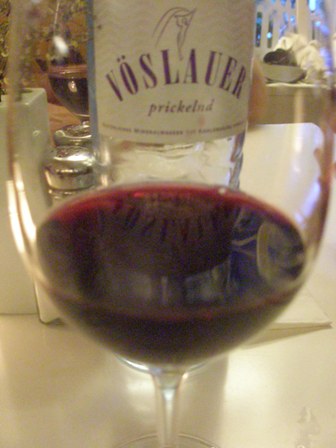
The wine is of a deep purple colour. It displays flavours of a lot of fruit, plum, some mint, chocolate and shows some peppery notes. The wine is very round and extremely smooth, for me just a bit too perfect in the mouth, I must say. It went extremely well with the food that I had ordered (Italian pasta filled with mushrooms). The wine is perfect and was a good choice. It retails for about 8 to 11 EURO but is worth the money.
Schneider Ursprung

A very simple label on the bottle: “Schneider Ursprung”
Schneider ursprung2

What a beautiful deep purple colour

Later the same evening, we tasted a dessert wine from my native lands, the Mosel, actually from the Saar river. It was a ‘1992 Ockfener Bockstein Riesling Spaetlese’ from “Staatliche Weinbaudomaene Trier”.

OckBockRiesAus

What a delight this wine was, a drop from heaven. It had aged well, was fresh and round. Although low in alcohol (only 8%), the acids were vibrant so that the wine was extremely well balanced, honey sweet, just wonderful. Only my friend Gerhard can wait for a wine like this to ripen in the cellar and patiently await the right moment to open a treasure like this.

I know the terroir quite well, Ockfener Bockstein, just a couple of meters away from the boundaries of the hunting grounds of my friend Heinz in Schoden, Saar which borders on Ockfen. The vineyards here are extremely steep and all work in manual. The 1992 vintage of this Riesling Auslese is just wonderful. I have no words to describe this nectar and do justice to the wine.

Address:
Schneeweiss
Kern Ranogajec GbR
Simplonstraße 16
10245 Berlin
Proprietors: Denis Ranogajec and Ralf Kern
Tel.: +49-30/29 04 97 04
Fax: +49-30/29 04 97 05

Weingut Markus Schneider
Am Hohen Weg 1
67158 Ellerstadt
(near Wachenheim, Pfalz)
Tel.: +49 (0)62…
Fax.: +49 (0)6237 – 977230

Administration:
Georg-Fitz-Straße 12
67158 Ellerstadt
info@black-print.net
http://www.black-print.net

Staatliche Weinbaudomänen Trier
Deworastr. 3
54290 Trier, Germany
+49 651 97598-0
www.staats
weingueter.rlp.de


Spring in Schoden, Saar

May 25, 2009

Spring was in full force when I visited Germany recently. The sky was blue and everything was fresh, a young green covered the land. As always I accompanied my friend Heinz on the hunt in Schoden, Saar. We took a tour around the 500 ha of hunting ground rented from the local land owners association (“Gehoeferschaft).

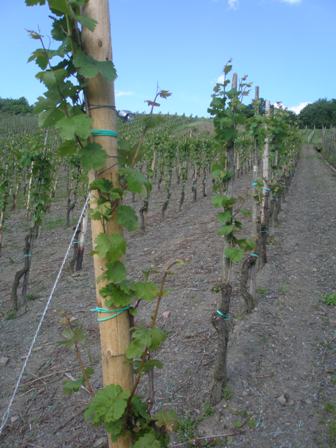
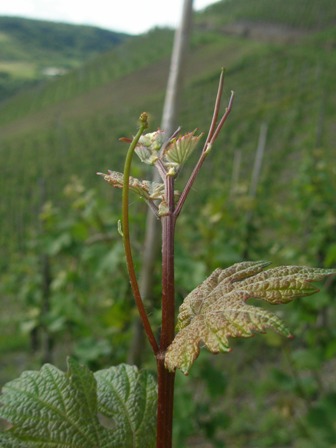
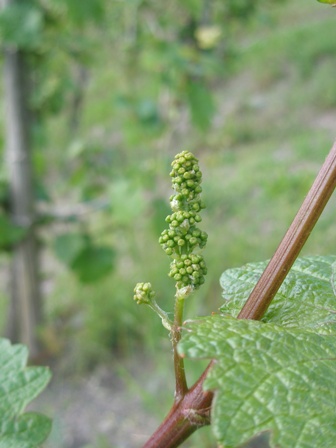
I took photos of the vines at “Herrenberg” one of the best terroirs at the steep hillside overlooking the Saar valley.

Sch1

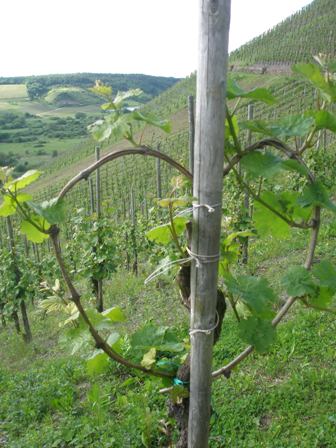
The canes are bent down and arranged in a circle

Sch2

The Herrenberg vineyards are very steep

Sch3

The view downwards

Sch4

New shoots

Sch5

The flowers are almost ready

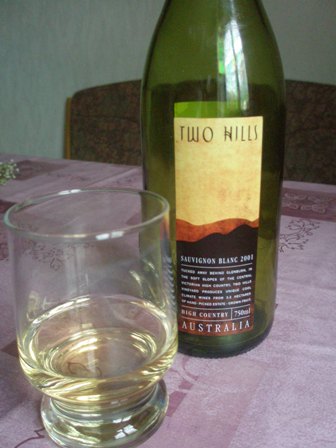
And guess what I found in my mothers cellar? A rare bottle of ‘2001 Two Hills Vineyard Sauvignon Blanc’.
The colour of the wine was still a splendid light straw, and it was drinkable. Of course it had lost its zest, almost no finish but it was still OK with my meal, I must say. A clean white wine.

Schx


Wild pig from Schoden, Saar

January 31, 2009

schoden111

The village of Schoden (left) at the Saar River

The Saar is one of my favourite tributaries of the Mosel river. I love its wines, the landscape, the villages and the people. In early December I was roaming the region again, and visited Schoden, a small village near Wiltingen, where my friend Heinz and his mates have rented a hunting territory for many years.

schoden12

Herrenberg, one of the best terroirs in Schoden, left the Saar river

There is also a vineyard and boutique winery called Herrenberg which is owned and operated by Claudia and Manfred Loch. The vineyard above belongs to them. Their wines are hand crafted and award winning.

schoden13

The vines are ready for pruning, single vines where two canes are tied down

schodenkeiler1

A young wild boar killed in early December offering good quality game

The forest along the Saar are inhabited by various wild animals. Particularly numerous and very difficult to hunt down are wild pigs. Wild pigs inflict huge damages to fields, orchards, paddocks and from time to time even on vineyards. But if a young pig has been successfully killed, the meat makes a wonderful lunch or dinner or both.

schodenkeiler21

Liver and kidneys of the wild pig above

Here is a wild pig goulash recipe:
-500 to 800 gr. of wild pig meat
-some bacon
-onions
-some oil
-tomato paste
-150 ml red wine
-350 ml of extract from boiling game
-sour cream
-laurel, tyme and juniper berries
-salt and pepper.

If you want to enjoy it with mushrooms, you could add a selection of various wild forest mushrooms, preferably “funghi porcini” (Steinpilze in German). I just love them; they are great with wild pig.

The cooking process is like any other goulash. Add the sour cream at the end so that the goulash is not too watery.

My tip: buy the wild pig meat from the hunter if you can and make sure the animal was “not too old” (buy meat from year-old animals). This is easy if you live in Germany.

As the pairing with wine is concerned, I suggest a good red (14% alcohol), preferably a Malbec from Argentina or a Tempranilo from Spain or a Barolo from Italy. A GMT from Australia, maybe from McLaren Vale, would also do. Of course you could also have a Saar Riesling with it. From Schoden I recommend a Riesling from the Loch family of Herrenberg.