Moufflon leg and Loch Riesling

October 15, 2009

Loch1

When I am at home in Trier, Mosel my mother cooks for me. This time Heinz had shot a young moufflon (a kind of wild sheep) in Schoden. He prepared a leg of the lamb and we had it the traditional way. It was simmering on low heat for ages. The meat was tender and had a fine gamy taste.

This feast was accompanied by a wine from the same place, a ‘2008 Schodener Herrenberg “Stier” by Weinhof Herrenberg and the Loch family in Schoden. This Riesling shows that it was made by hand. It has a fine character, is minerally and fruity with good acidity and length, a perfect Saar wine to be enjoyed right away or cellared for a couple of years.

Nothing could be more perfect, I thought. The moufflons might have roamed the very location of the Herrenberg, the vineyard where the Loch Riesling was produced. I consumed the fruits of the land, the forests of Schoden and the dedicated vintners from the Saar. I am glad my mum is such a good cook. Cheers

Loch2

It’s vintage time at the Saar right now. Why not go on an outing and drive along the romantic Saar river, visit wineries and enjoy rustic German food?

Address:
Claudia and Manfred Loch
Weinhof Herrenberg
D-54441 Schoden/Saar
Tel.: +49-6581-1258
Fax: +49-6581-995438
info@lochriesling.de
www.lochriesling.de


Weinhof Herrenberg – Loch Riesling, Schoden, Saar

October 8, 2009

My friend Heinz was kind enough to help me out. He dropped by the Weinhof Herrenberg in Schoden, Saar, on his way back from the hunt and bought three bottles of Loch Riesling. I had planned to visit the Loch family winery for some time but never managed to get there. There was always something else when visiting Trier, my hometown nearby, a birthday, a visit, a train to catch etc.

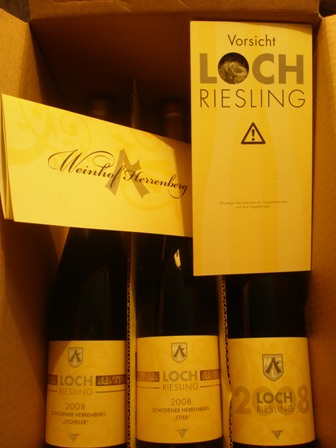
Heinz brought back the box shown below and three different Loch Riesling wines, all of the 2008 vintage. Regular visitors of my blog know that I am a Riesling lover, especially if they were grown along the Saar, my favorite provenance of German Riesling wines.

LochRiesling2

The treasures from Weinhof Herrenberg and the two brochures

The three wines were a ‘2008 LochRiesling’ (8.90 Euro/bottle), a blend of Riesling grapes from various vineyards, a ‘2008 Schodener Herrenberg “Stier”‘ (12.90) and a ‘2008 Schodener Herrenberg “Stoveler”‘ (13.90), both wines from my favorite ‘terroir’, a very steep vineyard called “Herrenberg” bordering a forest and enticing large groups of wild pigs and deer to visit and taste the sweet grapes during vintage time. I had walked the vineyard and heard about the Loch wines but never tried a single drop. It was high time to change that.

LochRiesling3

2008 Loch Riesling wines from Schoden, Saar

I also love the brochure with the “whole” (the “Loch” in German) explaining the philosophy of Claudia and Manfred Loch, the proprietors and vintners of the boutique winery “Weinhof Herrenberg”, which is the basis for their wine-making. In short, the Loch’s aim for authenticity, uniqueness, they reject designer wines but quest for a unique character and truthfulness.

The brochure is a very unusual one, telling people why to keep their hands off LochRiesling wines and what the weaknesses of the wines are: for instance that their wines are unknown, consumer hostile, old fashioned, egoistic, lawless, dangerous and limited (in numbers of bottles!). I like this brochure.

LochRiesling5

The “Loch” brochure with a whole in it

The wine list also includes wines from locations in Ockfen and Wiltingen, two famous Saar wine villages. The “Beerenauslese” wines are not available any longer. The Loch’s also produce a dry, sparkling wine. All wines are reasonably priced.

LochRiesling4

The current wine list

You might wonder what they taste like? Well, I will tell you more about this at a later blog entry. But if you are near Schoden or in the vicinity of the Saar, please visit the Loch family vineyard at Weinhof Herrenberg. If you cannot visit in person, visit the website which is very informative.

Address:
Claudia and Manfred Loch
Weinhof Herrenberg
D-54441 Schoden/Saar
Tel.: +49-6581-1258
Fax: +49-6581-995438
info@lochriesling.de
www.lochriesling.de


Vintage time: Schodener Herrenberg

October 6, 2009

Schoden1

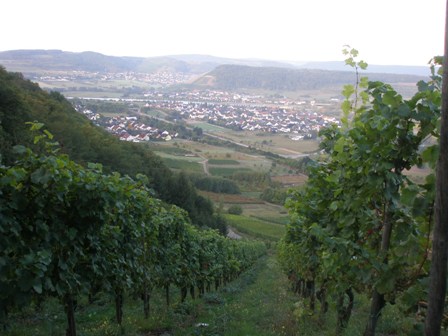
Schodener Herrenberg, in the background the village of Schioden with the Saar

One of my favourite places along the Saar river is Schoden, a small hamlet about 30 minutes southwest of Trier, my hometown. I visit regularly, because my friend Heinz together with some friends has rented the local hunting territory and when I visit Trier, we often go together on the hunt.

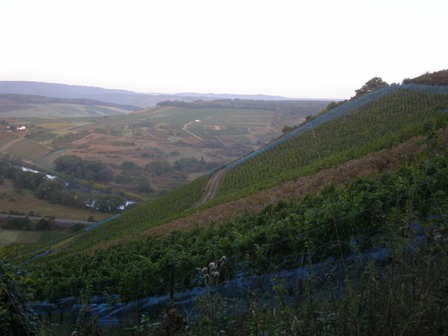
Schoden has also some vineyards and wineries. The location (terroir) “Herrenberg” is one of them. The vineyards are quite steep, which is difficult to depict in a photograph as you can see from the comparison of the two pictures above and below. It is realy a steep site, and the best location for producing Saar Riesling wines of superior quality.

Schoden2

Schodener Herrenberg: vineyards from the South

Schoden3

Schodener Herrenberg: the vineyards from below

Schoden4

A promising vintage?

Schoden5

Beautiful Riesling fruit

The fruit on the vines looked very healthy. In a couple of days or weeks, depending on the weather, the pickers will come to harvest. Needless to say that no machinery can be used, all the work will be done by hand. The vineyards workers will have to navigate the steep hills and balance on the slate pebbels which can be tricky when they are wet.

Needless to say that Schodener Herrenberg produces outstanding Riesling wines. Learn more about these Saar wines on my blog soon. Cheers


Also the foxes like sweet grapes

October 4, 2009

Fuchs00

Ripe Riesling grapes, Herrenberg in Schoden/Saar

Right now it is vintage time in Germany and along the Mosel and the Saar one can admire ripening grapes. What a beautiful picture.

The weather was warm and dry when I accompanied my friend Heinz on a morning hunt in Schoden, Saar. We sat on a raised hide from about 5:30 until 8 in the morning. We watched two red deer does with their young ones making their way through the meadow. Later we went through the hunting territory and checked out a couple of places.

Fuchs1

I found the above turd of a red fox. Obviously the beast loves what humans love: the juicy fresh and sweet grapes. Also other wild animals love to nibble from the vines, especially red deer and wild pigs. They can be a quite a nuisance.

Autumn is just such a beautiful time in Germany. I will share more with you soon. Watch my blog entries.


German wine regions: the Nahe

September 17, 2009

Nahe2

The Nahe wine region has a great significance for me and my family. It was here that I got first into contact with vine cultivation and wine appreciation at a rather tender age.

Why you might ask? Were you not from Trier, Mosel?
Well, my maternal grandfather, Hans Heinrich Schüssler, a native of Reichenberg, a village near Würzburg, used to live in Martinstein. Being from Franconia, another famous German wine region, he was the only wine drinker in the immediate family (my father preferred beer). He used to be the station master in Martinstein (today 322 inhabitants), a hamlet along the left bank of the Nahe river. The village was founded in the middle ages at a ford crossing the Nahe river. In 1340 it got a castle and even market (city) rights.

My brother and I, we used to spend the long summer holidays (and many other holidays) at my grandparents house in Martinstein. My grandfather used to take us on long walks in the forest and villages nearby. During these walks we always found a country inn where we could refresh ourselves, enjoy a drink or a “Brotzeit” (a typical German snack). He would drink a “Schoppen” (0.25 litre glass) of the local Nahe wine. He loved dry white wines. We would have a lemonade.

He was associated with a “hiking brotherhood” (called “Hunsrückhöhenverein”) whose members would walk in large groups on weekends to various destinations. Usually a country inn was the designated object of the hikers. Here the group converged for a hearty meal and some drinks. Shortly after vintage, “Federweisser” (freshly made but still half-fermented wine) was a popular drink.

But boys being boys, we would sip at his glass from time to time. He being deeply involved in conversation with fellow hikers, did not notice. Neither did we. The sweetness of the fresh wine veiled its dangers. To cut a long story short, we had the experience of a first inebriation of our young lives and could hardly walk strait on our long way home.

After my grandfathers retirement he moved out of the train station into a newly built home right in the middle of vineyards at the outskirts of the village towards the east. Vineyards stretched right to the door. Just a short walk up the hill and endless vineyards lay at your footsteps. Occasionally we would help during vintage time (more play than serious helping). But we would often taste fully ripened grapes and enjoy the fruit. I treasure these wonderful memories of my youth at my grandfathers house in Martinstein.

Map Nahe wine region

The Nahe wine region (photo source: wikipedia)

As you can see from the above map, the Nahe wine region stretches from Martinstein to the West along the river eastward, later north towards the estuary at Bingen where it flows into the Rhine river. The largest city in the region is Bad Kreuznach, a small town of about 45,000 inhabitants.

Nahe1

With about 4,200 ha under vines, the Nahe region is one of the smaller wine growing areas in Germany. It is still larger than, for instance the Yarra Valley in Victoria (with about 3,800 ha, about 2% of Australia’s total). The Nahe region is dominated by white grape varieties (about 74% of the total area under vines). The main variety is Riesling (26%) followed by Mueller-Thurgau (14%) and Dornfelder (13%).

Fifty years ago the variety distribution was very different. Silvaner used to be the most planted variety with about 50% of the total area but has ever since been replaced by the Burgundy varieties (Pinot White, Gris and Noir) as well as by Riesling, Dornfelder, Blauer Portugieser and Müller-Thurgau plantings.

The Nahe is divided into seven collective sites (Grosslagen) and 328 individual sites (Einzellagen). Due to its volcanic origins, the soils of the nahe show a great diversity. The wines reflect this. Only in 1971, the German wine law defined the nahe region. before that time, its wines were sold as “Rhine wines”. However, some of the best Riesling wines of germany originate from the Nahe and today Nahe wine can rival the best from Mosel and Rheingau or any other German wine region.
Nahe3

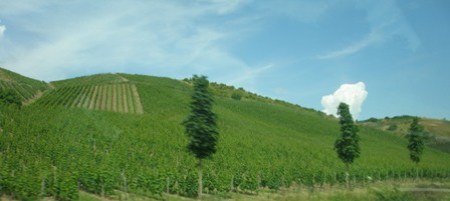
The Nahe can be divided into the upper (west) and lower (north-east) Nahe and the region around Bad Kreuznach. In Martinstein and the neighbouring village of Monzingen (first mentioned in 778) the oldest vineyards of the Upper Nahe are to be found. The soils of the Nahe range from sandstone to quartzite and slate. The region shows a temperate climate and some of the southern slopes enjoy a micro climate comparable to the Mediterranean. Elevations range from 100 to 300 meters altitude.

Nahe4

Who are the top producers of the Nahe wine region?

Well, the name Herrmann Doenhoff comes to mind. He is the leading vintner of the Nahe and his wines are ranked among the top Rieslings in Germany. Herrmann Dönnhoff has about 20 ha under vines and produces about 140,000 bottles a year. His winery is located in Oberhausen/Nahe. The 2007 vintage produced outstanding wines; the 2008 Riesling wines did not quite reach that quality level during recent tastings. But his ‘2008 Niederhäuser Hermannshöhle Riesling Gran Cru’ earned 93 Parker points.

Other top producers are Emrich-Schönleber in Monzingen (about 15 ha under vines, yearly production about 110,000 bottles), Schlossgut Diel (17.5 ha and 120,000 bottles) in Rümmelsheim and Schäfer-Fröhlich (14 ha under vines and 75,000 bottles annually) in Bockenau.

Wines and vintners I like very much are Sascha Montigny in Laubenheim and Weingut Edelberg at Gonratherhof 3 in Weiler just on the other side of Martinstein. The former I like because of the high quality of his red wines, especially the 2006 vintage; the latter produces solid country wines which remind me of my youth in Martinstein and the long hikes with my grandfather. The country inn at Gonratherhof was often our destination when the three of us set out from our little house in the vineyards.

Wine shopping in Healesville, Yarra Valley

August 16, 2009

Barrique

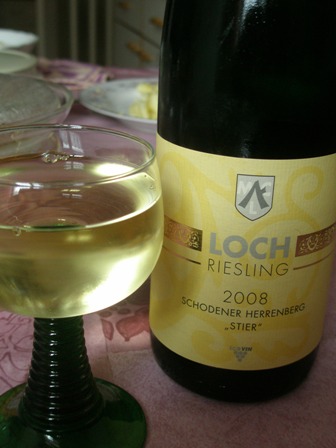
For a long time I wanted to write about my wine shopping experience in Healesville, a charming tourist town in the Yarra Valley, about an hour’s drive from Melbourne. One can find a jewel of a wine store in this rural retreat, called Barrique. I took the photo above Christmas last year.

Barrique2

This is the old shop front

When visiting Healesville again in July 2009, I was shocked to not see the above signpost in the old place. I was afraid that the global financial crises and the bush fires might have let to the closure of this little wine shop. Alas, it had only moved a block further along the main street into the city centre. I was so happy when I found it again.

Barrique3

The “new” Barrique, a block further up the main street

I could not resist the temptation. Previously, I had bought German wines from this shop. I dashed in to see what was on offer. The wines are beautifully displayed. There was so much out there. I could not stop browsing through the shelves.

Barrique5

The inside of Barrique

Barrique4

So many bottles

Barrique6

Wines from all over the world

Barrique7

The “German box” with selected Riesling wines from various German wine regions

The box above announces some of the best German Riesling producers from Mosel, and Nahe. I just love Riesling wines. In the end I picked up four bottles, one from the Pfalz, three from the Mosel. I will not tell you what they were today. More about the tastings of these wines later. Stay tuned to the Man from Mosel River.
Cheers


German wines: delight in red and white

July 4, 2009

Traveling in Germany I had the opportunity to taste some marvelous wines with some of my friends. Two of these I would like to briefly present to you, one red, one white wine, one from the Pfalz and one from my native land, the Mosel or to be precise the Saar.

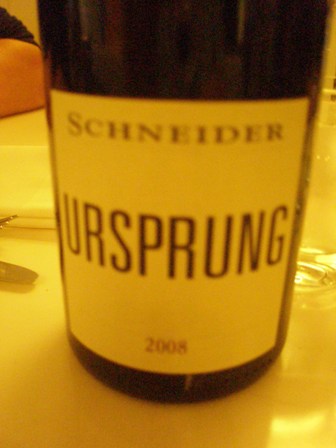
Over a dinner at “Schneeweiss”, a fashionable restaurant in the eastern part of Berlin offering “cuisine from the Alp mountain lands”, we had a bottle of ‘2008 Schneider Ursprung’, a cuveé made of Cabernet Sauvignon, Merlot and Portugieser by Markus Schneider.

Markus Schneider is one of the young but accomplished vintners who earned the highest praise from wine critics and experts from the wine and hospitality industry. This cuveé is made from grapes grown on a rather warm location at the “Feuerberg”, a terroir known for its capacity of heat retention by the local gravel stones which allows the grapes to fully ripen.

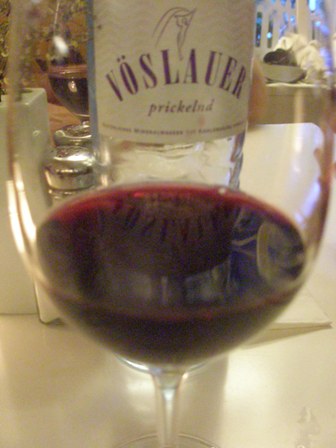
The wine is of a deep purple colour. It displays flavours of a lot of fruit, plum, some mint, chocolate and shows some peppery notes. The wine is very round and extremely smooth, for me just a bit too perfect in the mouth, I must say. It went extremely well with the food that I had ordered (Italian pasta filled with mushrooms). The wine is perfect and was a good choice. It retails for about 8 to 11 EURO but is worth the money.

Schneider Ursprung

A very simple label on the bottle: “Schneider Ursprung”

Schneider ursprung2

What a beautiful deep purple colour

Later the same evening, we tasted a dessert wine from my native lands, the Mosel, actually from the Saar river. It was a ‘1992 Ockfener Bockstein Riesling Spaetlese’ from “Staatliche Weinbaudomaene Trier”.

OckBockRiesAus

What a delight this wine was, a drop from heaven. It had aged well, was fresh and round. Although low in alcohol (only 8%), the acids were vibrant so that the wine was extremely well balanced, honey sweet, just wonderful. Only my friend Gerhard can wait for a wine like this to ripen in the cellar and patiently await the right moment to open a treasure like this.

I know the terroir quite well, Ockfener Bockstein, just a couple of meters away from the boundaries of the hunting grounds of my friend Heinz in Schoden, Saar which borders on Ockfen. The vineyards here are extremely steep and all work in manual. The 1992 vintage of this Riesling Auslese is just wonderful. I have no words to describe this nectar and do justice to the wine.

Address:
Schneeweiss
Kern Ranogajec GbR
Simplonstraße 16
10245 Berlin
Proprietors: Denis Ranogajec and Ralf Kern
Tel.: +49-30/29 04 97 04
Fax: +49-30/29 04 97 05

Weingut Markus Schneider
Am Hohen Weg 1
67158 Ellerstadt
(near Wachenheim, Pfalz)
Tel.: +49 (0)62…
Fax.: +49 (0)6237 – 977230

Administration:
Georg-Fitz-Straße 12
67158 Ellerstadt
info@black-print.net
http://www.black-print.net

Staatliche Weinbaudomänen Trier
Deworastr. 3
54290 Trier, Germany
+49 651 97598-0
www.staats
weingueter.rlp.de


Heaven on a stick

June 14, 2009

As you all know life in the tropics is sweet, and can therefore be described as “heaven on a stick”, as we say in Australia. This is even more so since (finally) the best beer of the world arrived in our local neighbourhood super market, the Villa Market in Thonglor, Bangkok.

There are of course many “best” beers in the world depending on ones taste, upbringing, and the general circumstances. But since I come from the Mosel river, my favourite beer is Bitburger Pilsener, brewed in the small town of Bitburg about 30 km north of my home town Trier.

BitteeinBit

Bitburger Pilsener

After patronizing this supermarket for about nine month and browsing the beer section consisting mostly of Japanese, Thai and Bavarian beers, you cannot imagine my joy to find a few bottles of Bitburger beer.

Apart from a good beer, a glass of wine and a good meal, the tropical pleasures are simple: enjoy the fragrance of a Frangipani flower (Plumeria), a dash in the pool, and company of family and friends.

Franjipani

A potted Frangipani tree on my terrace in Bangkok

Pool

It’s just too hot these days

Hope you all have a good weekend. Cheers.


Spring in Schoden, Saar

May 25, 2009

Spring was in full force when I visited Germany recently. The sky was blue and everything was fresh, a young green covered the land. As always I accompanied my friend Heinz on the hunt in Schoden, Saar. We took a tour around the 500 ha of hunting ground rented from the local land owners association (“Gehoeferschaft).

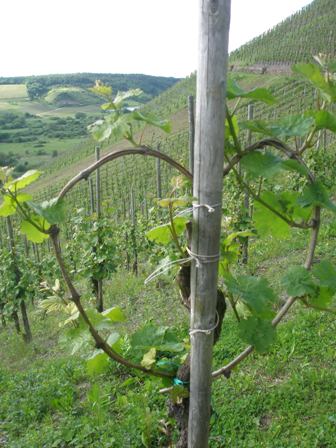
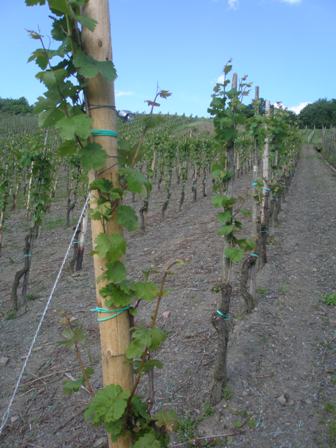
I took photos of the vines at “Herrenberg” one of the best terroirs at the steep hillside overlooking the Saar valley.

Sch1

The canes are bent down and arranged in a circle

Sch2

The Herrenberg vineyards are very steep

Sch3

The view downwards

Sch4

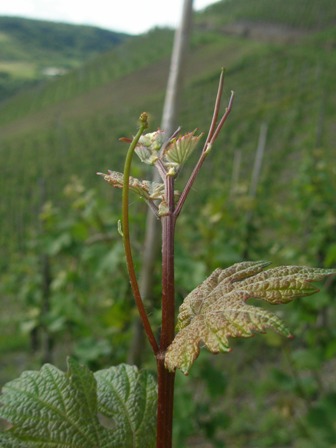
New shoots

Sch5

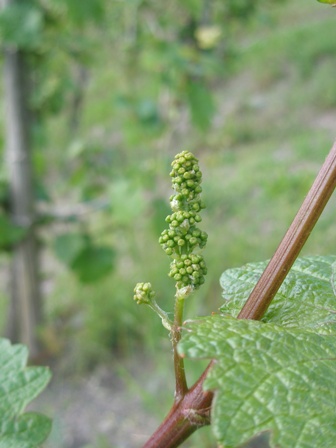
The flowers are almost ready

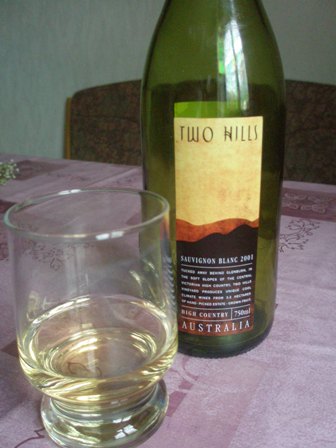
And guess what I found in my mothers cellar? A rare bottle of ‘2001 Two Hills Vineyard Sauvignon Blanc’.
The colour of the wine was still a splendid light straw, and it was drinkable. Of course it had lost its zest, almost no finish but it was still OK with my meal, I must say. A clean white wine.

Schx


On the road again

May 21, 2009

Huns2

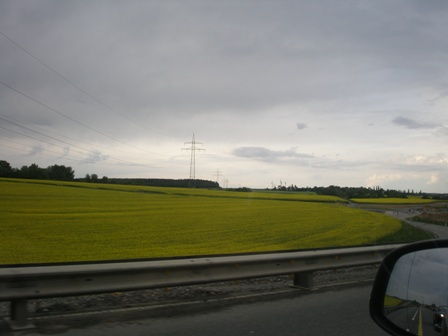
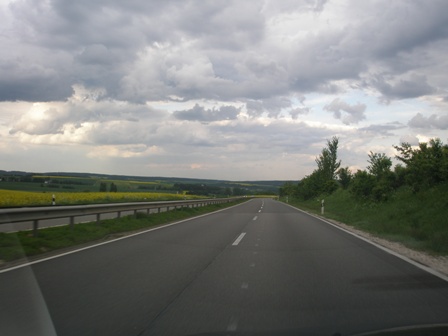
It was a gorgeous day when I drove from my home town Trier at the Mosel to the airport in Frankfurt. I passed through the hilly country called the “Hunsrueck”, a large plateau with deep forests and not-to-infertile plains where grains, maize and rape seed are grown. After a couple of kilometres clouds appeared and it started to rain.

Huns3

The yellow of the rape seed fields contrasted beautifully with the surrounding green of the grains, the grass and the trees. From the moving car I took a couple of shots to capture the contrast. Reality is almost always more beautiful than those quick digital camera shots.

Huns1

I had about two hours for contemplating about life, death and the universe. I love these rare occasions of introspection. I love the short life between the worlds, leaving Germany for the tropics of Thailand. Having left a world behind but not reached the desired destination, leaves me in a kind of vacuum, an emptiness full with feelings.

Huns4

The last leg of my journey led me through parts of the Nahe and the Rheingau wine regions. At this time of the year the vines appear tender and soft, near the flowering stage maybe, but the green of the leaves is still a light green.

The rainy season would wait for me on the other side of the world. Only the long hours in the narrow plane would be between “me in Germany” and “me in Thailand”, the past and the future, the wines of Germany and the wines of Australia and Thailand of course.